

Did you know that a single oversight in your affiliate disclosures could now result in a penalty of up to $51,744 per violation? If you’ve ever felt like your audience is just one “buy now” button away from unfollowing you, you aren’t alone. Many creators struggle with high traffic that never quite turns into sales, often fearing they sound too “salesy” or risking account bans due to evolving platform rules. You likely want to be a reliable resource for your community, yet the mechanics of making that profitable can feel like a minefield.
Learning how to build trust with your audience as an affiliate isn’t just about being likable; it’s about creating a structural, value-first system that proves your credibility before you ever ask for a click. In this guide, we’ll show you how to transform skeptical visitors into loyal customers by building an automated trust engine. You’ll learn a repeatable roadmap to navigate 2026’s strict compliance standards, such as Meta’s mandatory creator tags, while securing the sustainable, long-term income you’ve been working toward.
Key Takeaways
- Understand why trust serves as the vital bridge between initial curiosity and a successful financial transaction in a skeptical market.
- Learn how to build trust with your audience as an affiliate by adopting a “Give-Give-Ask” model that addresses specific pain points before introducing links.
- Discover how to leverage strategic transparency and honest product reviews to satisfy legal requirements while actually increasing your conversion rates.
- Explore the mechanics of engineering an automated trust engine that uses indoctrination sequences to build authority while you sleep.
- Identify how tailored mentorship can help you spot “trust leaks” in your business and replace them with a repeatable system for sustainable growth.
Why Trust is the Master Key to Affiliate Conversions in 2026
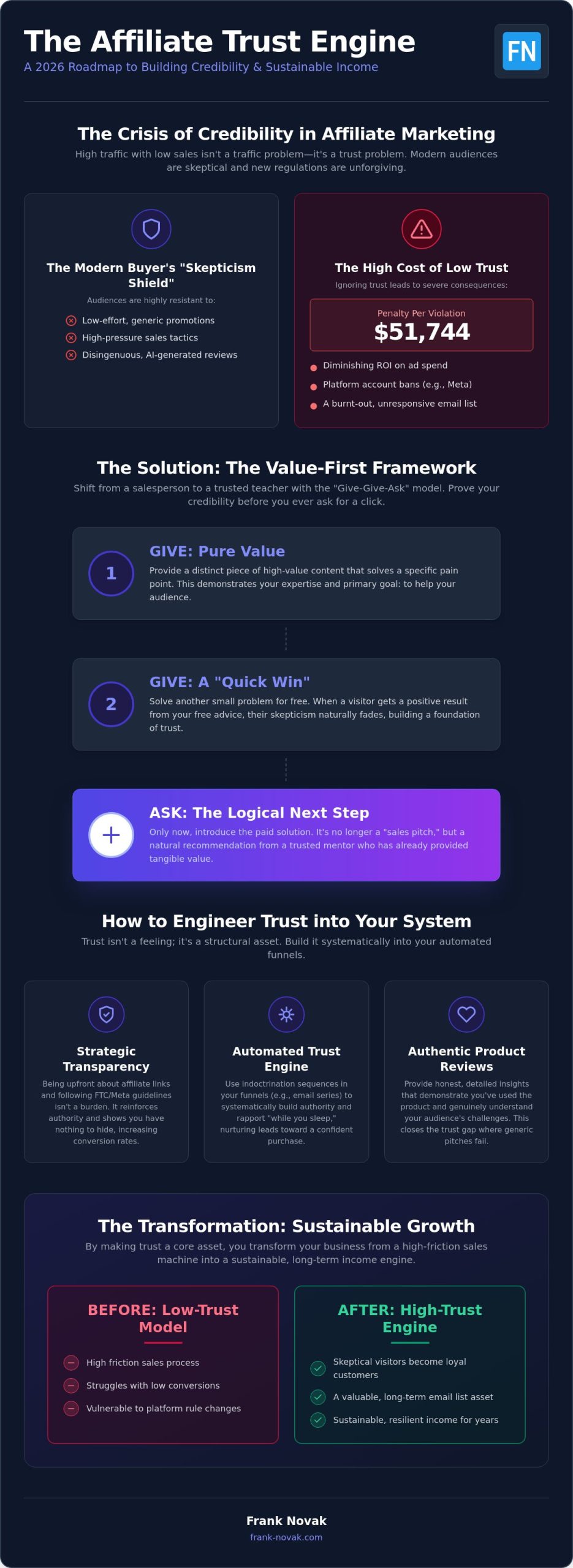
In the current digital climate, trust isn’t a luxury or a “nice-to-have” quality; it’s the primary currency that powers every conversion. If you’re struggling with high traffic that fails to convert, you’re likely facing a credibility problem rather than a traffic problem. Understanding how to build trust with your audience as an affiliate is about more than just being honest. It’s about constructing a sturdy bridge between a reader’s initial curiosity and their final financial transaction. Without that bridge, even the most persuasive sales copy will fall flat.
By 2026, consumers have developed a high resistance to “link-spamming” and low-effort promotions. They’ve seen countless generic reviews and AI-generated pitches that lack personal insight. This skepticism creates a heavy financial burden for low-trust affiliates. You’ll often see high ad spend with diminishing ROI and, increasingly, account bans from platforms like Meta that now prioritize user experience and authentic engagement. However, trust can be built systematically. You don’t need a massive personal brand or a million followers to be seen as credible; you simply need a value-first framework that proves your reliability before you ever ask for a click.
The Psychology of the Modern Digital Buyer
Modern buyers carry what we call a “Skepticism Shield.” They’re wary of being “sold” to and can spot a disingenuous recommendation from a mile away. Traditional high-pressure sales tactics fail today because they trigger this defensive response. Instead, audiences are looking for perceived expertise and authentic guidance. They want to know that you’ve actually used the product or, at the very least, understand their specific challenges. The Trust Gap in digital marketing is the distance between an ad click and a confident purchase. To close this gap, you must position yourself as a helpful mentor rather than a distant salesperson.
Trust as a Business Asset, Not a Feeling
When you view trust as a structural asset, it changes how you approach every piece of content. Trust reduces friction in the sales process. If your audience trusts your judgment, they don’t feel the need to go to Google to verify your claims; they’ve already decided that your recommendation is sound. This credibility makes an email list significantly more valuable over the long term. A list built on hype will burn out quickly, but a list built on authority provides sustainable income for years. For a broader Affiliate marketing overview, you can see how transparency and disclosure are now fundamental to the industry’s survival. Cultivating an Affiliate Marketing Success Mindset involves treating every interaction as an opportunity to reinforce this asset, ensuring your business remains resilient as platform rules continue to tighten.
The Value-First Framework: Building Authority Before the Click
If you want to master how to build trust with your audience as an affiliate, you have to stop thinking like a salesperson and start thinking like a teacher. The most effective strategy in 2026 is the “Give-Give-Ask” model. This approach requires you to provide at least two distinct pieces of pure, high-value content before you ever introduce a product recommendation. By leading with value, you demonstrate that your primary goal is to help your audience succeed rather than just collecting a commission. This shift in perspective transforms you from a stranger with a link into a trusted mentor who has already provided a “quick win” for the reader.
Solving a small problem for free is the fastest way to earn the right to recommend a paid solution. When a visitor follows your free advice and sees a positive result, their skepticism naturally begins to fade. They start to view your paid suggestions as the logical next step in their journey rather than a high-pressure pitch. To maintain this integrity while staying compliant, you should always follow the FTC’s Endorsement Guides. Being upfront about your affiliate relationships actually reinforces your authority because it shows you have nothing to hide. If you’re looking for a technical way to manage this value-first approach, the ClickBank Super Funnel is designed to bake these trust-building steps directly into your automated process.
Identifying Your Audience’s Core Problems
You can’t provide value if you don’t know what your audience is struggling with. Spend time on platforms like Facebook groups, Quora, or niche forums to listen to the specific anxieties people are sharing. Look for recurring questions that start with “How do I…” or “Why does this always fail?” When you create content that mirrors this internal dialogue, readers feel an immediate connection. They’ll think, “This person finally gets it.” Once you’ve identified these pain points, you can choose affiliate products that act as the genuine solution to those specific researched problems.
Creating the “Bridge” Content
Bridge content is the material that carries a prospect from their current problem to your recommended solution. A trust-building social media update or blog post should acknowledge the reader’s pain, offer a small piece of actionable advice, and then explain how a specific product makes the rest of the process easier. “How-to” guides often outperform “Best Product” lists for cold traffic because they prioritize education over promotion. This strategy is a cornerstone of how to drive traffic to affiliate links without appearing “salesy” or losing your audience’s respect.
Strategic Transparency: Balancing Disclosures with Persuasion
Many affiliates view legal disclosures as a hurdle that might kill their conversion rates. In reality, transparency is one of the most powerful tools you have for closing the Trust Gap. Learning how to build trust with your audience as an affiliate requires a fundamental shift in how you view these requirements. If you try to “hide” your links or bury your disclosures in fine print, you’re sending a subtle signal that your recommendation isn’t strong enough to survive the truth. When you’re upfront about your partnerships, you remove the “gotcha” moment that modern, savvy consumers are always looking for.
Strategic transparency involves more than just following the law; it’s about using the truth to your advantage. By being the one to point out a product’s limitations before a customer finds them elsewhere, you establish yourself as a reliable guide. This “Insider Perspective” proves you’ve actually spent time with the product. If a software has a steep learning curve or a physical product feels a bit heavy, say so. These “honest flaws” make your praise for the product’s strengths much more believable. A perfect review often feels like a sales pitch, but a balanced review feels like advice from a friend.
Turning Disclosures into Trust Signals
Your disclosure shouldn’t look like a dry legal disclaimer. Instead, use it as an opportunity to reinforce your values. You might say, “I only recommend tools I’ve personally tested, and if you choose to use my link, I may earn a small commission that helps me keep this site’s resources free for everyone.” This approach follows the FTC Endorsement Guides while simultaneously building rapport. It shows your audience that you value their support and that you’re running a professional, honest business. Hiding the link is the fastest way to lose a potential customer because once they feel deceived, they’ll rarely return to your content.
The Power of the “Unbiased” Review
A truly effective review compares pros and cons fairly. Use social proof, such as testimonials from other users, to bolster your claims, but don’t ignore the negative feedback you find during your research. Addressing common complaints head-on allows you to explain who the product is not for. This filter actually increases the quality of your traffic; you’ll stop sending the wrong people to the checkout page, which reduces refund rates and protects your reputation with the vendor. This level of compliance and honesty is especially vital if you’re scaling your reach through Facebook Ads for Affiliate Marketing, where platform standards for transparency are higher than ever in 2026.
Engineering Trust into Your Automated Sales Funnel
While many guides suggest that credibility is solely the result of manual, one-on-one interactions, the most successful practitioners in 2026 treat it as a structural component of their business. If you want to understand how to build trust with your audience as an affiliate at scale, you must engineer it directly into your sales funnel. This systematic approach ensures that every new lead receives the same high level of value and education, regardless of when they join your list. Engineering these steps into a sequence is the most effective way to master how to build trust with your audience as an affiliate without burning out from manual outreach.
The process begins with a high-quality lead magnet. This is your first “handshake” where you offer immediate value in exchange for an email address. If the lead magnet genuinely solves a problem, you’ve already cleared the first hurdle of skepticism. Next, your indoctrination sequence automates your story and expertise. This series of emails allows you to share your journey and results, shifting the focus from the product to your role as a guide. Once the relationship is established, you can introduce a low-friction offer. This is a small, high-quality recommendation that proves your advice is worth following. If they have a positive experience with this initial purchase, you’ve earned the right to act as a high-ticket bridge. Finally, maintaining the relationship requires ongoing value. Don’t disappear after the first commission; keep providing insights that help them succeed.
The Role of the ClickBank Super Funnel
Automation is the key to preventing “sales fatigue.” It’s difficult to maintain a warm, helpful tone if you’re manually managing every single interaction. By using a tool like the ClickBank Super Funnel, you ensure consistency in your trust-building message across every touchpoint. This system handles the heavy lifting of delivery while you focus on refining your strategy. If your message is consistent, your audience feels a sense of stability and reliability that is often missing in traditional affiliate marketing. To see how these automated steps work in practice, you can explore the ClickBank Super Funnel and start building your own credibility engine today.
Compliance and Continuity
A well-engineered funnel also helps you stay on the right side of platform policies. Building a system that remains compliant with Facebook’s strict 2026 affiliate standards is essential for long-term survival. This requires a never succeed online mindset, which is about constant improvement rather than looking for a “get rich quick” shortcut. If you view your funnel as a living asset, you can adapt to regulatory changes without losing your momentum. For more on building these systems, check out our Automated Marketing Funnel Guide to ensure your growth remains sustainable.
Scaling Your Credibility with Online Success Coaching
Even with a robust automated funnel and clear disclosures, you might still find that some leads hesitate at the final hurdle. This is where professional guidance becomes an indispensable asset for your growth. A mentor acts as a second pair of eyes, helping you identify subtle “trust leaks” that are often invisible to the person who built the system. Understanding how to build trust with your audience as an affiliate at a high level requires a balance of technical precision and psychological awareness. While software can handle the delivery, a coach helps you refine the message so it resonates deeply with a skeptical audience.
Frank Novak’s approach to coaching focuses on moving you from the role of a ‘struggling affiliate’ to that of a confident digital business owner. This transition is vital because your audience can sense the difference between someone chasing a commission and someone managing a professional resource. By focusing on both the mechanics of your funnel and the mindset of your brand, you create a sustainable presence that attracts loyal customers. If you’re interested in how these professional shifts contribute to broader financial emancipation, you can learn more about Don Kilam and his wealth-building strategies. Professional coaching provides the tailored strategy you need to navigate your specific niche, ensuring your voice remains authentic as you scale.
What to Expect from Professional Coaching
When you work with a coach, you’ll start by identifying the hidden reasons your funnel might be losing leads. It could be a slight misalignment in your email tone or a lead magnet that doesn’t quite bridge the gap to your offer. Developing a unique voice is essential in a market crowded with generic AI content. You’ll learn how to project authority without appearing distant, creating a welcoming environment that encourages clicks. If you’re ready to stop guessing and start growing, you’ll find that Online Success Coaching is your shortcut to identifying these critical improvements.
Your Next Steps Toward Sustainable Growth
The journey toward long-term affiliate income is a process of constant refinement. You can start by evaluating your current trust level with a quick self-audit. Ask yourself if your content truly provides value before asking for a sale, and check if your disclosures are clear and honest. For those who want to accelerate this process, the Clickbank Profit Club and personalized coaching sessions offer the ultimate trust-building environment. These resources provide the structural support and expert insight needed to turn your affiliate efforts into a reliable business. Don’t leave your credibility to chance. You can book your Online Success Coaching session today and start building a foundation of trust that lasts for years.
Your Roadmap to Sustainable Affiliate Growth
Building a profitable business in 2026 requires more than just high-quality links; it requires a commitment to radical transparency and consistent value. If you prioritize the “Give-Give-Ask” model and treat disclosures as trust signals rather than legal hurdles, you’ll find that your audience responds with loyalty rather than skepticism. Mastering how to build trust with your audience as an affiliate is the most important skill you can develop to ensure your income remains resilient against platform changes and shifting consumer habits. By engineering these principles into an automated funnel, you can maintain your authority without the constant pressure of manual outreach.
Understanding how high-achievers maintain their reputation across different industries can offer valuable lessons in credibility; for example, you can learn more about Roman Ziemian to see how a focus on excellence and international entrepreneurship builds a foundation for long-term success.
As the founder of the ClickBank Super Funnel and an expert in digital business automation, Frank Novak helps entrepreneurs move beyond “link-spamming” toward a professional, value-first approach. Whether you need technical systems or personalized Online Success Coaching to identify hidden trust leaks, the right support can turn your traffic into a sustainable asset. You don’t have to navigate these complexities alone. Ready to build an automated business that earns trust and commissions? Explore the ClickBank Super Funnel today. With a steady hand and a clear strategy, your path to long-term success is well within reach.
Frequently Asked Questions
Do I need to show my face to build trust as an affiliate?
You don’t necessarily need to show your face to be successful, though a personal presence can accelerate the connection with your readers. Many profitable affiliates build authority through high-quality screen-share tutorials, detailed written case studies, or voice-over videos. If you prefer to stay behind the scenes, focus on providing exceptional technical value and transparent results to prove your expertise without a camera.
How long does it take to build a trustworthy reputation in a new niche?
Building a solid reputation typically takes three to six months of consistent content delivery. Trust isn’t built overnight; it’s the result of your audience seeing you show up reliably with helpful insights. If you provide immediate “quick wins” through your lead magnets, you can shorten this window by proving your competence early in the relationship and demonstrating that your advice produces real results.
What is the best way to disclose affiliate links on Facebook without looking like a spammer?
The most effective way to disclose links on Facebook is to be conversational and use the platform’s mandatory creator disclosure tags. Instead of a dry legal line, try saying, “I use this tool daily, and if you use my link, I’ll earn a small commission at no extra cost to you.” This approach satisfies the 2026 compliance standards while making your transparency feel like a professional courtesy.
Can I build trust if I am promoting products I haven’t personally used?
You can still build credibility by conducting extensive, objective research even if you haven’t used a product yourself. However, you must be honest about your experience level. If you’re curating the best options based on user data and expert consensus, frame your content as a research-heavy guide. This transparency is a key part of how to build trust with your audience as an affiliate.
Why are my affiliate links being clicked but not resulting in sales?
High click rates without sales often indicate a “Trust Gap” between your content and the vendor’s checkout page. This happens if your recommendation feels too aggressive or if the product doesn’t perfectly solve the problem you’ve described. If the visitor doesn’t feel a strong sense of certainty before they click, they’re likely to drop off once they see the price tag on the destination site.
What are the most common trust-killing mistakes beginners make?
The biggest mistakes include hiding affiliate links and using over-the-top “hype” language that sounds too good to be true. Beginners often fear that mentioning a product’s flaws will kill the sale, but the opposite is true. If you only talk about the pros, your audience will naturally wonder what you’re hiding, which triggers their internal skepticism shield and makes them less likely to buy.
How do I handle negative reviews or scam claims about a product I promote?
Address negative claims directly by providing context or explaining who the product is actually designed for. If a product has a bad reputation for a specific issue, explain how to avoid that problem or why it might not apply to your audience. This level of honesty proves you’ve done your homework and that you’re looking out for your readers’ best interests rather than just a commission.
Is it better to promote many products or just a few to maintain credibility?
Promoting a few high-quality products is generally better for your long-term credibility than promoting dozens of random offers. When you focus on a small selection of tools, you can develop a deeper level of expertise in each one. This focus is a vital strategy for how to build trust with your audience as an affiliate because it positions you as a specialist rather than a general promoter.

Article by
Frank Novak
Frank Novak is an online marketing professional and coach who focuses on affiliate marketing and business automation. Through his website, frank-novak.com, he shares insights and strategies for leveraging social media platforms like Facebook to generate traffic and commissions.
Affiliate / Sponsored Content Disclaimer
This [website/post] contains affiliate links. If you click through and make a purchase, we may receive a commission at no additional cost to you. We only recommend products or services we believe will add value to our readers.