

What if a clear affiliate disclosure could strengthen a recommendation instead of weakening it? If you’re unsure what counts as a material connection, where to put a disclosure, or whether your wording is clear enough, you’re not alone. Disclosing affiliate links legally starts with making the relationship easy for your audience to understand before they click.
Transparency doesn’t have to interrupt your content or sound like fine print. A straightforward explanation can tell readers that you may earn a commission while preserving the trust behind your recommendations. The key is to make the disclosure visible and clear in the same context as the link.
This 2026 U.S. guide explains the core principles and how to apply them across websites, email, social posts, and video. You’ll learn how to identify common material connections, choose plain-language wording, and place disclosures where people are likely to see them. The goal is a repeatable approach to affiliate marketing that avoids vague language and unsupported legal claims.
Key Takeaways
- Understand how material connections, including affiliate commissions, can shape what your audience should know about a recommendation.
- Use a format-aware approach to disclosing affiliate links legally across articles, social posts, video, livestreams, and email.
- Compare clear, plain-language disclosure examples with vague wording, while treating examples as guidance rather than guaranteed legal safe harbors.
- Build a repeatable pre-publication review that checks how disclosures appear on mobile and to logged-out readers.
- Make transparency part of a sustainable affiliate practice without assuming it will automatically reduce conversions.
What does legally disclosing affiliate links mean in the United States?
An affiliate disclosure is a plain-language notice that explains your relationship with a company when you recommend or endorse its products. In short, an affiliate disclosure tells readers when you may benefit from a recommendation. The Federal Trade Commission (FTC) is the key U.S. authority on endorsement disclosures. Its Endorsement Guides explain how the FTC interprets rules against deceptive advertising, including when a material connection should be disclosed.
A connection may include the opportunity to earn a commission when someone buys through your link. This matters because readers may weigh a recommendation differently if they know the person sharing it could benefit. The broader context of affiliate marketing and disclosure guidelines can help explain referrals and compensation, but the FTC’s guidance is the relevant U.S. reference for endorsements.
For a concise overview of affiliate link disclosure, watch this video:
What counts as an affiliate relationship worth disclosing?
If you share a link that could earn you a commission, that opportunity may be a material connection tied to your endorsement. A material connection is a relationship that could affect how an audience evaluates what you say. The disclosure gives readers that context; it doesn’t mean every link in your content is an affiliate link.
Other benefits can matter, too. FTC guidance recognizes that free or discounted products and other incentives may create a connection worth disclosing. Consider what you received or could receive in relation to the recommendation, then explain it accurately. Don’t suggest that you earn a commission from an ordinary link if you don’t.
Why do affiliate disclosures matter to readers?
Readers use recommendations to make decisions. Knowing that a link may earn you a commission gives them relevant context without requiring them to guess how you benefit. Clear disclosure is a practical trust habit: it lets you explain your relationship openly while readers decide how much weight to give your opinion.
Disclosing affiliate links legally involves more than adding a sentence to a page. FTC guidance is separate from an affiliate program’s contract terms and a platform’s policies. A program may set its own participation conditions, and a platform may have separate posting rules. Meeting one set of terms doesn’t automatically satisfy the others, and a disclosure alone doesn’t guarantee compliance in every situation. Treat transparency as a starting point, then review the requirements that apply to each campaign and format.
Where should affiliate disclosures appear on each content format?
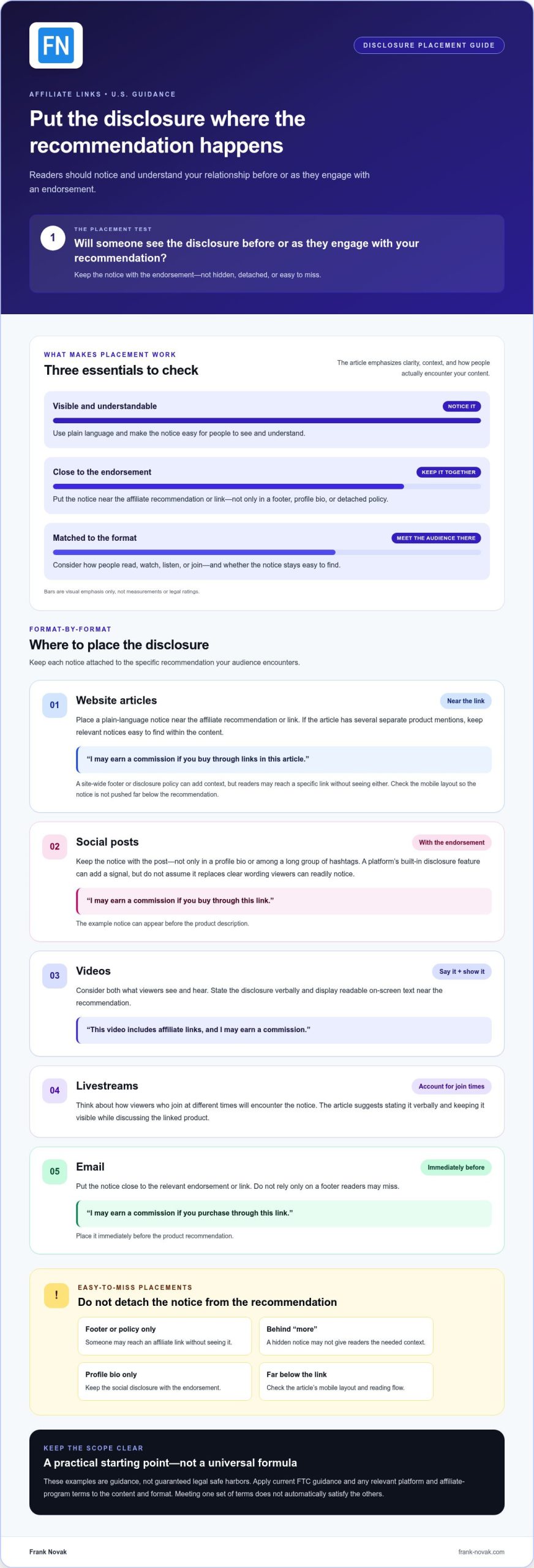
Start with a practical placement test: will someone see the disclosure before or as they engage with your recommendation? The FTC’s clear-and-conspicuous standard emphasizes that people should notice and understand a disclosure. A notice hidden behind a “more” button or separated from the endorsement may not give readers the context they need. Placement depends on how the content is presented, so consider how people actually read, watch, or listen.
Include the disclosure as part of the recommendation, not as a detached legal note. These examples are practical starting points, not a universal formula or a guarantee of compliance. Apply current FTC guidance and any relevant platform and affiliate-program terms to your content.
How should a website article disclose affiliate links?
In an article, place a plain-language notice near the affiliate recommendation or link, especially when the page includes several separate product mentions. A site-wide footer or disclosure policy can add context, but someone may reach a specific link without seeing either one. In a long article, keep relevant notices easy to find within the content. Check the mobile layout, too, so a disclosure isn’t pushed far below the recommendation.
For example: “I may earn a commission if you buy through links in this article.” If a particular section contains a recommendation, a nearby sentence can explain the connection where it matters.
How do social posts, videos, and emails change placement?
On social platforms, keep the notice with the endorsement, not only in a profile bio or among a long group of hashtags. For example, a post could begin, “I may earn a commission if you buy through this link,” before describing the product. A platform’s built-in disclosure feature can provide an additional signal, but don’t assume it replaces clear wording that viewers can readily notice.
Video requires attention to both what viewers see and hear. One practical approach is to say, “This video includes affiliate links, and I may earn a commission,” while also displaying readable on-screen text near the recommendation. For livestreams, consider how viewers who join at different times will encounter the disclosure. You could state it verbally and keep it visible while discussing the linked product.
Email gives you more control over layout, but the notice still belongs close to the relevant endorsement or link. For instance, put “I may earn a commission if you purchase through this link” immediately before a product recommendation instead of relying only on a footer readers may miss.
These format choices are part of building a sustainable affiliate marketing practice. The related guide “How to Drive Traffic to Affiliate Links: The Strategic Guide for 2026” explores traffic strategy alongside promotion. As you put its ideas into practice, keep the disclosure attached to the content wherever your audience encounters it.
What makes affiliate disclosure wording clear and credible?
Readers shouldn’t have to decode your disclosure. State the possible benefit directly in familiar language, then place the notice near the recommendation it relates to. This helps people understand the connection without needing to know affiliate-marketing jargon. The FTC’s guidance focuses on whether a disclosure is clear and conspicuous, but sample wording can’t guarantee compliance in every context.
What should a plain-language disclosure tell the reader?
If you may earn money when someone buys through a link, say so plainly. For example: “I may earn a commission if you buy through this link.” This explains the relationship without suggesting that every link earns money. Treat it as illustrative wording, and review it against current FTC guidance and the specific affiliate program’s terms before using it in a campaign.
When disclosing affiliate links legally, make each notice accurate to the relationship. If you receive a different benefit, describe that connection in words your audience can understand rather than using a generic commission statement.
Which disclosure habits can make a message unclear?
Abbreviations and euphemisms can leave readers guessing. “#aff” or “partner” may not explain whether you’re paid, receive a benefit, or have another relationship with the brand. Don’t bury a disclosure among unrelated text or rely on color alone to make it noticeable. A privacy policy serves a different purpose and may not give readers context beside a particular recommendation.
| Wording | Example | Why the difference matters |
|---|---|---|
| Clear | “I may earn a commission if you buy through this link.” | It identifies the potential benefit and connects it to the purchase. |
| Vague | “Partner” | It doesn’t explain what the relationship means to the reader. |
| Unclear abbreviation | “#aff” | Readers may not know it refers to an affiliate relationship. |
| Detached notice | “See my policy page for details.” | It sends readers elsewhere instead of explaining the connection near the endorsement. |
Use the table as a wording check, not a legal safe harbor. Read the sentence as if you’ve never heard terms such as “affiliate” or “partner.” Would you understand how the publisher might benefit? If not, say more directly what could happen, and keep the statement easy to see beside the recommendation.
Clear communication matters throughout a marketing journey, including on pages that connect content to offers. You can consider the ideas in Automated Marketing Funnel: The 2026 Guide to Sustainable Business Growth alongside disclosure planning, so each step of a funnel explains its purpose plainly. Review wording and placement in the actual context where readers encounter them.
How can you check affiliate disclosures before publishing?
A short pre-publication review can catch a disclosure that’s missing, unclear, or easy to overlook. Use the same process for articles, landing pages, social posts, email campaigns, and other content. Then check the reader-facing version, not just what you intended to publish.
A practical pre-publication disclosure checklist
- Map the endorsements. Review every product mention, recommendation, and link. Identify which links are affiliate links and note any related connection that could affect how readers interpret an endorsement.
- Match the notice to the relationship. Check that the wording accurately explains how you may benefit. Use straightforward language and put the disclosure with the recommendation so readers can understand the connection in context.
- Preview the finished content. Open the published or scheduled version on a phone and a larger screen. Check that the disclosure is readable, visible, and not pushed far from the endorsement by layout changes.
- Test the audience view. Where possible, view the page or post while logged out. Confirm that pop-ups, platform interfaces, collapsed text, or other display differences don’t obscure the notice.
- Repeat by format. For campaigns that span several channels, review each version separately. A disclosure in an article may not appear in a social caption, email, video, or landing page promoting the same offer.
Quotable checklist: “Before publishing, identify each endorsement and affiliate link, explain the connection clearly beside the recommendation, and check that readers can see the notice on the final page or post.”
How should you review program and platform requirements?
Keep the sources distinct. FTC guidance concerns how endorsements and material connections are presented to consumers. An affiliate program’s contract terms and a platform’s policies are separate requirements that may also apply. Reviewing one source doesn’t replace reviewing the others. Guidance and program rules can change, so check current materials before a campaign goes live.
If you participate in Amazon Associates, consult the current official program materials for its required disclosure statement and any placement instructions. Don’t rely on an old template or wording copied from another publisher. Record when you checked the materials and which source you reviewed, so you can revisit the wording if a program updates its terms or your campaign changes.
For a larger campaign, a simple review log can make disclosing affiliate links legally a repeatable process. Note the content or campaign, the formats checked, the relevant official guidance and program terms, and any edits made. This won’t guarantee compliance, but it creates a useful record of your review and helps keep disclosures consistent as content is reused.
How does transparent disclosure support a sustainable affiliate business?
Clear disclosures are more than a final publishing detail. They help readers evaluate your recommendations and understand how you may benefit. Consistency can support a sustainable affiliate content process, especially when you publish across multiple channels and revisit older campaigns.
It’s understandable to worry that mentioning a commission will put readers off. But transparency doesn’t automatically undermine conversions, and there’s no reliable promise that disclosure will increase them either. The practical goal is to give people clear information while making recommendations that are useful on their own merits. Avoiding disclosure to protect a short-term result can leave readers uncertain about the relationship behind your advice.
How can creators make transparency part of their workflow?
Build disclosure review into the steps you already use to create and publish content. Add a prompt to the content brief, check the wording during editing, and preview placement before publishing. Keep sample language available for writers, but don’t paste it in without checking that it accurately describes the relationship and fits the specific content.
A repeatable workflow might include:
- Briefing: Flag affiliate recommendations and any related benefits while planning the content.
- Editing: Check that the disclosure is accurate, understandable, and close to the endorsement.
- Publishing: Preview the finished page, post, or campaign on the devices and in the formats your audience uses.
- Reviewing: Revisit existing content when links, partnerships, or relevant guidance change.
This routine makes disclosing affiliate links legally part of the publishing process instead of a last-minute addition. It also helps catch content copied into a new channel without its original disclosure.
What is a sensible next step for affiliate marketers?
Start with one existing article or campaign. Review its recommendations, links, disclosure wording, and reader-facing layout. Note any changes you make, then use that review as a model for your next piece of content. As your marketing becomes more automated, include disclosure checks wherever recommendations or affiliate links are reused.
If you’d like support developing sustainable affiliate marketing and automation practices, explore Online Success Coaching. Clear, consistent disclosure is one practical habit to carry forward as you build your business.
Build Your Next Step on Trust
Make transparency part of how you run your affiliate business, not a task you remember only when a post is ready to go live. Choose one upcoming campaign and include disclosure in its planning from the start. That small shift can help you build a more consistent, audience-first way of working.
Disclosing affiliate links legally is one part of creating a sustainable digital business. Frank Novak focuses on online marketing, affiliate marketing, and business automation. Online Success Coaching supports entrepreneurs as they build digital businesses and develop their next steps.
Explore Online Success Coaching
Keep improving your process, and let honest communication guide the business you’re building. Each clear, considered step can help you move forward with greater confidence.
Frequently Asked Questions
Is it enough to disclose affiliate links in a website footer?
A footer notice alone may not give readers enough context for a specific recommendation. Someone who lands directly on a product review, for example, might never notice the footer before clicking its link. Keep a site-wide disclosure as supporting information, but assess each page on its own: can a visitor understand the relationship while reading the endorsement? Review long pages and mobile layouts, where footers may be especially far from the recommendation.
Can I use #affiliate or #ad as my only disclosure?
Don’t assume either hashtag will explain the relationship clearly to every reader. “#affiliate” may be unfamiliar, while “#ad” signals advertising but might not explain that you could earn a commission. If you use a label, consider adding plain wording that states how you may benefit. Check current FTC guidance and the platform’s display rules, including whether the disclosure stays visible beside the post text.
Do I need to disclose if I receive a free product but no commission?
A free product can still create a material connection even if you receive no commission. Consider why you received it, whether the brand expects coverage, and whether the benefit could affect how readers view your recommendation. Describe the arrangement accurately, such as by noting that the company provided the item. Before publishing, verify the relevant facts and current FTC guidance rather than treating “no commission” as proof that no disclosure is needed.
Does the FTC require one exact phrase for every affiliate link?
The FTC’s guidance emphasizes clear communication, not a single phrase that fits every endorsement. A statement should accurately describe your relationship in the context where readers encounter it. An affiliate program may separately require specific wording or other disclosures as a condition of participation. Check the program’s current official terms and use language that meets those terms while remaining understandable to your audience.
What happens if my affiliate disclosure is unclear or easy to miss?
An unclear notice can leave readers unaware of a relationship that may affect how they interpret your endorsement. Depending on the content and circumstances, it may also raise compliance concerns under applicable advertising guidance. No single outcome can be assumed for every case. If you spot a problem after publishing, review the affected content promptly, make the disclosure easier to understand and notice, and check the current rules relevant to that campaign.
Do affiliate disclosure rules apply to posts on Facebook, Instagram, or YouTube?
They can apply to endorsements shared on social platforms, including posts, videos, and livestreams. The format matters: a disclosure in a profile bio may not accompany a particular endorsement, and viewers may join a livestream after an opening notice. Review current FTC guidance and each platform’s policies. Treat platform disclosure features as an additional tool, not a substitute for checking whether your audience can readily notice the disclosure.
Do U.S. affiliate disclosure rules cover content viewed by people in other countries?
It depends on the circumstances, including where your business operates, whom the content targets, and which laws apply to the promotion. U.S. guidance may be relevant to a U.S.-based publisher, but audiences in other countries can raise additional requirements. Don’t assume one U.S. disclosure approach covers every market. If your campaign reaches people internationally, check current rules in the relevant jurisdictions and any program or platform requirements that apply.

Article by
Frank Novak
Frank Novak is an online marketing professional and coach who focuses on affiliate marketing and business automation. Through his website, frank-novak.com, he shares insights and strategies for leveraging social media platforms like Facebook to generate traffic and commissions.
Affiliate / Sponsored Content Disclaimer
This [website/post] contains affiliate links. If you click through and make a purchase, we may receive a commission at no additional cost to you. We only recommend products or services we believe will add value to our readers.