

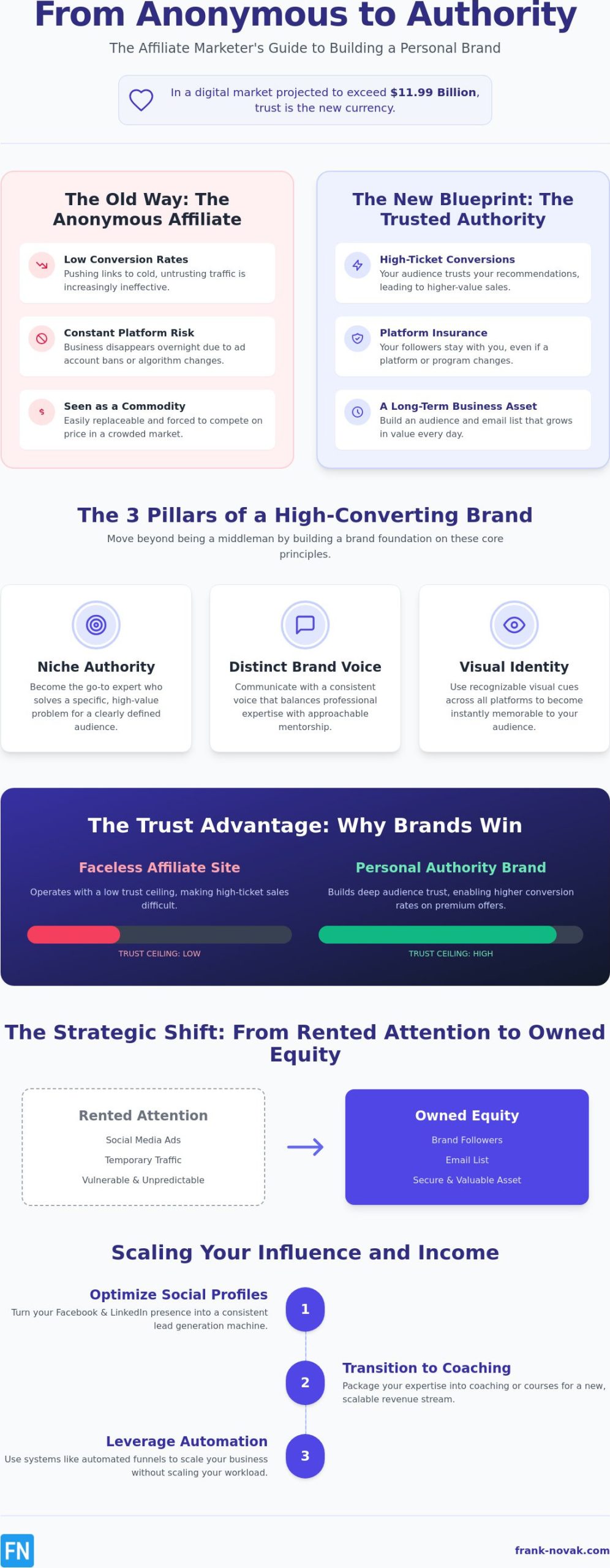
In a digital market projected to exceed $11.99 billion in spending this year, the anonymous affiliate marketer is becoming an endangered species. If you want to move beyond the cycle of low conversion rates and the constant fear of platform bans, learning how to build a personal brand as an affiliate marketer is your most important next step. It’s the only way to stop being a replaceable commodity and start becoming a trusted authority who owns a business asset that grows in value every single day.
You likely feel that the old methods of pushing links to cold traffic aren’t working like they used to, and it’s exhausting to compete in such a crowded niche. This guide will show you how to transform from an anonymous middleman into a respected voice that commands high-ticket commissions. We’ll explore the mechanics of building a sustainable presence, including how to meet the latest FTC disclosure requirements while using smart automation to scale your influence. By the end, you’ll have a clear roadmap to create a brand that converts because people actually trust your word.
Key Takeaways
- Understanding why a personal brand acts as a trust-bridge is essential for overcoming the rising costs and platform skepticism that make anonymous marketing difficult.
- You’ll learn how to build a personal brand as an affiliate marketer by defining your niche authority and developing a voice that resonates with your specific audience.
- Discover why authority brands have a much higher trust ceiling than faceless sites, which allows for better conversion rates on high-ticket offers over the long term.
- Learn how to optimize your social profiles on platforms like Facebook and LinkedIn to turn your presence into a consistent lead generation machine.
- See how transitioning into online success coaching and using automated systems like the ClickBank Super Funnel can turn your brand into a scalable revenue stream.
Why a Personal Brand is the Ultimate Affiliate Asset in 2026
If you have ever felt like just another link-pusher in a crowded market, you aren’t alone. In the current market, the distance between a customer’s problem and your recommended solution is often too wide for a simple link to cross. This is where your brand steps in. Think of it as a trust-bridge. Without it, you’re just another voice in a noisy room. With it, you’re the guide your audience has been looking for. This shift is critical because anonymous affiliate marketing is facing massive headwinds. Rising ad costs and increased platform skepticism mean that cold traffic rarely converts like it used to. Understanding what personal branding is helps you realize that your identity is actually your most valuable business asset.
If you’re wondering how to build a personal brand as an affiliate marketer, it starts with moving away from temporary income streams and toward a sustainable digital business. In 2026, commerce is creator-led. People don’t just buy products; they buy into the people who recommend them. When you position yourself as an authority, you stop being a commodity and start being a resource. This allows you to command higher commissions and work with better brands that value your influence.
To better understand this concept, watch this helpful video:
The Evolution of Trust in Digital Marketing
Consumer behavior has shifted dramatically over the last few years. People no longer just click on the first ad they see; they look for a face and a story they recognize. Transparency is no longer optional if you want to build long-term affiliate revenue. When you focus on your identity, you provide the personal touch that modern audiences demand. This is particularly important when you’re figuring out how to drive traffic to affiliate links, as traffic without trust is simply a wasted expense.
Branding as an Insurance Policy Against Platform Changes
Account bans and algorithm changes are constant threats in the digital world. If your entire business relies solely on rented traffic from social media ads, you’re always one policy update away from zero income. A personal brand acts as your insurance policy. If a specific affiliate program closes or an ad account gets flagged, your followers stay with you because they value your perspective. By building an email list as an extension of your brand, you turn rented attention into owned equity, transforming temporary tactics into a real business asset.
The Core Pillars of a High-Converting Personal Brand Identity
Building a brand is far more than just picking a color palette or designing a logo. It’s an intentional, strategic practice that defines how the digital world perceives your expertise and values. If you are currently learning how to build a personal brand as an affiliate marketer, you must move beyond the role of a simple middleman. You need a solid foundation that consists of niche authority, a distinct brand voice, and visual cues that make you instantly recognizable across the web. Without these pillars, your marketing efforts will likely feel scattered, and your audience will struggle to find a reason to choose your links over someone else’s.
Your ‘Niche Authority’ is the specific problem you solve for your audience. Are you the guide helping new entrepreneurs navigate the technical side of automation, or the expert who simplifies complex health regimens? Once you’ve identified your lane, your brand voice carries that message. It should strike a balance between professional authority and approachable mentorship. You want to sound like a seasoned practitioner sharing insights in a one-on-one setting. This steady, reliable personality builds confidence in your readers, making your recommendations feel like helpful advice rather than a high-pressure sales pitch.
Consistency also plays a vital role in how you are perceived. Your social media profiles, landing pages, and emails should share a cohesive look. This doesn’t mean you need a team of designers, but you should use the same professional imagery and tone across all touchpoints to breed familiarity. Alongside this, a ‘Value-First’ content strategy is essential. Educate your audience and provide them with a clear roadmap before you ever ask for a sale. When you prioritize their success, they’ll naturally look to you when they’re ready to invest in a solution.
Defining Your Unique Selling Proposition (USP)
Standing out in crowded niches like health, wealth, or relationships requires a sharp USP. You don’t need to be the only person in the room; you just need to be the most relevant person for a specific group. Find the intersection where your personal experience meets a current market demand. Your brand promise should be a single, clear sentence that tells your target audience exactly what they’ll gain by following your lead.
Building the ‘Know, Like, and Trust’ Factor
People buy from those they feel they know. Sharing ‘behind-the-scenes’ content is a powerful way to build this bond without oversharing your private life. Show your process, the challenges you’ve faced, and the results you’ve achieved. Use case studies to provide immediate credibility. Social proof in the context of affiliate marketing is the documented evidence that your recommended solution actually delivers the specific results you claim. If you’re finding it difficult to define your brand voice, Online Success Coaching can help you refine your message and find your unique angle.
Personal Branding vs. Faceless Affiliate Marketing: Which Scales Faster?
Choosing between a faceless niche site and an authority brand is a pivotal moment for any digital entrepreneur. If you prioritize speed, a faceless model allows you to launch quickly by focusing on generic SEO or direct-to-offer ads. However, these systems often hit what we call a “Trust Ceiling.” While a faceless site can easily sell a low-cost gadget, it struggles to convince a buyer to invest in a high-ticket program. If you’re learning how to build a personal brand as an affiliate marketer, you’re essentially building a bridge over that ceiling. It allows you to promote premium offers with much higher commission rates because the audience trusts the person behind the recommendation.
The hybrid model offers a middle ground for those who aren’t ready to be the face of every advertisement. You can build a branded persona or use a mascot to create a consistent identity without sacrificing your personal privacy. This approach still provides more longevity than a purely anonymous site. Regardless of which path you choose, using automated systems like the ClickBank Super Funnel can help you manage the technical side of your revenue while you focus on your identity. Scaling happens faster when you aren’t stuck doing manual tasks that don’t add value to your brand equity.
The ROI of Authority: Why Personal Brands Convert Better
Brand-led funnels consistently outperform anonymous ones because they reduce the “friction” of the affiliate link click. When a user recognizes your name or face from a helpful Facebook post, the psychological barrier to clicking your link drops. This recognition also has a direct impact on your advertising metrics. Authority brands often see higher Click-Through Rates (CTR) and lower Costs Per Mille (CPM) on platforms like Facebook because the algorithm rewards engagement. Since people are more likely to interact with a person than a corporate logo, your ad spend goes much further.
When to Choose the Faceless Path
If your comfort level with public visibility is low, starting with a faceless model is a perfectly valid strategy. You can focus on building niche-specific sites that solve narrow problems. This path works well if you want to manage multiple brands across different industries without being the central figure in all of them. As your business scales and you gain confidence, you can slowly transition into a personal brand. Starting with a branded persona allows you to test the waters of authority before fully committing to a public-facing identity.
Step-by-Step: Constructing Your Multi-Channel Affiliate Brand Presence
When you’re ready to implement the steps for how to build a personal brand as an affiliate marketer, consistency becomes your greatest ally. Your presence across different platforms should feel like a single, unified experience for your audience. Start by optimizing your primary profiles on Facebook and LinkedIn to act as lead generation hubs rather than digital resumes. If a visitor lands on your page, they should immediately understand who you are, what problem you solve, and how they can take the next step with you. This systematic approach is the secret to how to build a personal brand as an affiliate marketer that actually pays dividends over time.
A successful brand requires a content calendar that balances different types of value. If you only post promotional links, your audience will quickly lose interest. Instead, aim for a mix that prioritizes education and engagement. Share insights that help your followers solve small problems for free, which builds the necessary trust for them to follow your recommendations later. Once you have a content baseline, you can use Facebook ads for affiliate marketing to amplify your message. These ads shouldn’t just push a product; they should invite people into your branded ecosystem by offering a high-quality lead magnet that aligns with your core offers.
The Facebook Authority Strategy
Facebook remains a powerhouse for affiliate growth if you use it correctly. Your professional profile and business page must build trust instantly through clear imagery and helpful bio sections. Engaging in niche-specific groups is another vital step. When you provide genuine answers to questions without immediately dropping a link, you establish yourself as a reliable resource. To stay compliant with platform policies, always avoid sending ad traffic directly to an affiliate link. Instead, guide your audience to a helpful piece of content or a bridge page that you own.
Integrating Your Brand into the Sales Funnel
The transition from your social media content to an affiliate offer must be seamless. Designing ‘Bridge Pages’ is the best way to maintain your brand’s look and feel while introducing a third-party product. If the tone or visual style changes too abruptly, the buyer may feel a sense of “click-shock” and leave the page. Your email sequences should continue this conversation, sounding like a personal chat with a mentor rather than a corporate broadcast. By focusing on this cohesive journey, you ensure that the transition to the vendor’s sales page feels like the logical next step in the relationship you’ve built.
Start building your automated brand with the ClickBank Super Funnel today
Scaling Your Brand Authority through Coaching and Automation
As you master the foundational steps of how to build a personal brand as an affiliate marketer, you will eventually reach a point where your own time becomes the primary bottleneck. To move past this plateau, you must transition from simply performing daily tasks to leading your audience as a recognized authority. This shift allows you to move from a solopreneur mindset to that of a true business owner. By focusing on your brand authority, you create a sustainable legacy that doesn’t require your constant presence to generate revenue. It’s about building a business asset that grows in value independently of your hourly input.
The most effective way to accelerate this transition is by combining professional guidance with robust technical systems. If you’ve spent months trying to find your unique angle without success, you’ve likely realized that a lack of clarity is expensive. This is why learning how to build a personal brand as an affiliate marketer often requires an outside perspective, such as the professional advisory of Jani Havunen, to see the opportunities you might be missing. When you align your personal story with a proven technical framework, you stop chasing temporary trends and start building a structured, scalable enterprise.
The Power of Online Success Coaching
Even the most experienced marketers need a steady, reliable guide to navigate the rapidly changing trends of 2026. This is why online success coaching is your most effective shortcut to growth. A mentor helps you refine your unique brand voice and provides the reassurance needed to make bold moves in your niche. Instead of guessing which strategies will work, you follow a clear roadmap designed by someone who has already navigated the professional landscape you’re currently entering. This support builds your confidence and ensures every piece of content you create serves your long-term goals.
Automating Trust with the ClickBank Super Funnel
While branding provides the trust that drives conversions, automation provides the scale that drives growth. When you use the ClickBank Super Funnel, you’re implementing a pre-built system that handles the technical heavy lifting of lead generation and sales. This allows you to focus entirely on being the face and voice of your brand. You can integrate your personal insights and results into automated assets that nurture your audience 24/7. This combination ensures that your impact scales without a corresponding increase in your daily workload, allowing your business to operate even when you aren’t actively online.
Securing Your Affiliate Future with Sustainable Authority
By moving beyond the role of an anonymous link-pusher, you’ve taken the first step toward building a business that actually lasts. We’ve explored how a personal brand acts as the essential trust-bridge for high-ticket sales and why consistency across your social channels is the key to long-term lead generation. Learning how to build a personal brand as an affiliate marketer gives you the power to command attention in a crowded market while protecting your business against platform changes. When you combine this authority with lead generation expertise and business automation, you stop trading time for money and start building a real asset.
Success in 2026 requires more than just hard work; it requires the right systems and supportive mentorship for digital growth. Utilizing tools like the ClickBank Super Funnel allows you to focus on your brand’s voice while the technical mechanics work in the background. If you’re ready to move from a solopreneur to a market leader, having a reliable guide can help you avoid common mistakes and reach your goals much faster.
You have the potential to become a trusted voice in your niche. With the right foundation and a commitment to providing genuine value, your digital business will continue to grow in value every single day.
Frequently Asked Questions
Do I have to show my face to build a personal brand in affiliate marketing?
You don’t necessarily have to show your face to be successful, though doing so often speeds up the trust-building process. If you prefer to stay private, you can develop a branded persona or use a mascot to represent your business identity. This hybrid model allows you to maintain a consistent voice and professional authority without sacrificing your personal privacy.
How long does it take to see results from personal branding?
Most marketers begin to see a measurable increase in engagement and trust within three to six months of consistent effort. While a faceless ad might get a click today, a brand is a long-term asset that compounds over time. If you stay the course, you’ll find that your conversion rates begin to rise as your audience grows more familiar with your recommendations.
What is the best social media platform for affiliate branding in 2026?
Facebook and LinkedIn remain the top choices for building professional authority because they prioritize community interaction and long-form content. These platforms allow you to share the educational insights that position you as a guide rather than a salesperson. By engaging in specific groups and sharing your journey, you can turn a simple profile into a lead generation hub.
To expand your influence further, joining a professional networking organization like Network In Action can provide the structured environment needed to build high-quality referral relationships that support your online brand.
Can I build a personal brand if I’m a complete beginner with no results?
You can absolutely build a brand as a beginner by adopting a “document, don’t create” approach. Learning how to build a personal brand as an affiliate marketer while you are still learning the ropes actually builds more trust because your audience can relate to your growth. Transparency about your progress is often more persuasive than a polished, corporate image.
How do I choose a niche for my personal brand?
The best niche for your brand lies at the intersection of your personal interests and a proven market demand. If you choose a topic you are genuinely interested in, you’ll find it much easier to maintain a consistent content schedule. You should also look for niches that support high-ticket offers, as this allows you to maximize your revenue with a smaller, more focused audience.
Is personal branding better than just running direct ads to affiliate offers?
Personal branding offers a significantly higher long-term return on investment than simply running direct ads to offers. If you are focused on how to build a personal brand as an affiliate marketer, you’ll find that your conversion rates on high-ticket items far exceed those of anonymous campaigns. A brand creates a “trust-bridge” that anonymous ads simply cannot replicate.
How do I stay compliant with Facebook Ads while building a personal brand?
Staying compliant on Facebook requires you to act as a bridge between the platform and the vendor’s offer. You should always send ad traffic to a landing page or bridge page that you own rather than linking directly to an affiliate product. It is also essential to follow the latest FTC guidelines by clearly disclosing your affiliate relationship within the first two lines of your ad copy.
What are the most common mistakes when building an affiliate brand?
The most frequent mistake is being too promotional too early in the relationship with your audience. If you only post affiliate links without providing educational value, people will quickly tune you out. Another common error is inconsistency; if you don’t show up regularly, your audience will forget your brand and move on to a more reliable guide.

Article by
Frank Novak
Frank Novak is an online marketing professional and coach who focuses on affiliate marketing and business automation. Through his website, frank-novak.com, he shares insights and strategies for leveraging social media platforms like Facebook to generate traffic and commissions.
Affiliate / Sponsored Content Disclaimer
This [website/post] contains affiliate links. If you click through and make a purchase, we may receive a commission at no additional cost to you. We only recommend products or services we believe will add value to our readers.