
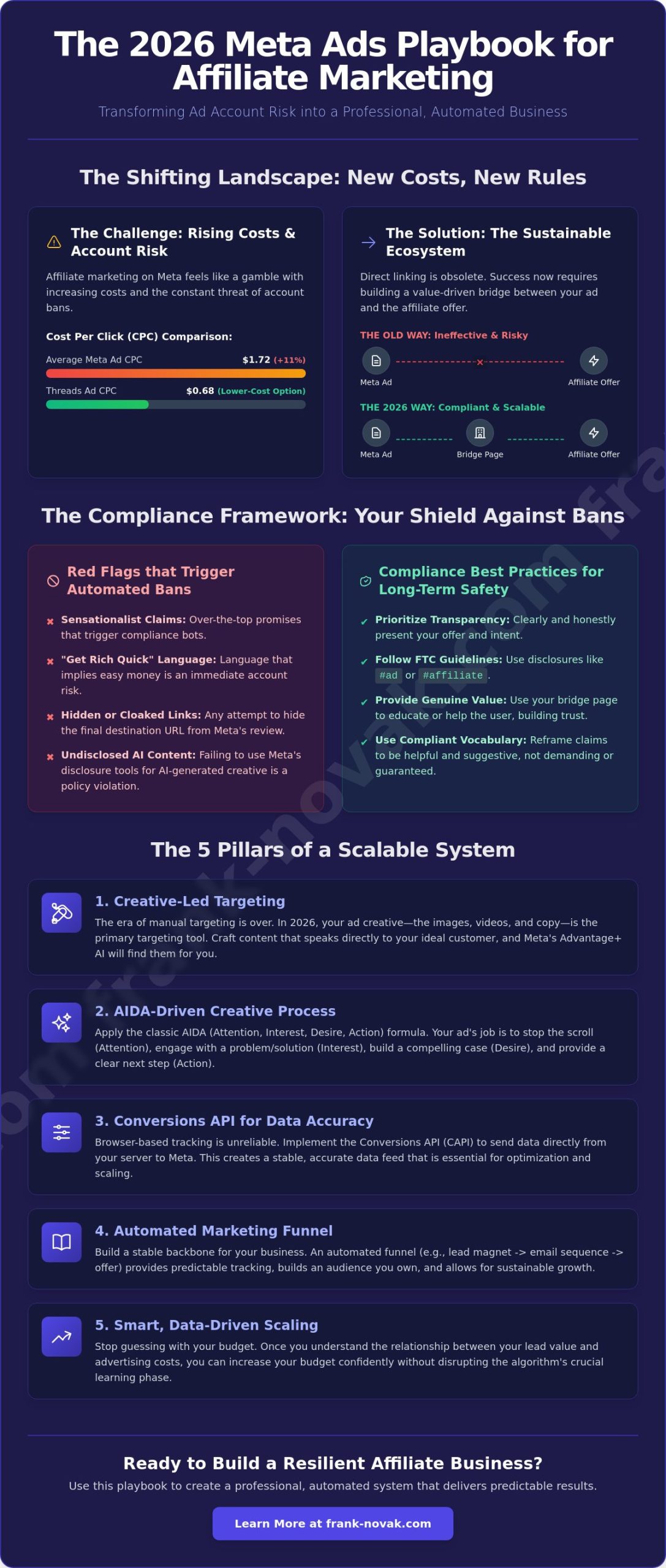
What if the very thing you fear most, a permanent ad account ban, is actually the compass that leads you toward a professional and automated business? If you’ve spent late nights worrying about Meta’s shifting policies or watching your budget drain away, you’re not alone. Many marketers find that using Facebook ads for affiliate marketing feels like a gamble, especially now that the average cost per click has risen 11 percent to $1.72. It’s easy to feel discouraged when high costs don’t immediately lead to conversions, but there’s a more reliable way to grow.
We understand that you want a stable traffic source that doesn’t disappear overnight. In this guide, you’ll learn how to leverage Meta’s powerful advertising platform to drive high-quality traffic to your offers without risking your account. We’ll walk you through the 2026 landscape, including how to use lower-cost options like Threads ads at $0.68 per click and how to navigate mandatory AI content disclosures. By the end of this article, you’ll have a clear roadmap for building a compliant, scalable system that delivers predictable results.
Key Takeaways
- By identifying the specific red flag behaviors that trigger automated bans, you can build a compliant foundation that keeps your account safe for the long term.
- If you apply the AIDA formula to your creative process, you’ll find that your visuals and copy do the heavy lifting of finding your ideal audience for you.
- To ensure your data remains accurate despite browser changes, this guide shows you how to set up Facebook ads for affiliate marketing using the Conversions API.
- By implementing an automated marketing funnel, you’ll create a stable backbone for your tracking that allows for predictable and sustainable scaling.
- Once you understand the relationship between lead value and costs, you can increase your budget without disrupting the learning phase of the algorithm.
Understanding Facebook Ads for Affiliate Marketing in 2026
Success in the current digital environment requires a clear understanding of how Meta’s algorithms interact with Affiliate marketing. Meta’s platform processes billions of data signals every day, which makes it an incredibly powerful engine for matching specific products with the right buyers. While other platforms might rely on search intent, using Facebook ads for affiliate marketing allows you to excel at discovery. You are essentially showing users a solution to a problem they might not have even realized they could solve yet.
If you’ve tried running ads in the past, you may have noticed that the old strategy of “direct linking” to an offer is no longer effective or safe for your account. In 2026, the focus has shifted toward building a sustainable ecosystem. This involves creating a bridge between the ad and the offer, such as a helpful landing page or a lead magnet. This layer not only protects your advertising standing but also helps you build a long-term asset that you actually own.
To better understand how these campaigns are structured for maximum profit, watch this helpful video:
The Role of Paid Traffic in Your Affiliate Journey
Organic reach can be a wonderful way to grow, but it’s often too slow for someone looking to build a professional business today. Paid traffic acts as the ultimate shortcut. When you invest in Facebook ads for affiliate marketing, you aren’t just paying for clicks; you’re buying valuable data. This information tells you exactly which headlines grab attention and which offers actually result in commissions. If you approach your initial ad spend as a form of “market tuition,” you’ll find it much easier to stay calm and focused on the long-term numbers. A realistic goal for a new campaign is to aim for data gathering first, then optimization, and finally, scaling.
The Fundamental Shift in 2026 Advertising
The way we find customers has changed fundamentally due to the rise of AI and Advantage+ campaigns. We no longer need to spend hours layering complex interests to find a specific audience. Instead, the algorithm has become so sophisticated that your ad creative now handles the targeting for you. If your image and copy are designed correctly, Meta’s AI will find the people most likely to click and convert. This shift means your primary job is now to provide genuine value within the ad itself. If you want to see how this looks in practice, studying a ClickBank Super Funnel can give you a clear roadmap for your own setup. Providing helpful information upfront is now a requirement for maintaining high ad delivery and keeping your costs manageable.
The Compliance Framework: Why Most Affiliates Fail
Many marketers mistakenly believe that Meta is intentionally hostile toward affiliate offers. In reality, the platform is simply protective of its user experience. If your strategy for Facebook ads for affiliate marketing relies on sensationalist claims or hidden links, you’re essentially waving a red flag at Meta’s automated compliance bots. These bots are more proactive than ever. Since the policy updates on March 14, 2026, Meta’s system now proactively scans ad components, including text, images, and your destination URL, before your ads even reach an audience. If you fail to disclose AI-generated creative or use aggressive “Get Rich Quick” language, your account is at immediate risk. Understanding the root causes behind these flags is the first step toward prevention, and troubleshooting common Facebook ad rejections for affiliates before they escalate into full account bans can save you significant time and budget.
Compliance isn’t a hurdle to clear; it’s the framework for a professional business. To stay safe, you must prioritize transparency. This includes following the FTC Endorsement Guides by clearly labeling your content with tags like #ad or #affiliate. When you treat your marketing like a legitimate business rather than a shortcut to a commission, the algorithm begins to work with you instead of against you.
Navigating Meta Advertising Policies
Meta maintains strict standards for sensitive niches like health, wealth, and relationships. You don’t have to avoid these profitable sectors, but you do have to change your vocabulary. Instead of promising “$10,000 in thirty days,” focus on the process or the educational value of the offer. Since March 2026, there has been even stricter enforcement for ads that might fall under Special Ad Categories. If you’re unsure how to phrase your copy, seeking Online Success Coaching can help you find that balance between high-converting language and platform safety. Always ensure your landing page includes a visible Privacy Policy and Terms of Service to prove your legitimacy to Meta’s reviewers.
The Power of the Bridge Page
Linking directly to an affiliate offer is one of the fastest ways to get your ad account disabled. Most affiliate sales pages use aggressive marketing tactics that violate Meta’s policies. A bridge page acts as a vital buffer. It allows you to introduce yourself, provide value, and set expectations before the user ever sees a sales pitch. This extra step builds trust with the user and ensures the traffic you send to the affiliate partner is pre-qualified and ready to buy. It’s about creating a smooth, professional journey that keeps both the user and the platform happy. If you want a detailed walkthrough of building ban-proof campaigns around ClickBank offers specifically, this step-by-step guide on how to run Facebook ads for ClickBank covers the exact 2026 compliance requirements you need to follow.
Crafting High-Converting Ad Creative and Targeting
If you’ve spent hours clicking through the technical settings in Meta Ads Manager, you might be surprised to learn that the most effective targeting tool in 2026 isn’t a button or a checkbox. It’s your ad creative. When you use Facebook ads for affiliate marketing today, your visuals and headlines act as a filter. If your ad features a specific solution for home office productivity, the algorithm observes who stops to look and who keeps scrolling. By analyzing these interactions, Meta’s AI identifies patterns and automatically serves your content to similar users. This “Creative is the Targeting” philosophy means you can spend less time worrying about technical minutiae and more time focusing on the psychology of your audience.
To capture attention in a crowded feed, you should follow the classic AIDA formula. You start with a hook to grab Attention, build Interest with a relatable story, create Desire by highlighting the benefits of the affiliate offer, and end with a clear call to Action. If you balance curiosity with clarity, you’ll attract the right clicks without misleading your potential customers. This approach is particularly effective on mobile devices, where users make split-second decisions about what content deserves their time.
Audience Targeting that Actually Converts
While the algorithm is highly capable, giving it a head start can lead to faster results. If you have an existing lead list, creating Lookalike Audiences (LLAs) allows Meta to find new people who share characteristics with your best customers. However, many successful marketers are finding that “Broad Targeting,” where you leave interest fields empty, often results in a lower cost per acquisition. This success happens because the AI has more room to explore and find hidden pockets of buyers. Professional Strategic Traffic Generation usually involves a thoughtful mix of these broad cold audiences and warm audiences who have already interacted with your bridge page.
Creative Principles for the Modern Scroll
The style of your ad matters just as much as the message. In 2026, simple images and User-Generated Content (UGC) often outperform highly polished, professional graphics. This is because users prefer content that blends naturally into their social feed rather than looking like a traditional commercial. If you’re using video, the “3-Second Hook” rule is non-negotiable; you must give the viewer a reason to stop their thumb immediately. Data from April 2026 shows that advertisers using AI-powered creative tools see an 18% higher click-through rate on average. Additionally, with Instagram Reels CPC sitting at $1.28, which is 26% lower than the standard Facebook Feed, vertical video has become a primary format for affordable affiliate traffic.
The Technical Setup: Funnels and Tracking
If you’re serious about scaling your Facebook ads for affiliate marketing, you must move beyond the basic Pixel setup. In the current privacy-first environment, relying solely on browser-based tracking often results in significant data loss. If a browser blocks your tracking code, Meta never receives the signal that a conversion occurred, which prevents the AI from optimizing your campaign. To solve this, you must implement the Conversions API (CAPI). This tool creates a direct connection between your server and Meta, ensuring that your data remains accurate even when browser-based cookies fail.
The backbone of this entire technical process is an Automated Marketing Funnel. Instead of sending traffic directly to a vendor’s page where you have no control over the tracking, your funnel allows you to capture first-party data. This “Lead First, Sale Second” strategy is essential for long-term success. By collecting an email address before redirecting the user to an affiliate offer, you’re building an asset that you can market to repeatedly without paying for additional ads.
Setting Up Your Tracking Infrastructure
Your journey begins with setting up a Meta Dataset, which is the evolved version of the traditional Pixel. To ensure your ads are delivered reliably, you must verify your domain within the Meta Business Suite. This step proves to the platform that you are a legitimate business owner and helps maintain data integrity. As of March 3, 2026, Meta updated its attribution model to focus strictly on link clicks for website conversion campaigns. This means that having a clean, verified technical setup is more important than ever to ensure every commission is correctly attributed to your efforts.
Automating the Lead-to-Commission Journey
Once your tracking is in place, you can focus on the flow of your leads. A professional system like the ClickBank Super Funnel automates the transition from your Facebook ad to the affiliate thank-you page. You should integrate your email autoresponder directly with your funnel so that every new lead receives a sequence of helpful, value-driven messages. To identify exactly which ad creative or headline is driving your profits, use UTM parameters on every link. This level of detail allows you to stop spending money on underperforming ads and double down on the winners. If you’re ready to stop guessing and start measuring, you can explore a pre-built funnel system that handles these technical integrations for you.
Scaling Your Business with Automated Affiliate Funnels
Scaling your efforts with Facebook ads for affiliate marketing is a methodical process that requires patience and a deep understanding of your numbers. Many beginners make the mistake of doubling their budget the moment they see a profitable day, but this often leads to a sudden drop in performance. If you increase your daily spend by more than 20 percent at one time, you risk pushing your campaign back into the “learning phase.” This reset happens because the algorithm needs to recalibrate how it bids for your new, higher budget. By making small, incremental adjustments every 48 hours, you allow the AI to maintain its momentum while you gradually increase your reach.
The real secret to scaling lies in the relationship between your Lead Value and your Cost Per Lead (CPL). If you know that every lead you capture is worth five dollars over the next month, you can confidently spend three dollars to acquire that lead. This mathematical certainty is what separates a professional digital business from a temporary side hustle. As you scale, you should also look for ways to improve your efficiency. For instance, Meta’s Advantage+ Shopping campaigns currently show a 32 percent lower cost per acquisition compared to manual setups. Utilizing these automated tools allows you to grow your volume without a proportional increase in your workload.
From Single Sale to Sustainable Business
A sustainable business is built on more than just a single winning ad. To protect your income, you should look for opportunities to diversify the affiliate offers you promote within your specific niche. If one partner changes their commission structure or pauses their program, your business remains intact because you have other revenue streams flowing through your funnel. Reinvesting a portion of your profits back into your ad spend creates a compounding effect that can lead to exponential growth over time. Developing a Success Mindset is essential during this phase, as it helps you stay focused on long-term stability rather than chasing short-term wins.
Leveraging Professional Coaching for Growth
While you can certainly learn the mechanics of advertising on your own, having an expert eye on your campaigns can prevent costly mistakes. Professional mentorship acts as a shortcut by identifying the small errors in your tracking or copy that might be draining your budget. When you join a community of entrepreneurs, you gain access to shared insights and proven strategies that are working in the current market. Choosing to invest in Online Success Coaching provides you with a personalized roadmap that is tailored to your specific goals and experience level. This level of support ensures that you aren’t just running ads; you’re building a compliant and scalable system that will last for years to come.
Your Path to Sustainable Affiliate Growth
Building a professional business using Facebook ads for affiliate marketing is no longer about finding loopholes; it’s about embracing a system that rewards transparency and user value. By shifting your focus toward a compliant framework and utilizing the power of a bridge page, you protect your ad account while building a long-term asset. If you implement the technical foundations we’ve discussed, such as the Conversions API and automated funnels, you’ll ensure your data remains accurate in a privacy-first world.
If you’re ready to move beyond the trial-and-error phase, you don’t have to navigate this landscape alone. Having a clear roadmap can save you thousands in wasted spend and months of frustration. Frank Novak provides personalized mentorship to help you implement proven high-conversion funnel templates that focus on long-term sustainability rather than temporary wins. You can access the tools you need to create a stable, scalable traffic source that delivers predictable results.
Ready to automate your commissions? Discover the ClickBank Super Funnel here.
The strategies are now in your hands. With a steady approach and the right guidance, you can transform your marketing efforts into a predictable engine for growth. Your journey toward a scalable digital business starts with a single, compliant step today.
Frequently Asked Questions
Is Facebook ads good for affiliate marketing in 2026?
Yes, it remains a premier source for discovery based traffic because Meta’s AI has become incredibly precise at identifying buyer intent. While costs have increased, the platform’s ability to find users who aren’t actively searching for a product but are likely to buy makes using Facebook ads for affiliate marketing a dominant strategy for growth.
How much budget do I need to start affiliate marketing on Facebook?
You can begin with a modest daily budget of five to ten dollars to gather initial data. This allows the algorithm to start learning without a large financial risk. Once you identify which creatives are performing well, you can gradually increase your spend to reach a larger audience and improve your return on investment.
Can I promote ClickBank links directly on Facebook?
You should never promote ClickBank links directly as this often leads to immediate account flags. Meta prefers to see a professional bridge page that provides value before the user reaches the sales offer. Using a structured system like the ClickBank Super Funnel ensures your links are wrapped in a compliant, high converting environment. For a complete breakdown of the exact steps involved, the guide on how to run Facebook ads for ClickBank walks you through every requirement in the current policy landscape.
What happens if my Facebook ad account gets banned?
If your account is banned, you should first review Meta’s policies to identify the specific violation before filing an appeal. Most bans for affiliates happen due to misleading claims or a lack of transparency. Focusing on a professional compliance framework from the start is the best way to ensure your business remains active and stable.
Do I need a website to run Facebook ads for affiliate marketing?
You definitely need a domain and a landing page to run successful campaigns today. Meta requires domain verification to ensure ad delivery and data integrity. Having your own site also allows you to implement the Conversions API, which is necessary for tracking sales accurately in a privacy conscious world.
What is a bridge page and why do I need one?
A bridge page is an intermediate website that sits between your Facebook ad and the affiliate offer. It serves to warm up the visitor and provide context, which significantly increases the likelihood of a sale. It also protects your ad account by ensuring the user has a positive, informative experience before seeing a commercial pitch.
How do I target people who are likely to buy affiliate products?
The most effective way to target buyers is to let your creative do the work. If your ad speaks directly to a specific pain point, the algorithm will naturally find people who share those interests. You can also use Lookalike Audiences based on your existing lead list to give the AI a head start in finding high quality traffic.
Can I use Facebook ads for high-ticket affiliate marketing?
Facebook ads for affiliate marketing are actually perfect for high ticket offers because they allow you to build an email list first. High ticket products usually require more trust and multiple touchpoints. By using ads to drive leads into a follow up sequence, you can educate your audience and close larger commissions over time. If your campaigns are hitting walls during this process, a dedicated resource on troubleshooting common Facebook ad rejections for affiliates can help you resolve policy issues quickly and keep your scaling momentum intact.

Article by
Frank Novak
Frank Novak is an online marketing professional and coach who focuses on affiliate marketing and business automation. Through his website, frank-novak.com, he shares insights and strategies for leveraging social media platforms like Facebook to generate traffic and commissions.
Affiliate / Sponsored Content Disclaimer
This [website/post] contains affiliate links. If you click through and make a purchase, we may receive a commission at no additional cost to you. We only recommend products or services we believe will add value to our readers.