

What if the strongest affiliate business isn’t the one chasing the next commission, but the one readers trust enough to return to? If unpredictable income or reliance on a single traffic source has made growth feel uncertain, that concern is understandable. Building a sustainable long-term affiliate business takes more than adding links to content. It means helping people make informed choices while building systems that can adapt as your audience and offers change.
You don’t need to solve everything at once. Start by defining who you want to help and what problem you can help them solve. Then choose offers that fit, explain affiliate relationships clearly, and build a repeatable way to reach readers. A simple review routine can help you respond to results without treating every change in commissions as a reason to start over.
This guide walks through a practical sequence for connecting audience value, product fit, and revenue. You’ll learn how to make useful recommendations, reduce dependence on one channel or offer, and measure results so you can choose your next step with more confidence. The goal is steady progress built on relationships and adaptable systems, not quick wins or guaranteed income.
Key Takeaways
- Assess business durability through repeatable value and ongoing learning, not commission spikes alone.
- Build recommendations around your audience’s real needs, and give readers useful context before presenting an offer.
- Compare offers by audience fit, usefulness, terms, and how clearly you can explain them. Avoid relying on a single offer or traffic source.
- Use a regular review cycle to establish a baseline, spot patterns, test changes, and record what you learn.
- Building a sustainable long-term affiliate business starts with manageable steps: define your audience, publish helpful content, build direct relationships, and adjust as you learn.
Building a Sustainable Long-Term Affiliate Business Starts with a Strong Foundation
Building a sustainable long-term affiliate business isn’t about making commissions arrive automatically. It’s about creating repeatable value for a defined audience, learning from how people respond, and maintaining your work as their needs and the market change. The basic model is straightforward: an affiliate recommends a product or service and may earn a commission when a reader takes a qualifying action. The Affiliate Marketing Overview provides background on the model and its key components.
A practical starting sequence is to choose an audience, identify a problem they want to solve, create useful content about it, and build trust before recommending an offer. Once that foundation is in place, improve the systems that help readers find your content and follow up on what interests them. This keeps monetization connected to real needs instead of making a commission the starting point.
A sustainable business model creates repeatable value and adapts over time; a short-term promotional campaign depends on a temporary burst of attention.
What makes an affiliate business sustainable over time?
Sustainability comes from combining audience value with relevant recommendations and ongoing maintenance. A useful guide can continue helping readers, but it may need updated details, refreshed links, or a clearer explanation. An offer that fits today may become less relevant as audience needs or market conditions shift. No process can promise a particular income or remove uncertainty, but sound execution helps you respond to change.
A commission spike can be encouraging, but it’s only one moment in the business. A campaign tied to a seasonal trend or a single source of attention may fade when the promotion ends. Instead, look for repeatable work you can sustain: publishing useful content, reviewing reader questions, checking that links work, and confirming that recommendations remain appropriate. Those habits give you a better basis for judging whether the business continues to serve people over time.
Choose a focused audience and problem to serve
Start with people whose needs you understand well enough to explain in plain language. Instead of aiming at everyone interested in “making money online,” for example, focus on beginners who want to understand how affiliate links fit into a content business. A clear focus makes it easier to create relevant material without locking you into one narrow topic forever.
Before committing, look for signs that people actively seek information and solutions. Note recurring questions in relevant discussions, search suggestions, or conversations with people in the group. These are clues, not proof of demand, so keep learning as you publish. Ask yourself:
- Can I describe this audience and its challenge clearly?
- Do people seek practical information about this problem?
- Can I help them with useful content before recommending an offer?
If you can answer yes, you have a workable starting point. Use the audience and problem to decide what to publish first, then refine your focus as questions and feedback reveal what readers need.
Earn Audience Trust Before You Build Affiliate Revenue
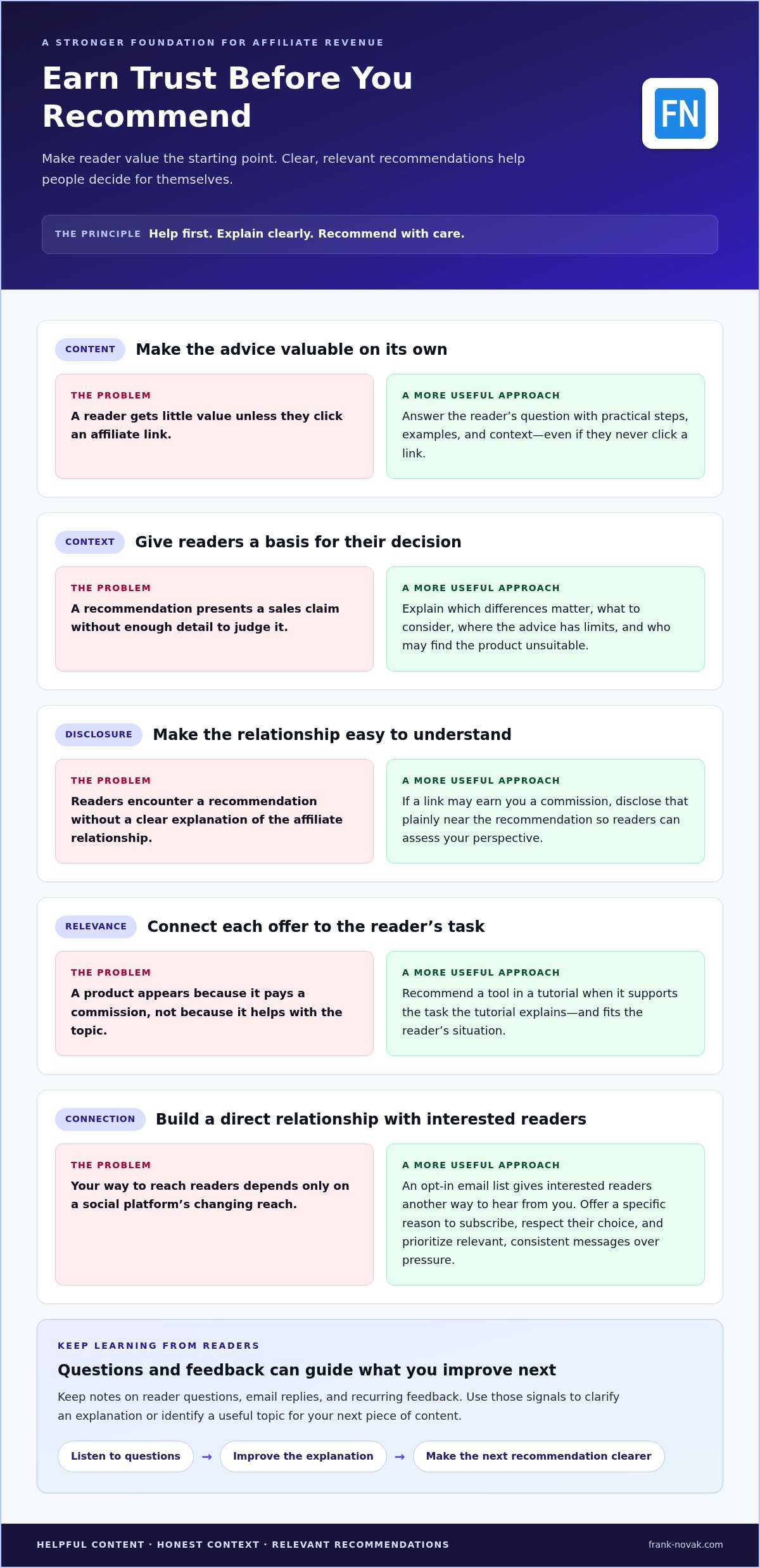
Once you know whom you want to help, make usefulness the first measure of your content. A reader should be able to learn something practical from a guide even if they never click an affiliate link. If someone is comparing email platforms, for example, explain which differences matter to a beginner, what to consider before choosing, and where your advice has limits. That gives readers a basis for making their own decision rather than asking them to accept a sales claim.
Create content that helps before it promotes
Start with questions your audience actually asks, then answer them with clear steps, examples, and context. Keep educational explanations distinct from promotional claims: describe what a product may help with, where it might fall short, and who may find it unsuitable. If you earn a commission from a link, disclose that plainly near the recommendation so readers understand the relationship as they assess your perspective.
Make each recommendation relevant to both the reader’s situation and the content itself. A tool mentioned in a tutorial should support the task the tutorial explains, not appear simply because it pays a commission. Keep a running note of reader questions, email replies, and recurring feedback. These signals can show where an explanation needs work or point to a useful topic for your next article.
Reader trust is a business asset, not a shortcut to conversion; it grows through helpful, honest decisions repeated over time.
Build a direct relationship with your audience
An opt-in email list gives interested readers a way to hear from you beyond a social platform’s changing reach. Invite people to subscribe for a specific reason, such as practical guidance on a topic they care about, and respect that choice. Useful messages might answer a common question, share a new resource, or explain how you reached a recommendation. Sending more often isn’t automatically better; relevance and consistency matter more than pressure.
For instance, if readers are trying to understand how to attract visitors to affiliate content, answer the question in a helpful email and point them to a deeper strategic traffic-generation guide. The guide should be useful on its own, with any affiliate recommendation clearly separated from the educational advice.
This approach supports building a sustainable long-term affiliate business because readers can return to your guidance, ask questions, and help you understand what they need next. Keep the relationship permission-based: explain the purpose of your messages, offer value beyond promotions, and make it easy for subscribers to change their preferences or leave.
For structured guidance as you put these principles into practice, Online Success Coaching for digital business growth offers personalized mentorship.
Choose Affiliate Offers and Channels That Can Adapt as You Grow
Once readers know they can rely on your guidance, choose offers and ways to reach them that suit your business. A high commission alone doesn’t make an offer a good fit. Start with the audience’s problem, then ask whether the product addresses it, whether you can explain its value and limitations honestly, and whether its terms support your approach. Building a sustainable long-term affiliate business means reassessing those choices as your audience, programs, and marketing conditions evolve.
Evaluate an affiliate offer for audience fit
Before promoting an offer, write down the problem it is meant to solve and the audience members most likely to benefit. Where possible, consider your own experience with the product and look for credible evidence to support what you plan to say. Review the commission structure, attribution terms, and program rules so you understand how the arrangement works. Then check that the offer belongs in the content and that you can describe it fairly, including its limitations. Don’t recommend a product just because its commission looks attractive.
Build a balanced traffic and funnel system
Different channels play different roles, and each has trade-offs. A balanced system can introduce a problem through useful content, let interested readers choose to stay connected, and offer a relevant next step. No channel removes uncertainty or guarantees commissions. Start with one you can maintain, then add another when you have the time and process to support it consistently.
| Channel | Useful role | Trade-off to consider |
|---|---|---|
| Organic content | Explains a topic and helps people discover useful answers over time. | Visibility can take time to build and may shift with platform or search changes. |
| Continues communication with people who chose to hear from you. | Requires permission, relevant messages, and regular attention to the relationship. | |
| Paid traffic | Can bring targeted visitors to a tested page or offer. | Requires spending and careful measurement; results can vary. |
Think of a funnel as a clear path, not an automatic sales machine: content introduces a need, a useful follow-up helps readers explore it, and a fitting offer provides an optional next step. Automation can support timely, consistent follow-up, but it can’t replace relevant communication or sound judgment. The automated marketing funnel guide explains how funnel systems can support a business over time.
To reduce concentration risk, consider what would happen if one offer changed its terms or one traffic source lost reach. You don’t need to use every channel or promote multiple products immediately. Build a small, manageable mix, watch how each part serves your audience, and adjust when the evidence points to a better fit.
Measure Affiliate Business Health and Improve It Step by Step
Once your offers and channels are in place, regular measurement helps you make thoughtful adjustments instead of reacting to every commission change. Use a simple cycle: set a baseline, observe results, look for possible causes, test one change, and document what you learn. The aim isn’t to predict income with certainty. It’s to understand how your work is performing and choose a sensible next step.
A measured experiment gives you evidence to consider; an unsupported assumption gives you a story without a reliable test.
Select a small set of useful business indicators
Choose indicators that answer specific questions. To see whether an article reaches its intended audience, review relevant engagement, such as which pages readers visit and whether they continue to related resources. For email, consider replies and clicks alongside feedback about whether messages are useful. Affiliate conversions, where available, can show whether a recommendation leads to action, but they don’t explain by themselves why a reader decided to act.
Separate activity from outcomes. Publishing more often is an activity, not proof that your content is helping the right people. Track a manageable set of measures and review them over a meaningful period. Note changes such as a new promotion, shifts in traffic, or an updated offer. A single quiet week or strong day may not tell the whole story.
Run small tests and document what you learn
When a measure changes, look for possible explanations before making a broad adjustment. Where practical, change one meaningful variable at a time, such as an article’s structure, the placement of a relevant link, or the wording that introduces a recommendation. Record what you expected, how long you observed the change, what happened, and what you’ll do next. That makes it easier to learn from both positive and disappointing results.
For example, if readers visit a guide but don’t continue to a related resource, consider whether the next step is clear and relevant before changing the offer itself. Write down the original baseline, and avoid treating correlation as proof that one change caused a result. If the test doesn’t provide enough evidence to guide a decision, keep observing or choose a more focused test.
This steady process supports building a sustainable long-term affiliate business because it replaces guesswork with learning while leaving room for market conditions and audience needs to change. Improvement takes patience; the affiliate marketing resilience guide offers a perspective on maintaining a steady approach as you work through challenges.
Keep review notes in one simple document or spreadsheet. Over time, they can help you see which content attracts the right readers, which messages prompt useful responses, and where a channel or offer may need attention. Use the patterns to guide your next test, not to predict future results.
Turn the Long-Term Affiliate Business Plan into Your Next Steps
A durable affiliate business grows through manageable actions, repeated and improved over time. You don’t need to launch on every platform, build a complex funnel, or promote several offers at once. Choose one useful next step, make it sustainable within your schedule, and use what you learn to decide what comes after it. That’s more practical than trying to build the entire business in a single push.
Create a focused first-month action plan
Begin with a clear audience and problem statement before planning promotional content. For example: “I help new affiliate marketers understand how to evaluate offers before promoting them.” A specific statement gives you a filter for deciding which questions to answer and which recommendations belong in your content.
Then create a routine you can maintain. Your first month might include:
- Write down the audience you want to serve and one recurring problem they face.
- Choose a realistic publishing schedule and create helpful content that addresses that problem.
- Invite readers to respond or subscribe, then set aside time to review their questions and feedback.
- Schedule a recurring review to note what you published, what readers engaged with, and one possible experiment to try next.
Keep the plan small enough to follow even during a busy week. If you can’t maintain the routine, simplify it rather than adding another channel or automation. Your first goal is to establish a working rhythm, not to create a perfect marketing system.
Know when coaching or funnel resources may help
As your work develops, you may want more structure. Online Success Coaching provides personalized mentorship for digital business growth. It can help you clarify priorities and build a process that fits your goals. Coaching can support your learning, but it doesn’t guarantee commissions or a particular business outcome.
If you’re exploring how a funnel can organize the steps between a reader’s first visit and a relevant next action, the ClickBank Super Funnel is a digital resource for affiliate marketing. Use a funnel to support consistent communication and follow-up, while keeping the real value in useful information and recommendations that fit the reader’s needs.
Building a sustainable long-term affiliate business is a continuing practice: define your audience, publish helpful content, develop direct relationships, review what you learn, and adjust your next step. You don’t need to predict every challenge in advance. Choose one action you can take now, then build from the evidence and experience you gain.
Take One Practical Step Toward Steady Growth
Building a sustainable long-term affiliate business is an ongoing practice, not a finish line you reach by getting every decision right at the start. Your next step can be small: choose one audience question to answer, set a date to review what you learn, or improve one part of your current process. A manageable action gives you something real to build on while leaving room to change direction as your experience grows.
If personalized structure would help you decide what to work on next, Online Success Coaching with Frank Novak offers mentorship focused on digital business growth, affiliate marketing, and business automation. Choose the level of guidance that fits your needs, and keep your plan grounded in useful work and steady learning.
You don’t need to have the whole journey mapped out today. Start with one thoughtful move, learn from it, and keep going with confidence.
Frequently Asked Questions
Is affiliate marketing sustainable long term?
Yes, affiliate marketing can be viable over the long term when it serves genuine audience needs and recommendations are made honestly. Building a sustainable long-term affiliate business still depends on execution, market changes, and whether affiliate program terms remain workable. If a product no longer suits your readers, update your content and reconsider the offer. Repeatable habits are more resilient than relying on one promotion or traffic source.
How long does it take to build a sustainable affiliate business?
There’s no universal timeline, because progress depends on your audience, niche, content, offer fit, and consistency. Rather than setting an income deadline, choose an initial review point and assess whether you’re learning: have you published useful material, received relevant questions, or seen readers engage with your emails? These signs don’t guarantee future revenue, but they can show where to improve. Allow enough time to notice meaningful patterns before judging a new approach.
Can you build a long-term affiliate business without paid ads?
Yes, paid advertising isn’t required to begin. You can create useful content, work on search visibility, use social platforms, and build a permission-based email list. Choose methods that make sense for the audience you want to reach. Each takes time and ongoing effort, and an organic channel can change or attract a different mix of visitors than expected. A tutorial may draw searchers while a social post starts a conversation, but neither guarantees a particular volume of traffic.
How many affiliate programs should a beginner join?
Start with a manageable number of programs you can understand and support with useful content. Before joining, consider whether each product fits your audience, whether you can explain its value fairly, and whether its terms suit your plans. More programs don’t automatically create a stronger business if you can’t evaluate or maintain the recommendations. As you gain experience, review your choices and consider whether another relevant offer would reduce dependence on one program.
Do I need an email list to build a sustainable affiliate business?
No, an email list isn’t essential, but it can give you a direct way to reach people who have chosen to receive your messages. You might send subscribers a practical follow-up to a guide they found useful rather than relying only on a platform to show them your next post. Make the reason for subscribing clear and keep messages relevant. An email list is one audience channel, not a guaranteed source of clicks or commissions.
How do I know whether my affiliate business is growing sustainably?
Look at several signals together: whether your content attracts the intended readers, whether people respond to emails, whether recommendations lead to conversions, and whether your business relies on a range of suitable offers or channels. No single measure proves sustainability, and results can fluctuate. Compare trends across a consistent review period, note changes such as offer or content updates, and record your experiments. If a metric shifts, investigate possible causes before making a major strategic change.

Article by
Frank Novak
Frank Novak is an online marketing professional and coach who focuses on affiliate marketing and business automation. Through his website, frank-novak.com, he shares insights and strategies for leveraging social media platforms like Facebook to generate traffic and commissions.
Affiliate / Sponsored Content Disclaimer
This [website/post] contains affiliate links. If you click through and make a purchase, we may receive a commission at no additional cost to you. We only recommend products or services we believe will add value to our readers.