

What if the reason your audience isn’t clicking has nothing to do with the quality of your offer, and everything to do with how you’re asking? If you’ve ever felt the sting of high traffic paired with zero sales, you know how discouraging it is to feel like your links are being ignored. You might worry about sounding too salesy or accidentally triggering a compliance penalty on platforms like Facebook. Finding effective call to action examples for affiliate marketing is about more than just swapping a button color; it is about understanding the psychological tension your reader feels in that specific moment.
I understand that the 2026 landscape feels complex, especially with updated FTC disclosure rules and Meta’s partnership ad mandates. This guide provides a steady roadmap to help you navigate these changes with confidence and professional authority. You will learn how to master the art of the click using frameworks that prioritize empathy over pressure. We’ll look at specific, high-converting examples and a repeatable system to align your content with your offers perfectly. By the end of this article, you will have the tools to build a sustainable digital business where your calls to action feel like a natural, helpful next step for your audience.
Key Takeaways
- If you want to move beyond outdated commands, you’ll learn how to use call to action examples for affiliate marketing that act as an emotional bridge for your audience.
- By understanding traffic temperature, you can tailor your messaging to use curiosity-driven hooks for new visitors and direct-response offers for those ready to buy.
- To protect your account health, you’ll see how shifting toward native social CTAs helps you stay within Facebook’s compliance filters and avoid AI flags.
- Since pre-selling is vital for conversion, you’ll explore the bridge page strategy to ensure your leads are properly warmed up before they see a sales page.
- If you’re looking to scale, you can see how implementing the ClickBank Super Funnel streamlines your copywriting and removes the guesswork from your strategy.
The Anatomy of a High-Converting Affiliate CTA in 2026
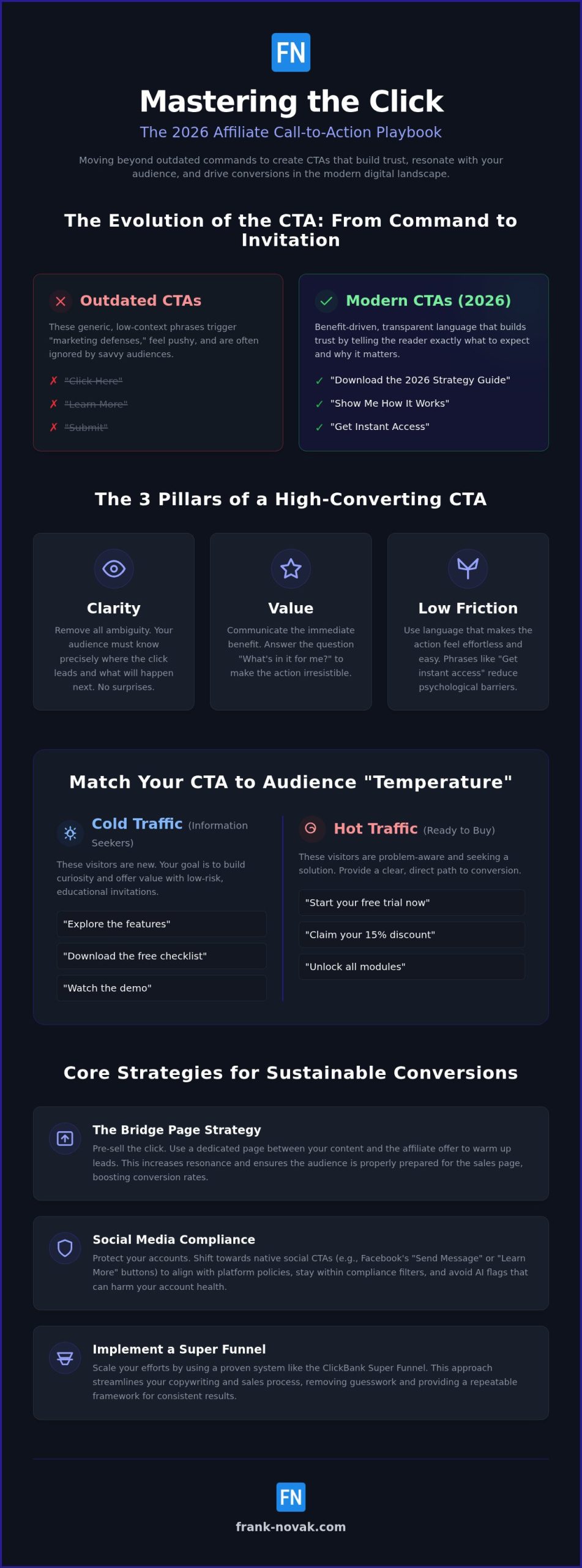
A Call to action (CTA) serves as the emotional bridge between your educational content and the commission you earn. In the 2026 affiliate landscape, your audience is more sophisticated than ever. They can spot a generic pitch from a mile away. If you want to master the art of the click, you have to stop viewing the CTA as a simple command and start seeing it as a helpful invitation. It’s the moment where you resolve the tension you’ve built throughout your content by offering a clear, logical next step.
If you’re still using “Click Here” as your primary anchor text, you’re likely leaving money on the table. By 2026, this phrase has become almost entirely ineffective because it lacks context and transparency. It triggers a “marketing defense” in readers who worry about where a blind link might lead. Modern call to action examples for affiliate marketing focus on descriptive, benefit-driven language. Instead of a vague command, successful affiliates use phrases like “Start your free trial” or “Download the 2026 strategy guide.” These phrases build trust because they tell the reader exactly what will happen after the click.
The “Resonance Factor” is what separates top-tier affiliates from those who struggle. This involves aligning your CTA directly with the specific pain point your reader is feeling in that exact moment. If you’ve just explained how to lower Facebook ad costs, your CTA shouldn’t be a generic “Check out this tool.” It should be “See how this automation saves you 15% on your next campaign.” When the solution mirrors the problem perfectly, the click feels like a relief rather than a transaction.
The Three Pillars of a 2026 CTA
Clarity is your first priority. You must remove all ambiguity about the destination. If a user feels even a slight hesitation about where they are going, they won’t click. Second, you must communicate value. The reader needs to know the immediate benefit of taking action right now. Finally, aim for low friction. Use language that makes the action feel effortless; for example, “Get instant access” feels much lighter and more inviting than “Register for an account.”
Why Your Mindset Dictates Your CTR
Your internal state often bleeds into your copy. If you’re operating from a “lack mindset,” your CTAs often become pushy, desperate, or overly aggressive. This approach usually backfires by triggering the platform’s AI flags or alienating your audience. Developing a strong affiliate marketing success mindset allows you to write with a sense of calm authority. You aren’t just “selling” a product; you are guiding a person toward a solution that you genuinely believe will help them. This shift from salesperson to mentor is what creates the resonance required for high conversion rates in a crowded digital space.
Psychological CTA Examples for Every Stage of the Funnel
Effective marketing relies on meeting your audience exactly where they are in their decision-making process. By applying principles of consumer psychology, you can select the right words to match the “temperature” of your traffic. Cold traffic requires curiosity and education, while hot traffic needs a clear path to the final transaction. If you use a high-pressure sales pitch on someone who is just starting their research, you risk pushing them away before the relationship even begins.
One powerful technique for text links is the Benefit-Driven Anchor. This involves replacing generic phrases with a specific result. Instead of linking the name of a software, you might link a phrase like “automate your social media posts.” This tells the reader what they gain rather than just where they are going. Additionally, you can use “Micro-Copy” to reduce click anxiety. These are small snippets of text placed near a button, such as “No credit card required” or “Takes less than 2 minutes,” which help lower the psychological barrier to taking action.
Low-Friction Examples for Information Seekers
For visitors in the awareness stage, your call to action examples for affiliate marketing should feel helpful and low-risk. In 2026, “Show me how it works” consistently outperforms “Learn more” because it promises a visual or practical demonstration. If you are building an email list, offering a specific resource like “Get the checklist” provides immediate, tangible value. For those promoting software or courses, the “Peek Inside” CTA is highly effective. It leverages natural curiosity, allowing the user to feel they are getting an exclusive look behind the curtain without making a financial commitment.
High-Intent Examples for Ready-to-Buy Audiences
When your audience has reached the bottom of the funnel, they are looking for a reason to act now. “Claim my discount” is a classic example that triggers a sense of reciprocity and the desire to save. You can also shift the focus from the transaction to the transformation by using “Start your journey today.” This positions the product as a vehicle for personal or professional growth. First-person confirmation copy, such as “Yes, I want the results,” is another high-converting strategy. It forces the reader to mentally agree with the statement, making the transition to the checkout page feel like a personal choice they’ve already made.
If you find that your current copy isn’t resonating as expected, you might benefit from a more structured environment for your offers. You can see how these psychological triggers are built into a proven system by exploring the ClickBank Super Funnel, which is designed to handle the heavy lifting of conversion for you.
Optimizing CTAs for Facebook Ads and Social Media Compliance
Facebook’s AI in 2026 is highly sensitive to the intent behind your copy. If your call to action feels like a high-pressure pitch or makes unsubstantiated claims, it often triggers a compliance filter that can lead to ad rejection or account penalties. Finding safe call to action examples for affiliate marketing requires a shift from aggressive selling to helpful discovery. This approach doesn’t just protect your account; it also aligns with how users interact with social feeds. People are there to be entertained or informed, so your CTA should feel like a natural extension of that experience.
One of the most effective ways to build algorithm favor before making an affiliate pitch is through engagement CTAs. Instead of immediately asking for a click, you might ask users to leave a comment or share their thoughts. This activity signals to the platform that your content is valuable, which often results in lower costs when you eventually introduce your link. When you are ready to place your link, following the best practices for Facebook ads for affiliate marketing ensures that your placement feels native and non-disruptive to the user journey.
The ‘Safe’ CTA Framework for 2026
To stay compliant, you should avoid “You” language that speaks directly to a user’s personal attributes or financial status. For example, instead of saying “Are you tired of your job?”, you might say “Explore new ways to build a digital business.” This frames the action as a discovery rather than a direct sales pitch. Transparency is also vital. In accordance with the FTC’s Endorsement Guides, your call to action should be accompanied by clear disclosures so the reader understands the nature of the recommendation. A high-conversion social tactic is using “Comment [Keyword]” to trigger an automated message, which keeps the user on the platform while delivering your offer privately.
Visual CTAs in Social Feeds
Your text CTA needs strong visual support to be effective in a crowded feed. Thumb-stopping imagery acts as a pattern interrupt, pausing the user’s scroll long enough for them to read your message. You might use high-contrast colors or unexpected layouts to make your link stand out. It is also essential to remember that message match is critical for social ad compliance because the content on your landing page must perfectly mirror the promises made in your ad creative. This consistency builds trust with both the platform and your potential customers, leading to more sustainable long-term results.
The Bridge Page Strategy: Pre-Selling the Click
A bridge page acts as an essential buffer between your traffic source and the final affiliate offer. If you send visitors directly to a sales page, you’re often asking for a commitment before you’ve established any rapport. This intermediate step allows you to “warm up” the lead by providing context and building trust. By the time they reach your affiliate link, they aren’t just clicking out of curiosity; they’re clicking because they believe the product is the logical solution to their specific problem. This strategy is a cornerstone of automated marketing funnels that prioritize long-term business growth over quick, unsustainable hacks.
The psychology behind a successful bridge page relies on the “Small Win.” When you give away a helpful tip, a PDF, or a short instructional video, you create a sense of reciprocity. The reader feels they’ve already received value for free, which makes them much more inclined to follow your professional recommendation. Using specific call to action examples for affiliate marketing on this page involves transitioning the user from a state of “learning” to a state of “doing.” It’s about showing them that the product behind the link is the natural next step in their progress.
Structuring the Bridge Page CTA
A proven layout for these pages is the “Headline-Video-Action” structure. The headline immediately addresses the reader’s primary pain point, the video provides the “Small Win” or a demonstration, and the CTA offers the comprehensive solution. You can increase resonance by using conditional CTAs, such as “If you want to automate your lead generation, then click here to see the tool I use.” This phrasing ensures that only highly qualified leads move forward, which actually improves the quality of traffic you send to the vendor. You should also include your affiliate disclosure clearly. When you handle this with transparency, it reinforces your professional authority and builds trust rather than hurting your click-through rate.
Capturing Leads Before the Click
Your bridge page is also the perfect place to secure a lead before they leave your ecosystem. Integrating a lead magnet CTA allows you to build an email list, which is arguably the most valuable asset in your digital business. If you offer a free resource that aligns with the “Online Success” journey, you’re not just getting a one-time click; you’re starting a relationship. This ensures that even if they don’t buy the affiliate product today, you can continue to guide them through your follow-up sequence with helpful advice and steady encouragement. This methodical approach turns a single visit into a repeatable framework for growth.
Get the roadmap to building a sustainable online business
Scaling Conversions with the ClickBank Super Funnel
Scaling your affiliate business requires moving beyond manual adjustments and individual link tweaks. While understanding various call to action examples for affiliate marketing is a vital starting point, the ClickBank Super Funnel offers a comprehensive environment where these elements are already optimized for high performance. Instead of spending your valuable time guessing which button text might work, you can leverage a system designed to handle the complex psychology of the click for you. This “Done-For-You” approach removes the stress of copywriting, providing you with A/B tested assets that have already proven their effectiveness in the 2026 digital landscape.
Professional coaching serves as the “unfair advantage” in this process. Even the most advanced systems benefit from a human touch to troubleshoot low-converting copy or to align your strategy with current market shifts. By working with a mentor, you can identify exactly where your funnel might be losing momentum and apply specific fixes to boost your results. This combination of technical automation and expert guidance is what allows you to move from a hobbyist level to a sustainable, professional operation.
From Manual Links to Automated Engines
When you transition from being a simple “link poster” to a professional digital business owner, you start focusing on the entire “Click Journey” rather than just a single interaction. The ClickBank Super Funnel manages this journey by ensuring that every touchpoint, from the initial social media post to the final bridge page, maintains a consistent and persuasive message. This level of automation is vital for maintaining a healthy EPC (Earnings Per Click). By using consistent, automated follow-ups, you keep your offer in front of your audience without the need for constant manual intervention. It turns your daily efforts into a repeatable engine for growth.
Your Next Step Toward Online Success
Even with a powerful automated system, your unique brand voice remains a critical component of your long-term success. This is where online success coaching helps you refine your messaging and build a deeper connection with your audience. A coach provides the objective perspective needed to identify “dead” CTAs that are no longer resonating. Additionally, being part of a supportive community offers a feedback loop that keeps you updated on what is working right now. It’s about building a foundation of mental resilience and technical excellence that supports your growth for years to come.
Ready to automate your affiliate commissions? Discover the ClickBank Super Funnel today.
Your Roadmap to Sustainable Affiliate Growth
Success in the modern digital landscape requires a shift from aggressive selling to empathetic guidance. By implementing the call to action examples for affiliate marketing discussed in this guide, you can transform your links from ignored text into helpful invitations that resolve your audience’s tension. Whether you’re optimizing for Facebook compliance or building a high-converting bridge page, the focus remains on creating a seamless journey that respects the reader’s intent and builds long-term trust.
If you’re ready to move beyond manual tweaks, you can leverage a system designed for technical excellence and sustainable growth. Through founder-led coaching by Frank Novak and the use of proven high-conversion funnel templates, you gain the tools to master 2026-compliant traffic strategies with confidence. This methodical approach ensures that your business remains resilient even as platform algorithms and regulations continue to evolve. It’s about building a foundation that supports your progress step-by-step.
Join the ClickBank Super Funnel and Start Automating Your Success
You have the potential to build a digital legacy that provides genuine value while creating professional freedom. Stay patient, continue to refine your approach, and trust the steady path toward your goals. Your journey to a more automated and successful affiliate business starts with the very next click you inspire.
Frequently Asked Questions
What is a good click-through rate (CTR) for affiliate marketing in 2026?
A good CTR for affiliate links in the “Make Money Online” niche typically ranges between 1% and 3%, though highly optimized bridge pages can see much higher engagement. If you’re using Meta Partnership Ads, research indicates these can deliver 13% higher click-through rates compared to standard brand ads. Monitoring your own data is essential because your specific audience’s resonance with your brand voice will always dictate your baseline results.
Should I use buttons or text links for my affiliate offers?
You should ideally use a combination of both to cater to different reader behaviors. Text links are excellent for “in-the-moment” curiosity within your content, while buttons provide a clear, high-contrast visual anchor for those scanning the page. If you look at successful call to action examples for affiliate marketing, you’ll see that text links build trust through context, while buttons finalize the decision with a low-friction command.
Does link cloaking negatively affect my CTR?
Link cloaking generally has a positive effect on CTR because it replaces long, intimidating affiliate strings with clean, branded URLs. If a user sees a link that looks like yourdomain.com/recommends/product, they feel more secure than clicking a raw, messy ID string. This transparency reduces click anxiety and reinforces your professional authority, making it a critical practice for building a sustainable digital business in 2026.
How many CTAs should I include in a single blog post?
Aim for three to five CTAs in a standard 2,000-word article to provide enough opportunities without overwhelming the reader. You should place one early for eager visitors, one in the middle to capture those engaged in the content, and a final one at the end. If you include too many, you risk sounding spammy or triggering compliance filters on social platforms that favor high-quality, educational content.
Can I use ‘Buy Now’ as a CTA for high-ticket affiliate products?
“Buy Now” is often too aggressive for high-ticket products where the reader needs more time to build trust. For expensive offers, it’s better to use low-friction phrases like “Watch the free presentation” or “See how it works.” These call to action examples for affiliate marketing move the user to a bridge page or webinar where you can provide the necessary education before asking for a significant financial commitment.
What are the best power words to use in an affiliate CTA?
Power words that emphasize clarity and immediate benefit work best, such as “Instant,” “Proven,” “Free,” and “Simple.” Words that imply discovery, like “Reveal” or “Unlock,” are also highly effective for curiosity-driven hooks. You should choose words that reflect an optimistic entrepreneur’s mindset, focusing on the transformation the reader desires rather than just the mechanics of the transaction itself. This builds confidence and steady encouragement.
How do I track which specific CTA is driving the most sales?
You can track specific CTA performance by using unique Sub-IDs or tracking tags provided by your affiliate network. By assigning a different ID to your sidebar button than your mid-content text link, you can see exactly which placement generates the most revenue. This data allows you to troubleshoot low-converting copy and focus your efforts on the frameworks that resonate most with your specific audience and niche.
Is it better to put my affiliate link at the top or bottom of the page?
While bottom placement is traditional for a final wrap-up, placing a “soft” CTA near the top of your page captures high-intent readers who don’t need to read every word. If you provide a helpful summary or key takeaways box early on, including a link there can significantly boost your overall CTR. Balancing these placements ensures you meet the reader exactly where they are in their decision-making process.

Article by
Frank Novak
Frank Novak is an online marketing professional and coach who focuses on affiliate marketing and business automation. Through his website, frank-novak.com, he shares insights and strategies for leveraging social media platforms like Facebook to generate traffic and commissions.
Affiliate / Sponsored Content Disclaimer
This [website/post] contains affiliate links. If you click through and make a purchase, we may receive a commission at no additional cost to you. We only recommend products or services we believe will add value to our readers.