

What if the headline on your affiliate landing page isn’t the problem at all? You’ve poured real money into traffic, watched the clicks roll in, and still the commissions barely move. It’s easy to assume something is broken, but the harder truth is that without a structured testing process, you’re essentially guessing in the dark about which element is quietly killing your conversions.
If that frustration sounds familiar, you’re not alone. Most affiliate marketers reach a point where they know their funnel needs work but have no clear starting point. Changing the button color feels arbitrary, rewriting the headline feels like a gamble, and the fear of pushing a non-compliant variation to a paid traffic source makes the whole process feel risky before it even begins.
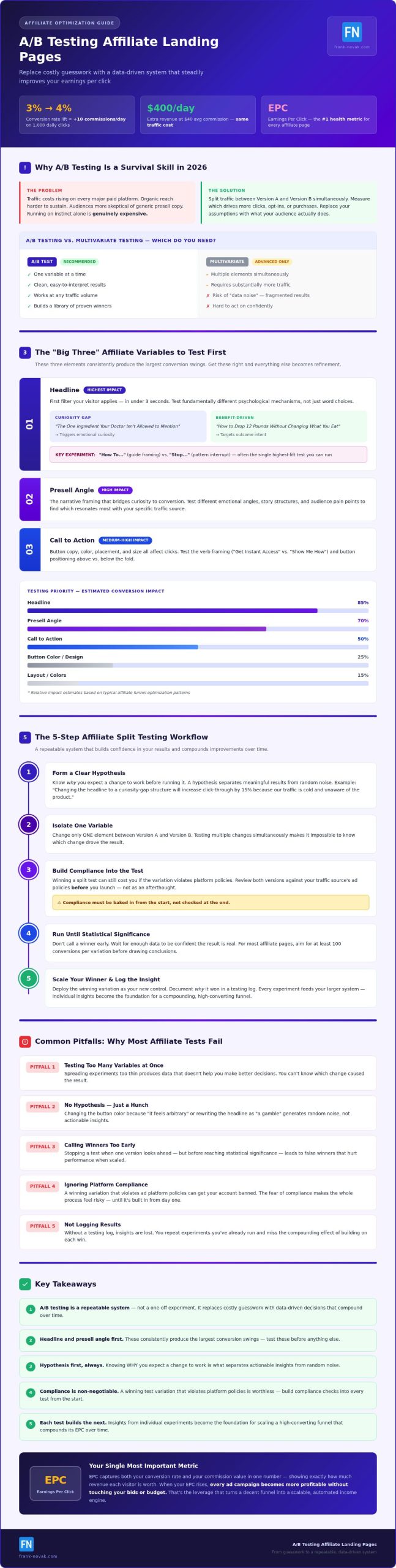
That’s exactly what this guide is designed to solve. A/B testing affiliate landing pages, when done systematically, replaces that guesswork with a repeatable method for finding what actually moves the needle for your specific audience and traffic source. You’ll walk away with a clear roadmap for prioritizing your tests, understanding the psychology behind why visitors convert, and building a funnel that steadily improves its earnings per click over time. Let’s start from the beginning and build this up step by step.
Key Takeaways
- A/B testing affiliate landing pages is a structured, repeatable process that replaces costly guesswork with data-driven decisions, helping you steadily improve your earnings per click over time.
- Not all page elements deserve equal testing priority — your headline and presell angle typically have the highest impact on conversions and should be the first variables you put head-to-head.
- A strong test always starts with a clear hypothesis, not a hunch; knowing why you expect a change to work is what separates meaningful results from random noise.
- Winning a split test can still cost you if the variation violates platform policies, so compliance must be built into your testing workflow from the very beginning — not checked as an afterthought.
- Every test you run feeds a larger system: the insights you gather from individual experiments become the foundation for scaling a high-converting funnel that compounds its results over time.
Why A/B Testing is the “Survival Skill” for Affiliates in 2026
The affiliate landscape has never been more competitive, and the margin between a profitable funnel and a money-losing one has never been thinner. Traffic costs have risen across nearly every major paid platform, organic reach has become harder to sustain, and the audiences affiliates are targeting have grown more skeptical of generic presell copy. In that environment, running a landing page on instinct alone isn’t just inefficient; it’s genuinely expensive.
A/B testing, at its core, is the practice of presenting two versions of a page to your traffic simultaneously, splitting visitors between Version A and Version B, and then measuring which one drives more of the action you care about. In the context of a modern affiliate funnel, that action is almost always a click to the offer, an opt-in, or a qualifying purchase. The test removes your personal assumptions from the equation and lets the audience tell you what works. That shift, from opinion to observation, is what makes it a survival skill rather than just a nice-to-have optimization technique.
A/B Testing vs. Multivariate Testing: Which Do You Need?
If you’re earlier in your optimization journey, the choice between these two approaches matters a great deal. A/B testing compares one variable at a time, which keeps your results clean and easy to interpret. Multivariate testing runs multiple element combinations simultaneously, and while it can surface complex interactions between page components, it requires substantially more traffic to reach statistical significance. For most affiliates, multivariate testing introduces what’s best described as data noise: results that look meaningful but are too fragmented to act on confidently. Start with simple A/B tests, build a library of proven winners, and only consider multivariate approaches once your traffic volume can genuinely support them.
The ROI of Optimization
Here’s where the numbers make the case better than any argument could. Imagine your landing page currently converts at 3% and your average commission is $40. A lift to 4% doesn’t sound dramatic, but on 1,000 daily clicks, that’s ten additional conversions every single day. The traffic cost stays the same; only the output changes. That’s the compounding power that makes A/B testing affiliate landing pages one of the highest-leverage activities in your entire business.
The metric that ties all of this together is Earnings Per Click (EPC), which is the single most honest measure of your affiliate landing page’s health because it captures both your conversion rate and your commission value in one number, showing you exactly how much revenue each visitor is worth before you spend another dollar on traffic.
When your EPC rises, every ad campaign you run becomes more profitable without touching your bids or your budget. That’s the kind of leverage that turns a decent funnel into a scalable, automated income engine over time.
What to Test First: The “Big Three” Affiliate Variables
Not every element on your landing page deserves the same testing attention, and spreading your experiments too thin is one of the fastest ways to collect data that doesn’t actually help you make better decisions. When you’re prioritizing where to start with A/B testing affiliate landing pages, three variables consistently produce the largest conversion swings: your headline, your presell angle, and your call to action. Get these three right, and everything else becomes a refinement rather than a rescue mission.
Crafting the Perfect Affiliate Headline
Your headline is the first filter your visitor applies, and it happens in under three seconds. The most productive headline tests aren’t about wordsmithing; they’re about testing fundamentally different psychological mechanisms. A curiosity-gap headline for a ClickBank health product, something like “The One Ingredient Your Doctor Isn’t Allowed to Mention,” operates on a completely different emotional trigger than a benefit-driven statement like “How to Drop 12 Pounds Without Changing What You Eat.” Both can work, but they attract different levels of intent from the same traffic source.
One of the most revealing experiments you can run is the “How To” versus “Stop” headline structure. “How To Build Passive Income” positions you as a guide; “Stop Wasting Money on Ads That Don’t Convert” positions you as a protector. The framing shifts the reader’s emotional starting point before they’ve read a single word of your body copy. Using an introductory clause before your main promise, such as “If you’ve tried every supplement on the market and still feel exhausted…” also does something subtle but powerful: it pre-qualifies the reader and makes the headline feel personally addressed rather than broadcast to the masses.
The Power of the Presell Angle
This is the variable that most optimization guides overlook entirely, and it’s often the one with the most room to move your numbers. The presell angle is the narrative frame your entire page sits inside, and there are three archetypes worth testing against each other:
- The Discovery: “I stumbled across this method by accident, and it changed everything.” Feels authentic and relatable.
- The Warning: “Before you buy another supplement, read this.” Creates urgency through loss aversion.
- The Secret: “What the industry doesn’t want you to know.” Triggers curiosity and mild rebellion.
Testing a personal story structured around a Hero’s Journey against a clinical, evidence-based review will often produce dramatically different results depending on your traffic source. A personal narrative tends to perform well with cold social media traffic because it mirrors the content format that audience already consumes. A clinical review format tends to resonate more with search traffic, where the visitor is already in research mode and wants validation rather than inspiration.
This is also why your presell angle must align with your broader Facebook ads for affiliate marketing strategy. If your ad creative uses a personal story hook and your landing page opens with a detached, third-person review, the visitor experiences a jarring disconnect that breaks trust before you’ve had a chance to build it. The angle on your page should feel like a natural continuation of the ad, not a change of subject.
Traffic temperature matters here too. Cold traffic arriving from an interest-based Facebook audience needs more emotional context and story before it’s ready to click through to an offer. Warmer traffic, such as retargeted visitors or email list subscribers, is already familiar with the problem you’re solving and responds better to direct, benefit-focused copy that moves quickly toward the CTA. Matching the angle’s depth and pacing to where the visitor is in their awareness journey is one of the most underused levers in affiliate funnel optimization.
The Call to Action: Beyond “Click Here”
Your CTA is the final handoff between your page and the offer, and the language you use shapes the visitor’s expectation of what happens next. Testing urgency-based CTAs like “See Today’s Availability” against value-framing CTAs like “Show Me the Full System” consistently reveals that the winning version depends on the emotional state your presell angle has created. If your page builds tension through a warning angle, urgency language tends to convert better. If your page builds excitement through a discovery angle, value-forward CTAs often win because they feel like a reward rather than a deadline. Run these tests deliberately, not interchangeably.
If you want a structured starting point for building and testing a funnel that accounts for all three of these variables together, the ClickBank Super Funnel framework is worth exploring as a foundation before you begin your first split test.
The 5-Step Affiliate Split Testing Workflow
Most split testing advice skips straight to the tools and misses the process entirely. That’s why so many affiliates run tests for weeks, collect data, and still can’t confidently answer the question: “Did that actually work, and do I know why?” The workflow below is designed to close that gap. Each step builds on the last, so by the time you’re analyzing results, you already know exactly what you’re looking for.
Step 1: Identify the Leaking Bucket
Before you change anything, you need to know where your funnel is losing people. Pull your analytics and look for the drop-off point with the sharpest decline. If 80% of visitors scroll past your headline but fewer than 20% reach your CTA, your headline section is the leak. If traffic reaches the CTA but click-through to the offer is weak, that’s a different problem entirely. Testing the wrong element, even brilliantly, won’t move your numbers. Let the data tell you where to start.
Step 2: Formulate a Strong Hypothesis
This is the step that separates meaningful experiments from random tinkering, and it’s where most competitors’ guides fall flat. “I want more sales” is a goal, not a hypothesis. A proper hypothesis follows a specific structure: “If I change [X], then [Y] will happen because [Z].” That third component, the “because,” is what makes it genuinely useful. It forces you to articulate the reasoning behind the change, which means your results, whether the test wins or loses, teach you something about your audience rather than just your page.
A strong hypothesis must also be falsifiable: if there’s no possible outcome that could prove it wrong, it isn’t a hypothesis at all, it’s a preference dressed up as a prediction.
Setting Up Your First Hypothesis
Here’s a concrete example to make this tangible. Instead of “I think the CTA needs to be better,” write: “Changing the CTA from ‘Buy Now’ to ‘Get Instant Access’ will increase click-through rate by 15% because the original phrasing emphasizes cost while the new version emphasizes the reward.” That’s a testable, specific, falsifiable statement. You can run it, measure it, and learn from it regardless of which version wins.
Step 3: Isolate the Variable
The golden rule of A/B testing affiliate landing pages is this: test one thing at a time. If you change your headline and your CTA simultaneously, you’ll never know which change drove the result. It feels slower, but isolating a single variable is what gives your data its credibility. A result you can explain is worth far more than a lift you can’t replicate.
Step 4: Drive Clean Traffic
Your test is only as reliable as the traffic feeding it. If your traffic source shifts mid-test, whether that means a campaign audience changes, a new ad creative goes live, or your bid strategy adjusts, you’ve introduced a variable you can’t control for. Lock your traffic source before the test begins and don’t change it until the test concludes. Using strategic traffic generation to fuel your experiments also means understanding your minimum sample size before you draw any conclusions. As a general principle, aim for enough conversions on each variation to give you a statistically meaningful read, rather than calling a winner after a handful of clicks.
The danger of “peeking” at results too early is real and underappreciated. When you check results after just two days and pause the losing variation, you’re often acting on noise rather than signal. Early data fluctuates naturally, and stopping a test prematurely based on an early lead is one of the most common ways affiliates end up implementing changes that actually hurt their long-term performance.
Step 5: Analyze and Implement
Once your test reaches statistical significance, typically a 95% confidence level or higher, you have a result you can act on. Document what you tested, what the hypothesis predicted, and what the data showed. Then implement the winner and move to the next variable. That documentation habit is what turns individual experiments into a compounding system, because every test you run makes the next one smarter.
Common Pitfalls: Why Most Affiliate Tests Fail
Running a test and getting a result are two very different things. A surprising number of affiliates go through the full motion of A/B testing affiliate landing pages, collect their data, implement the winner, and then wonder why their results don’t hold up or why their ad account suddenly gets restricted. The problem usually isn’t the testing itself. It’s the invisible traps that sit on either side of the process, and most optimization guides never mention them.
The Compliance Trap
Here’s a scenario that plays out more often than it should: you run a clean test, your aggressive new headline wins by a meaningful margin, you push it live across your paid campaigns, and within a week your Facebook ad account is flagged or your ClickBank account receives a warning. The variation converted better precisely because it made claims that platforms don’t allow. A “winning” page that gets you banned isn’t a win at all; it’s a delayed disaster.
The smarter approach is to establish a compliant baseline first. Before you test anything aggressive, build a version of your page that you’re confident would pass a manual review on any platform you’re running traffic from. That becomes your control. From there, you can test incremental variations that push the angle slightly further, rather than jumping straight to language that risks your account. Think of it as testing in layers: each variation moves one step further from the safe baseline, and you stop the moment a variation starts triggering policy flags.
This also means your compliance check needs to happen before a variation goes live, not after you see the results. Review your copy against the platform’s advertising policies and the network’s terms simultaneously. Facebook’s policies around health claims, income claims, and before-and-after language are specific and regularly updated, so checking once at campaign launch isn’t enough if your test runs for several weeks.
Dealing with failed tests or restricted accounts is genuinely discouraging, and how you respond to those setbacks matters as much as the technical process. Developing the mental resilience to treat a compliance rejection as data rather than defeat is part of what separates affiliates who scale from those who stall. The affiliate marketing success mindset you bring to your testing process shapes how quickly you recover and iterate.
Understanding Statistical Significance
Calling a test early is one of the most expensive habits in affiliate optimization. If Version B gets seven conversions in two days and Version A gets four, that gap feels meaningful. It isn’t. Small sample sizes produce results that fluctuate wildly, and acting on them is essentially the same as flipping a coin and calling it a strategy.
Statistical significance measures how confident you can be that your result reflects a real difference rather than random chance. The standard threshold is 95% confidence, which means there’s only a 5% probability that the result you’re seeing happened by luck. To reach that threshold reliably, you generally need at least 100 conversions per variation, not clicks, but actual goal completions. If your page converts at 3%, that means you need roughly 3,300 visitors per variation before your data is worth acting on.
P-values are the underlying calculation that confidence levels are built from. Without going deep into the math, a p-value below 0.05 is the conventional signal that your result is statistically meaningful. You don’t need to calculate this manually. Tools like Neil Patel’s A/B testing significance calculator or VWO’s built-in reporting handle the math for you. The key habit is simply refusing to call a winner until the tool confirms you’ve crossed the threshold.
Over-Testing and Micro-Conversion Traps
Two other pitfalls quietly drain testing resources without producing useful insights. The first is over-testing low-impact elements. Button color, font size, and background shades are worth refining eventually, but running them as your primary experiments while your headline and presell angle remain untested is like adjusting the trim on a car with a faulty engine. Prioritize elements that affect comprehension and motivation before you touch anything cosmetic.
The second trap is optimizing for micro-conversions, things like scroll depth or time on page, while ignoring whether those behaviors actually connect to final sales. A page that keeps visitors reading longer isn’t necessarily a better page if those same visitors aren’t clicking through to the offer. Always anchor your testing metrics to the action that generates revenue, and treat engagement signals as supporting context rather than the primary measure of success.
Scaling Your Winners with the ClickBank Super Funnel
Running a successful split test is genuinely satisfying, but a single winning variation isn’t the destination. It’s the raw material. The affiliates who build durable, compounding income treat each confirmed winner as an input into a larger system rather than a standalone achievement. That shift in perspective, from optimizing a page to building a business, is where automated marketing funnels become the natural next step after your A/B testing affiliate landing pages process matures.
The mechanism that holds this together is what practitioners call the “Control” page. Once a variation wins and crosses your significance threshold, it becomes the new control: your proven champion that all future challengers must beat. You never abandon it on a hunch or because something new looks appealing. You only replace it when data says so. This discipline is what prevents the common pattern of affiliates who optimize aggressively for a few weeks, then let their funnel drift back toward mediocrity because there’s no structured process keeping the best version in place.
Integrating Winners into the Super Funnel
The ClickBank Super Funnel is built around this exact principle. Rather than asking you to build and test from a blank page, it provides pre-optimized templates that already reflect proven conversion patterns. That matters because one of the quietest costs in affiliate marketing is the time between launching a funnel and reaching a version that actually performs. Starting from tested assets compresses that timeline considerably, letting you focus your testing energy on the variables most specific to your audience and traffic source rather than rediscovering what the industry already knows about page structure and copy flow.
Automation plays a supporting role here that’s easy to underestimate. Once your winning page is in place and traffic is flowing predictably, the funnel handles follow-up sequences, offer routing, and conversion tracking without your daily involvement. Your job becomes reviewing performance data periodically and introducing new challengers, not managing every moving part manually. That’s what transforms a testing habit into a passive income system.
Taking the Next Step in Your Affiliate Journey
There’s a gap that most affiliates hit somewhere between understanding these concepts and executing them consistently under real conditions. Reading about statistical significance is straightforward; knowing when to pause a test on a live paid campaign when your ad spend is climbing is a different kind of pressure entirely. That’s where Online Success Coaching closes the distance between learning and earning.
A mentor who has navigated these decisions before can help you move faster, avoid the compliance pitfalls that derail accounts, and build the kind of systematic approach that doesn’t stall every time a test produces an unexpected result. The goal isn’t to keep studying the process indefinitely. It’s to start running it, improving it, and eventually stepping back from it.
If you’re ready to stop guessing and start building a funnel backed by tested, proven assets, join the ClickBank Super Funnel today and put everything covered in this guide to work inside a system designed to grow with you.
Your Next Conversion Is One Test Away
A/B testing affiliate landing pages isn’t a one-time project you complete and move on from. It’s the ongoing discipline that separates funnels that slowly lose ground from those that steadily compound their results. The process you’ve built through this guide, starting with your highest-impact variables, forming honest hypotheses, respecting statistical thresholds, and keeping compliance at the center of every decision, gives you a repeatable system rather than a series of lucky guesses.
Two things are worth carrying forward above everything else. First, the test that teaches you something is never a failure, even when the challenger loses. Second, a winning variation only matters if it becomes the foundation for the next experiment, not a reason to stop testing.
Frank Novak built the ClickBank Super Funnel around exactly this philosophy: pre-optimized, platform-compliant assets designed for sustainable growth across ClickBank and Facebook, with business automation built in from the start so your funnel keeps working while you keep improving it.
Master your affiliate conversions with the ClickBank Super Funnel
You already have the roadmap. The next step is simply running the first test.
Frequently Asked Questions About A/B Testing Affiliate Landing Pages
How much traffic do I need to run a valid A/B test on my landing page?
The honest answer depends on your current conversion rate. As a practical rule, you need at least 100 conversions per variation, not just clicks, before your data is reliable enough to act on. If your page converts at 2%, that means roughly 5,000 visitors per variation to reach a meaningful sample. Running a test on 200 total clicks and calling a winner is one of the most common and costly mistakes in affiliate optimization.
If your traffic volume is genuinely low, focus on testing your highest-impact element first, typically your headline or presell angle, rather than spreading thin traffic across multiple simultaneous experiments. Concentrated tests on big variables will teach you more, faster, than broad tests that never reach significance.
Can I A/B test my affiliate landing pages for free?
Yes, several tools offer free tiers that are genuinely functional for getting started. Google Optimize was the most widely used free option for years, though it has since been discontinued. Current free alternatives include Hotjar’s basic plan for behavioral data, Nelio A/B Testing for WordPress users, and some page builders like Elementor that include basic split testing in their free or low-cost tiers.
The trade-off with free tools is usually reporting depth and traffic limits. They’ll tell you which version won, but they won’t always give you the granular segmentation data that helps you understand why. For most affiliates just starting out, a free tool is a perfectly reasonable place to begin before investing in a paid platform.
What is the most important element to test first for an affiliate marketer?
Start with your headline. It’s the first decision your visitor makes about whether to keep reading, and it operates before any other element on the page has a chance to influence them. Testing fundamentally different headline mechanisms, curiosity-gap versus benefit-driven, or “How To” versus “Stop” framing, produces larger conversion swings than any cosmetic change you could make elsewhere on the page.
Once you have a proven headline, your presell angle becomes the next highest-leverage test. These two elements together set the emotional context for everything that follows, which means getting them right makes your CTA, your social proof, and your offer presentation all work harder without any additional changes.
How long should I run an A/B test before choosing a winner?
Run your test until you hit statistical significance at 95% confidence, and for at least one full business cycle, typically seven to fourteen days, regardless of how quickly the numbers move. Day-of-week patterns affect visitor behavior in ways that can make early results misleading. A variation that looks like a clear winner on Tuesday might lose ground by the weekend when a different audience segment is browsing.
The practical discipline here is simple: don’t check results daily and don’t make decisions based on early momentum. Set a minimum duration before you start, commit to it, and let your significance calculator confirm the result rather than trusting your instincts about which version “feels” like it’s winning.
Is it better to test a single element or two completely different pages?
Testing a single element is almost always the smarter starting point, because it gives you a result you can actually explain and replicate. When you test two entirely different pages simultaneously, you might find a clear winner, but you won’t know whether the headline, the layout, the angle, or the CTA drove the difference. That ambiguity makes it harder to apply the lesson to your next test.
Whole-page tests, sometimes called split URL tests, do have a place once you’ve already built a library of proven individual winners and want to compare two fully evolved versions of your funnel. At that stage, the test is validating a complete experience rather than isolating a variable, and the context makes the results more interpretable than it would be at the beginning of your optimization process.
Will A/B testing my landing page affect my Facebook Ad Quality Score?
Running a split test itself won’t negatively affect your quality score, but the content of your variations can. Facebook evaluates the destination URL experience as part of its ad relevance diagnostics, so if a test variation contains aggressive claims, poor mobile experience, or content that conflicts with your ad creative, it can pull your quality rating down even while the test is running.
The safest approach is to ensure both your control and your challenger meet Facebook’s advertising policies before either goes live. Testing within a compliant range, rather than using the test as an opportunity to push boundaries, protects your ad account health throughout the experiment. Think of compliance as a constraint that shapes your test design, not something you revisit after the results are in.
What happens if both versions of my test perform poorly?
Two underperforming variations usually signal that the problem sits upstream of the page itself. Check whether your traffic source aligns with the offer, whether your ad creative sets an expectation the page doesn’t fulfill, or whether the offer itself has a weak value proposition for that audience. A/B testing affiliate landing pages can optimize what’s already working, but it can’t rescue a fundamental mismatch between traffic intent and offer relevance.
Treat a double-loss as diagnostic data rather than a failure. It tells you the variable you tested wasn’t the actual leak in your funnel. Go back to your analytics, identify where the drop-off is sharpest, and form a new hypothesis around that specific point. Sometimes the most valuable outcome of a test is learning where not to focus your next experiment.
How do I track conversions if the affiliate offer is on a different domain?
Since you don’t control the merchant’s domain, you can’t place tracking pixels directly on their thank-you page. The practical workaround is to track your click-through to the offer as your primary conversion event, using UTM parameters on your CTA link combined with your page’s analytics platform to measure how many visitors from each variation clicked through. This gives you a clean, comparable metric that reflects your landing page’s performance without needing access to the merchant’s backend.
If the affiliate network supports it, some platforms like ClickBank allow postback URL tracking, which fires a conversion signal back to your tracking tool when a sale is confirmed. Tools like Voluum, RedTrack, or even a properly configured Google Tag Manager setup can receive these postbacks and tie them back to your specific test variations, giving you revenue-level data rather than just click-through rates.

Article by
Frank Novak
Frank Novak is an online marketing professional and coach who focuses on affiliate marketing and business automation. Through his website, frank-novak.com, he shares insights and strategies for leveraging social media platforms like Facebook to generate traffic and commissions.
Affiliate / Sponsored Content Disclaimer
This [website/post] contains affiliate links. If you click through and make a purchase, we may receive a commission at no additional cost to you. We only recommend products or services we believe will add value to our readers.