

A bigger commission doesn’t automatically make an affiliate campaign more profitable. A clear understanding of EPC in affiliate marketing starts with one simple calculation: divide total affiliate commissions by the number of clicks. If a link earns $200 from 50 clicks, its EPC is $4 per click.
EPC gives you a practical way to compare the average earnings generated by different links or campaigns, but it doesn’t tell the whole story. Click-through rates affect how many people reach an offer, while conversions and traffic quality influence how many clicks earn commissions.
If EPC feels confusing or you’re unsure how to use it to guide your next move, you’re not alone. This guide explains what EPC measures, how it relates to clicks and conversions, and why traffic sources can produce different results. You’ll also learn to interpret EPC alongside other performance measures and find practical ways to improve it without relying on this metric alone.
Key Takeaways
- Calculate EPC by dividing affiliate commissions by link clicks, then use it to understand average earnings per click.
- Compare offers and networks using consistent reporting periods, and treat EPC as one measure of performance rather than a complete picture.
- Separate click-through performance from conversions: more clicks don’t necessarily mean more commissions.
- Track traffic sources and placements to see which audiences are more likely to convert, then focus on attracting relevant traffic.
- Judge an EPC in context by weighing it against traffic costs and other measures, such as conversion rate and return on investment.
Why Is Earning Per Click (EPC) Important?
EPC turns affiliate clicks into an average earning, helping you assess what each click generated. Calculate it consistently, because the reporting period and earnings figure determine the result.
EPC Formula and Definition
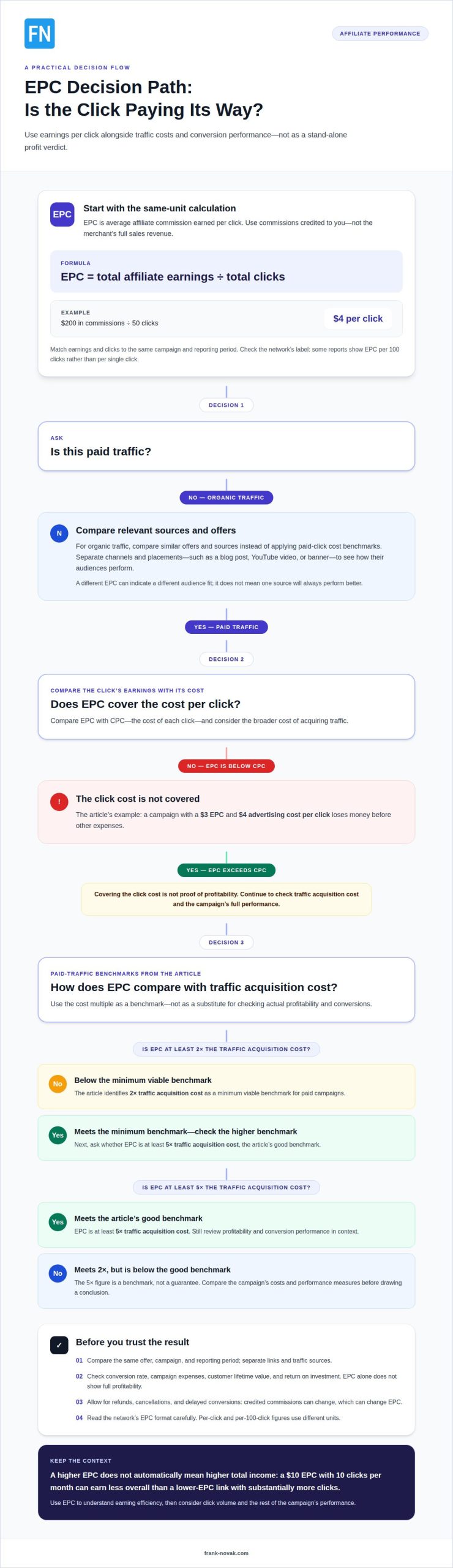
Earnings per click, or EPC, is the average affiliate commission earned per click, calculated as total commissions divided by clicks. This measure helps you evaluate the earning value of a link, rather than focusing only on total revenue or the number of visitors. For example, $1,000 from 100 clicks produces an EPC of $10 per click.
The basic formula is EPC = total affiliate earnings ÷ total clicks. Use commissions credited to you as earnings, rather than the merchant’s full sales revenue. If an offer generates $1,000 in sales but your commission is only part of that amount, using the sales total would overstate your EPC. Match the earnings and click totals to the same campaign and reporting period.
Calculating Earnings from Clicks
To calculate earnings per click, divide the commission total by the number of affiliate-link clicks in the same period. For instance, $500 in commissions across 100 clicks equals $5 per click. This calculation lets you compare links using a shared unit, even when their total traffic or commission earnings differ.
Some network reports express EPC per 100 clicks instead of per single click. Some network reports use a different EPC format, so check the label and calculation method before comparing results. Read the reporting label carefully before comparing it with a per-click result, since the two formats use different units.
Refunds and cancellations can reduce credited commissions, lowering EPC when the reporting total updates. An attribution window determines which clicks may receive credit for a later conversion, so delayed conversions can change the calculation; an example moves from $2 EPC to $4 when delayed conversions are included.
For a useful comparison, calculate EPC separately for each affiliate link and use the same timeframe. Weekly and monthly results may differ because conversions can be credited later. If you compare clicks from one landing page with earnings from another campaign, the result won’t provide a fair performance comparison.
EPC also helps put traffic volume in context. A link with a $10 EPC and 10 clicks per month can produce less total income than a lower-EPC link receiving substantially more clicks. Use the per-click figure to assess earning efficiency, then consider the click count to understand the campaign’s overall contribution.
What Does EPC Mean in Affiliate Marketing?
EPC helps compare affiliate links, offers, networks, and traffic sources by average earnings per click. Understanding EPC in affiliate marketing becomes practical when you compare similar offers over consistent reporting periods and factor in the costs of reaching each audience.
EPC Across Networks and Traffic Sources
EPC across networks and traffic sources compares average earnings from different affiliate links or visitor channels. Use matching timeframes and similar offers to make comparisons useful. For example, organic search traffic with a $4 EPC earns more per click than social media traffic with a $1.50 EPC. That difference can guide where you implement or refine a campaign.
Network dashboards may show an offer’s earning potential, but reports can use different periods or definitions of a click. Compare the same offer across networks where possible, and note whether a figure applies to one affiliate link or an entire program. Campaign EPC can also vary by placement, audience, and traffic source, so a network-wide average may not predict your results.
Separate traffic sources rather than grouping all clicks together. Label links from a blog post, YouTube video, and banner placement individually. If Google search visitors produce a different EPC from social visitors, the contrast may show which audience better matches the offer. It doesn’t mean one source will always perform better.
EPC Compared with CPC and CPA
EPC measures average earnings per click, CPC measures the cost of each click, and CPA measures the cost of an action or acquisition. Comparing these metrics helps show whether paid traffic costs are supported by affiliate earnings. For example, a campaign with a $3 EPC loses money when advertising costs $4 per click, before other expenses.
Earnings per click that exceed cost per click don’t necessarily mean a campaign is profitable. Include campaign expenses and consider conversion rate, customer lifetime value, and return on investment. CPA offers another perspective by relating acquisition costs to completed actions, while EPC averages earnings across all clicks, including those that don’t convert.
There isn’t one good EPC for every offer. Compare it with traffic acquisition cost: a minimum viable benchmark is 2x that cost, while a good benchmark is 5x. These benchmarks can help assess paid campaigns, but they don’t replace reviewing profitability and conversion performance. For organic traffic, compare relevant offers and sources instead of applying paid-click costs.
Offer categories also differ. Typical EPC ranges vary among enterprise SaaS, web hosting, physical products, and digital courses. A higher figure isn’t automatically better if traffic is limited or the audience isn’t a good match. To understand EPC in affiliate marketing, compare similar offers and weigh conversion performance against traffic costs.
Click-through rates and conversion performance
Click-through rate shows how often people select an affiliate link after seeing it. Conversion rate measures how often clicks lead to a desired action, while EPC reflects average affiliate earnings across clicks. A high click-through rate can bring visitors to an offer, but conversions determine whether those visits generate commissions.
For example, an offer may convert 5% of visitors while producing $1 EPC. These figures describe different parts of the process: conversion rate measures actions, and EPC connects clicks with affiliate earnings. Average order value, or AOV, measures the average amount customers spend per order. It can influence commission revenue, but it doesn’t show how many clicks converted.
Review the path from impression to income in stages. If a page attracts attention but few visitors click its affiliate links, placement or relevance may be the issue. If clicks are plentiful but conversions remain low, review the landing page, offer, or audience match. Separate these signals before changing a campaign so you know which part of the journey needs attention.
Use sub-IDs to identify where affiliate clicks originate. Assign distinct labels to links in a blog post, YouTube description, and banner placement, then compare the resulting click and conversion reports. Affiliate networks may offer tools to report clicks, conversions, and earnings. Keep labels consistent so placement comparisons remain clear.
Affiliate link tracking plugins can record outbound clicks on a site and organize them by link or placement. They show whether visitors select a link, while the affiliate network’s report can connect tracked clicks with conversions and commissions. Use one clear naming system and avoid counting the same event twice across tracking tools.
Commission rate and revenue per click aren’t interchangeable. A commission rate describes the share or amount paid for a qualifying sale; EPC averages earnings across clicks. A higher commission rate may still produce a modest EPC if few clicks convert, while a lower rate can earn more per click when conversions are stronger.
Click volume also shapes how you interpret results. Compare a link’s performance across a sample of 100 clicks, then review a larger sample such as 1,000 clicks to spot patterns. Small totals can shift sharply when a conversion is added or removed. Track click counts alongside conversion rate, commission, and EPC rather than treating any single metric as the full picture.
Finally, compare placements using separate tracking labels and consistent reporting periods. If a blog placement and a banner produce different conversion patterns, consider the context in which each audience sees the affiliate link. This makes it easier to refine the page or placement based on observed behavior, rather than simply increasing the number of clicks.
Strategies for improving EPC
Improving EPC means strengthening the path from audience interest to a credited commission. Start with one offer and one traffic source, then identify where potential buyers drop off. If visitors click but don’t convert, review the offer presentation or audience match before increasing promotion.
Prioritize relevant, high-quality traffic instead of pursuing clicks alone. A reader seeking a solution is more likely to consider a closely matched offer than someone who clicked without clear intent. For example, a detailed article about email automation can feature an offer that addresses email workflows. A loosely related promotion may attract attention but fail to generate commissions.
Make each call to action clear and relevant to the surrounding content. Explain what readers will find after clicking, and place the affiliate link near the recommendation it supports. If a comparison page discusses several tools, use descriptive calls to action beside the relevant features instead of sending everyone through one generic link. This gives readers useful context for their choice.
Test one change at a time, such as link placement, button wording, or an offer’s position on a landing page. Track each version consistently, then compare clicks, conversions, and EPC over the same reporting period. If a new call to action earns more clicks but fewer commissions, the added clicks may reflect curiosity rather than stronger buying intent.
Use placement tracking to distinguish results from blog content, email, and social posts. Review each source separately, then focus on placements that bring relevant visitors and credited sales. Device type, geolocation, and seasonality can also affect performance, so a change in EPC may reflect a different audience mix rather than an issue with the offer.
Email promotion needs a measured balance. Keep the proportion of marketing emails containing affiliate links at 30% or less, and make each message useful beyond the promotion. For example, an email can teach a practical technique first, then introduce a related product as an optional resource. This keeps the recommendation connected to the message rather than making every email a sales pitch.
Review EPC trends over time alongside conversion rate and return on investment. A consistent rise can indicate that a campaign change is working, while a dip may point to a shift in traffic quality, offer fit, or seasonal demand. Record what changed, such as a landing-page feature or call-to-action placement, so your next adjustment builds on observed results rather than guesswork.
What is a good EPC for affiliate marketing?
A good EPC depends on the offer, audience, commission structure, and cost of acquiring traffic. A figure that works for an organic campaign may not cover costs in paid advertising. Judge EPC against relevant offers and campaign expenses instead of treating one universal number as a target.
Typical ranges vary by product category. High-value enterprise SaaS products may show EPCs of $5-$50+ per click, while web hosting ranges from $2-$15. Physical e-commerce products may range from $0.50-$3, and digital courses from $1-$10. These figures offer context, not a guarantee that a particular campaign will reach the same result.
Compare like with like. A digital course’s EPC is more useful beside similar course offers than beside enterprise software. Commission structures and audience intent affect the result, too. If one offer reports $4 per click and another reports $2, the first appears stronger, but conversion quality and traffic costs still influence whether it suits your campaign.
For paid traffic, compare EPC with the cost of acquiring each click. A minimum viable benchmark is EPC at 2x traffic acquisition cost; a good benchmark is 5x. For example, if an advertising campaign costs $1 per click, those benchmarks imply EPCs of $2 and $5. This comparison helps account for click expense, but it doesn’t include every campaign cost.
For organic traffic, acquisition costs work differently, so don’t apply paid-click benchmarks without adjustment. Compare relevant pages, placements, and offers over matching periods. A $3 EPC from a focused product review may be more useful than a higher figure from a placement that attracts few clicks or produces little overall income.
Consider how much traffic the EPC reflects, too. A strong result from a limited number of clicks may shift as more visitors arrive, while steady results across a larger audience can offer a clearer signal. Review EPC alongside conversion rate, return on investment, and customer lifetime value, since EPC alone doesn’t capture every aspect of an offer’s value.
Use category ranges as a starting point, then assess your audience and traffic costs. If your EPC falls below acquisition costs, revisit offer fit, placement, and the conversion path. If it exceeds costs, check that the result holds over time before increasing promotion.
Frank Novak
Frank Novak helps aspiring entrepreneurs build their affiliate marketing knowledge through Online Success Coaching and resources such as Never Succeed Online. If you’re working out how EPC fits into your wider strategy, this support can help connect performance metrics with the practical decisions involved in developing an online business.
Turn to these resources for guidance on applying ideas like traffic quality, offer fit, and click tracking to your approach. ClickBank Super Funnel and Clickbank Profit Club also support readers exploring affiliate marketing and online business development.
Build a stronger decision-making habit
Understanding EPC in affiliate marketing is more valuable when it informs your next business decision rather than simply appearing in a report. Use what you’ve learned to choose a focused experiment, define what you want to learn, and give the change enough context to assess it. Keep the process manageable: one thoughtful adjustment can reveal more than several simultaneous changes.
As your affiliate marketing plans develop, revisit the questions behind each campaign: which audience are you serving, what decision are you helping them make, and what would make an offer relevant? These questions can guide future experiments without letting one performance measure dictate every choice. Briefly record the reasoning behind each change so later decisions build on what you learned, not memory alone.
With a clear question and a considered next step, you can keep improving your approach steadily.
Keep learning, stay curious, and let each considered decision move your affiliate marketing forward.
Frequently Asked Questions
How is EPC Calculated?
Divide affiliate earnings by the number of clicks in the same reporting period. Make sure the earnings and clicks refer to the same campaign and timeframe. Comparing different periods can make results harder to interpret because of seasonal buying patterns or conversions credited later.
What are some common EPC pitfalls and how can they be avoided?
Common pitfalls include comparing different reporting periods, mixing traffic sources, and overlooking conversions that arrive later. Sales made offline or through untracked channels may not appear in reported EPC. Seasonality can also shift results as purchasing patterns change. Keep comparisons consistent, review trends over time, and consider conversion rate and return on investment alongside EPC.
What does 3 month EPC mean?
A 3-month EPC is the average earnings per click calculated using earnings and clicks over a three-month period. It gives a longer view than a short reporting window, which can help smooth temporary changes in traffic or buying behavior. For a fair comparison, use the same three-month timeframe for each offer and remember that late-reported conversions can still affect the total.
What does EPC stand for in advertising?
EPC stands for earnings per click. In affiliate marketing, it describes the average affiliate earnings associated with clicks on promotional links. It differs from the advertiser’s revenue because the affiliate’s earnings depend on credited commissions. When evaluating a campaign, interpret EPC alongside its traffic source and costs rather than assuming it represents total sales or profit.
What is 7 day EPC?
7-day EPC describes typical earnings per click over the previous week. It offers a short-term view that can help reveal recent changes in an offer or campaign. Compare it with another seven-day period to see whether performance has shifted.
What is the difference between CPC and EPC?
CPC means cost per click, the amount paid to receive a click, while EPC means earnings per click, the average affiliate earnings associated with clicks. Comparing them helps assess whether click revenue exceeds click expense. For example, a $3 EPC is lower than a $4 CPC, so earnings per click don’t cover that advertising cost, before other campaign expenses.
How is affiliate EPC calculated?
Affiliate EPC is calculated by dividing the commissions credited to an affiliate by the relevant affiliate-link clicks. For example, $500 in commissions from 100 clicks gives an EPC of $5 per click. Use commissions rather than the merchant’s full sales revenue, and keep the click and earning totals aligned to the same offer and reporting period.
How do affiliate networks calculate and report EPC?
Affiliate networks generally calculate EPC from reported earnings and clicks, but their display format can differ. Some reports show average earnings per click; others express earnings per 100 clicks, multiplying the per-click result by 100. Read the unit and reporting timeframe before comparing networks. Network tracking and reporting tools can also show clicks, conversions, and earnings separately.

Article by
Frank Novak
Frank Novak is an online marketing professional and coach who focuses on affiliate marketing and business automation. Through his website, frank-novak.com, he shares insights and strategies for leveraging social media platforms like Facebook to generate traffic and commissions.
Affiliate / Sponsored Content Disclaimer
This [website/post] contains affiliate links. If you click through and make a purchase, we may receive a commission at no additional cost to you. We only recommend products or services we believe will add value to our readers.