

Revenue can look strong while an affiliate campaign leaves little profit behind. Knowing how to calculate affiliate marketing profit margins helps you see what remains after expenses: subtract your costs from affiliate commissions, divide the result by those commissions, then multiply by 100. For example, $10,000 in commissions and $7,000 in expenses produce a 30% profit margin.
It’s easy to focus on revenue or return on ad spend (ROAS), but neither tells you how much money you keep. A campaign can generate more sales and still have a lower margin if traffic, tools, or other costs rise. This guide explains how to calculate affiliate marketing profit margins, identifies the main costs to include, and shows why measuring commissions against profit can reveal more than looking at a revenue-based rate alone.
Key Takeaways
- Include traffic, tools, content, and operating expenses to get a clearer picture of what affiliate activity actually earns.
- Compare ROAS with profit margin: one tracks returns against ad spend, while the other shows what remains after costs.
- Account for commission tiers, VIP rates, bonuses, and referral incentives when estimating the full cost of an affiliate program.
- Separate gross and net margin so you can see how commissions and other variable expenses affect the amount retained.
- Factor refunds and chargebacks into your calculations, since reversed sales can change both commission payouts and campaign profit.
Margin-Based Affiliate Commissions: Why Not Use Revenue?
Revenue-based rates are easy to compare, but they don’t show how much profit remains after costs. A margin-based commission links the payout to the amount left after those costs.
Affiliate networks generally track attributed sales, apply the program’s commission rules to qualifying transactions, and pay commissions under the program’s terms. The calculation depends on whether the agreement bases commissions on sale revenue, profit margin, or specific tiers and incentives.
-
Compare Revenue and Margin Commissions
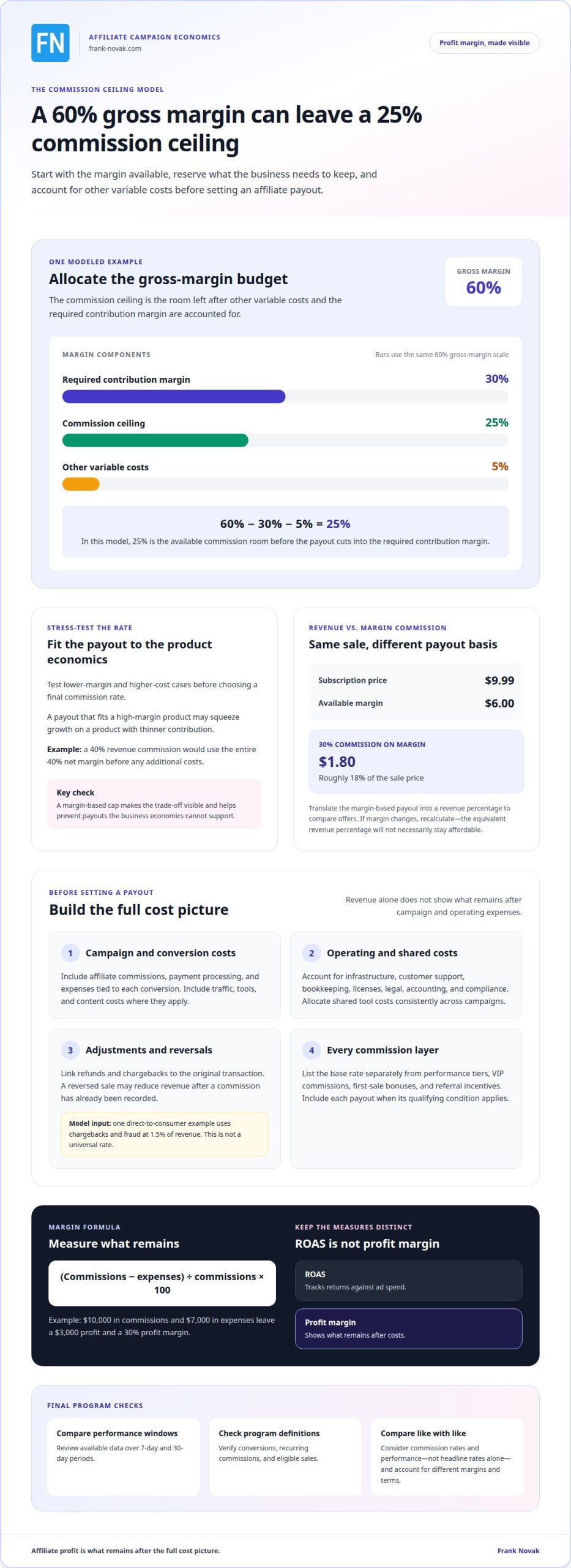
Start by calculating each commission against the same sale and its margin. A revenue-based rate applies to the sale price, while a margin-based rate applies to the profit available after relevant costs. For a $9.99 subscription with a $6.00 margin, a 30% commission on margin is $1.80, roughly 18% of revenue. Compare both payouts before choosing a structure.
-
Compare Commission Rates and Performance
Compare competitor programs using both commission rates and performance statistics, not headline rates alone. Review the available data over 7-day and 30-day periods to see whether earnings hold across different windows. Check how each brand defines conversions, recurring commissions, and eligible sales. Avoid treating another merchant’s rate as a direct benchmark if its product margins or program terms differ.
- Convert the commission into a revenue percentage. Divide the proposed margin-based payout by the sale price, then multiply by 100. For the $1.80 commission on a $9.99 subscription, the equivalent is roughly 18% of revenue. This translation helps merchants compare offers using a familiar commission rate while keeping the payout tied to margin. If margin changes, recalculate the equivalent rather than assuming the revenue percentage stays affordable.
Include every payout layer in your calculation. A standard rate may come with performance tiers, VIP commissions, first-sale bonuses, or referral incentives. List each rule separately and estimate its payout under the conditions that trigger it. For example, model the base commission and a tier increase as separate costs, then add a bonus only when its qualifying action occurs. This reveals the total potential commission expense.
- Stress-test the payout against contribution margin. Begin with gross margin, then subtract other variable costs and the contribution margin the business needs to retain. In one model, a 60% gross margin, a required 30% contribution margin, and 5% in other variable costs leave a 25% commission ceiling. That ceiling represents the modeled room before a commission would cut into the required contribution.
Test lower-margin and higher-cost cases before setting the final rate. A commission that fits a high-margin product may squeeze growth on a product with thinner contribution. A 40% revenue commission, for instance, would use the entire 40% net margin before any additional costs. A margin-based cap makes that trade-off visible and helps brands avoid promising earnings that their economics cannot support.
What Does Affiliate Profit Margin Mean?
Affiliate profit margin shows what remains after the costs of earning commissions or running an affiliate program. Include direct campaign expenses and ongoing business costs to avoid overstating the result.
For break-even cost per click, multiply the commission earned per sale, after other variable costs, by the conversion rate. At a 2% conversion rate, 50 clicks produce one sale, so a $0.50 cost per click means $25 in traffic costs per sale.
For U.S. planning, account for bookkeeping, licenses, legal, accounting, and compliance expenses. Track income-tax payments separately from operating costs so you can distinguish operating margin from cash remaining.
-
Identify Affiliate Program Costs
List fixed and variable costs before calculating an affiliate program’s margin. Fixed costs remain even when sales change, while variable costs rise with transactions or activity. Include affiliate commissions, payment processing, and expenses tied to each conversion. Don’t count only the rewards paid to affiliates.
Then allocate shared costs consistently. If a tool supports several campaigns, divide its expense among them rather than charging the full amount to one campaign. This makes comparisons between commission rates and conversion rates more useful.
-
Include Operating and Startup Costs
Include infrastructure and customer support in the calculation. These expenses reduce the profit available to reward affiliates.
Separate setup spending from ongoing operations.
-
Account for Commissions and Adjustments
Subtract affiliate commissions from the revenue they generate, then account for refunds and chargebacks. Depending on the program’s payout terms, a reversed sale may reduce revenue after a commission has been recorded. Link each adjustment to the original transaction so your calculation reflects retained sales, not just initial conversions.
Include fraud and chargeback allowances in campaign models where applicable. One direct-to-consumer example uses chargebacks and fraud at 1.5% of revenue. Treat this as a model input, not a universal rate; actual results depend on transaction outcomes.
-
Include Business and Tax Expenses
Record bookkeeping, licenses, legal, accounting, and compliance expenses alongside campaign costs. Match the expense period to the revenue period in your margin calculation, such as monthly revenue against monthly allocated expenses.
Separate operating expenses from income-tax payments in your records. That distinction lets you see campaign performance before tax payments, then assess the cash retained afterward. For practical guidance on building an online business, explore these affiliate business resources.
Affiliate ROAS versus profit margin
Paid advertising costs reduce affiliate profit because you pay for traffic out of the commissions earned. Compare campaign revenue with advertising spend, then calculate the percentage retained after all relevant costs.
-
Compare ROAS with Profit Margin
Calculate ROAS by dividing revenue attributed to advertising by advertising spend. Then calculate profit margin using net profit divided by affiliate commission revenue, multiplied by 100. ROAS shows the return generated against ad spend; margin shows the share left after costs. A campaign can hit its ROAS target and still have a narrow margin if commissions or operating costs absorb the remaining earnings.
Use the same reporting period and attribution rules for both measures. For example, don’t compare a 30-day ROAS figure with monthly profit that includes costs from another period. Keep merchant sales distinct from your own affiliate commissions, since those figures represent different income.
-
Account for Paid Advertising Costs
Subtract paid traffic costs before deciding whether a campaign is profitable. If you need more clicks to generate one commission, advertising can take a larger share of your earnings.
Track spend by channel, campaign, and partner, then connect it to attributed commissions. Don’t treat gross commissions as profit while leaving paid ads out of the calculation. Include ad spend for the same reporting period as the revenue it helped generate.
- Compare conversion scenarios. Use the same traffic volume and commission value to understand how conversion rate changes results. For example, 10,000 visitors at a 1% conversion rate and a $40 average commission generate $4,000. At a 3% conversion rate, the same visitor count and commission generate $12,000.
Those figures show commissions before campaign costs, not profit. Apply actual advertising spend and other expenses to each scenario before comparing margins. This separates higher earnings from greater profitability and helps you see whether improved conversion leaves room to grow.
- Set a target using both measures. Choose a ROAS target for monitoring advertising efficiency, then set a profit-margin target that accounts for operating costs. A 30% ROAS figure alone does not show how much a publisher keeps; the underlying commission structure and costs determine retained profit.
Review both measures when changing bids, audiences, or landing pages. If ROAS rises while margin falls, investigate higher traffic costs or less favorable commission economics. If margin improves but conversions decline, consider whether the resulting earnings still support your campaign’s growth goals.
Affiliate profit margin formulas and margin types
- Choose the income figure that matches your role. An affiliate marketer calculates margin using commission earnings, not the merchant’s full sales revenue. Use this formula: (affiliate commissions − affiliate expenses) ÷ affiliate commissions × 100. For example, $10,000 in commissions and $7,000 in expenses produce a 30% profit margin. Keep the reporting period consistent for both figures.
If you promote products through multiple channels, calculate each channel separately before combining results. This shows whether each platform or traffic source generates earnings efficiently, instead of hiding a weak channel within stronger overall results.
- Separate gross profit from net profit. Gross profit per sale subtracts direct acquisition costs from the commission earned. If a sale generates a $40 commission and costs $25 in traffic, gross profit is $15 per sale. Net profit also subtracts operating expenses, such as tools or content costs. Use net profit for a fuller view of what remains after paying campaign expenses.
For an affiliate site, fixed expenses are spread across purchases. A site earning commissions from fewer sales may carry more fixed cost per sale than the same site at a higher sales volume.
- Calculate the margin percentage. Divide profit by the relevant income, then multiply by 100. An affiliate earning $5,000 in monthly commissions and spending $4,500 has $500 left. The calculation is $500 ÷ $5,000 × 100, resulting in a 10% monthly profit margin. This percentage makes comparisons easier across periods with different commission totals.
Keep the denominator clear. For affiliate earnings, use commissions as income; for a merchant’s product margin, use product revenue. Mixing these figures can produce a percentage that accurately describes neither business.
- Compare margin types before changing your plan. Gross margin focuses on direct costs, while net margin includes broader expenses. A generally healthy affiliate profit margin is described as 20% to 50%, but that range is a reference, not a universal target. A newer channel may have different costs from an established one, so compare like periods and cost categories.
Also distinguish commission rate from profit margin. Selling one hundred $10 products at a 10% commission earns $100, as does selling one $1,000 product at a 10% commission. The same earnings can involve different purchase volumes and expenses. A 50% commission on an initial sale may be viable when later customer profits compensate for that payout, but model those future purchases separately instead of counting them as immediate profit.
A DTC ecommerce example calculates a 47.4% net affiliate profit margin on an $80 product. That example reinforces why margin should be assessed after relevant costs: commission rate alone cannot show how much of the income remains as profit.
How do affiliate commissions, refunds, and chargebacks affect profit?
Affiliate marketing is performance-based: businesses pay commissions on actual sales. Refunds and chargebacks can reduce retained revenue, so include their effect when assessing a campaign’s profit.
- Record commission expense against each attributed sale. This payout reduces the amount available to cover product costs and contribute to profit. Track commissions by transaction and reporting period so you don’t count the same sale twice.
For affiliates, commission is earnings rather than a cost of acquiring the sale. A $20 book purchase at a 4.5% commission generates $0.90 in affiliate earnings. The merchant and affiliate therefore calculate profit from different revenue bases.
- Apply refunds to the sale that generated the commission. A refund can reverse revenue after an affiliate refers a customer. Whether the related commission is reversed or adjusted depends on the program’s payout terms. Keep refunded transactions identifiable in your records instead of treating every initially reported conversion as a completed sale.
For example, compare the commission ledger with retained sales for the same period. If a report shows 100 conversions but some orders were refunded, calculate earnings from the transactions that remain eligible under the program’s rules. This prevents temporary sales volume from making the final margin appear stronger.
- Track chargebacks and fraud separately from refunds. They can also reduce retained revenue, but recording them as a distinct adjustment helps reveal their effect. A direct-to-consumer model uses chargebacks and fraud at 1.5% of revenue. Treat that as an example input, then use the campaign’s actual transaction outcomes when calculating its margin.
This arithmetic shows why recording the commission alone can overstate the merchant’s remaining profit.
- Model payout timing and customer value separately. A SaaS example uses a 30% commission on first-year revenue, while an analysis of more than 2,600 SaaS affiliate programs reports a typical rate around 30%. For recurring payments, calculate commissions against revenue actually earned during the modeled period.
A 50% initial-sale commission may still work if later customer profits compensate for the payout. Keep those later purchases as a separate scenario, not guaranteed current-period earnings. Comparing retained revenue, adjustments, and affiliate payouts gives a more useful view of actual profit.
For SaaS comparisons, the page reports an average commission rate of 22.5%; app store commissions on a subscription are listed as 15 to 30.
Frank Novak: Clickbank Profit Club
Clickbank Profit Club can help you apply these margin principles to your affiliate marketing plans. Use the calculations in this guide to clarify your costs, commissions, and earnings, then consider whether structured support could help you develop your online business. Frank Novak also offers Online Success Coaching for people working toward their digital business goals.
If you’re ready to discuss your next step, contact Frank Novak.
Make your next affiliate decision with margin in mind
As you plan your next campaign, make margin part of your decision-making, not just a figure you calculate after a sale. Knowing how to calculate affiliate marketing profit margins can help you assess whether a new channel, offer, or commission structure fits your business goals. Apply that thinking to a real campaign and refine your approach as you learn from the results.
Frank Novak offers Online Success Coaching, ClickBank Super Funnel, and Never Succeed Online. These provide different paths for people developing an online business, whether you’re looking for guidance or exploring affiliate marketing resources.
Build your skills one thoughtful decision at a time. A clearer view of your margins can help you move forward with purpose.
Frequently Asked Questions
How do you calculate affiliate marketing profit margin?
To calculate affiliate marketing profit margins, subtract eligible expenses from affiliate commissions, divide the result by commissions, then multiply by 100. Use commission income you actually earned for the period, rather than the merchant’s total sales. Keep the calculation period consistent, and account for refunded or reversed transactions where they affect your earnings. This gives you a margin that reflects retained affiliate income after costs.
What is the formula for affiliate marketing net profit?
Affiliate net profit equals total affiliate commissions earned minus total affiliate business expenses for the same period. Include advertising, software, content, and other costs attributable to earning those commissions. Then adjust for refunds or chargebacks that affect retained earnings. If you use a platform report, reconcile its commission figures with your payment records so pending, reversed, or unpaid amounts don’t distort the result.
Which costs should affiliate marketers include when calculating profit margins?
Include costs directly linked to earning commissions, such as paid traffic, content creation, affiliate tools, hosting, and payment processing. Add a reasonable share of shared business expenses, including bookkeeping or customer support, when they support your affiliate activity. Separate fixed costs from those that rise with clicks or sales. Allocate shared expenses consistently across campaigns and avoid counting the same expense more than once.
How do you calculate affiliate marketing return on investment (ROI) and return on ad spend (ROAS)?
Calculate ROI as net profit divided by total investment costs, multiplied by 100. Calculate affiliate ROAS by dividing commissions attributed to advertising by the ad spend for that campaign. ROI includes the broader costs included in net profit, while ROAS isolates advertising efficiency. Compare both over the same period and attribution window; strong ROAS alone doesn’t show whether other campaign expenses leave a positive return.

Article by
Frank Novak
Frank Novak is an online marketing professional and coach who focuses on affiliate marketing and business automation. Through his website, frank-novak.com, he shares insights and strategies for leveraging social media platforms like Facebook to generate traffic and commissions.
Affiliate / Sponsored Content Disclaimer
This [website/post] contains affiliate links. If you click through and make a purchase, we may receive a commission at no additional cost to you. We only recommend products or services we believe will add value to our readers.