

A sales funnel rarely fails at every stage at once. Troubleshooting a failing sales funnel starts with finding where qualified prospects stop moving forward, then identifying what is causing the drop-off. Review conversions between stages and time spent in each stage, then compare lost-deal reasons with lead qualification and follow-up.
If leads enter the funnel but don’t progress, the issue may be poor fit, unclear next steps, or a gap between what buyers need and what your sales content explains. If opportunities stall near a decision, look for unresolved concerns, missing stakeholder agreement, or value that hasn’t been made clear. The pattern matters more than a single overall conversion figure.
This guide shows you how to qualify leads and use funnel analytics and lost-deal reasons to pinpoint friction, then help buyers move forward with relevant next steps. You’ll also learn how to assess each funnel stage, so you can address the problem where it occurs instead of changing the whole process at once.
Key Takeaways
- Define lead qualification around genuine need and fit so sales effort goes toward prospects who can benefit from the offer.
- Compare conversion rates and time in each stage to find where prospects drop off, then investigate that specific point in the process.
- Use the AIDA stages to match sales messages to what buyers need next, and avoid asking for a major commitment before they’re ready.
- Make each call to action clear and relevant to the buyer’s next step, whether that means learning more or discussing a decision.
- Group lost-deal reasons into patterns to uncover recurring friction, then adjust the sales conversation or supporting content accordingly.
1. Pre-qualifying leads
Pre-qualification helps sales teams focus on prospects with a real need who may benefit from the offer. Start by defining your target audience, then compare each lead’s situation with that profile. Market research can clarify the problems, goals, preferences, and previous solutions that matter to potential buyers. These details give marketing and sales a shared basis for prioritizing leads and improving pipeline quality.
Next, establish clear criteria for moving a prospect forward. A sales-qualified lead (SQL) typically emerges from an initial conversation that confirms a genuine need and secures a further discussion. A sales-accepted lead (SAL) has met the organization’s qualification criteria and been accepted by sales to begin the selection process. Keeping these stages distinct helps reveal whether leads are poorly matched, insufficiently qualified, or not being accepted by sales.
Use discovery conversations to test fit instead of assuming it. Set an agenda, ask permission to explore the prospect’s goals, and listen for the problem they want solved. For example, a prospect who requests information but can’t describe a relevant need may need education before sales invests in a detailed opportunity. A prospect who explains the problem and agrees to follow up has shown a stronger buying signal.
Critical events can sharpen your assessment. A change in priorities, a request for a demonstration, or a newly stated decision timeline may indicate that a prospect is ready for a specific next step. Record the event and the buyer’s reason for it, then tailor your follow-up. If timing is uncertain or the need is still developing, useful educational content can keep the relationship active without treating interest as a qualified opportunity.
Qualification should also protect sales capacity. Poor-fit leads can divert attention from prospects with clearer needs, while an empty middle of the funnel may point to weak qualification or missing commitments. In one funnel example, 10% of marketing-qualified leads progressed before intervention, and SQLs later increased sixfold. The practical lesson is to examine how qualification criteria affect progression, not simply to add more leads.
Qualification timing depends on the sales process. In a high-velocity environment, a representative may qualify an SQL and accept it as an SAL in one call. In another organization, the transition can take two engagements, making a scheduled second meeting part of the qualification process. A clear funnel structure can help connect those criteria to the next buyer step without rushing prospects who still need information.
2. Using data and analytics to identify conversion problems
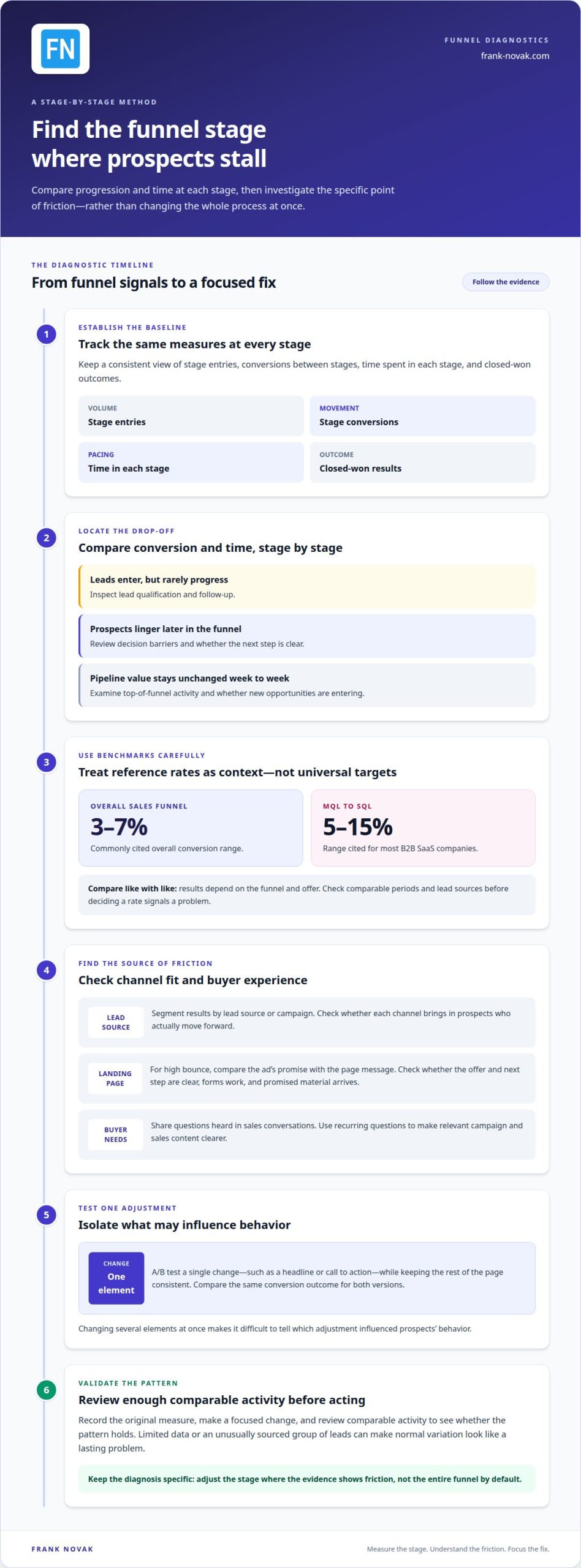
Diagnose prospect loss by comparing conversion rates between funnel stages, then reviewing time in each stage. If leads enter but rarely progress, inspect qualification and follow-up. If prospects linger later, review decision barriers and next steps. This stage-by-stage view shows where to investigate instead of changing the entire process.
Track a consistent set of measures: stage entries, conversions between stages, time in each stage, and closed-won outcomes. Segment results by lead source or campaign to see whether a marketing channel attracts prospects who actually move forward. If pipeline value stays unchanged from week to week, examine top-of-funnel activity and whether new opportunities are entering.
Conversion expectations depend on the funnel and offer. A commonly cited overall sales funnel conversion range is 3-7%, while MQL-to-SQL conversion for most B2B SaaS companies falls within 5-15%. Treat these as reference points, not targets for every business. Compare like-for-like periods and lead sources before deciding whether a rate signals a problem.
High landing-page bounce rates can result from a mismatch between an ad’s promise and the page’s message, a confusing offer, or an unclear next step. Compare the page headline with the campaign that brought visitors there, then make the intended action easy to find. Check that forms submit correctly and that promised material arrives after signup.
Use A/B testing to isolate one change, such as a headline or call to action, while keeping the rest of the page consistent. Compare the same conversion outcome for both versions, then use the result to guide your next test. Changing several elements at once makes it difficult to tell which adjustment influenced prospects’ behavior.
Sales and marketing teams can align by sharing the questions sales hears in conversations. Marketing can use those questions to create content for specific funnel stages, while sales reports which messages help prospects move forward. For example, if buyers repeatedly ask how an offer addresses a particular need, make that answer clearer in relevant campaign and sales materials.
Changing a funnel with limited data risks treating normal variation as a lasting problem. A redesign based on a small or unusually sourced group of leads may weaken a page that performs well for other prospects. Record the original measure, change one element, and review enough comparable activity to see whether the pattern holds.
For a steadier process, connect the measurements to a clear funnel plan rather than reacting to isolated results. A structured approach to online sales can help keep the offer, marketing message, and buyer’s next step aligned.
3. Sales funnel stages and the AIDA framework
A sales funnel maps a buyer’s journey from first interaction to purchase or a closed-lost outcome. The AIDA framework describes four stages: Attention, Interest, Desire, and Action. Each stage reflects a different buyer need, so the sales team can adapt its message instead of using the same approach throughout. For example, someone noticing an offer may need a clear explanation before considering whether it fits.
At Attention, help the right prospects recognize a relevant problem or goal. Interest begins when they engage with useful information, such as an explainer or product details. During Desire, connect the offer to the buyer’s priorities and address comments or concerns. Action is the next agreed step, which might be a purchase or a defined decision conversation. These stages describe progress, not just page views or email opens.
To optimize one stage at a time, first identify where movement slows. Then review the message, content, and commitment at that point. If prospects reach Interest but don’t continue, check whether the material answers questions raised by the first interaction. If buyers show Desire but avoid Action, examine whether the value is clear and the next step feels relevant. Change the specific stage element, then monitor the transition to the next stage.
Skipping a stage can leave an opportunity stalled. For example, asking a new prospect to make a buying decision before exploring their needs may leave important concerns unanswered. A product demonstration that jumps straight into features can also miss the buyer’s reason for attending. Establish what the prospect already understands, then secure an appropriate commitment before advancing, such as an agreed follow-up discussion.
Middle-funnel progress often depends on building consensus. If one contact sees value but other stakeholders have unanswered questions, the opportunity may remain stuck. Share information that helps the buyer explain the decision internally, and clarify who needs to participate in the next discussion. Comments from different stakeholders can reveal whether the barrier is unclear value, unresolved risk, or disagreement about priorities.
Use stage definitions consistently so everyone interprets progress the same way. For example, define what counts as Interest, what evidence signals Desire, and which buyer action qualifies as Action. Then compare movement between those stages instead of treating every interaction as progress. If the sales process repeatedly stalls after a demo, review the commitment secured during that meeting before changing the entire funnel.
4. Calls to action that guide buyers through the funnel
A useful call to action gives prospects one clear next step. Match it to the buyer’s current stage: an early-stage reader might explore an explainer, while a ready prospect may request a conversation. If one page asks everyone to subscribe, book a call, and buy, competing choices can make progress harder.
Choose metrics that show whether the requested action leads to meaningful movement. Track clicks on a specific call to action, completed forms, booked meetings, and progression to the next funnel stage. Pair each measure with its intended outcome. A high click rate but few completed forms, for example, suggests friction after the initial action rather than a lack of interest.
If email open and click-through rates are low, first review the subject line, audience segment, and promised content. Then make the message and its call to action consistent, and check that the link leads to the expected page.
Strengthen calls to action with direct wording that names the action and its value. “Watch the product demonstration” sets a clearer expectation than “Learn more.” Keep the surrounding copy focused on one outcome, and make the button stand out from secondary links. Prospects should understand what happens after clicking without having to guess.
Reduce cart abandonment by removing unnecessary checkout steps and making the purchase process easy to follow. Check each stage for confusing fields, unclear costs, or errors that prevent completion, then make the next action visible.
Set expectations around follow-up before asking for a commitment. If a prospect watches a demonstration, offer a relevant next step, such as discussing how the offer fits their goals. A short educational follow-up can also help buyers explore information at their convenience. The action should feel relevant and useful enough to move the opportunity forward.
Use calls to action consistently across email, landing pages, and sales conversations. If an email promises a guide, its link should lead to that guide, not an unrelated sales page. Everyone involved in marketing and sales should use the same next-step language, so prospects don’t receive conflicting requests across channels.
Review performance by action and funnel stage, not clicks alone. If a call to action earns engagement but few buyers progress, examine what happens after the click. If prospects complete the action but stall afterward, clarify the next commitment and who is responsible for it. This helps identify wasted effort without changing effective parts of the funnel.
5. Using lost reasons to identify funnel problems
A closed-lost label is useful only when it explains why the opportunity ended. Replace broad entries such as “no decision” or “other” with a specific reason, such as an unresolved need, a timing change, unclear value, or a missing stakeholder. During discovery, ask what changed, which concern remained, and what would have helped the buyer decide. Record the buyer’s explanation, not an assumption.
Review lost reasons by funnel stage and lead source to locate repeated patterns. If prospects from one campaign frequently report a mismatch between the promise and the offer, the issue may begin before sales contact. If qualified opportunities repeatedly stall after a demonstration, inspect the demo and its agreed next step. Pipeline value that stays unchanged from week to week can also point to a top-of-funnel problem.
Make lost-reason categories clear enough for everyone to use consistently. For example, separate “no budget” from “value not established,” since each calls for a different response. The first may reflect a timing or resource constraint; the second may mean the sales conversation did not connect the offer to the buyer’s priorities. A short note alongside the category can capture context without turning the CRM into a transcript.
Look for the biggest recurring cause, then test a focused response. If prospects say they didn’t understand how the offer solves their problem, revise the explanation used in discovery or sales materials. If they say another stakeholder was involved in the decision, include that person’s questions in the next conversation. This step-by-step review helps distinguish a messaging issue from a process gap.
Demonstrations should show how the offer addresses the prospect’s stated problem, not tour unrelated features. Begin with a discovery recap: confirm the goal, summarize the difficulty, and ask whether anything has changed. Then demonstrate only the parts tied to that need. For example, if a prospect is evaluating a specific workflow, show the relevant process and explain how it supports the desired outcome.
After the demonstration, ask what remains unclear and agree on a concrete next step. A prospect who needs internal agreement may benefit from follow-up that addresses stakeholder concerns; a prospect who sees no fit should be recorded accurately as lost. Sharing recurring buyer questions with marketing helps shape useful content for the right funnel stage, rather than sending every prospect the same material.
Use a structured approach to improving your sales funnel
Frank Novak: ClickBank Super Funnel
ClickBank Super Funnel is a relevant next step if you want to put a more deliberate funnel approach into practice. After reviewing lead qualification, stage movement, calls to action, and lost reasons, use those insights to clarify what buyers need at each point in the journey. It’s most useful when you’re ready to shape your online sales process around a clear offer and a guided path from prospect interest to action.
If you’re still working through the fundamentals, Online Success Coaching or Never Succeed Online may fit your next step. Choose based on whether you’re ready to apply a funnel approach or need support building your understanding first.
Make your next funnel improvement deliberate
Treat each funnel adjustment as a learning opportunity. Choose a change that responds to what buyers are showing you, document why it matters, and give the team a shared understanding of what success should look like. This turns day-to-day selling into a more deliberate process, where each decision helps create a clearer buyer experience.
As you continue troubleshooting a failing sales funnel, focus on progress buyers can recognize. A smoother path isn’t built by changing everything at once; it grows from considered choices that make the next step easier to understand and take. Let buyer responses guide what you refine next.
If you’d like support deciding how to move forward, start a conversation with Frank Novak.
Keep learning from each interaction. A clearer process begins with one considered step.
Frequently Asked Questions
So how do you create a funnel that works?
Build the funnel around one clear outcome for a defined audience, then make each step support that outcome. For example, an educational offer might guide a prospect from a relevant article to a focused signup page, then to information that helps them decide. Map the handoffs between marketing and sales, and make sure each page or message gives buyers a useful reason to continue.
What are the key sales funnel conversion rates and benchmarks by industry?
Benchmarks vary by business model, offer, and funnel definition, so compare your results with similar stages and audiences. A commonly cited overall funnel conversion range is 3-7%, while MQL-to-SQL conversion for most B2B SaaS companies is commonly reported at 5-15%. These figures are reference points, not targets for every industry. Your own historical rates can show whether performance is changing under comparable conditions.
How do you calculate conversion rates at each sales funnel stage?
For each transition, divide the number of prospects who reached the next stage by the number who entered the earlier stage, then express the result as a percentage. For example, measure form submissions against landing-page visitors, or sales-qualified leads against marketing-qualified leads. Keep the reporting period and lead population consistent, and define stage entry clearly so duplicate records or changing criteria don’t distort comparisons.
How can you identify and fix low-quality leads in a sales funnel?
Look for patterns in leads that fail to progress, such as a source that repeatedly attracts people outside your intended audience or contacts without a relevant need. Compare those records with closed-won customers, then refine audience targeting and campaign expectations. Add clear disqualification reasons and share sales feedback with marketing, so future content and campaigns attract prospects who better match the offer.
Which analytics tools and reports help troubleshoot a failing sales funnel?
A CRM report tracking stage entry, progression, time in stage, and closed outcomes can reveal where opportunities slow down. Add lead-source and campaign breakdowns to distinguish acquisition issues from later-stage friction. Landing-page and email reports can show whether prospects engage with key actions, while lost-reason summaries add context for stalled deals. Use consistent stage definitions across reports to connect activity with pipeline outcomes.

Article by
Frank Novak
Frank Novak is an online marketing professional and coach who focuses on affiliate marketing and business automation. Through his website, frank-novak.com, he shares insights and strategies for leveraging social media platforms like Facebook to generate traffic and commissions.
Affiliate / Sponsored Content Disclaimer
This [website/post] contains affiliate links. If you click through and make a purchase, we may receive a commission at no additional cost to you. We only recommend products or services we believe will add value to our readers.