
The quickest way to earn a commission, sending traffic directly to an offer, might actually be the most expensive mistake you make this year. When you see clicks climbing but your bank balance staying the same, it’s natural to wonder: are affiliate marketing funnels worth it? It’s easy to feel overwhelmed by the technical setup and the pressure to buy every new tool on the market, especially when you’re just trying to make your first consistent sales.
If you’ve ever felt the frustration of watching your ad budget disappear without a single conversion, you aren’t alone. We’re here to help you discover whether building a sales funnel is a profitable investment for your affiliate business or just an unnecessary expense in 2026. This guide provides a clear look at the ROI these systems offer and a simpler way to automate your commissions. We’ll walk through the mechanics of how these assets work so you can finally feel confident that your marketing investment will pay off. By understanding the logic behind the funnel, you can stop guessing and start building a sustainable asset that works for you around the clock.
Key Takeaways
- Learn why sending traffic straight to a sales page often doesn’t work and how a multi-step journey helps protect your accounts.
- Understand how a simple bridge page builds the necessary trust to warm up cold traffic before they see your main offer.
- Examine the real math behind lead acquisition to help you decide if are affiliate marketing funnels worth it for your current business stage.
- Identify which high-competition niches require a funnel and which low-cost products you can still promote without one.
- Discover how to shift from chasing one-off sales to building an automated system that captures leads for future commissions.
The Great Debate: Direct Linking vs. Affiliate Marketing Funnels
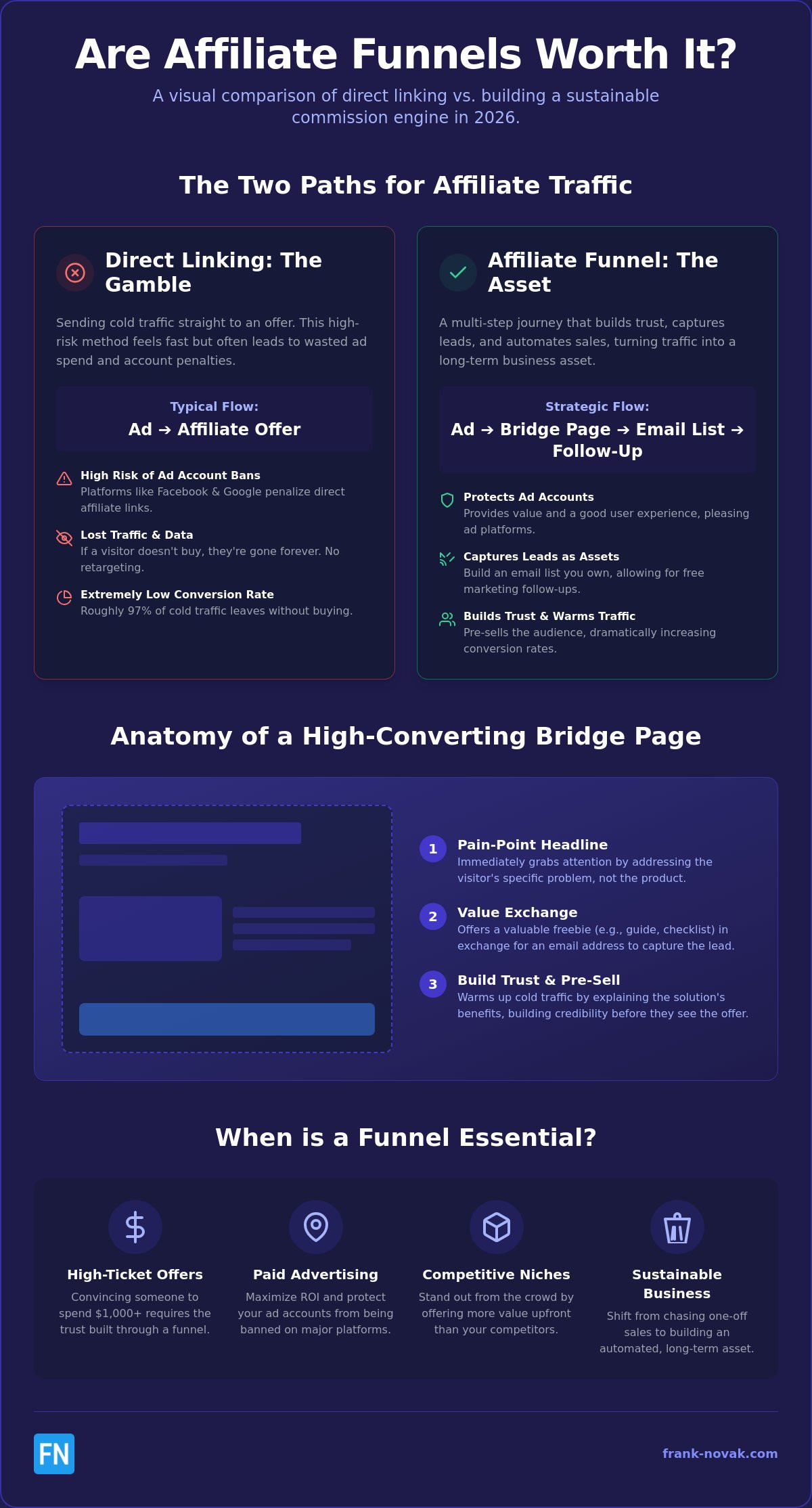
Many newcomers to Affiliate marketing start with a simple goal: send traffic to a link and get paid. This method, known as direct linking, involves taking a prospect straight from an ad or social post to the vendor’s sales page. While this sounds efficient, the reality in 2026 is often much harsher. When you ask yourself, are affiliate marketing funnels worth it, you’re really asking if you want a one-off transaction or a sustainable business. A funnel is a multi-step journey that guides a stranger through awareness and interest before they ever see a “buy” button.
To better understand how these systems compare in the real world, watch this honest breakdown:
If you rely solely on direct linking, you’re essentially gambling with your traffic. Major ad platforms like Facebook and Google have become increasingly strict about where they send their users. They often penalize or outright ban accounts that link directly to affiliate offers, viewing them as low-quality or “bridge” page violations. Beyond the risk of losing your ad account, the ROI is usually disappointing. Cold traffic rarely buys on the first click. Most people need several touchpoints with a brand before they feel comfortable opening their wallets.
Why Direct Linking is Becoming Obsolete
Ad platform algorithms now prioritize user experience above all else. If you send a user to a generic sales page they’ve seen a thousand times, the platform sees it as a poor experience. Additionally, direct linking means you lose your data the moment the click happens. If the visitor doesn’t buy right then, they’re gone forever. You can’t retarget them, you can’t follow up, and you’ve essentially paid for a “no” with no way to turn it into a “maybe” later.
The Core Purpose of a Sales Funnel
A well-designed funnel, like the ones discussed in our ClickBank Super Funnel training, serves a much higher purpose than just showing an offer. Its primary job is to capture a lead. By offering a small piece of value in exchange for an email address, you own that relationship. This allows you to market to that person for free via email, rather than paying for every single visit. It also allows you to pre-sell the audience. You can address their specific pain points and build trust, so when they finally arrive at the vendor’s page, they’re already convinced they need the solution. Automation is the final piece of the puzzle. Once your funnel is set up, it handles the follow-up process 24/7, allowing you to focus on growth rather than manual tasks. When evaluating whether are affiliate marketing funnels worth it, consider the difference between chasing a single sale and building a long-term asset.
Why High-Converting Funnels Outperform Direct Offers in 2026
While direct linking might feel like a faster route to a commission, it often leaves a significant amount of money on the table because it ignores the psychology of the modern buyer. In 2026, consumers are more skeptical than ever; they rarely purchase a product the very first time they see it. If you are questioning whether are affiliate marketing funnels worth it, consider that roughly 97% of people leave a sales page without buying. A funnel allows you to capture those visitors before they disappear, turning a one-time click into a long-term relationship.
Funnels also provide the necessary space to promote high-ticket offers. It is very difficult to convince someone to spend $1,000 or more on a single click from a social media ad. However, if you guide them through a structured journey that provides value and education first, that high price point becomes much easier to justify. This transition is where the most successful affiliates separate themselves from those who are just “chasing clicks.”
The Anatomy of a High-Converting Bridge Page
The bridge page is the psychological transition between curiosity and commitment. Its primary job is to take a stranger from an ad and “warm them up” before they reach the vendor’s sales page. To do this effectively, your headline must address the visitor’s specific pain point immediately. Instead of just talking about the product, talk about the solution they’ve been looking for. This value-first approach gives the reader a small win or a new insight before you ever ask them to click your affiliate link. Building this trust also involves transparency. Following the FTC’s Endorsement Guides by clearly disclosing your affiliate relationship actually helps build credibility rather than hurting it, as modern audiences appreciate honesty.
The Fortune is in the Follow-Up
Most affiliate commissions don’t happen on the first day. Industry data suggests that the majority of conversions occur between the 4th and 7th email in a sequence. When you own the lead, you can automate this entire process. You set up your email sequence once, and it continues to provide value and offer solutions to your subscribers 24/7. This automation is the ultimate safety net; it ensures that even if you stop running ads for a few days, your business continues to generate revenue. If you want to master these psychological triggers and build a system that lasts, seeking out online success coaching can provide the roadmap you need to scale. By shifting your focus from making a sale to building an automated engine, you’ll quickly see why are affiliate marketing funnels worth it for anyone serious about long-term growth.
Calculating the Real ROI: Tools, Time, and Long-Term Value
When you look at the monthly subscription fees for page builders and email software, it’s easy to hesitate. This financial hurdle is usually the main reason people wonder are affiliate marketing funnels worth it. While these tools require an upfront cost, the real calculation should compare those fees against the hidden cost of lost opportunities. Building a funnel isn’t just about making a single sale; it’s about creating a predictable system that turns every dollar of ad spend into a long-term asset.
The ‘Wasted Traffic’ Tax
If you use direct linking, you’re essentially paying a “tax” on every visitor who doesn’t buy immediately. Since the average affiliate conversion rate across all industries sits between 1% and 5%, you are effectively letting 95% to 99% of your traffic investment walk away forever. If you pay for 100 clicks and 99 people leave without a trace, that’s a massive drain on your budget. By using an automated marketing funnel, you can capture a portion of that “lost” 99% as leads. Funnel costs are operational investments, not expenses. When you compare a monthly software fee to the cost of a single failed ad campaign that yields zero leads, the funnel quickly pays for itself by lowering your overall cost per acquisition.
Lifetime Value (LTV) in Affiliate Marketing
Chasing one-off commissions is a recipe for burnout. If you have to find a brand-new customer for every single payout, you’ll always be on a treadmill. Funnels change the math by introducing the concept of Lifetime Value. When you capture an email for roughly $1.00, that lead doesn’t just represent one potential sale today. Over the next six months, you can promote multiple related products to that same person through your automated sequences. That $1.00 lead can easily turn into $10.00 or more in total commissions over time. This approach provides a psychological peace of mind that direct linking simply can’t offer because you finally own your distribution channel.
Beyond the immediate math, a high-performing funnel is a digital asset. Unlike a temporary ad campaign, a funnel is something you can optimize, leverage, or even sell as part of a business exit. It saves you time in the long run because you aren’t constantly hunting for the next “burning” traffic source. Once the system is built, it works while you sleep, which is the ultimate goal for anyone asking are affiliate marketing funnels worth it. Instead of being a merchant who sells products, you become a business owner who manages an automated commission engine.
Identifying if an Affiliate Funnel is Right for Your Business
Deciding when to transition from simple link-sharing to a structured system is a pivotal moment for any marketer. While you might wonder are affiliate marketing funnels worth it during your first few weeks, the answer usually depends on your specific goals and the niche you’ve chosen. If you’re promoting low-cost impulse buys, like a $15 kitchen gadget, a complex funnel might actually be overkill. In those cases, the friction of an extra step could potentially lower your conversion rate. However, if you are operating in high-stakes niches like health, wealth, or relationships, a funnel is no longer optional; it’s a requirement for building the trust needed to close a sale.
You can tell your current strategy is “leaking” money if you notice three specific signs. First, if your bounce rate on the vendor’s sales page is high and you have no way to reach those people again, you’re losing potential revenue. Second, if your cost per click is rising but your conversion rate remains stagnant, your “cold” traffic isn’t being warmed up properly. Finally, if you’re only making one-and-done sales with no repeat customers, you’re missing out on the compounding growth that defines a real business. If these scenarios sound familiar, it’s time to stop testing and start building.
The Readiness Checklist
If you’re unsure whether to make the leap, use these three criteria to evaluate your situation. If you meet even one of these, a funnel will likely provide a significant boost to your results:
- Ad Spend: Are you spending more than $10 per day on paid traffic? If so, you need a way to capture those leads to maximize your return on investment.
- Price Point: Are you promoting a product that costs over $50? Higher prices require a “bridge page” to explain the value before the visitor sees the checkout.
- Brand Vision: Do you want to build a recognizable brand, or are you comfortable remaining an anonymous link-pusher? A funnel allows you to inject your own personality into the process.
Overcoming the ‘Tech-Phobia’ Barrier
It’s a common fear that building a funnel requires advanced coding or design skills. In the past, this might have been true, but modern systems have changed the landscape. You don’t need to be a developer to create a high-converting 2-step system. Often, a simple page that offers a free resource in exchange for an email is more effective than a complex 10-step journey. If you’re looking for a simplified entry point that removes the technical guesswork, you can explore our ClickBank Super Funnel to see how an automated system can work for you. By using pre-built structures, you can focus on your marketing strategy rather than the mechanics of the software, finally answering the question of are affiliate marketing funnels worth it for your own bank account.
Conclusion: Building a Sustainable Commission Engine
As we have explored throughout this guide, the digital landscape in 2026 has matured to a point where automation is no longer a luxury for the few. It is a necessity for anyone who wants to remain competitive. When you ask yourself, are affiliate marketing funnels worth it, you are really deciding whether you want to build a temporary income or a lasting professional asset. Funnels serve as the essential bridge to financial freedom because they decouple your time from your earnings. By moving away from a simple “link” mindset and embracing a “system” mindset, you stop being a merchant who is constantly chasing the next sale. Instead, you become a business owner who attracts customers through value, education, and trust.
This shift from chasing to attracting is the most significant change you can make in your affiliate career. When you send traffic directly to a vendor, you are working for the vendor. When you send traffic into your own funnel, you are working for yourself. You are building a list, gathering data, and creating a community that you can serve for years to come. This is how you move from the uncertainty of daily clicks to the stability of a predictable commission engine. It requires a bit more effort upfront, but the long-term rewards in both revenue and peace of mind are undeniable.
Stop Guessing and Start Scaling
Many people spend years trying to “hack” the system on their own, jumping from one traffic source to another without ever building a foundation. This approach often leads to burnout and is exactly why many newcomers fall into the Never Succeed Online trap. Having a clear roadmap is significantly more effective than relying on trial and error. Mentorship plays a critical role in this journey, as it helps you identify which tools are actually necessary and which are just distractions. When you have a guide who has already navigated these complex systems, you can skip the confusion and focus on the specific actions that drive your ROI higher. Scaling a business is much easier when you aren’t guessing which step to take next.
Your Next Action Step
Your first step toward a more sustainable business is to take an honest look at your current conversion data. If you’re seeing clicks but no sales, or if you’re losing the vast majority of your traffic once they leave the vendor’s page, your strategy is likely leaking revenue. We invite you to explore our specialized resources and coaching to help you plug those leaks and build a system that lasts. Remember, automation is the key to achieving the work-life balance you likely started this journey for in the first place. It allows your business to run 24/7, even when you aren’t at your computer. Digital success requires resilience, but once you have your funnel in place, you’ll finally see why are affiliate marketing funnels worth it for your future. Stay patient, stay consistent, and trust the process as you build your engine.
Take the Next Step Toward Sustainable Growth
Building a professional system is what separates those who struggle from those who succeed online. By now, the answer to whether are affiliate marketing funnels worth it should be clear; they aren’t just a tool, but the foundation of a real business. You’ve learned that capturing leads creates a safety net for your traffic and that a bridge page is essential for maintaining Facebook ad compliance. Instead of hoping for a single sale, you can now focus on building a list that pays you for years.
If you’re feeling ready to move beyond the “link-pusher” phase, we’re here to guide you. You don’t have to handle the technical setup alone. Through personalized mentorship and field-tested strategies, you can bypass the common pitfalls. Ready to automate your commissions? Explore the ClickBank Super Funnel today. With the right Online Success Coaching, you can gain the confidence to scale your efforts and finally achieve the work-life balance you deserve. Your journey toward a more predictable income starts with one intentional choice.
Frequently Asked Questions
Are affiliate marketing funnels worth it for beginners with no budget?
Affiliate marketing funnels are worth it for beginners, but you should expect to invest time if you lack capital. If you don’t have a budget for ads, you can use free versions of software to build your first lead magnet. This allows you to learn the logic of the system without financial pressure. As you start earning commissions, you can then reinvest those profits into professional tools that offer better automation and scaling capabilities.
How much does it cost to set up a basic affiliate marketing funnel in 2026?
Setting up a basic funnel in 2026 involves two main costs: a page builder and an email service provider. While some all-in-one platforms offer free starter plans, professional-grade software typically ranges from $39 to $89 per month. It’s helpful to remember that these tools are the infrastructure of your business. They allow you to capture leads and automate your follow-ups, which is much more cost-effective than paying for clicks that never return.
Do I need a website to build an affiliate marketing funnel?
You don’t need a traditional, complex website to succeed, but you do need a platform to host your funnel pages. Most modern builders handle the hosting for you, so you won’t need to manage a separate web server. This approach is much simpler for beginners as it focuses on high-converting pages rather than technical maintenance. You simply connect your own custom domain to the builder to maintain a professional and trustworthy appearance for your brand.
What is the difference between a landing page and a sales funnel?
A landing page is a single point of entry, whereas a funnel is the entire strategic journey a visitor takes. If you think of a landing page as a digital flyer, the funnel is the complete conversation that follows. A funnel includes the initial opt-in page, a bridge page to build trust, and the automated email sequences that nurture the relationship. This structure is designed to guide a stranger toward becoming a loyal customer over time.
Can I use a funnel for ClickBank products without getting banned on Facebook?
Using a funnel is the safest way to promote ClickBank products on Facebook without risking a ban. Ad platforms generally dislike direct affiliate links because they often lead to poor user experiences. By using a bridge page, you create a compliant “buffer” that provides value before sending the user to the vendor. This method satisfies the platform’s requirements for original content and helps you build a lead list at the same time.
Is email marketing still necessary for affiliate funnels in 2026?
Email marketing is still the “secret sauce” for high-converting funnels because it handles the follow-up process automatically. Since most people need multiple touchpoints before purchasing, your email sequence does the heavy lifting while you focus on other tasks. It also protects your business from being entirely dependent on social media algorithms. If a platform changes its rules, you still have direct access to your subscribers through their inbox, ensuring long-term stability.
How long does it take to see a return on investment from a funnel?
The time it takes to see a return varies based on your niche and the price of the product you’re promoting. If you use paid traffic, you might see initial data within a few days, but the real ROI often materializes after the first two weeks of email follow-ups. Patience is key here; you are building a system that compounds in value as your list grows and your automation begins to work for you around the clock.
Which is better: Building my own funnel or using a pre-made template?
Starting with a pre-made template is usually the most efficient path for anyone wondering are affiliate marketing funnels worth it. Templates are built on proven conversion principles, which saves you from the frustration of technical errors or poor design. Once you have a working system that generates commissions, you can then tweak the copy and images to better reflect your personal brand. This “copy then customize” approach helps you get results much faster than building from scratch.

Article by
Frank Novak
Frank Novak is an online marketing professional and coach who focuses on affiliate marketing and business automation. Through his website, frank-novak.com, he shares insights and strategies for leveraging social media platforms like Facebook to generate traffic and commissions.
Affiliate / Sponsored Content Disclaimer
This [website/post] contains affiliate links. If you click through and make a purchase, we may receive a commission at no additional cost to you. We only recommend products or services we believe will add value to our readers.