

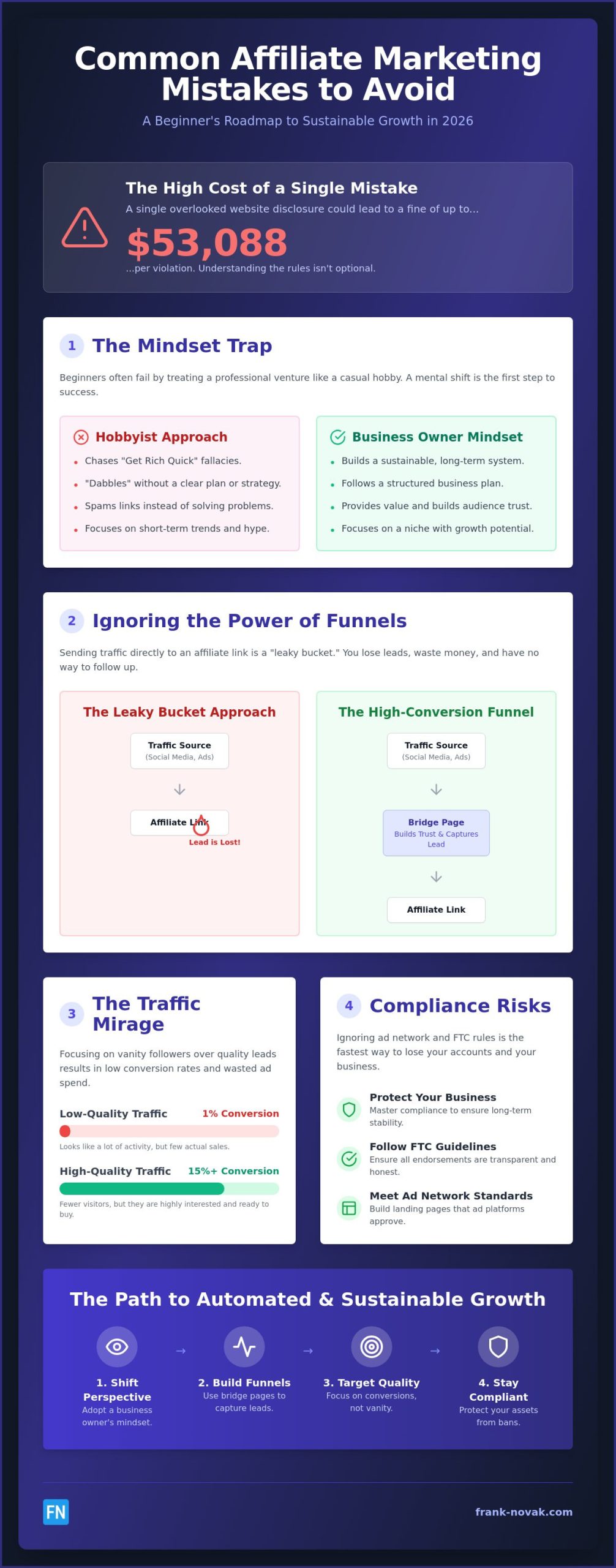
Did you know that a single overlooked disclosure on your website could result in a fine of up to $53,088 per violation? It’s a sobering reality in 2026, but it highlights why understanding the current regulatory landscape is so vital for your peace of mind. If you’ve felt overwhelmed by conflicting advice from online gurus or feared wasting your hard-earned money on ineffective ads, your hesitation is completely understandable. Many people start this journey with high hopes, only to find themselves frustrated by low conversion rates or the sudden loss of an ad account. By recognizing the common affiliate marketing mistakes for beginners early on, you can transition from frustrating trial and error to a more structured, confident approach.
In the following sections, you’ll discover the critical pitfalls that stall digital growth and learn the strategic frameworks used by successful practitioners to build sustainable income. We’ll explore how to construct high-converting funnels that actually resonate with your audience and discuss specific ways to keep your accounts safe from unexpected bans. This guide provides a clear roadmap to automated growth, ensuring that every step you take serves as a solid building block for your long-term professional success.
Key Takeaways
- Shift your perspective from a hobbyist to a business owner to avoid the “get rich quick” traps that often derail new ventures.
- Learn why sending traffic directly to affiliate links is a mistake and how a bridge page creates the trust needed for higher conversions.
- Identify the common affiliate marketing mistakes for beginners regarding traffic quality, focusing on conversion metrics rather than vanity followers.
- Protect your business by mastering compliance safety, ensuring your landing pages and ads meet the strict standards of 2026 ad networks.
- Discover how to transition from manual daily tasks to an automated system that supports sustainable, long-term growth.
The Mindset Trap: Why Beginners Fail Before Their First Sale
When you first explore Affiliate marketing, it’s easy to get swept up in the idea of effortless income. This “Get Rich Quick” fallacy often stalls growth before it even begins because it prioritizes speed over sustainability. If you’re looking for a long-term career, you have to accept that building a digital business takes time, just like any physical storefront would. Success in this field isn’t about finding a magic button; it’s about developing a reliable system that provides value to a specific group of people.
Treating your new venture as a hobby is a recipe for amateur results. It’s one of the most common affiliate marketing mistakes for beginners to think they can just “dabble” and see what happens without a clear plan. A professional approach requires a shift in how you view your daily tasks and your overall strategy. To help you visualize the shift from a casual mindset to a professional one, it’s helpful to see how these errors manifest in real-world scenarios.
Instead of measuring success only by your bank balance in the first week, try setting realistic 90-day benchmarks. This might include mastering a specific traffic source or refining your email copy. When you transition from a “link-spamming” approach to becoming a “problem-solver” for your audience, you establish yourself as an authority. This trust is the currency that fuels long-term sales and builds a community that listens to your recommendations.
The Danger of Short-Term Thinking
It’s tempting to chase every trending product you see on social media, but these markets are often saturated by the time you arrive. If you focus on a niche with long-term growth potential, you’re building an asset that won’t disappear when the hype dies down. Developing an affiliate marketing success mindset helps you maintain focus on these long-term goals, providing the mental resilience needed to ignore temporary distractions and stay the course.
Treating Affiliate Marketing as a Professional Business
Creating a structured business plan for your first three months provides a clear roadmap through the noise of information overload. You should also consider setting aside a “learning budget” specifically for testing new strategies or tools. This simple step reduces financial stress and allows you to treat every campaign as a valuable data point rather than a personal failure. If you find the technical side daunting, professional online success coaching often serves as the most direct route to overcoming the common affiliate marketing mistakes for beginners that hold so many people back.
Building Without a Blueprint: Ignoring the Power of Funnels
One of the most common affiliate marketing mistakes for beginners is treating a traffic source like a direct line to a sale. If you send someone straight to a vendor’s page, you’re essentially handing over your lead without getting anything in return. This “leaky bucket” approach means you lose the chance to follow up with that visitor. If they don’t buy right then, they’re gone forever, and you’ve wasted the effort it took to find them. A professional strategy focuses on capturing that interest so you can build a relationship over time.
Successful practitioners use a bridge page to solve this problem. This intermediate page introduces you, sets expectations, and frames the product as a solution to a specific challenge. It’s also the perfect place to ensure you’re following the FTC’s Endorsement Guides by being transparent about your relationship with the product. When you build trust first through honest disclosure and helpful context, your conversion rates naturally climb. If you’re looking for a clear path forward, exploring proven business frameworks can provide the clarity you need to start on the right foot.
The Architecture of a High-Converting Funnel
A solid funnel has three specific parts that work together to guide a prospect. First, the opt-in page captures an email address in exchange for a lead magnet, like a helpful guide or a checklist. Second, the bridge page pre-sells the offer and establishes your authority. Finally, the visitor lands on the affiliate offer. If you find the technical setup overwhelming, using a pre-built system like the ClickBank Super Funnel can help you bypass the learning curve and focus on getting results. Don’t forget to test different headlines on your opt-in page. A small change in wording can lead to a significant increase in how many people enter your funnel.
Why Your Email List is Your Only True Asset
It’s helpful to distinguish between “borrowed media” and “owned media.” Social platforms are borrowed spaces where the rules can change overnight; if a platform changes its algorithm, your reach could disappear. Your email list is the only part of your business you actually own. Some industry professionals report that a well-structured follow-up sequence can significantly increase your ROI because most sales happen after multiple touchpoints. Avoid the trap of hard-selling in every message. Instead, use a 7-day Welcome Sequence to provide genuine value and establish your authority. This automated approach ensures you’re helping your audience while building a sustainable income, effectively avoiding the common affiliate marketing mistakes for beginners that lead to burnout.
The Traffic Mirage: Choosing Quantity Over Quality
It’s tempting to believe that more eyes on your content always lead to more money in your account. This belief is one of the most common affiliate marketing mistakes for beginners because it ignores the fundamental truth that not all visitors are equal. You might see thousands of “likes” on a social media post, but if those people aren’t interested in solving a specific problem, your sales will stay at zero. These vanity metrics feel good for your ego, but they don’t pay the bills or build a sustainable business.
Instead of chasing a high follower count, you should focus on conversion metrics like click-through rates and actual sales. If you look at lists of common mistakes for new affiliate marketers, you’ll find that many people fail because they try to be “everywhere at once.” Spreading yourself across Instagram, TikTok, and a blog usually leads to burnout and mediocre results. It’s much more effective to master one reliable traffic source before you even think about moving to a second one.
In 2026, the way people find information has shifted from traditional SEO to GEO, or Generative Engine Optimization. This means your content needs to be optimized for AI-driven search engines that summarize information for the user. If you rely on “Cheap Traffic” sources like solo ads, you’ll often find that the intent isn’t there. These visitors are usually looking for freebies rather than solutions, which is why avoiding common affiliate marketing mistakes for beginners regarding traffic quality is so critical for your long-term budget.
Organic vs. Paid Traffic: Which Should Beginners Choose?
Organic Facebook marketing is often the best place to start because it allows you to build momentum without financial risk. Once you’ve identified what resonates with your audience and generates sales, you can transition to paid ads to scale your automated marketing funnel. The key is to find high-intent traffic sources where users are actively searching for a fix to their problems, ensuring your ad spend is an investment rather than an expense.
The AI Content Trap in 2026
While AI tools are powerful, relying on 100% AI-generated content is a mistake that many are making this year. These articles often lack the personal touch and authority that search engines and readers now demand. A “Human-in-the-Loop” strategy uses AI for deep research and data gathering, but leaves the final writing and emotional connection to you. If you want to drive traffic to affiliate links effectively, you must combine technology with authentic social proof and real human experience.
Compliance Catastrophes: Avoiding the Bans That Kill Businesses
Among the most common affiliate marketing mistakes for beginners is the assumption that aggressive marketing is the only way to get noticed. In 2026, ad networks and regulatory bodies have become significantly more sophisticated in identifying non-compliant content. If you fail to properly disclose your affiliate relationships, you could face civil penalties ranging from $51,744 to $53,088 per violation. This level of risk makes “Compliance Safety” a mandatory part of your business strategy rather than an optional checklist. Protecting your ad accounts and your reputation starts with understanding that platforms prioritize the user experience over your short-term sales goals.
The fastest way to lose your Facebook or Google ad account is by making misleading income claims. If you promise specific dollar amounts or “overnight” success, automated algorithms will likely flag your account for a permanent ban. Instead of using high-pressure tactics, successful marketers use the “Curiosity Gap” method. This involves writing copy that highlights a specific problem or a unique framework without making unverifiable promises. By focusing on the process rather than a guaranteed payout, you stay within platform guidelines while still driving high-quality traffic to your pages.
If you want to ensure your business is built on a foundation of long-term stability, implementing a professional compliance strategy is the best way to move forward with confidence.
The Beginner Checklist for Ad Compliance
To maintain a healthy standing with ad networks, your landing page must include a Privacy Policy, Terms of Service, and a clear Disclaimer. These pages signals to the platform that you are a legitimate business operator. You should also avoid “Direct Linking,” which is the practice of sending an ad straight to an affiliate offer. Major platforms often view this as a poor user experience because it bypasses the opportunity for you to provide context. Learning how to use Facebook ads for affiliate marketing correctly involves using a bridge page to house these legal documents and introduce the offer properly.
Navigating Platform Risk
Relying on a single ad account for your entire revenue is a dangerous position to be in. If that account is flagged, your income stops instantly. It’s a wise practice to “warm up” new accounts by running low-spend, high-engagement campaigns before launching your main offers. This builds a history of trust with the platform. If your account is ever disabled, the first step is to review the specific policy violation and submit a calm, professional appeal. By avoiding these common affiliate marketing mistakes for beginners, you protect your digital assets from sudden platform shifts and ensure your growth remains steady.
Scaling to Success: Why Personal Mentorship is the Final Piece
Moving from a manual hustle to becoming an automated business owner is the ultimate goal for most digital entrepreneurs. While many start by doing everything themselves, this approach eventually hits a ceiling. Automation isn’t just about saving time; it’s about creating a system that works consistently even when you aren’t at your desk. Many people struggle because they focus on the “what” of the business without understanding the “why” behind the systems they use. By implementing structured frameworks like Webinar Profit Engines, you can remove the technical guesswork that often stalls progress for months.
It’s a reality that while information is often free, successful implementation usually requires a seasoned guide. Course-hopping is one of the most common affiliate marketing mistakes for beginners because it leads to a fragmented strategy. You might have ten different pieces of a puzzle but no idea how they fit together. Investing in high-ticket coaching provides a higher ROI because it offers a direct path to your goals, cutting out the noise and focusing on what actually moves the needle for your specific situation.
The Value of a Proven Framework
Following a mentor’s blueprint prevents the expensive and frustrating trial and error periods that cause most people to quit. If you find yourself consistently hitting a wall or feeling unsure about your next move, it might be time for advanced Online Success Coaching. Beyond just the strategy, joining professional communities like the Ambassador JV offers networking opportunities that can lead to partnerships and insights you simply can’t find on your own. Having a steady hand to guide you through technical shifts or compliance changes makes the entire process feel much more manageable.
Next Steps for Your Affiliate Journey
Your path forward should be clear and methodical. Start by creating your first compliant lead magnet this week to begin building your email list. It’s helpful to stay focused on one traffic source until you reach a steady $1,000 in monthly profit. Master the mechanics of that platform before complicating your business. To keep your momentum, review the Never Succeed Online guide to identify and avoid the next set of common affiliate marketing mistakes for beginners as you scale toward your goals. This steady, building-block approach ensures your growth is both sustainable and predictable.
Building Your Sustainable Affiliate Future
You now have the roadmap to navigate the digital landscape of 2026 with clarity and confidence. By shifting your focus from short-term hacks to building owned assets like email lists and compliant funnels, you’re already ahead of most newcomers. We’ve explored how identifying the common affiliate marketing mistakes for beginners through better traffic selection and strict adherence to ad platform rules can save your business from costly setbacks. These foundational shifts are what separate a temporary hobby from a professional, long-term career.
If you’re ready to move past the implementation hurdles and want a proven system to follow, you can apply for Online Success Coaching with Frank Novak. With over 7 years of active industry experience, Frank offers specialized systems for ClickBank and Facebook automation that focus on sustainable business scaling. While it’s tempting to try and figure everything out alone, having a seasoned guide helps you bridge the gap between complex systems and real-world results. Remember that every successful entrepreneur started exactly where you are today. With the right framework and a commitment to professional growth, you can turn these insights into a thriving, automated business.
Frequently Asked Questions
How much money do I need to start affiliate marketing in 2026?
You can start with a very low budget if you focus on organic traffic, but you should set aside funds for a few essential tools. Expect to pay for a domain name and a basic hosting plan, which usually costs under $150 per year. If you choose to use paid ads, starting with a modest daily budget of $5 to $10 allows you to gather valuable data without facing high financial risk.
Is affiliate marketing still worth it for beginners with the rise of AI?
Affiliate marketing remains highly profitable if you use AI as a research assistant rather than a total replacement for human connection. While AI can generate content quickly, search engines in 2026 prioritize unique perspectives and real social proof. By focusing on Generative Engine Optimization (GEO) and providing authentic value, you can thrive in an environment where people still crave recommendations from trusted sources.
Why do most affiliate marketers fail in their first six months?
Most failures occur because of the “Get Rich Quick” fallacy and a lack of professional business structure. Many people treat the venture as a hobby and quit when they don’t see immediate results. Avoiding common affiliate marketing mistakes for beginners, such as ignoring funnel architecture or chasing vanity metrics, is essential to surviving the initial learning curve and building a real business.
How do I avoid getting my Facebook ad account banned for affiliate links?
You should never link directly from an ad to an affiliate offer; instead, use a compliant bridge page to introduce the product. Ensure your landing page contains a Privacy Policy, Terms of Service, and clear disclosures to meet the FTC’s standards. Avoiding aggressive income claims and warming up your ad account with engagement campaigns will also significantly reduce the risk of being flagged by automated algorithms.
Do I really need an email list to be a successful affiliate?
While you can make individual sales without one, an email list is the only asset you truly own in the digital space. Relying solely on social media platforms means your income is at the mercy of their sudden algorithm changes. A list allows you to follow up with prospects multiple times, which often triples the return on your initial traffic investment by building long-term trust.
How many products should a beginner promote at once?
You should focus on promoting just one high-quality product until you have mastered your traffic source and reached a consistent profit level. Spreading your attention across multiple offers often leads to mediocre results and confusion for your audience. Once you’ve reached a milestone like $1,000 in monthly profit, you can consider adding complementary products that serve the same niche and audience needs.
Can I do affiliate marketing without a website in 2026?
It is possible to use social media profiles or direct-to-funnel tools, but having a website is a strategic way to avoid common affiliate marketing mistakes for beginners related to platform dependence. A website acts as a central hub for your brand and provides a professional place to host the legal disclaimers required by ad networks. Without one, you may find it difficult to get approved for premium affiliate programs.
What is the best way to find high-converting products on ClickBank?
You should look for products with a high “Gravity” score, which indicates that many other affiliates are currently making successful sales. It’s also vital to review the vendor’s “Affiliate Tools” page to see if they provide high-quality banners, email swipes, and bridge page templates. Choosing a product that aligns with your niche and offers a genuine solution to a real problem will always lead to better conversion rates.

Article by
Frank Novak
Frank Novak is an online marketing professional and coach who focuses on affiliate marketing and business automation. Through his website, frank-novak.com, he shares insights and strategies for leveraging social media platforms like Facebook to generate traffic and commissions.
Affiliate / Sponsored Content Disclaimer
This [website/post] contains affiliate links. If you click through and make a purchase, we may receive a commission at no additional cost to you. We only recommend products or services we believe will add value to our readers.