

If you’re watching thousands of visitors land on your pre-lander only to see a conversion rate under 1%, it’s natural to feel like you’re throwing your Facebook ad budget into a void. You might wonder if your results are typical or if there’s a fundamental flaw in your landing page. Achieving success with affiliate marketing conversion rate optimization isn’t about chasing a single “perfect” number, but rather understanding how your specific niche and traffic source influence your bottom line.
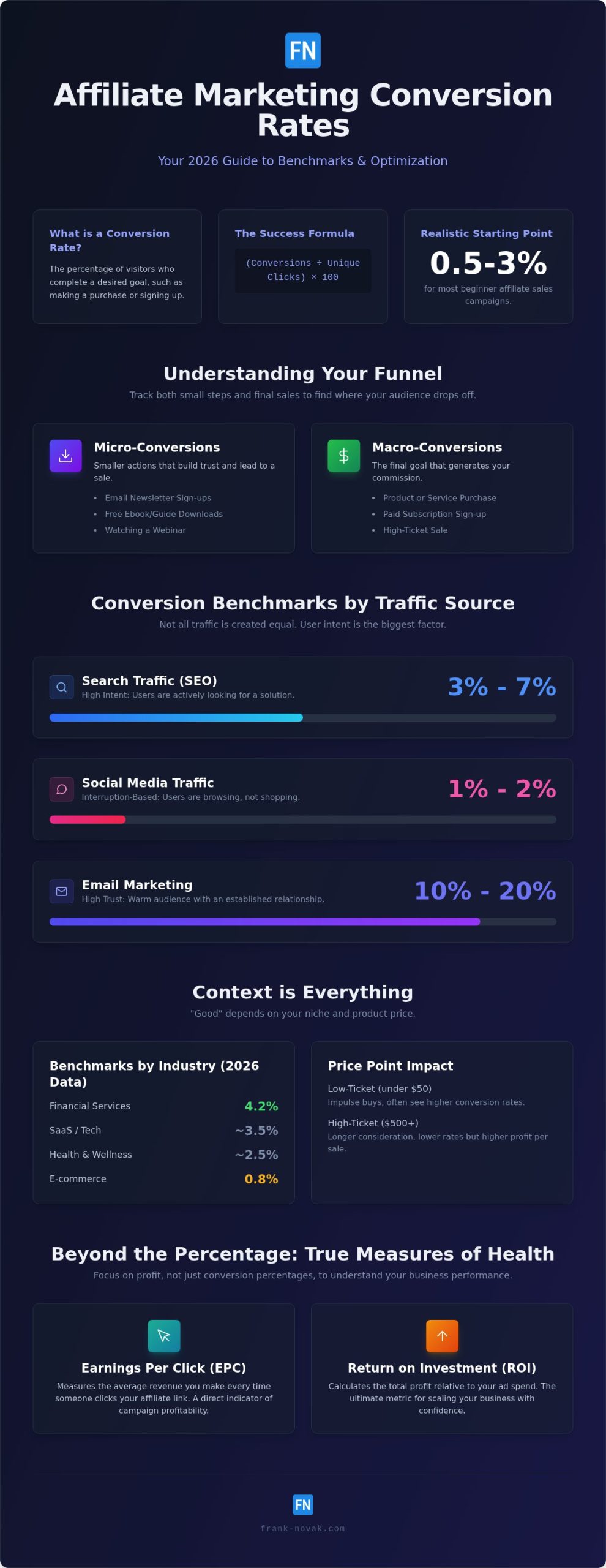
It’s frustrating when industry benchmarks feel like a moving target, especially when verified 2026 data shows averages ranging from 0.8% in e-commerce to 4.2% in financial services. You want to scale with confidence, yet the fear of wasting spend often keeps you stuck in analysis mode. This article provides you with realistic benchmarks for sectors ranging from health to SaaS, helping you identify exactly where your business stands today.
We’ll move past generic advice to look at how funnel architecture and traffic intent dictate your results. You’ll learn how to identify a “leaky” funnel and discover the practical steps to build a high-converting affiliate business. By the end of this guide, you’ll have the data and the strategy needed to turn those clicks into consistent, predictable revenue.
Key Takeaways
- Understand the 2026 benchmarks that distinguish between high-intent search traffic, which often converts at 3% to 7%, and social media traffic that typically sees 1% to 2%.
- Learn how to apply affiliate marketing conversion rate optimization by focusing on mobile responsiveness and the critical alignment between your ad copy and landing page headlines.
- Discover why tracking Earnings Per Click (EPC) and total Return on Investment (ROI) provides a much clearer picture of your business health than focusing on conversion percentages alone.
- Identify the difference between micro-conversions, such as email opt-ins, and macro-conversions to better understand how your audience moves through your sales process.
- Explore how leveraging an optimized system like the ClickBank Super Funnel can help you avoid common technical pitfalls and scale your revenue using proven funnel structures.
Defining the Good Affiliate Conversion Rate in 2026
A conversion rate is the percentage of total visitors who successfully complete a specific goal on your landing page. In the context of affiliate marketing conversion rate optimization, this metric acts as a pulse check for your entire business strategy. When you understand what affiliate marketing is, you realize that your primary job isn’t just sending traffic; it’s facilitating a decision. Your conversion rate tells you how effectively you’re making that happen.
In 2026, we categorize these decisions into micro-conversions and macro-conversions. Micro-conversions include smaller actions like signing up for a newsletter or downloading a free lead magnet. Macro-conversions are the actual sales that generate a commission. Tracking both allows you to see where your funnel is working and where it might be leaking potential revenue. If your micro-conversions are high but your sales are low, you know the issue lies in your final sales pitch rather than your initial offer.
To see how these principles work in practice, watch this video on optimizing your site for conversions:
For most beginners, a realistic starting point for sales conversions is between 0.5% and 3%. While these numbers might seem small, the revenue they generate depends heavily on your product’s price point. For example, a 1% conversion rate on a $500 high-ticket coaching program is far more valuable than a 10% rate on a $5 ebook. It’s always better to focus on the total profit and return on investment rather than just the percentage on the screen.
The Formula: Calculating Your Success
To calculate your rate, take your total number of conversions and divide them by your total unique clicks, then multiply by 100. It’s vital to use unique clicks because raw hits can be inflated by repeat visitors or bots, giving you a false sense of performance. Establishing this 2026 baseline is a mandatory step for effective affiliate marketing conversion rate optimization before you commit to larger ad spends. If you don’t know your starting point, you can’t accurately measure your growth.
Context Matters: Niche and Price Point
Your niche significantly impacts what a “good” rate looks like. Low-ticket items under $50 often have higher conversion percentages because they’re impulse buys that require little research. Professional services and high-ticket coaching generally see lower rates because they require a higher level of trust and a longer consideration phase. However, these high-value offers often result in much better long-term revenue. Using a structured system like the ClickBank Super Funnel can help automate the trust-building process, making it easier to convert those more complex offers without manual intervention.
Conversion Benchmarks by Traffic Source: Social vs. Search
Traffic sources are not interchangeable. If you treat search traffic the same as social traffic, your affiliate marketing conversion rate optimization efforts will likely fall flat. Understanding the psychological state of your visitor is the first step toward hitting your revenue goals. A visitor from Google is on a mission; a visitor from Facebook is on a break. This fundamental difference in intent changes everything about how you should structure your funnel.
Search traffic (SEO) typically sees conversion rates between 3% and 7% because the user is actively hunting for a specific solution. In contrast, social media traffic from platforms like Facebook or Instagram is interruption-based. These users aren’t looking for a product when they see your ad, which is why benchmarks for social traffic usually hover between 1% and 2%. Email marketing remains the gold standard for performance; warm lists often reach conversion rates of 10% to 20% because the relationship and trust are already established.
The gap between search and social benchmarks exists because of intent. When someone searches for a product review, they’re at the end of the buying cycle. When they’re scrolling through social media, you have to stop their thumb and convince them to care. This is why social ads require a bridge page to pre-sell the offer. Focusing on real metrics like Return on Advertising Spend (ROAS) rather than just raw clicks will help you see which traffic source is actually fueling your growth.
Mastering Facebook Ad Conversions
Success on social platforms requires you to respect the interruption mindset. A Facebook user didn’t ask to see your offer, so your ad must feel like a helpful discovery rather than a jarring sales pitch. To maintain steady benchmarks, you must target users with high commercial intent and ensure your landing page is fully compliant with platform policies. Compliance is the key to long-term stability; without it, your account risk increases and your conversion data becomes inconsistent. For a detailed roadmap on this, you can explore our guide on Facebook Ads for Affiliate Marketing.
The Power of Organic Social Traffic
Organic reach allows for a much deeper level of relationship building. Converting members in a Facebook Group or through your personal profile often yields results that are twice as high as cold paid ads. You’re essentially transitioning from a random poster to a trusted advisor in your niche. While this takes more time than turning on an ad, the loyalty you build creates a much more resilient business. If you’re feeling overwhelmed by the technical side of these systems, Online Success Coaching can help you bridge the gap between beginner confusion and expert execution.
Beyond the Percentage: Why EPC and ROI Are the Real Metrics
While tracking your conversion rate is a vital part of affiliate marketing conversion rate optimization, it is not the final word on your success. It is quite possible to have a high conversion rate on a campaign that is losing money every day. Conversely, a campaign with a seemingly “poor” conversion rate can be a massive profit generator if the backend math is structured correctly. To build a sustainable business, you must look past the surface percentages and focus on the numbers that actually pay your bills.
Earnings Per Click (EPC) is the ultimate equalizer between different conversion rates. This metric tells you exactly how much revenue you generate for every single click you send to an offer. If you are paying $0.80 for a click on Facebook but your EPC is $1.20, your business is growing. It doesn’t matter if your conversion rate is 1% or 10% in that scenario; the relationship between your cost and your earnings is what dictates your ability to scale.
Return on Investment (ROI) is the only metric that determines if your business survives. You could have a 0.5% conversion rate on a high-ticket program and still be more profitable than someone with a 15% conversion rate on a low-cost ebook. Your goal isn’t just to get clicks or even just to get sales. Your goal is to ensure that the revenue coming in significantly outweighs the costs of your traffic and tools.
Calculating Your Break-Even Point
You need to know exactly how much you can afford to pay for a visitor. This requires understanding the relationship between your Lead Cost and your Customer Acquisition Cost (CAC). If you know your conversion rate is 2%, you know it takes 50 clicks to generate one sale. If that sale nets you $100, your break-even point is $2.00 per click. We often use coaching sessions to help entrepreneurs uncover these invisible numbers, ensuring they don’t stop a campaign that is actually profitable just because the conversion rate looks low.
The High-Ticket Advantage
High-ticket affiliate marketing is significantly more forgiving of lower conversion rates. Making one sale at $1,000 requires much less traffic volume and a lower conversion threshold than trying to make 100 sales at $10 to reach the same revenue goal. Even if your affiliate marketing conversion rate optimization results in a modest 0.5% rate, the high commission floor keeps your ROI in the green. You can see how this strategy changes the scaling process by exploring Online Success Coaching, where we prioritize high-leverage metrics over vanity stats.
Strategic Fixes for Underperforming Affiliate Funnels
If your campaign isn’t hitting the benchmarks we discussed earlier, it’s usually because of a mechanical friction point in your funnel. Identifying these leaks is the core of affiliate marketing conversion rate optimization. You don’t always need more traffic; often, you just need a more efficient way to process the visitors you already have. By systematically removing hurdles, you create a smoother path for your audience to follow.
- Step 1: Audit your landing page load speed and mobile responsiveness. In 2026, a delay of even two seconds can cause a significant drop in visitors. Since most social traffic comes from mobile devices, your page must look and function perfectly on a smartphone.
- Step 2: Align your ad copy perfectly with your landing page headline. This is known as Message Match. If your Facebook ad promises a specific solution, that exact solution should be the first thing the user sees on your headline.
- Step 3: Implement a Bridge Page. Sending cold traffic directly to a vendor’s sales page often results in low trust. A bridge page allows you to introduce yourself and pre-sell the benefits before the visitor sees the price.
- Step 4: Use scarcity and urgency elements ethically. Real countdown timers for a bonus or limited-time offers can nudge a hesitant buyer. Avoid fake timers, as they damage your credibility long-term.
- Step 5: Set up an automated email follow-up sequence. Most people won’t buy on their first visit. An automated sequence allows you to stay top-of-mind and address common objections over several days.
The Anatomy of a High-Converting Landing Page
Your landing page has to pass the 3-second rule. This means a visitor should understand exactly what you’re offering and how it helps them within three seconds of landing. To build trust quickly, social proof and testimonials are non-negotiable. People want to see that others have succeeded with the product you’re promoting. Finally, ensure your primary Call to Action (CTA) is placed above the fold, so users don’t have to scroll to find the next step.
Plugging the Leaks in Your Sales Funnel
Many affiliates focus only on the final sales page, but “funnel depth” is where the real optimization happens. You need to identify exactly where users drop off, whether it’s at the lead magnet stage or the bridge page. If you find that visitors are opting into your list but not clicking through to the offer, your bridge page likely needs a stronger hook. Using this Automated Marketing Funnel Guide can help you build a system that nurtures those leads who aren’t quite ready to pull the trigger today.
Scaling Your Conversions with the ClickBank Super Funnel
When you transition from a hobbyist to a professional, you’ll find that manual tweaks only take you so far. Beginners often spend weeks building DIY pages that fail because they lack the technical nuances of affiliate marketing conversion rate optimization. Pre-built systems provide a foundation that has already been tested against thousands of visitors. With ClickBank having paid out $7.3 billion in commissions as of 2026, it’s clear that the platform’s top performers rely on systems that work at scale. This allows you to skip the exhausting guesswork phase and move straight into the growth phase of your business.
The ClickBank Super Funnel is designed specifically to promote high-gravity products that people are already buying. By using a system that is engineered for performance, you remove the emotional stress often associated with affiliate marketing conversion rate optimization and daily fluctuations. Instead of worrying about every single click, you can trust that the automation is doing its job. This shifts your focus from micro-managing technical tasks to looking at the bigger picture. When you aren’t stuck fixing broken links or adjusting button colors, you have the mental space to analyze your traffic quality and refine your overall messaging.
How the Super Funnel Optimizes for You
One of the biggest hurdles in 2026 is maintaining compliance with social media platforms. The ClickBank Super Funnel includes built-in compliance features for Facebook ads, which helps protect your ad account from sudden bans. It also features automated lead capture to ensure that every click has long-term value. Even if a visitor doesn’t buy on the first day, they are added to your list so you can nurture them through the automated follow-up sequences we discussed earlier. This ensures your marketing budget is working for you 24/7.
Your Roadmap to a 6-Figure Mindset
Building a successful business is about more than just clicking buttons; it requires a shift in how you view your digital assets. Your email list and your funnel are the engines of your revenue. Professional Online Success Coaching during your first 90 days can be the difference between giving up and breaking through to a new income level. A mentor helps you identify conversion bottlenecks that are often invisible when you’re working in isolation. They see the patterns in your data that you might miss due to lack of experience.
By 2026, the number of people who have earned their first paycheck on ClickBank reached 700,000, and most of them did so by following a structured roadmap rather than trying to reinvent the wheel. Taking the next step by joining the Clickbank Profit Club gives you a direct line to proven strategies. You aren’t just buying a tool; you’re investing in a professional infrastructure that supports sustainable growth. We provide the roadmap so you can focus entirely on your results and your future.
Moving Toward a High-Converting Future
Success in this industry isn’t about hitting a lucky number; it’s about building a system that rewards your efforts. You now understand that while a 1% to 2% rate is typical for social traffic, your true focus should remain on Earnings Per Click and total Return on Investment. If you implement strategic fixes like bridge pages and mobile speed audits, you can turn a struggling campaign into a reliable asset. Mastering affiliate marketing conversion rate optimization requires a blend of the right technology and expert guidance.
Whether you’re navigating 2026-ready Facebook ad strategies or refining your funnel architecture, having a roadmap makes the journey much smoother. Using proprietary Super Funnel technology and personalized Online Success Coaching helps you bypass the common pitfalls that stall most beginners. You have the tools and the data to move past generic averages and build something sustainable. The path to scaling is much clearer when you aren’t walking it alone.
Ready to stop guessing? Get the ClickBank Super Funnel and start converting today.
We’re here to help you turn these benchmarks into your new reality. Your progress is our priority, and we look forward to seeing you scale with confidence.
Frequently Asked Questions
What is a typical conversion rate for ClickBank products?
A typical conversion rate for ClickBank products generally falls between 0.5% and 1%, though specific niches like health and wellness can reach 3.1%. These numbers vary significantly based on the quality of your traffic and the relevance of your pre-lander. If you use a system like the ClickBank Super Funnel, you can often exceed these averages by providing a more structured and professional experience for your visitors.
Why is my affiliate conversion rate so low despite getting clicks?
A low conversion rate despite high traffic often indicates a message mismatch between your ad and your landing page. If your visitors feel misled or confused when they arrive, they’ll leave immediately. Other common culprits include slow page load speeds, poor mobile optimization, or a lack of social proof. Focusing on affiliate marketing conversion rate optimization involves auditing these technical friction points to ensure a seamless journey for your visitors.
Is a 2% conversion rate good for Facebook ads?
Yes, a 2% conversion rate is considered very strong for Facebook ads, as social media traffic is interruption-based rather than intent-based. Most social media campaigns hover between 1% and 2% because you’re capturing users while they’re browsing for entertainment. If you can maintain a 2% rate while scaling your budget, your campaign is likely highly profitable. Success here depends on using a bridge page to warm up the audience.
How do I track my affiliate conversion rate accurately?
Accurate tracking requires using unique clicks rather than total raw hits to avoid data inflation from bots or repeat visitors. You should use tracking software or the reporting tools provided within the ClickBank dashboard to compare your total sales against unique visitors. If you find the technical side of tracking overwhelming, Online Success Coaching can help you set up reliable systems that ensure every dollar of your ad spend is accounted for properly.
Can a landing page really double my conversion rate?
A well-optimized landing page can certainly double or even triple your results by removing confusion and building immediate trust. By implementing a clear headline, strong social proof, and a single call to action, you guide the visitor toward the sale more effectively than a generic vendor page. This is a core component of affiliate marketing conversion rate optimization, as it allows you to capture leads and pre-sell the benefits.
Does the price of the product affect the conversion rate?
Price has a direct impact on conversion percentages because lower-priced items under $50 are often impulse buys that require less consideration. High-ticket products usually see lower conversion rates because they require a higher level of trust and a longer sales cycle. However, these high-ticket offers are often more profitable because the commission per sale is significantly larger. It’s better to focus on your total profit rather than just the percentage.
What is the difference between CTR and conversion rate?
Click-through rate measures the percentage of people who see your ad and click on it, while conversion rate measures those who take a final action, like making a purchase. A high CTR is great for getting traffic, but if those visitors don’t convert, your campaign will lose money. You need both metrics to be healthy. A strong CTR gets them through the door, but optimization ensures they actually complete the sale.
How many clicks should I get before I judge my conversion rate?
You should generally wait until you have at least 100 to 200 unique clicks before making any major judgments about your conversion rate. Smaller sample sizes can be misleading due to statistical variance. If you’ve sent 200 targeted visitors and haven’t seen a sale, it’s time to audit your bridge page or your message match. Patience is key; making decisions too early can lead to stopping a campaign that just needed more data.

Article by
Frank Novak
Frank Novak is an online marketing professional and coach who focuses on affiliate marketing and business automation. Through his website, frank-novak.com, he shares insights and strategies for leveraging social media platforms like Facebook to generate traffic and commissions.
Affiliate / Sponsored Content Disclaimer
This [website/post] contains affiliate links. If you click through and make a purchase, we may receive a commission at no additional cost to you. We only recommend products or services we believe will add value to our readers.