

What if the fastest AI draft isn’t the copy most likely to earn a reader’s trust? Using AI to write affiliate marketing copy can save time, but an unedited draft may sound generic, repeat familiar sales language, or leave out details people need to make a decision. The difference comes from the context and judgment you bring to the process.
If you’re unsure what product information to provide, how to keep the copy in your own voice, or what to verify before publishing, you’re not alone. AI can help you brainstorm, draft, and compare versions, but you remain responsible for making sure claims are accurate and recommendations are useful.
This guide offers a repeatable workflow for creating reader-focused affiliate copy, from gathering product and audience details to revising drafts, checking claims, and handling disclosures. You’ll see where AI can speed up the work, where human review matters most, and how to make the final copy sound recognizably yours.
Key Takeaways
- Use AI to draft and refine affiliate copy, not to guarantee sales or replace your judgment.
- When using AI to write affiliate marketing copy, start with a brief covering the reader, their question, the product, and the next step.
- Compare chat assistants, specialist writing tools, and manual-first drafting to find a workflow that gives you the control you need.
- Before publishing, check claims, relevance, originality, readability, and transparency, paying close attention to sensitive performance or income statements.
- Adapt reviewed copy to the format you need, then track meaningful outcomes and reader responses to improve your process.
What AI Can and Cannot Do for Affiliate Copy
AI can help you move from a blank page to a workable draft, but it can’t guarantee sales or decide what your audience needs to hear. Using AI to write affiliate marketing copy works best when you treat the tool as a writing assistant: it can suggest angles, organize information, and offer wording to revise. You remain responsible for whether the recommendation is relevant, truthful, and useful.
Affiliate copy does more than promote a product. It connects a reader’s question with a relevant offer and a clear next step. If you’re new to the model, What is affiliate marketing? provides background on how it works. Your copy still needs a specific purpose, such as helping a reader compare options or understand whether a product fits their needs.
This tutorial shows how an AI writing tool can support the drafting process:
Think of AI output as a starting point, not a finished asset. A product description, email, landing-page section, and call to action each have a different job. A description explains relevant features, an email earns attention and guides the reader, and a call to action makes the next step clear. Give each draft an audience and a defined purpose before asking AI to write it.
Which affiliate copy tasks can AI help with?
AI is useful for generating options quickly. Ask for article angles, an outline that answers a reader’s question, several headline directions, or a first draft based on product details you provide. It can also adapt a verified message for different formats, such as turning a product benefit into an email introduction and a concise landing-page section. Include the audience and intended action in each request, then review the wording rather than copying it unchanged.
Why does AI-written affiliate copy often sound generic?
Generic prompts invite generic answers. Without a reader profile, product evidence, or reason to choose the offer, AI may fall back on stock phrases such as “game-changing” or “perfect for everyone.” Those claims are broad because they don’t explain who benefits or why. Replace them with firsthand observations or clearly attributed, verified information. For example, describe a feature accurately and explain which reader need it may address, without implying an unsupported result.
AI can arrange supplied facts into polished sentences, but it can’t independently confirm every claim against current product information or your own experience. Check features, comparisons, and performance statements against reliable sources. If you haven’t tested the product, don’t imply that you have. Strong copy starts with three inputs: knowledge of the audience, evidence for product details, and a clear purpose for the message. With those in place, AI can help express your judgment, not replace it.
How to use AI to write affiliate marketing copy step by step
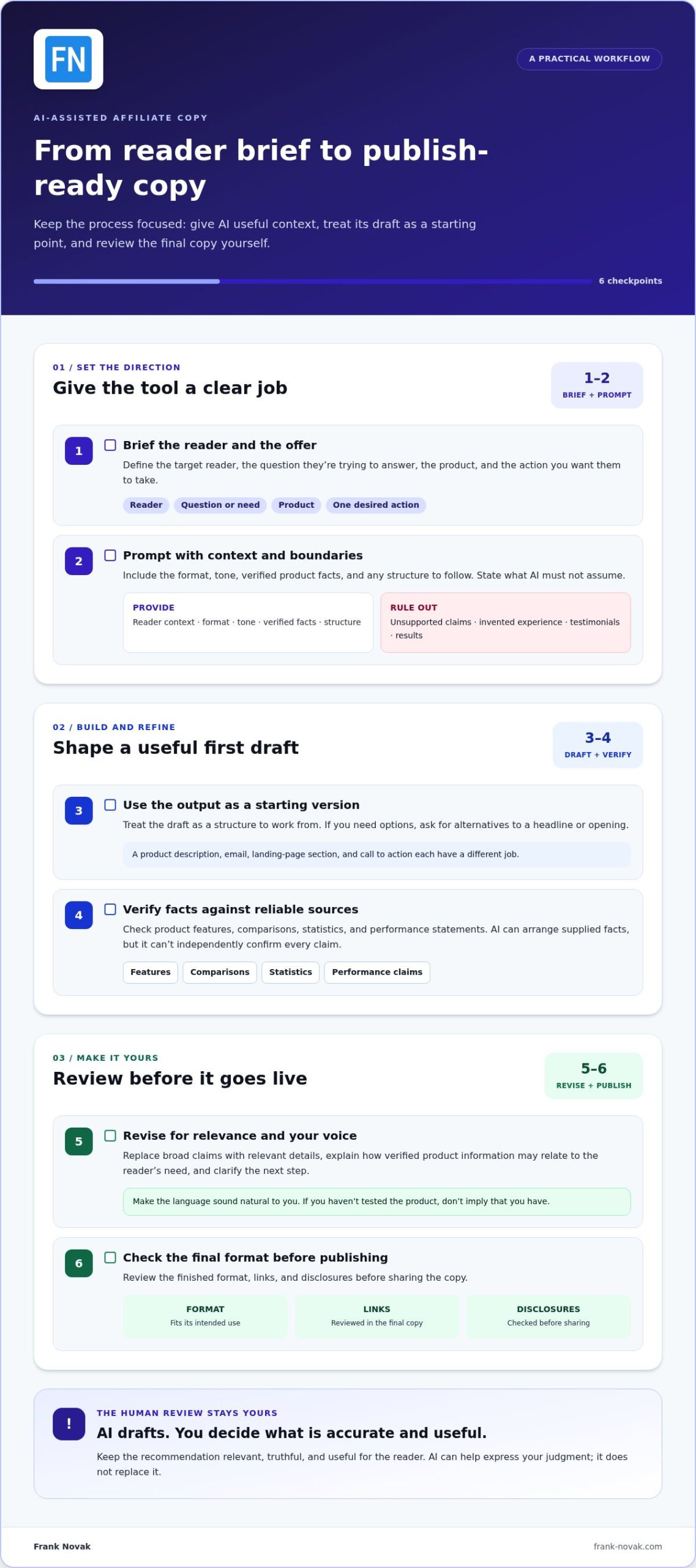
A reliable process keeps the tool focused and gives you clear points to check before anything goes live. Start with what the reader needs, then guide AI through a brief, prompt, draft, verification, revision, and publication. Using AI to write affiliate marketing copy is more effective when each stage has a purpose than when you ask for “persuasive copy” and accept the first response.
Work through these steps in order:
- Brief: Define the target reader, the question they’re trying to answer, the product, and the action you want them to take.
- Prompt: Give AI the brief, format, tone, verified facts, and boundaries. Ask for a draft, not invented testimonials or personal experience.
- Draft: Use the result as a structure or starting version. Request alternatives for a headline or opening if you need options.
- Verify: Check product features, comparisons, statistics, and performance statements against reliable sources.
- Revise: Replace broad claims with relevant details, clarify the reader’s next step, and make the language sound natural to you.
- Publish: Review the final format, links, and disclosures before sharing the copy.
Keep copy and traffic acquisition distinct. Copy helps a visitor understand an offer and decide what to do next. Traffic strategy focuses on bringing suitable visitors to that message. Both belong in a broader affiliate system, alongside audience understanding and follow-up.
What information should an AI writing prompt include?
Give the tool enough context to write for a real person, not a broad audience. Include what the reader already knows, their problem or question, the product’s verified details, the format, the desired tone, and one primary action. State what must not be assumed, such as personal testing, guaranteed outcomes, or features you haven’t verified.
A reusable prompt might look like this:
Prompt: “Draft a [format] for [target reader], who wants to [question or need]. Use a [tone] tone and plain language. The product details I’ve verified are: [facts]. Explain how these details may relate to the reader’s need, without adding unsupported claims, invented experience, testimonials, or results. Use this structure: [sections]. End by inviting the reader to [one action].”
For an email, the structure might be a relevant opening, a short explanation, and a next step. A landing-page section may need a concise benefit explanation and supporting detail. The same verified message can be adapted, but the format and reader action should shape each draft.
How should you revise the first AI-generated draft?
Check every factual statement against a reliable product source, then ask whether each detail helps this particular reader. Replace vague benefits with specific, supportable information. Read the draft aloud to catch stiff phrasing, repetition, or a tone that doesn’t sound like you. If you can’t substantiate a claim, remove it or rewrite it more cautiously.
Then consider how the copy fits with the rest of your affiliate process. Frank Novak’s affiliate marketing guidance connects copywriting with broader topics such as traffic, follow-up, and sustainable online growth.
Compare AI copywriting approaches before choosing your workflow
The right setup depends on the copy you create, the information you already have, and how much control you want over each draft. A general-purpose chat assistant can handle a range of writing tasks, specialist writing tools may organize more of the writing process in one place, and manual-first drafting keeps your expertise at the center. None removes the need to review product claims.
Compare approaches by how they fit your work, rather than by promises of more conversions or better rankings. Consider how easily you can provide context, revise the output, and trace claims back to evidence.
| Approach | Strengths | Trade-offs |
|---|---|---|
| General-purpose chat assistant | Flexible for brainstorming, outlines, and drafts based on supplied details. | Needs clear instructions and context; you must verify product facts and edit the output. |
| Specialist writing tool | May bring writing tasks or templates together in a workflow suited to frequent content creation. | Features vary, and a convenient template can’t replace accurate source information or human review. |
| Manual-first drafting | Lets your subject knowledge and established voice shape the copy from the beginning. | Can take more effort to get started; AI can still help later with outlines or alternate wording. |
Tool choice matters less than the quality of your brief and review process. If your prompt leaves out the audience or product evidence, a specialist template won’t fill those gaps. If you know the subject well, a manual draft may give AI a stronger foundation to refine.
When is a general-purpose AI assistant enough?
For brainstorming angles, outlining a landing page, or drafting from verified details, a general-purpose assistant may be enough. Its output depends on the instructions and context you provide, so specify the reader, format, and purpose. Before publishing a recommendation or product claim, check it against reliable information. Treat the response as editable copy, not an authority on the offer.
When might a specialist tool or human-first draft fit better?
A specialist tool may suit a workflow that relies on reusable formats or produces several kinds of copy regularly. Focus on the features you’ll actually use, such as saved templates or convenient revision, not unverified performance claims. If you know the topic well, write the key explanation yourself first, then use AI to explore clearer wording or different structures.
To compare approaches, test the same small task in each workflow. Use identical product facts, reader profile, and format, then assess how much editing each draft needs, whether claims are traceable, and how naturally the copy reads. That gives you a practical basis for choosing without assuming a particular tool will improve results on its own.
How to review AI affiliate copy for accuracy, usefulness, and trust
A polished draft can still contain errors, miss the reader’s real question, or make a recommendation sound stronger than the evidence supports. Treat review as a separate step, not a quick proofreading pass. Before publishing, assess whether each statement is accurate, relevant, original, readable, and transparent. This matters especially when using AI to write affiliate marketing copy, because you remain responsible for what readers see.
Use this pre-publication checklist:
- Accuracy: Do product features, limitations, comparisons, and conditions match current, reliable information?
- Relevance: Does the copy address the intended reader’s question and help them assess product fit?
- Originality: Does it offer useful analysis or experience, rather than simply rephrasing product descriptions?
- Readability: Is the language clear, specific, and free of repeated or inflated sales phrases?
- Transparency: Can readers understand the affiliate relationship and the basis for the recommendation?
How can you fact-check product claims in AI drafts?
Review each claim against current primary product information, such as the product’s official description or documentation. Check limitations and conditions as carefully as benefits: a feature may apply only in a particular situation. Be especially cautious with health, financial, income, and performance statements. Unsupported figures, promised outcomes, or comparisons can mislead readers, so remove them unless you can substantiate them.
Look for claims of personal use, too. If you haven’t tried a product, don’t let a draft imply that you have. AI can produce plausible details to fill gaps. Mark anything uncertain for research, then verify it or leave it out. A shorter, accurate description is more useful than a detailed one built on assumptions.
How do you keep AI-assisted copy transparent and reader-focused?
Make the affiliate relationship easy to understand near the recommendation or relevant link. Use plain language that clearly tells readers you may earn a commission if they buy through it. Disclosure expectations can depend on the content and context, so check the current Federal Trade Commission endorsement guidance before publication rather than relying on a generic template.
Then review the balance of the recommendation. Does the copy explain who the product may suit, what the reader should consider, and what the product does not establish? Remove pressure tactics that push for a click without helping someone decide. Trust grows when the reader’s needs come before the commission.
Finally, consider where the copy sits in the reader journey. A recommendation may be one part of a wider experience that includes the page, follow-up, and other relevant information. Review it in that context while keeping each message useful on its own.
For further context on how copy fits into a broader affiliate marketing process, explore Frank Novak’s affiliate marketing guidance.
Turn your AI-assisted copy into a repeatable affiliate marketing workflow
Once a draft has passed review, give it a role in a larger publishing process. A useful workflow doesn’t stop at producing copy: it adapts the message to the reader’s next step, publishes it in the right format, and uses responses to inform future work. This keeps AI as a practical writing aid rather than treating it as a shortcut to results.
A landing page, email, or comparison article may address the same audience need, but each serves a different moment in a reader’s journey. A funnel helps organize those moments, from an initial introduction to follow-up. The ClickBank Super Funnel is a relevant resource for considering how finished copy fits into a broader affiliate marketing system.
How can one verified message support multiple formats?
Begin with a short source document containing the reader’s need and the product facts you’ve verified. Use it as the foundation for each version, then tailor the structure and action to the format: an email may invite a click to learn more, while a landing page can offer more room for explanation. Review each adaptation separately, since shortening or rephrasing can accidentally introduce a new claim.
For example, if the verified message explains how a product feature relates to a specific reader need, keep that connection intact across formats. Adjust the emphasis and length, not the underlying facts. If a version no longer makes sense without a bold promise or extra detail, revise it rather than filling the gap with an assumption.
How should you learn from published copy?
Set a baseline before changing a piece of copy, then choose a measure that fits its purpose. For an email, that might be clicks; for a landing page, it could be a relevant next action. Change one meaningful element at a time, such as the opening or call to action, so you can compare versions more clearly. Results offer signals, not proof that AI caused a change.
Keep a simple record of the format, version, change made, and outcome. Add reader questions and feedback, too. If readers repeatedly ask what a feature means, that may point to a missing explanation in the brief. If they misunderstand who the offer suits, make the next draft clearer about fit. Use these observations to improve your edits and future AI instructions.
A repeatable process for using AI to write affiliate marketing copy can be simple: keep a verified source of product facts, adapt one message carefully, review each version, and learn from what readers do and ask. Copy is one part of the system, alongside audience understanding and follow-up. Frank Novak’s online marketing resources offer further guidance as you develop your approach.
Make Your Next Affiliate Copy Test Count
Choose one upcoming piece of affiliate copy and treat it as a learning opportunity, not a final verdict on your approach. Keep a record of the audience, format, purpose, and version you publish. As readers respond, note which questions remain unanswered and what information helps them take the next step. Those observations can make your next brief more useful and help you decide where human judgment should shape the copy. Using AI to write affiliate marketing copy becomes more purposeful when each draft supports a clear experiment and teaches you something about your readers.
Copy also belongs within a wider marketing journey. Frank Novak shares affiliate marketing and business automation guidance, and the ClickBank Super Funnel is a resource for considering how copy fits into a funnel and ongoing reader follow-up.
Start with one manageable improvement, learn from the response, and build your process at a steady pace. Your judgment and growing audience insight can make each next step stronger.
Frequently Asked Questions
Can AI write affiliate marketing copy for beginners?
Yes. Beginners can use AI to create a starting draft even if they haven’t developed a writing process yet. Using AI to write affiliate marketing copy is more manageable if you begin with one small piece, such as a short product introduction, rather than a whole campaign. Include the audience’s actual question, then check the draft against product information. Reader questions and your edits can help you build stronger briefs over time.
Which AI tool is best for writing affiliate marketing copy?
There isn’t one best tool for every affiliate marketer. A general chat assistant may be sufficient for occasional brainstorming, while a writing platform with reusable templates may better suit frequent content production. Test a small, regular task, such as drafting an email introduction, and compare how much editing each option requires. Consider ease of revision and draft organization, not claims that a tool guarantees sales.
How do I prompt AI to write affiliate product copy?
Describe the specific reader, the decision they’re making, the format, and the product facts you can support. For example: “Write a short comparison introduction for readers choosing between two types of budgeting apps. Use only these supplied features, avoid claims about savings, and explain what detail a reader should compare next.” This gives the tool a clear assignment while preventing it from inventing benefits or implying that it has tested the product.
Can Google tell if affiliate content was written with AI?
There’s no reliable reason to treat an AI detector as a publishing safeguard. Google’s guidance does not ban content because AI helped create it; the focus is on whether the result is useful, original, and trustworthy. A draft that adds little value may be weak regardless of who or what wrote it. Review the page for firsthand insight, accurate details, and a clear answer to the reader’s question before publishing.
Do I need to disclose affiliate links in AI-written content?
Disclose the affiliate relationship clearly so readers understand that you may earn a commission from a qualifying purchase. AI assistance is a separate issue: don’t assume an affiliate disclosure automatically explains AI use, or that every AI-assisted sentence requires a separate notice. Disclosure expectations can depend on the content and context, so consult current Federal Trade Commission endorsement guidance before publication.
How can I make AI-generated affiliate copy sound less generic?
Give the draft a real point of view by using the words readers use in questions, reviews, or feedback, then explain what those concerns mean for product fit. Replace a broad line like “easy to use” with a specific, verified detail about the product’s interface or process. Add your own analysis, not an invented personal story. If you haven’t used the product, describe the source of your information accurately.
Can AI create affiliate emails and landing-page copy?
Yes. AI can help draft both, but each format should carry a consistent message in a way that suits its role. An email might introduce a reader’s question and invite them to explore further; the landing page can provide a fuller explanation. Check that the page delivers on the email’s promise and that neither adds unsupported claims. A mismatch between the two can confuse readers even if each piece reads well on its own.
To build a clearer affiliate marketing process, explore Frank Novak’s online marketing resources and the ClickBank Super Funnel.

Article by
Frank Novak
Frank Novak is an online marketing professional and coach who focuses on affiliate marketing and business automation. Through his website, frank-novak.com, he shares insights and strategies for leveraging social media platforms like Facebook to generate traffic and commissions.
Affiliate / Sponsored Content Disclaimer
This [website/post] contains affiliate links. If you click through and make a purchase, we may receive a commission at no additional cost to you. We only recommend products or services we believe will add value to our readers.