
Direct linking to affiliate offers is no longer just a risky shortcut; in 2026, it’s a primary trigger for permanent ad account bans. With the FTC now issuing penalties of up to $51,744 per violation for disclosure failures and Google Ads aggressively filtering out pages that lack unique value, the old “set it and forget it” methods are gone. If you’ve ever felt the sting of a rejected campaign or wondered why your traffic never seems to convert, you’re likely missing a critical piece of the puzzle. Learning how to use a bridge page for affiliate marketing is no longer optional if you want to protect your business and scale your earnings.
It’s completely natural to feel confused by technical funnel setups and the constant stream of new platform policies. You deserve a clear roadmap that replaces uncertainty with a steady, profitable strategy. In this guide, you’ll discover how to master the bridge page funnel to double your commissions while keeping your accounts safe. We’ll walk through the exact steps to create compliant campaigns that lower your costs and build a sustainable email list, ensuring your business thrives in this new era of digital growth.
Key Takeaways
- Learn why providing original content on your landing page acts as a compliance shield that keeps your ad accounts safe from unexpected bans.
- Discover the psychology behind “warming up” cold traffic to help you turn skeptical visitors into confident buyers before they ever reach the sales page.
- Identify which of the four high-converting models, such as the educational advertorial or personal video recommendation, best fits your specific niche.
- Master the technical foundation by following a step-by-step checklist on how to use a bridge page for affiliate marketing to ensure your funnel is professional and effective.
- Explore how to move beyond basic setups toward a sustainable digital business using automated systems like the ClickBank Super Funnel.
What is a Bridge Page and Why Direct Linking is a Mistake in 2026
A bridge page is an interstitial landing page that sits between your traffic source and the final offer. In the broad world of affiliate marketing, it serves as the essential handshake that builds trust with your audience. If you send cold traffic directly to a sales page, you’re asking for a major commitment before the visitor even knows who you are or why they should listen to you. This pre-sell approach is designed to warm up visitors by providing genuine value before they ever see a price tag.
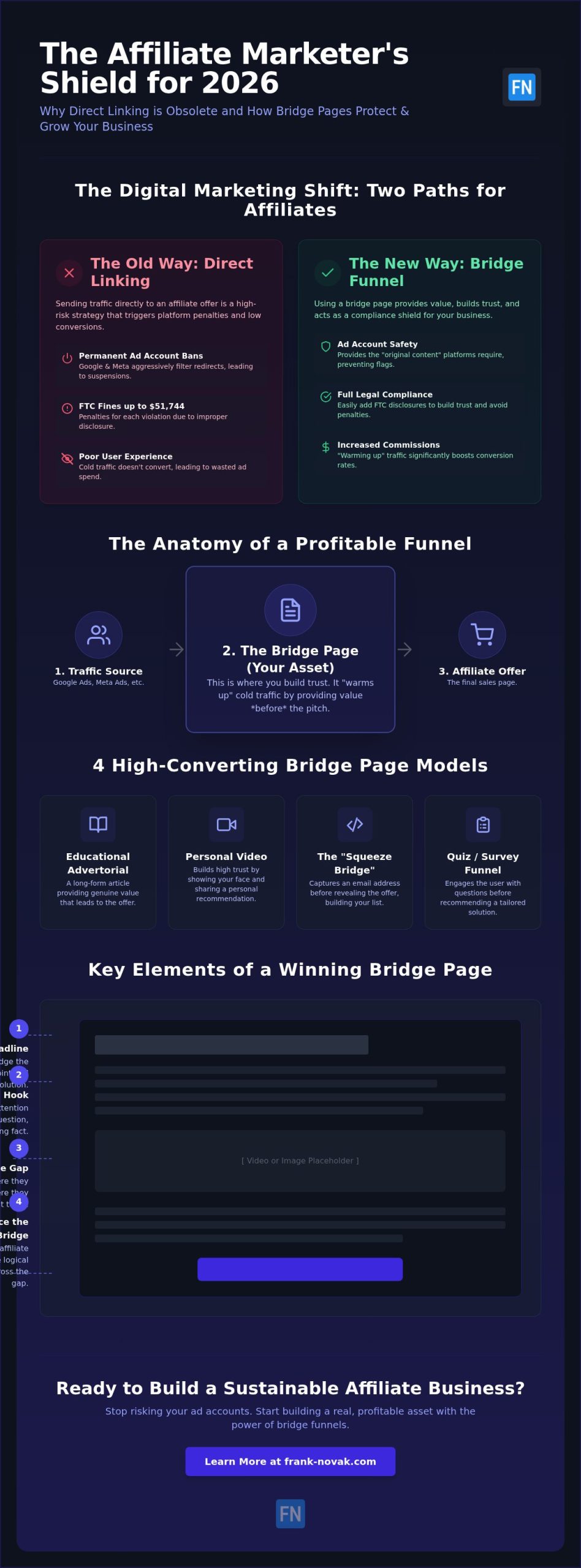
In 2026, direct linking is no longer just a poor conversion strategy; it’s a fast track to getting your ad account permanently banned. Platforms like Google and Meta now prioritize user experience and original content over simple redirects. If your ad points to a raw affiliate link, you’re likely to face “Limited Ad Serving” or immediate flags for deceptive practices. Beyond platform rules, the FTC now enforces penalties of up to $51,744 per violation for improper disclosures. Learning how to use a bridge page for affiliate marketing allows you to incorporate these legal requirements while positioning yourself as a trusted mentor rather than a faceless salesperson.
To better understand this concept, watch this helpful video:
The Anatomy of a High-Converting Bridge
Success starts with the “Congruence Factor.” This means your ad copy, your bridge page headline, and the final sales page must all feel like a single, seamless conversation. A high-converting bridge page typically features a strong headline that acknowledges the reader’s pain, followed by a hook that keeps them reading. You then identify the gap between where they are now and where they want to be. When you naturally introduce the affiliate product as the bridge that crosses that gap, the transition feels like a helpful recommendation rather than a pushy pitch.
Bridge Page vs. Landing Page: Is There a Difference?
While people often use these terms interchangeably, a bridge page has a specific purpose: to transition traffic. A standard landing page might just be a static information page, but a bridge page is active and persuasive. If you want to build a long-term business, you might use a “Squeeze Bridge.” This model requires the visitor to enter their email address before moving to the offer. This allows you to follow up with them later, which is a foundational strategy used in the ClickBank Super Funnel. Whether you use a simple pre-sell page or a lead capture system depends on your niche, but the goal remains the same: provide enough value that the user feels confident clicking through to the final solution.
The Compliance Shield: Using Bridge Pages to Prevent Ad Account Bans
If you’ve ever had an ad account shut down without warning, you know how devastating it feels for your business. Platforms like Facebook and Google often “shadowban” or block raw affiliate links because they want to protect their users from low-quality experiences and aggressive sales pitches. Mastering how to use a bridge page for affiliate marketing is your best defense against these sudden disruptions. A bridge page acts as a buffer between aggressive sales copy and platform bots, allowing you to control the narrative and maintain a professional presence.
In June 2026, Google updated its “Limited Ad Serving” policy to prioritize advertisers who provide clear branding and unique value. Instead of just redirecting traffic, you must provide the “Original Content” that ad platforms demand. This means moving away from simple domain masking and instead using your own dedicated URL. When you host your bridge page on your own domain, you establish authority and show manual reviewers that you’re a legitimate business owner rather than a temporary advertiser. Staying compliant also means following the FTC’s Endorsement Guides, which now carry penalties of up to $51,744 per violation for undisclosed affiliate relationships.
Facebook Ad Compliance for Affiliates
Meta has become increasingly strict, requiring all commercial ads to use specific formats like “Partnership Ads” as of 2026. To keep your account in the green, you must avoid “Unrealistic Claims” on your bridge page. If you promise overnight wealth or impossible health results, your account won’t last long. It’s also essential to include clear links to your Privacy Policy and Terms of Service in the footer. By implementing Facebook Ad Compliance for Affiliates strategies directly on your bridge page, you create a safe environment that the algorithm trusts. If you’re looking for a more structured way to manage these technical requirements, building a compliant system can help you focus on growth rather than troubleshooting bans.
The “Safety First” Copywriting Framework
Your copy should focus on education and mentorship rather than high-pressure sales tactics. Manual ad reviewers look for social proof, so including genuine testimonials can significantly improve your account health. Use this “Safe Bridge” checklist to ensure your page is ready for traffic:
- Include: Clear affiliate disclosures near your call-to-action buttons.
- Include: Educational content that explains the “why” behind the product.
- Delete: Countdown timers that create fake urgency.
- Delete: Words like “guaranteed,” “secret,” or “miracle.”
- Include: A clearly defined “Contact Us” page or email address.
By shifting your focus toward being a helpful guide, you satisfy both the platform algorithms and the needs of your potential customers.
4 High-Converting Bridge Page Models for Affiliate Marketers
Choosing the right structure is a strategic decision that depends on your traffic source and the offer’s price point. A comprehensive guide to affiliate marketing often highlights that the best results come from matching your landing page style to the user’s current mindset. If you’re running ads to people who don’t know you yet, you need a model that builds rapport quickly. Understanding how to use a bridge page for affiliate marketing effectively means selecting a layout that feels helpful rather than intrusive.
- The Educational Advertorial: This model looks and feels like a helpful news article or blog post. It focuses on a specific problem and educates the reader on a solution, eventually leading them to the affiliate product. It’s particularly effective for health and wellness offers where curiosity is high.
- The Personal Recommendation Video (VLS): If you’re comfortable on camera, this is your strongest tool. A simple, face-to-camera video explaining why you recommend a product builds immediate trust that text alone can’t match. It allows you to show your face, share your story, and act as a personal mentor to your visitors.
- The Quiz Bridge: This uses a series of simple questions to engage the visitor. By the time they reach the end, they’ve made several micro-commitments, making them much more likely to click through to the offer. It’s a low-pressure way to qualify your traffic and increase engagement.
- The Lead Magnet Bridge: Instead of sending people straight to the sale, you offer a free PDF or checklist in exchange for their email. This allows you to build a list while you promote the product, giving you the chance to follow up with those who don’t buy immediately.
The Quiz Bridge: Why Interactivity Wins
Quizzes are incredibly effective because they lower “Sales Resistance.” When a visitor clicks an ad, they’re often on high alert for a pitch. A quiz changes the dynamic from being sold to being helped. By asking questions about their specific goals or challenges, you can segment your audience. If someone says they’re a beginner, you can send them to a beginner-friendly offer. If they’re advanced, you show them something else. In 2026, specialized WordPress plugins or interactive tools make these bridges easy to set up without any coding knowledge. This interactivity makes the visitor feel like the final recommendation is tailored specifically to their needs.
The “Problem-Solution” Advertorial
The advertorial is the “secret weapon” for high-ticket affiliate marketers. It works because it doesn’t look like an ad; it provides genuine value by telling a story or sharing a case study. When you position your bridge page as an educational resource, you’re building a foundation for a long-term system like the ClickBank Super Funnel. This approach shifts the focus from a one-time commission to a sustainable relationship with your audience. It’s about showing the reader that you understand their struggle and have found a legitimate way to solve it. By the time they click the “Learn More” button, they’ve already accepted your premise and are ready to see the product.
How to Build Your First Bridge Page: A Practical 5-Step Checklist
If you’re ready to move from theory to action, building your first bridge page is an exciting milestone. It’s the moment your strategy becomes a tangible asset that works for you around the clock. While the technical side can feel daunting at first, following a structured approach ensures you don’t miss the details that separate a high-converting funnel from a wasted ad spend. Learning how to use a bridge page for affiliate marketing effectively requires a solid foundation, starting with your own digital real estate.
Step 1 & 2: Infrastructure and Messaging
Your first step is selecting a custom domain and reliable hosting. You should never use a free subdomain for professional affiliate work because it lacks credibility with both users and ad platforms. A unique URL shows you’re a serious practitioner and helps you avoid the “Limited Ad Serving” flags we discussed earlier. Once your site is live, prioritize performance by ensuring your bridge page loads in under 2 seconds for mobile users. Next, focus on your messaging by writing a headline that directly addresses the searcher’s “Entry Question.” If their search was about solving a specific problem, your hook should immediately confirm they’re in the right place, stopping the scroll before they bounce.
Step 3 & 4: Automation and Tracking
Many beginners fall into the Never Succeed Online trap by failing to build an email list from day one. Setting up an email capture is vital because it allows you to follow up with leads who don’t buy on their first visit, which is often the majority of your traffic. After they submit their details, use a “Thank You” redirect to pass the lead smoothly to the affiliate offer. To refine your performance, integrate your affiliate link with Sub-IDs. This allows you to track which specific bridge page variations or traffic sources are actually converting into sales. If you find the technical setup overwhelming, using a proven template like the ClickBank Super Funnel can save you hours of manual troubleshooting.
The final step is testing the “mobile-first” experience. Since the majority of social and search traffic now comes from smartphones, your page must look and function perfectly on small screens. Check your button sizes, font readability, and form fields on multiple devices. If your page is difficult to navigate on a phone, your conversion rates will suffer regardless of how good your offer is. Taking the time to polish these five steps will transform your bridge page from a simple redirect into a professional conversion engine.
Ready to skip the technical trial and error? Get started with a professional funnel system today to ensure your bridge pages are built for maximum conversions from day one.
Scaling Your Commissions: From Bridge Pages to Automated Success
Once you’ve built your first successful page, you’ll quickly realize that a single bridge page is just the beginning of a robust digital business. While your initial goal might be protecting your ad accounts or making your first few sales, the long-term objective is to create a system that works without your constant manual intervention. Using bridge pages to test new niches is a smart way to explore market trends in 2026 without risking your primary assets. If a particular niche doesn’t perform well during a small test, you can simply pivot your bridge page strategy without ever compromising the standing of your main ad accounts.
As you grow, the manual process of building and tweaking individual pages can become a bottleneck. This is where transitioning to a more comprehensive system like the ClickBank Super Funnel becomes essential. By moving away from one-off setups and toward a unified funnel, you ensure that every visitor is handled with the same high level of professional care. Mastering how to use a bridge page for affiliate marketing is the foundation, but scaling requires you to look at the entire journey from the first click to the final commission.
The Power of Business Automation
True freedom in this industry comes when you move from “active hunting” for every lead to “passive commission collection.” Automated funnels handle the heavy lifting of lead nurturing so you don’t have to. When you integrate your bridge page with a 7-day email follow-up sequence, you’re essentially creating a tireless sales assistant. If a visitor isn’t ready to buy the moment they land on your bridge page, your automated emails will continue to provide value and build trust over the following week. This persistent presence is often what turns a “maybe” into a high-ticket sale.
The Mentorship Advantage
Most affiliates fail at the bridge page stage because they’re operating in a vacuum without any professional feedback. It’s easy to miss a “leak” in your copy or a technical error that’s costing you half your traffic. This is why Online Success Coaching is such a critical shortcut in today’s landscape. Having a seasoned practitioner review your bridge page can help you identify exactly where you’re losing potential customers. Instead of guessing why your conversions are low, you get a clear roadmap for improvement.
If you’re ready to stop struggling with technical hurdles and start building a sustainable business, it’s time to seek the right guidance. Join our next session to see how a professional funnel and expert mentorship can transform your results. Click here to explore our coaching programs and take the next step toward your professional growth.
Take the Next Step Toward Scalable Success
Navigating the evolving landscape of digital growth requires more than just a good product; it requires a strategic foundation that protects your hard work. By mastering how to use a bridge page for affiliate marketing, you’ve moved beyond the risky tactics of direct linking and toward a model that prioritizes both compliance and user trust. We’ve explored how these pages act as a shield against ad account bans and how different models, such as quizzes or advertorials, can transform cold traffic into a loyal audience.
If you feel ready to transition from manual setups to a more streamlined approach, there’s no need to go it alone. With over 5 years of digital marketing expertise, I’ve specialized in helping practitioners bypass ad platform restrictions and find proven success with the ClickBank Super Funnel system. This roadmap is designed to turn complex technical hurdles into a clear path for your progress. Ready to automate your affiliate commissions? Discover the ClickBank Super Funnel here. Your journey toward a sustainable professional landscape starts with a single, well-placed building block, and we’re here to guide you through every step.
Frequently Asked Questions
Do I really need a bridge page if I have a high-converting offer?
You absolutely need one, regardless of the offer’s quality, because ad platforms like Meta and Google prioritize user experience over direct sales pitches. If you direct link, you risk immediate account suspension. A bridge page allows you to introduce yourself and provide the context necessary to turn a curious browser into a motivated buyer. It’s the difference between a cold pitch and a warm recommendation.
Will a bridge page lower my conversion rate by adding an extra click?
While it adds a step, it typically increases your Earnings Per Click (EPC) by filtering out unmotivated visitors. By the time someone clicks through to the offer, they’re pre-sold on the solution you’ve presented. This means the traffic reaching the sales page is much higher quality. If you’re learning how to use a bridge page for affiliate marketing, you’ll find that better-qualified traffic always leads to more sustainable long-term profits.
What is the best software for building affiliate bridge pages in 2026?
In 2026, the best options remain flexible tools like WordPress paired with page builders like Elementor or specialized systems like the ClickBank Super Funnel. These platforms allow you to host your own domain, which is essential for compliance. If you prefer a more automated approach, dedicated funnel builders offer templates specifically designed for affiliate pre-selling. The key is choosing a tool that allows for fast mobile loading and easy tracking integration.
How do I avoid getting my bridge page flagged by Facebook?
Staying in Facebook’s good graces requires total transparency and a focus on educational value. You must include clear affiliate disclosures and links to your Privacy Policy and Terms of Service in the footer. Avoid making “unrealistic claims” about income or health results, as Meta’s AI can now flag these instantly. By positioning yourself as a helpful guide rather than a salesperson, you create a safe environment that the algorithm trusts.
Can I use a bridge page for Amazon Associates or only digital products?
Yes, bridge pages work exceptionally well for Amazon Associates, particularly for high-ticket electronics or wellness gadgets. Amazon requires that your content provides “original value,” so a bridge page that features a detailed comparison or a “best of” list is perfect. It prevents your site from being flagged as “thin content” while allowing you to build an email list, which is something you can’t do with direct links to Amazon.
What should I write on my bridge page if I haven’t used the product myself?
You can still be effective by focusing on aggregate research and the specific problems the product solves. Use data from existing customer reviews, case studies, and official product specifications to build your case. You don’t need personal experience to be a helpful curator. If you explain the “why” behind the solution clearly, your audience will appreciate the time you’ve saved them in doing the research themselves.
How long should a bridge page be for maximum conversion?
There isn’t a single perfect length, but most successful bridge pages are between 300 and 600 words. If the product is expensive or complex, you might need more content to address potential objections. For simpler, low-cost items, a short video or a few punchy paragraphs are often enough. The goal is to provide just enough information to bridge the gap without overwhelming the visitor before they reach the main sales page.
Is a bridge page the same thing as a landing page?
A bridge page is a specialized type of landing page, but they serve different roles in a funnel. While a landing page is any page where a visitor “lands,” a bridge page specifically exists to transition traffic from an ad to an affiliate offer. Understanding how to use a bridge page for affiliate marketing helps you see it as a pre-sell tool. Its primary job is to build trust and prepare the visitor for the pitch.

Article by
Frank Novak
Frank Novak is an online marketing professional and coach who focuses on affiliate marketing and business automation. Through his website, frank-novak.com, he shares insights and strategies for leveraging social media platforms like Facebook to generate traffic and commissions.
Affiliate / Sponsored Content Disclaimer
This [website/post] contains affiliate links. If you click through and make a purchase, we may receive a commission at no additional cost to you. We only recommend products or services we believe will add value to our readers.