

Did you know that a single overlooked disclosure in your content could result in a fine of over $53,000 from the FTC? It’s a sobering reality in 2026, especially if you’re already struggling with frequent Facebook ad account bans and landing pages that just won’t convert. If you feel overwhelmed by manual tasks and the constant fear of losing your traffic sources, you’re certainly not alone. Many entrepreneurs find themselves stuck because they’re unknowingly making the common affiliate marketing mistakes to avoid in a market that now demands strict compliance and sophisticated automation.
This strategic guide is designed to help you break that cycle and reclaim your confidence. You’ll discover the critical strategic and technical errors that are currently derailing affiliate businesses; more importantly, you’ll learn exactly how to fix them. We’re going to walk through the process of building a resilient, automated lead generation system. By the end of this article, you’ll have a clear roadmap for transitioning from a fragile, link-based setup to a sustainable business model focused on high-ticket commission growth.
Key Takeaways
- Transition from a link-chaser to a system-builder to stay ahead of the latest AI-driven algorithm changes.
- Identify the common affiliate marketing mistakes to avoid when building on borrowed land so your business remains stable regardless of platform updates.
- Simplify your infrastructure to stop commissions from leaking through overly complex or broken conversion funnels.
- Protect your ad accounts by adopting compliant copywriting techniques that satisfy strict 2026 platform policies.
- Build a resilient foundation using automated systems and high-ticket offers to ensure sustainable and predictable growth.
The Mindset Shift: Why Chasing Links is a 2026 Dead End
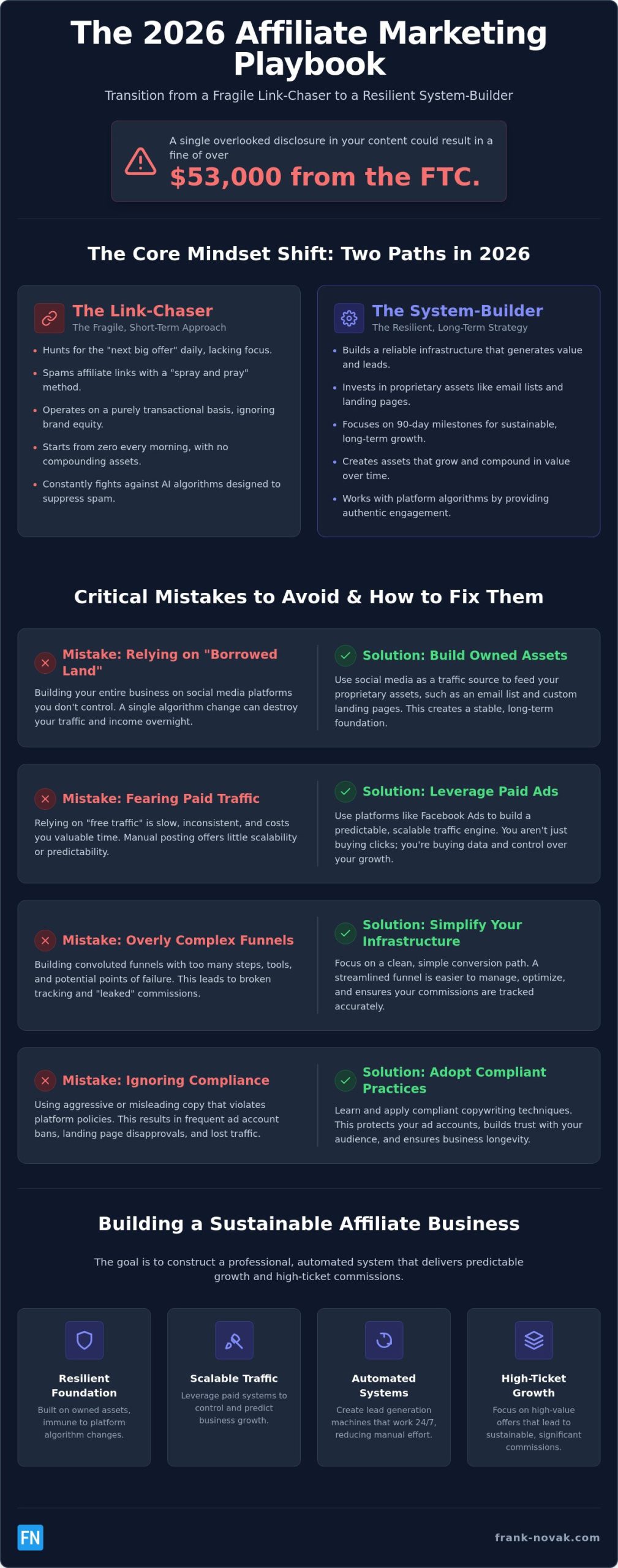
Success in this industry often begins with how you view your role. Many beginners start as “link-chasers,” spending their days hunting for the latest high-converting offer and pasting their affiliate links wherever they can find a gap. This approach is one of the most common affiliate marketing mistakes to avoid because it’s purely transactional. On the other hand, a “system-builder” focuses on creating a reliable infrastructure that generates value and captures leads. While link-chasers are always starting from zero every morning, system-builders create assets that grow over time.
If you look at the history of Affiliate marketing, you’ll see it has evolved from simple link sharing into a complex digital ecosystem. In 2026, AI-driven algorithms on platforms like Facebook and Google are incredibly adept at identifying and suppressing manual link spam. These systems prioritize user experience and authentic engagement. If you’re still relying on the “spray and pray” method, you’re essentially fighting an uphill battle against sophisticated machines that are programmed to filter you out.
To better understand this concept and see how these errors impact your results, watch this helpful video:
One of the biggest hurdles for many is “Shiny Object Syndrome.” It’s tempting to jump from one strategy to another the moment things get difficult. This lack of focus is why many fail before they ever see a result. Breaking these habits can be tough to do alone, which is why professional online success coaching is often the bridge between constant frustration and actual progress. Having a mentor helps you filter out the noise and focus on the core mechanics that actually drive growth while helping you identify other common affiliate marketing mistakes to avoid.
The Trap of Short-Term Thinking
Chasing the “next big offer” might feel productive, but it prevents your business from compounding. If you ignore brand equity in your niche, you’re forced to work twice as hard for every click. Instead of daily profit hunting, try setting 90-day milestones. This shift allows you to build a foundation that supports long-term stability rather than just a quick, fleeting win. When you stop looking for shortcuts, you start seeing the real opportunities for growth.
Moving from Amateur to Professional Practitioner
A professional treats this as a business, not a side-hustle. This means investing in proprietary assets, like your own email list or landing pages, right from the start. The most successful practitioners prioritize learning the mechanics of the system over immediate earnings in their first phase. If you’re willing to build the machine first, the commissions will eventually follow as a natural result of your work. It’s about moving from a hobbyist mindset to a structured, professional approach.
Traffic and Audience Mistakes: Relying on Borrowed Land
If you build your entire business on a social media platform, you’re essentially building on borrowed land. One of the most common affiliate marketing mistakes to avoid is the total reliance on a single traffic source that you don’t own. In 2026, we’ve seen how quickly algorithm shifts can decimate reach for even the most established creators. While social media is a fantastic tool for discovery, it should always function as a feeder for your own proprietary assets rather than the foundation of your business.
Many beginners gravitate toward “free traffic” because it seems safer, but this is often the most expensive path in terms of time and opportunity cost. Spending hours manually posting across groups or forums rarely yields the same consistency as a structured system. Instead, learning to use Facebook ads for affiliate marketing allows you to build a predictable, scalable engine. When you pay for traffic, you aren’t just buying clicks; you’re buying data and the ability to control your growth at will.
Another critical error is direct linking, which is the practice of sending traffic straight to a vendor’s sales page. If you do this, you lose the opportunity to follow up with the visitor. Since most people don’t buy on the first visit, you’re essentially throwing away the majority of your traffic investment. By capturing an email address first, you ensure that the money is indeed in the list. This owned audience becomes a hedge against platform changes and rising ad costs. To ensure your promotions remain above board, it’s helpful to review the FTC’s Endorsement Guides to maintain transparency with your new subscribers.
The Platform Risk Reality
We’ve witnessed countless “overnight” business deaths because a platform decided to change its terms or deprioritize a certain content format. If your income depends on a specific app’s favor, you don’t have a business; you have a high-risk hobby. Successful marketers use social channels to find leads, but they move those leads to an email list as quickly as possible. This strategy ensures that your quality of lead remains high and your communication channel stays open regardless of what a tech CEO decides tomorrow.
The Failure to Capture Leads
Every click that doesn’t result in a lead capture is a missed chance to build ROI. When you have a mailing list, your customer acquisition cost drops significantly because you can market to the same person multiple times for free. In 2026, audiences are more discerning, so your lead magnets must provide genuine, immediate value. If you’re feeling stuck on how to structure these systems, exploring Online Success Coaching can provide the clarity needed to stop the leak in your funnel and start building real equity.
Infrastructure Failures: Why Your Funnel is Leaking Commissions
If you’ve ever felt like your hard-earned traffic is disappearing into a black hole, you’re likely dealing with a leaky funnel. Many entrepreneurs spend thousands on ads only to realize their conversion path is filled with friction points that drive users away. Identifying these structural gaps is one of the most critical common affiliate marketing mistakes to avoid if you want to see a real return on your ad spend. Even the most targeted traffic cannot overcome a broken user experience or a confusing offer sequence.
One frequent error is the tendency to over-complicate the process. Some marketers build massive, multi-step funnels for relatively simple offers, which often leads to “decision fatigue” for the visitor. If a user has to click through five different pages before seeing the product, they’ll probably leave. This is why systems like the ClickBank Super Funnel are so effective; they remove the technical setup hurdles and provide a streamlined, proven path to conversion. By simplifying the journey, you make it easier for the customer to say yes.
We also see many affiliates underestimating the impact of mobile performance. In 2026, the majority of your traffic will likely come from mobile devices. If your landing page takes more than three seconds to load or has a cluttered UI, your conversion rate will plummet. A professional funnel must be light, fast, and intuitive to navigate on a small screen. If you haven’t tested your funnel on multiple devices, you’re likely leaving significant commissions on the table.
The Architecture of a High-Converting Funnel
A professional funnel typically follows a logical three-step progression. First, the Bridge Page acts as a warm-up for cold leads, introducing the solution and building rapport. Second, the Value Loop provides immediate utility or information, proving that you’re a helpful guide rather than just a salesperson. Finally, the Automated Follow-up handles the heavy lifting. Since roughly 80% of sales happen after the initial contact, having a structured email sequence is non-negotiable for long-term success.
Automation Mistakes that Kill Conversions
While automation is essential, over-automating can be another of the common affiliate marketing mistakes to avoid. If your email sequences feel robotic or lack a human touch, subscribers will quickly tune out. You also need to ensure your tracking is flawless. Broken tracking is a silent killer because it prevents you from knowing which ads are actually working. Without accurate data, you can’t effectively A/B test your “Hook” against your “Offer,” which is the only way to systematically improve your results over time.
The Compliance Trap: Avoiding Facebook Ad Bans and Account Flags
Facebook bans are rarely random. Usually, they’re the result of “lazy” copywriting that triggers automated filters. If you use aggressive income claims or “Get Rich Quick” language, you’re practically asking for an account flag. This is among the most common affiliate marketing mistakes to avoid because it instantly halts your traffic flow and can lead to permanent loss of your advertising assets. Instead of promising specific dollar amounts, focus on curiosity-based marketing. This approach piques interest without making unverifiable claims that violate Meta’s advertising policies.
Beyond the ad copy itself, your landing pages must meet strict standards. A compliant Privacy Policy and Terms of Service are not optional; they’re essential for passing both automated and manual reviews. If these elements are missing, platforms view your site as untrustworthy or even predatory. Ensuring your infrastructure is legally sound is a simple but vital step in building a resilient business that can withstand scrutiny. It’s about showing the platform that you’re a professional who respects the user experience.
Navigating High-Risk Niches Safely
If you operate in niches like business opportunities or health, you must use the “Benefit of the Benefit” technique. Instead of saying “make money,” describe the freedom or security that comes from having a successful side project. Your landing page should also provide genuine value before the pitch. This might include a helpful tip, a short educational video, or a mini-guide. Additionally, a well-structured “About Me” page helps manual reviewers see you as a real person rather than a faceless entity. When a reviewer sees a clear biography and contact information, it significantly lowers your risk profile.
Recovery and Resilience
If your account is flagged, don’t panic or immediately try to circumvent the system. The mistake of “hiding” or cloaking affiliate links from the platform is a fast track to a permanent ban. Platforms are much smarter than most people realize, and they’ll eventually catch on to deceptive redirects. A more professional approach is to build a multi-account strategy for risk mitigation. By diversifying your ad accounts across different Business Managers, you create a safety net. If one account has an issue, your entire business doesn’t come to a standstill. This level of resilience is what separates long-term practitioners from those who are constantly starting over from scratch.
Building a Sustainable Affiliate Business with Professional Systems
If you want to move beyond the cycle of trial and error, you must commit to a professional infrastructure. One of the final common affiliate marketing mistakes to avoid is the belief that you can scale a business through manual effort alone. To achieve genuine freedom, you need an automated marketing funnel that works while you’re away from your desk. This system handles the heavy lifting of lead generation and follow-up; it allows you to focus on high-level strategy rather than the daily grind of manual link posting.
Incorporating high-ticket offers into your funnel is another vital step for long-term sustainability. As ad costs continue to rise on platforms like Meta and Google, relying solely on small commissions makes it difficult to maintain a healthy profit margin. High-ticket commissions provide the necessary capital to offset your ad spend and reinvest in your growth. When you have a product that pays hundreds or thousands in a single sale, your return on investment becomes much more resilient to market fluctuations.
The biggest hurdle for many isn’t technical, it’s psychological. If you find yourself stuck in a loop of starting and stopping, you might be battling the Never Succeed Online mindset. This is the subconscious belief that success is for others but not for you. Transitioning from a struggling affiliate to a successful digital entrepreneur requires you to shed these limiting beliefs and adopt the habits of a system-builder. If you treat your work as a legitimate business, the results will eventually reflect that level of professionalism.
The Power of Proven Systems
Reinventing the wheel is often the most expensive mistake you can make in this industry. If you use proprietary systems like Webinar Profit Engines, you’re leveraging structures that have already been tested and refined in the real world. These tools remove the guesswork and let you focus on what matters most, which is driving traffic and building relationships. You can also accelerate your progress by participating in Joint Ventures such as the Ambassador JV program. These collaborations allow you to tap into existing authority and resources, which is far more efficient than trying to build every asset from scratch by yourself. It’s about working smarter by using the foundations others have already laid.
Your Next Steps for 2026
Take a moment to audit your current strategy against the common affiliate marketing mistakes to avoid that we’ve discussed throughout this guide. Look at your traffic sources, your lead capture rates, and your compliance standards. If you find gaps in your infrastructure or mindset, don’t be discouraged; identifying these issues is the first step toward fixing them. Finding a mentor who has already navigated these traps can save you years of frustration and thousands of dollars in lost ad spend. A guide provides the perspective you can’t see when you’re in the middle of the struggle.
Your Roadmap to a Resilient Digital Future
Navigating the shifts of 2026 requires a transition from being a simple link-promoter to becoming a strategic system-builder. We’ve explored how owning your audience and prioritizing platform compliance can protect your business from sudden algorithm changes. By addressing these common affiliate marketing mistakes to avoid, you’re doing more than just fixing errors; you’re building a foundation that supports long-term growth and predictable results.
If you’re ready to move past the technical hurdles, the ClickBank Super Funnel provides a streamlined solution. It reduces technical overwhelm by offering proven, Facebook-compliant templates and integrated email automation that works for you around the clock. This approach allows you to focus on high-level strategy while the system handles the heavy lifting of lead generation and follow-up.
Automate your path to commissions with the ClickBank Super Funnel
Success is rarely about working harder; it’s about working with better systems. You have the tools and the knowledge to build something truly sustainable. It’s time to take that next step with confidence and watch your digital business flourish.
Frequently Asked Questions
What is the most common reason affiliate marketers fail in their first year?
Most affiliate marketers fail because they jump between strategies before any single one has time to produce results. This lack of focus prevents the compounding effect necessary for growth. If you constantly switch niches or traffic sources, you never master the specific mechanics of a single system. Treating the business as a hobby rather than a structured professional endeavor is one of the common affiliate marketing mistakes to avoid during that critical first year.
Can I do affiliate marketing without an email list in 2026?
While it’s technically possible to market without a list, you’re essentially leaving your business’s survival in the hands of third-party platform algorithms. Relying solely on “borrowed land” means you lose the ability to follow up with potential customers for free. Building an email list allows you to capture traffic once and market to it indefinitely, which significantly lowers your long-term customer acquisition costs and provides a safety net against sudden account bans.
How do I avoid getting my Facebook ad account banned as an affiliate?
You avoid bans by prioritizing strict adherence to Meta’s advertising policies and avoiding aggressive income claims. Using curiosity-based hooks instead of “get rich quick” promises keeps your account in good standing with both automated filters and manual reviewers. It’s also vital to ensure your landing pages include clear, visible links to a Privacy Policy and Terms of Service, as these are mandatory requirements for 2026 compliance and build trust with the platform.
Is direct linking to affiliate offers still a viable strategy?
Direct linking is largely a dead end in 2026 because it prevents you from building an owned asset or following up with visitors. Most platforms now penalize or outright block direct affiliate links because they often lead to a poor user experience. By using a bridge page or a lead capture funnel instead, you protect your ad accounts and give yourself multiple opportunities to convert a single visitor into a customer through automated follow-up sequences.
How much should I spend on ads before deciding an offer is a failure?
As a general rule, you should spend at least two to three times the commission value of the product before deciding an offer isn’t working. This amount of spend provides enough data to see if your “Hook” or your “Offer” is the problem. If you haven’t reached this threshold, you likely don’t have a statistically significant sample size to make an informed business decision about the campaign’s potential or the quality of the traffic you’re receiving.
What is the 80/20 rule in affiliate marketing automation?
The 80/20 rule suggests that 80% of your business operations, such as lead capture and initial follow-up, should be handled by automated systems like the ClickBank Super Funnel. The remaining 20% should focus on high-level strategy and adding a personal human touch to your communications. This balance ensures your business runs efficiently without losing the authentic connection that builds trust with your audience. It’s about letting the machine handle the grind while you manage the growth.
How do I choose between high-ticket and low-ticket affiliate products?
Choosing between the two depends on your budget, but the most successful models use low-ticket offers to acquire customers and high-ticket products for profit. Low-ticket “tripwires” help offset your daily advertising costs by converting cold traffic quickly. Once a lead is in your system, you can then introduce high-ticket offers to generate significant profit margins. This layered approach ensures you aren’t just breaking even but actually building a scalable and sustainable digital entrepreneurship journey.
Is it worth paying for affiliate marketing coaching?
Investing in professional coaching is often the fastest way to identify the common affiliate marketing mistakes to avoid that you might be blind to. A mentor provides a proven roadmap and helps you navigate technical hurdles like funnel setup and ad compliance. This guidance acts as a bridge between simply knowing the theory and successfully executing a profitable, automated business model. It’s a shortcut that saves you from expensive trial and error.

Article by
Frank Novak
Frank Novak is an online marketing professional and coach who focuses on affiliate marketing and business automation. Through his website, frank-novak.com, he shares insights and strategies for leveraging social media platforms like Facebook to generate traffic and commissions.
Affiliate / Sponsored Content Disclaimer
This [website/post] contains affiliate links. If you click through and make a purchase, we may receive a commission at no additional cost to you. We only recommend products or services we believe will add value to our readers.