

Did you know that affiliate programs migrating to server-side tracking in 2026 are seeing an immediate 18% to 24% increase in attributed conversions? It is understandable to feel frustrated when you see your traffic numbers climb, yet your commission dashboard doesn’t seem to reflect that hard work. You likely feel that if you could just see exactly which click led to which sale, scaling your ads would be a logical next step rather than a risky gamble. Mastering sub-id tracking for affiliate marketing is the bridge that turns that uncertainty into a clear, actionable roadmap for your business.
This guide will teach you the exact methods and technologies needed to ensure every commission is captured and every ad dollar is fully accounted for. We’ll demystify technical terms like S2S and postbacks, replacing confusion with a future-proof setup that works even in a world without third-party cookies. By the end of this article, you’ll have the clarity required to optimize your Facebook ad spend with 100% confidence. We will walk through the transition to privacy-first tracking and show you how to build a reliable system that supports steady, sustainable growth.
Key Takeaways
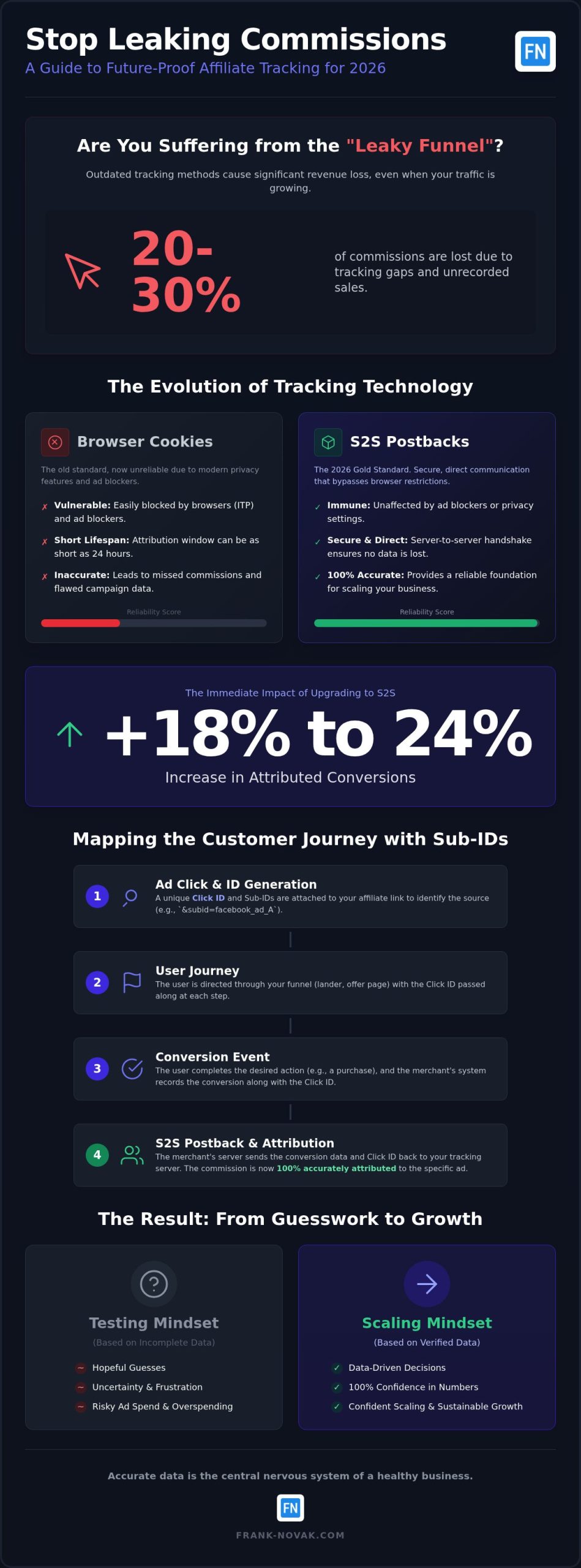
- Identify and repair the “leaky funnel” syndrome to recover the 20% to 30% of commissions that often go unrecorded due to outdated tracking setups.
- Move beyond browser-based cookies by adopting server-to-server (S2S) postbacks, ensuring your tracking remains functional despite modern privacy restrictions.
- Master the use of sub-id tracking for affiliate marketing to gain granular insights into which specific traffic sources and creatives are generating your highest ROI.
- Establish a step-by-step mapping framework that tracks the entire customer journey from the first ad click through to the final offer.
- Transition from a testing mindset to a scaling mindset by using verified data to confidently increase your daily ad spend.
Understanding Affiliate Tracking: Why Accuracy is Your Business Backbone
Many practitioners treat tracking as a secondary task, but it’s actually the central nervous system of a healthy business. In Affiliate marketing, tracking is the methodical process of attributing every single conversion back to its original traffic source. If you don’t have this clarity, especially when implementing sub-id tracking for affiliate marketing, you’re essentially flying blind. We often see affiliates struggling with the Leaky Funnel syndrome. This occurs when technical gaps cause 20% to 30% of sales to go unrecorded. You might be doing all the work, but without an accurate backbone, you’re leaving a significant portion of your income on the table.
If you want to scale Facebook Ads without draining your bank account, you must know exactly which creative is performing. Accurate data is the only reliable shield against overspending on losing campaigns. This is why we emphasize data-driven mentorship within our Online Success Coaching program. We believe that your growth should be based on verifiable facts, not hopeful guesses. When you can see precisely where your money is going, you can invest with the confidence of a seasoned professional.
The Difference Between Clicks and Conversions
It is easy to get distracted by a high click-through rate, but a click is merely a visitor, not a customer. If you aren’t using sub-id tracking for affiliate marketing, you won’t know which specific ad variant actually convinced someone to buy. Modern tracking ecosystems rely on a unique Click ID to follow a user from their first impression to the final checkout page. Attribution is the bridge between a lead’s interest and a coach’s commission. By assigning a unique identifier to every click, you ensure that your marketing efforts are properly rewarded and that you can identify your true winners.
How Tracking Fuels Business Automation
Once you establish a reliable data stream, you can begin to automate the more repetitive parts of your operation. If your tracking is set up correctly, it can trigger automated email sequences that significantly increase the lifetime value of every lead you generate. The ClickBank Super Funnel is built to use this specific data to send timely, relevant follow-ups to your prospects. There is also a quiet, psychological benefit to this approach. When you have absolute trust in your numbers, you can make bold decisions and scale your budget with a sense of steady optimism rather than frantic urgency.
Core Tech: From Cookies to Server-to-Server Tracking
Understanding the machinery behind your business is the first step toward scaling. In 2026, the technology we use to monitor traffic has undergone a significant transformation. While browser-based cookies were once the industry standard, they’re now becoming increasingly unreliable due to shifting privacy norms. To maintain a competitive edge, you need to understand how first-party and third-party data differ. First-party data is information you collect directly through your own systems, while third-party data comes from outside sources that are often blocked by modern browsers. Implementing sub-id tracking for affiliate marketing allows you to organize this data into meaningful insights, regardless of which underlying technology is being used.
The Cookie Crisis: What You Need to Know
Browser-based tracking relies on small files stored in a user’s browser to remember who referred them. However, Intelligent Tracking Prevention (ITP) and updated privacy laws have drastically shortened the lifespan of these files. In many scenarios, you might only have a 24-hour window to capture a sale before the connection is lost. This is particularly challenging for high-ticket items where customers often take several days to make a final decision. When evaluating the future potential of affiliate marketing, it’s evident that relying solely on cookies is a recipe for lost commissions. As a practical tip, you should always prioritize programs that offer at least a 30-day cookie duration to give yourself a fair chance at attribution.
S2S Postbacks: The Gold Standard for 2026
Server-to-Server (S2S) tracking, often called postback tracking, is the gold standard for any serious affiliate in 2026. Instead of relying on the user’s browser, the merchant’s server communicates directly with your tracking server. It’s like a secure digital handshake that happens behind the scenes, completely invisible to the end-user. Because this process doesn’t happen in the browser, it’s immune to ad blockers and restrictive privacy settings. S2S tracking is the secret sauce for high-ticket affiliate success. It ensures that every conversion is recorded with surgical precision, even if the customer switches devices or clears their cache. If you find the technical side of this setup overwhelming, the ClickBank Super Funnel is designed to simplify the tracking mess for beginners. Having a guided approach through Online Success Coaching can help you implement these systems correctly from day one.
While pixels still play a role in helping social media platforms optimize their algorithms, they shouldn’t be your primary source of truth. By combining S2S reliability with granular sub-id tracking for affiliate marketing, you create a robust data foundation that can withstand any future browser updates or regulatory changes.
Overcoming Attribution Gaps in a Privacy-First World
In 2026, the digital environment is more protective of user privacy than ever before. This shift means that standard browser-based methods often fail to bridge the gap when a user starts their journey on one device and finishes on another. This cross-device problem is a major hurdle for many affiliates. If a prospect clicks your ad on their phone during a commute but completes the purchase later on their laptop, you risk losing that commission without a robust system. To solve this, we look at deterministic and probabilistic matching. Deterministic matching uses verified data like email logins to connect sessions, while probabilistic matching uses modeling to predict a match based on behavioral patterns. Navigating these technical hurdles is a core part of what we do in Online Success Coaching. We help you build a setup that captures these hidden conversions so you don’t leave money on the table.
First-Party Data: Your Most Valuable Asset
Building your own email list is the ultimate fail-safe against tracking failures. If you capture a lead through a lead magnet before the affiliate click happens, you own that data regardless of what happens in the visitor’s browser. Using your own domain for tracking links also prevents your traffic from being flagged as a third-party intrusion by modern security software. If you’re looking for more ways to optimize your reach, check out our guide on how to drive traffic to affiliate links. This strategy ensures that you maintain a direct line of communication with your audience, even if tracking cookies are cleared or blocked.
The Facebook Conversion API (CAPI) for Affiliates
The standard Meta Pixel is no longer enough to ensure 100% accuracy in a world dominated by ITP 3.0+. By moving to the Facebook Conversion API (CAPI), you can send events directly from your server to Meta. This bypasses the limitations of iOS privacy settings and ad-blocking extensions that often strip away tracking parameters from the browser. Implementing sub-id tracking for affiliate marketing through CAPI ensures that your ad account receives the data it needs to optimize properly. For those concerned about keeping their accounts safe while scaling, we recommend reviewing Facebook Ads for Affiliate Marketing for the latest compliance tips. This server-side approach is essential for maintaining a future-proof tracking setup that can handle the complexities of modern advertising.
A Step-by-Step Framework for Accurate Funnel Tracking
Building a tracking system shouldn’t be a prolonged or overwhelming process for a solo entrepreneur. If you follow a logical sequence, you can establish a foundation that handles the technical heavy lifting for you. The first step is selecting a dedicated tracking platform that fits your business needs. While some beginners start with basic built-in funnel tools, professional-grade platforms like Voluum or BeMob provide the granular data required for serious scaling. Once your software is in place, you need to map your funnel stages. This involves visualizing the entire path from the initial ad click to your bridge page and through to the final affiliate offer.
After your funnel is mapped, you’ll need to implement sub-id tracking for affiliate marketing by adding specific parameters to your destination URLs. This step is vital because it allows you to see exactly which ad creative or audience segment is responsible for your profit. Finally, you must test the postback handshake. If the merchant’s server doesn’t successfully communicate with your tracker, you won’t see your sales reflected in your dashboard in real-time. Testing this connection before you spend significant money on ads is a non-negotiable part of a professional setup.
ClickBank Tracking Specifics
If you’re working with ClickBank, you’ll use TID (Tracking ID) parameters within your Hoplinks to identify your traffic sources. To get the most out of your data, you should also set up the ClickBank Instant Notification Service (INS). This service sends a real-time ping to your tracker every time a sale, refund, or rebill occurs. If you prefer a system where these technical details are already handled, the ClickBank Super Funnel provides a pre-configured environment that simplifies the process for you. Using sub-id tracking for affiliate marketing within this ecosystem ensures every click is accounted for.
Common Tracking Mistakes to Avoid
One of the most frequent errors is the “Double Pixel” mistake. This happens if you accidentally place your tracking code in two locations, causing a single sale to fire twice and ruining your optimization data. You should also be mindful of view-through conversions. These represent users who saw your ad but didn’t click, yet purchased later. Ignoring this data can lead you to undervalue certain campaigns. Lastly, always account for refunds and chargebacks in your tracking. If you only track the initial sale, you won’t have an accurate view of your actual net profit at the end of the month.
Leveraging Accurate Data to Scale Your Online Success
Once you have established a reliable tracking foundation, you can begin the exciting process of scaling your campaigns with total confidence. Identifying “winner” ads becomes a straightforward task of reviewing your dashboard to see which specific creatives are driving the most profit. If you see one particular ad variant consistently delivering a positive return on investment, you can safely shift your budget toward it while pausing the underperformers. This transition from a $10 per day budget to $1000 per day requires an absolute trust in your data. Scaling is often more of a mindset shift than a technical one; it’s about having the steady confidence to lean into what the numbers are telling you. By mastering sub-id tracking for affiliate marketing, you gain the ability to pinpoint exactly where your profit is coming from, allowing you to grow without the fear of overextending your resources.
Accurate tracking also allows you to build highly effective Lookalike Audiences on platforms like Facebook and Google. By feeding these ad platforms clean conversion data, you’re teaching their algorithms exactly who your ideal customer is. This results in more efficient targeting and higher conversion rates over time. We view tracking not as a technical burden, but as the essential price of entry for achieving true financial freedom. It is the mechanism that transforms a series of random experiments into a predictable, scalable business model.
From Data to Automation
Using tracking tags to segment your email list based on buyer behavior ensures that your follow-up messages are always relevant to the recipient’s journey. This level of precision is what makes Automated Marketing Funnels so effective in the long term. If you find yourself overwhelmed by the volume of data, working with a coach can help you interpret these complex signals for faster results. Implementing sub-id tracking for affiliate marketing is the first step toward a truly automated business that runs smoothly even when you aren’t at your desk.
Your Next Steps for 2026
We recommend that you conduct a thorough audit of your current links and Sub-ID setup today. Ensuring that every parameter is firing correctly is a prerequisite for any serious growth strategy in 2026. If you’re looking for a clear roadmap and a community of supportive, data-driven entrepreneurs, we invite you to take the next step in your professional development. We are here to help you bridge the gap between complex systems and your ultimate goals.
Building Your Scalable Future with Data
Transitioning to server-to-server tracking and mastering sub-id tracking for affiliate marketing are the first steps toward a sustainable business. By closing the gaps in your attribution and moving beyond browser-based cookies, you ensure that every sale is properly credited to your hard work. This level of precision allows you to stop guessing and start making strategic decisions that lead to long-term growth. If you’ve been losing commissions to technical errors, implementing these frameworks will provide the relief and clarity you need to move forward.
Frank Novak, the founder of the ClickBank Super Funnel, has spent years refining these exact methods to help affiliates succeed. His expertise in Facebook Ad compliance and business automation provides a steady roadmap for those looking to bypass common hurdles and scale their daily spend with confidence. You now have the tools and the mindset to turn your tracking from a technical burden into your greatest competitive advantage.
It’s time to step forward with the clarity and optimism required to reach your next professional milestone. You have the potential to create a lasting impact, and we’re here to support you as you build a business that is both profitable and resilient.
Frequently Asked Questions
What is the most accurate way to track affiliate sales in 2026?
Server-to-Server (S2S) tracking is the most reliable method for capturing affiliate sales in 2026. Unlike browser-based methods, S2S communicates directly between the merchant’s server and your tracking software. This ensures that privacy settings or ad blockers don’t interfere with your data. Programs using this method report an 18% to 24% increase in attributed conversions. This precision is vital if you want to scale your budget without losing track of your actual earnings.
Can I track affiliate sales without using cookies?
Yes, you can track sales without cookies by implementing server-side postbacks. This method relies on a unique Click ID that is generated when a user clicks your link. This identifier is passed to the merchant and sent back to your tracker once a purchase is made. It’s a highly effective way to future-proof your business against the ongoing deprecation of third-party cookies. This setup ensures that your sub-id tracking for affiliate marketing remains accurate and dependable.
Why is there a discrepancy between my affiliate dashboard and my tracking software?
Discrepancies often occur due to differences in time zones, bot filtering, or browser-side tracking failures. If your affiliate network uses cookies while your tracker uses S2S, the network might miss sales that your tracker correctly identifies. Additionally, some networks only update their dashboards every few hours rather than in real-time. Understanding these technical gaps is essential for maintaining a clear view of your ROI. Consistent auditing of your setup helps minimize these frustrating data mismatches.
How do I track affiliate sales coming from Facebook Ads?
The best way to track Facebook traffic is by using the Facebook Conversions API (CAPI) in conjunction with your primary tracker. CAPI sends event data directly from your server to Meta, bypassing browser limitations like ITP. This allows you to see exactly which ad sets are producing the best results. By integrating sub-id tracking for affiliate marketing into your URLs, you can identify winning creatives and scale your ad spend with a much higher degree of confidence.
What is a Postback URL and do I really need one?
A Postback URL is a specific web address used to notify your tracking software of a successful conversion. It acts as a digital handshake between the affiliate network and your system. You definitely need one if you plan on scaling to high volumes, as it’s the only way to ensure 100% accurate attribution in a privacy-first world. Without a postback, you’re forced to rely on less reliable browser-based pixels that often fail to fire when needed.
Is it possible to track cross-device affiliate conversions accurately?
Accurately tracking cross-device journeys is possible through deterministic matching, which uses persistent identifiers like email addresses to link sessions. While no system is perfect, modern tracking platforms use advanced modeling to connect a mobile click with a desktop purchase. This is particularly important for high-ticket offers where the customer journey is longer. Establishing a first-party data strategy, such as building an email list, is the most effective way to bridge these attribution gaps.
Do I need a developer to set up server-to-server tracking?
You don’t necessarily need a developer to set up S2S tracking because many modern platforms offer user-friendly interfaces. Most major affiliate networks have pre-configured templates for popular trackers, making the process a matter of copying and pasting the correct URLs. If you find the technical steps intimidating, automated systems or guided coaching can help you navigate the setup. The goal is to make these advanced systems accessible to entrepreneurs without a computer science background.
How much does affiliate tracking software typically cost?
The cost of tracking software depends on several factors, including your monthly click volume and the level of technical support you need. Most reputable platforms offer tiered subscription models that allow you to increase your capacity as your traffic grows. It’s advisable to compare different providers based on their integration capabilities and data retention periods. Investing in a reliable tracker is a strategic decision that helps ensure your marketing budget is spent efficiently and effectively.

Article by
Frank Novak
Frank Novak is an online marketing professional and coach who focuses on affiliate marketing and business automation. Through his website, frank-novak.com, he shares insights and strategies for leveraging social media platforms like Facebook to generate traffic and commissions.
Affiliate / Sponsored Content Disclaimer
This [website/post] contains affiliate links. If you click through and make a purchase, we may receive a commission at no additional cost to you. We only recommend products or services we believe will add value to our readers.