

More tools won’t necessarily make affiliate marketing more productive. If you repeat the same work across content, email, and tracking, the right affiliate marketing tools for productivity can help, but only when they fit a clear process. Otherwise, another app can add more to manage instead of giving you time back.
It’s easy to feel pulled between overlapping features, scattered links, campaign details, and follow-up tasks. The goal isn’t to automate everything at once. Identify the repetitive work that slows you down, choose a practical tool for that job, and keep the workflow simple enough to maintain.
In this guide, you’ll learn how to match tools to tasks such as content planning, email management, and link tracking, and how to assess whether an app belongs in your stack. You’ll also see how to establish a manageable routine before adding automation, so you spend less time retracing steps and more time creating useful content and building audience relationships.
Key Takeaways
- Identify which repeat tasks consume your time before choosing affiliate marketing tools for productivity.
- Match each tool category to a specific job, and skip features that don’t solve a current need.
- Compare tools by essential capabilities, setup effort, integrations, and observable signs they’re helping your workflow.
- Map a repeatable campaign process first, then automate administrative steps while keeping important content and audience decisions in your hands.
- Use a lean stack to support planning, publishing, follow-up, and measurement without expecting software to replace useful content or consistent audience care.
Affiliate Marketing Productivity Tools: Find the Tasks Taking Up Your Time
Affiliate marketing can involve writing, publishing, sharing links, sending emails, and reviewing results. Yet it’s easy for the workday to disappear into managing the tools meant to support those tasks: searching for a campaign note, checking several dashboards, or copying a link from an old document. The useful question isn’t how many apps you can add. It’s which repeated task is slowing you down.
Here, productivity tools means software or systems that help you organize, simplify, measure, or automate specific work. Since affiliate marketing centers on promoting another company’s products or services in exchange for a commission, its basic process is a helpful starting point. What is affiliate marketing? A tool can support the planning and follow-through around that process, but it can’t decide which audience needs your content or why your recommendation is useful.
Common time drains include:
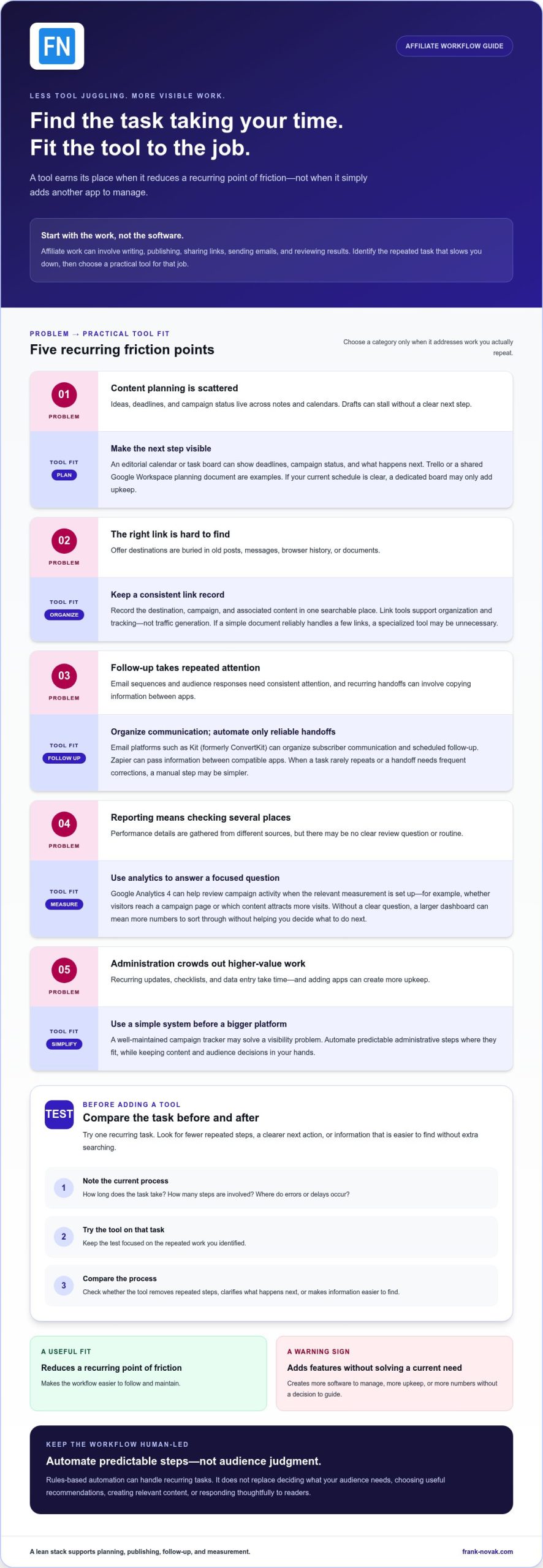
- Content planning: Ideas, deadlines, and campaign status are scattered across notes and calendars.
- Link management: You search old posts or messages to find the right destination for an offer.
- Follow-up: Email sequences and audience responses need consistent attention.
- Reporting: You gather performance details from different places without a clear review routine.
- Repetitive administration: Recurring updates, checklists, and data entry take time away from higher-value work.
These tasks don’t all need a new app. A simple, well-maintained campaign tracker may solve a visibility problem that would otherwise lead you to adopt a larger platform. The goal is to make your process easier to follow, not to build a complicated system for its own sake.
Which affiliate marketing tasks benefit most from tools?
Planning tools make content ideas, due dates, and campaign stages visible in one place, so a draft is less likely to stall unnoticed. Link-management tools give each offer a clear, searchable record instead of leaving destinations buried in browser history or old documents. Email tools help organize scheduled follow-up, while analytics tools bring performance signals together for review. Each category earns its place when it reduces a recurring point of friction.
How can you tell whether a tool is actually saving time?
Before adopting software, choose one recurring task and note how long it takes, how many steps it involves, and where errors or delays tend to occur. Try the tool on that task, then compare the process. A useful tool removes repeated steps, clarifies what needs to happen next, or makes information easier to find without extra searching.
“A better workflow means less friction in the work; a bigger software stack just means more software to manage.” Keep that distinction in mind as you explore affiliate marketing tools for productivity. Tools can support a sound strategy, but audience value still comes from relevant recommendations, useful content, and thoughtful follow-through.
Affiliate Marketing Tools for Productivity: The Main Categories to Know
Rather than treating tools as a ranked shopping list, group them by the work they help you complete. A useful stack might include one place to plan campaigns, a way to organize links, a channel for subscriber follow-up, and a method for reviewing results. The right mix depends on your process; not every affiliate marketer needs every category.
Planning, content, and link organization tools
Editorial calendars and task boards help move an idea from draft to publication by making deadlines, campaign status, and next steps visible. A board in Trello or a shared planning document in Google Workspace can illustrate this approach. If you can manage your content schedule without a dedicated board, adding one may create upkeep instead of clarity.
Link organization tools give you a consistent place to record the destination, campaign, and content associated with each affiliate link. This makes it easier to locate the right link when updating a post or preparing an email. These tools help with organization and tracking, not traffic generation. If you use only a few links and can reliably find them in a simple document, a specialized tool may be unnecessary.
Email, automation, and analytics tools
Email platforms, such as Kit (formerly ConvertKit), can help organize subscriber communication and scheduled follow-up. Automation connectors such as Zapier pass information between compatible apps, which can reduce repeated copying when a dependable connection is available. If you rarely repeat the task or the handoff needs frequent corrections, a manual step may be simpler.
Analytics tools such as Google Analytics 4 can help you review focused questions about campaign activity and outcomes, provided the relevant measurement is set up. You might check whether visitors reach a campaign page or which content attracts more visits. If you don’t have a clear question to answer, a larger dashboard may give you more numbers to sort through without helping you decide what to do next.
Marketing automation is rules-based handling of recurring tasks, not a substitute for deciding what your audience needs. Let tools handle predictable steps where they fit, while you retain judgment over recommendations, content, and how you respond to readers.
Before choosing among affiliate marketing tools for productivity, write down the job each one would perform and what it would replace. Compare the capabilities, setup effort, compatibility, and cost against your current needs. If you’re shaping your tools into a repeatable business process, Frank Novak’s affiliate marketing guidance can offer another perspective on connecting daily work to a broader plan.
How to Compare Affiliate Marketing Tools Without Overbuilding Your Stack
Two tools can offer similar features but fit very differently into your day. To compare affiliate marketing tools for productivity, start with the bottleneck you want to fix, then weigh the practical work of adopting the tool against the time or confusion it could remove. A feature list alone won’t tell you whether it suits your workflow.
Use this table to assess a candidate before adding it. Treat setup effort as the work required to configure and learn the tool, and choose a review signal you can actually observe.
| Task | Essential capability | Setup effort | Integrations | Review signal |
|---|---|---|---|---|
| Content planning | Track ideas, deadlines, and status | Low if the process is simple | Calendar or document tools | Fewer missed handoffs or unclear next steps |
| Link organization | Store destinations with clear labels | Low to moderate, depending on migration | Website, email, or reporting workflow | Less time searching or correcting links |
| Email follow-up | Organize subscribers and scheduled messages | Moderate if lists and sequences need setup | Forms and relevant campaign tools | More reliable follow-up with less manual work |
| Reporting | Show the activity or outcome you need to review | Moderate if measurement needs configuration | Website and campaign data sources | Clearer decisions from a regular review |
What should you check before adopting a productivity tool?
Give each candidate one specific job, such as reducing repeated link searches or making campaign status easier to see. Check whether it works with the tools and channels you already use, and whether you can access and export the data you need. Review its privacy practices and estimate the learning effort, too. A powerful tool may still be a poor fit if maintaining it becomes another recurring task.
When is a free or basic setup enough?
A simple setup can work well while your campaigns, content, or reporting needs remain straightforward. A calendar, spreadsheet, or basic account may cover the task without extra configuration. Consider upgrading only when a repeated limitation creates meaningful friction, such as routine manual work or information you can’t easily retrieve.
Before paying for a new platform, compare what it would replace with the functions you already have. Overlapping tools can split records and add learning effort without solving a distinct problem. Advanced reporting, complex automations, or extensive integrations may be useful later, but beginners don’t need them by default. Choose based on your current bottleneck, then review the fit after using the tool in your actual workflow.
Build a Productive Affiliate Marketing Workflow Before Automating It
Automation works best when the steps are already clear. Before connecting apps, decide what a campaign moves through, what handles each step, and how you’ll know it’s complete. That simple map helps you see which actions need your judgment and which are predictable enough to streamline.
Automating a broken process can reproduce its problems faster. If links are mislabeled or publishing steps are unclear, automation can spread those mistakes rather than fix them. Build the routine first, then add tools where they reduce avoidable effort.
A simple tool workflow for a solo affiliate marketer
Start with one campaign goal, such as publishing a useful article that introduces an offer to a relevant audience. Record the related content, links, publishing status, and next action in one accessible place. A simple sequence might look like this:
- Choose the task: Define the campaign goal and the specific content you’ll create.
- Plan: Add the idea, deadline, and next steps to a calendar or task board.
- Publish: Review the content, confirm its links, and mark its status.
- Organize: Keep campaign links and their destinations together with clear labels.
- Review: On a consistent schedule, check a small set of relevant measures, such as visits to the content or activity associated with the campaign.
This gives you a repeatable path without requiring a complex system. Keep the record easy to update; if it takes longer to maintain than to use, simplify it.
What should you automate first?
Look for a task that repeats, follows clear rules, and has a predictable result. For example, a form submission might trigger a notification or move information into a campaign record, if the apps support that connection. Start with one automation, run a test, and confirm that the right information arrives in the right place. Check it again during normal use so errors don’t quietly accumulate.
Keep human review for choices that depend on trust, message quality, or audience context. An automation can schedule a follow-up, but you should still decide whether the message is useful, accurate, and appropriate for the people receiving it. A practical automated marketing funnel guide can help you think through how recurring steps fit together, but your audience and campaign goals should shape the decisions.
Use affiliate marketing tools for productivity to support the process, not dictate it. Once the steps are clear, add automation only where a repeated handoff is genuinely slowing you down. If you’re ready to strengthen your affiliate workflow, explore Frank Novak’s online success guidance.
Turn Affiliate Marketing Tools Into a Sustainable Growth System
A lean tool stack is most useful when each part supports a step in a repeatable process. Planning tools help you map ideas and deadlines, publishing tools keep work moving, email tools support relevant follow-up, and analytics help you review what happened. The aim isn’t to automate every interaction. It’s to make routine work easier to manage while leaving room for thoughtful decisions.
Software alone can’t make an affiliate business sustainable. Useful content, relevant recommendations, and consistent audience care are what give your workflow purpose. Tools can help you carry out those activities reliably, but they can’t replace understanding who you’re speaking to or what would genuinely help them.
Where does a funnel fit into a productivity system?
A funnel connects the stages between someone discovering your content, receiving useful follow-up, and encountering an offer that fits their interests. Its structure describes how those steps relate; the software you use to organize contacts, schedule messages, or review activity is separate. Frank Novak’s ClickBank Super Funnel is a resource for exploring funnel implementation, without treating a particular tool or sequence as a guaranteed route to results.
Traffic is another part of the system: people need a way to find useful content before follow-up can begin. Consider how a strategic guide to affiliate traffic could fit alongside your planning and publishing process, while keeping your traffic activities aligned with the audience you want to reach.
To keep the system manageable, connect each tool to a clear purpose: plan the content, publish it, record the campaign links, follow up appropriately, and review relevant activity. If a tool doesn’t support one of those steps or resolve a real bottleneck, it may not need a place in your stack.
When can coaching help you simplify your approach?
Sometimes the hard part isn’t finding another app; it’s deciding what to prioritize and how the pieces fit together. Online Success Coaching with Frank Novak offers structured support to clarify campaign goals, review your workflow, and identify practical next steps. That guidance can help you focus your efforts without assuming that every business needs the same tools or process.
As you build your system, review it periodically. Notice which steps feel clear, where work gets delayed, and whether each tool still supports a meaningful task. Keep what helps, simplify what creates unnecessary maintenance, and adjust the workflow as your needs change. Sustainable progress comes from a process you can keep using, not a stack of features you rarely touch.
If you’d like support clarifying priorities and applying this framework to your affiliate workflow, explore online success coaching.
Make Your Next Workflow Improvement Count
Your next step doesn’t need to be a full system rebuild. Choose one point where your work routinely slows down, make that part clearer, and give the change enough time to prove useful. That steady approach keeps affiliate marketing tools for productivity connected to real needs instead of turning software selection into another project.
As your process takes shape, decide whether to keep refining it independently or get help choosing priorities. Frank Novak focuses on affiliate marketing and business automation. His Online Success Coaching offers support as you work through your next steps.
Build at a pace you can sustain. Each practical improvement can make it easier to focus on the work that matters to your audience.
Frequently Asked Questions
How many tools do you need to start affiliate marketing?
There’s no fixed number; start with the tools needed to publish and keep your work organized. One document or spreadsheet may be enough to record content ideas, campaign links, and next steps, while your existing publishing platform handles the content itself. Add another tool only when you can name the specific gap it fills. A small setup is easier to understand and adjust as your routine develops.
Can you do affiliate marketing with free tools?
Yes, free or basic tools can be enough to get started, especially if you’re managing a small number of campaigns. You might use a document to plan content, a spreadsheet to record links, and the reporting available through your publishing or affiliate platform. Consider the limits of a free plan before building your process around it. If a restriction repeatedly interrupts your work, that’s a practical reason to reassess.
What is the best productivity tool for affiliate marketers?
The best choice depends on your most persistent bottleneck, not on a universal ranking. If content deadlines slip, a calendar or task board may help more than an analytics platform. If you lose campaign destinations, a labeled link record could be the better first step. Choose affiliate marketing tools for productivity by naming the problem, trying a simple solution, and checking whether the work becomes easier to complete.
Is marketing automation useful for affiliate marketing beginners?
It can be useful when a beginner has a stable task that repeats in the same way, such as organizing a notification after a form is submitted. Start with one small automation and check that it handles information correctly before depending on it. If the process changes often or needs personal judgment, keep it manual for now. Learning the underlying steps first makes it easier to spot errors.
How can affiliate marketers track links and campaign results?
Give each campaign link a clear label that identifies the offer and the content where it appears. Keep a record of the destination and placement, then use reporting from relevant affiliate programs or site analytics to review activity. Compare like with like, such as two placements for the same campaign, rather than drawing conclusions from unrelated data. Test links after publishing so a tracking issue doesn’t go unnoticed.
Should affiliate marketers use AI productivity tools?
AI tools can assist with bounded tasks such as brainstorming article angles, organizing notes, or producing a rough outline. Treat the output as a starting point, not a finished recommendation: verify product details, add your own experience and audience context, and edit for accuracy and voice. If the tool creates more checking work than it removes, it may not be a fit. Avoid entering sensitive information without understanding the tool’s data practices.
Do affiliate marketers need an email list to be productive?
No. An email list can support ongoing communication, but it isn’t a prerequisite for keeping affiliate work organized or publishing helpful content. Your best starting channel depends on where you can consistently reach the people you want to serve. If you later build a list, plan what subscribers will receive and how often you can provide value. A manageable publishing routine matters more than adding a channel you can’t maintain.

Article by
Frank Novak
Frank Novak is an online marketing professional and coach who focuses on affiliate marketing and business automation. Through his website, frank-novak.com, he shares insights and strategies for leveraging social media platforms like Facebook to generate traffic and commissions.
Affiliate / Sponsored Content Disclaimer
This [website/post] contains affiliate links. If you click through and make a purchase, we may receive a commission at no additional cost to you. We only recommend products or services we believe will add value to our readers.