

A new ClickBank listing can look like a promising opportunity, but being new doesn’t make it a good fit. If you’re learning how to find new ClickBank products to promote, Marketplace listings and featured rankings can quickly feel overwhelming, especially when the numbers don’t tell the whole story.
A product may have appealing stats and still be a poor match for your audience, content, or promotion style. Treat each new offer as a lead to investigate, not proof that it deserves your time. Start by asking whether it solves a problem your audience already cares about.
This guide offers a repeatable process for finding fresh offers, comparing them against audience fit and offer quality, and interpreting Marketplace data carefully. You’ll learn where to look, what to assess, and how to narrow your options to a manageable shortlist. Then you can test one offer with a focused promotion before deciding whether to expand your efforts.
Key Takeaways
- Learn how to find new ClickBank products to promote by distinguishing recently listed offers from top performers and products that are simply new to you.
- Use a focused Marketplace search: start with an audience problem, explore relevant categories, and narrow results with the controls available.
- Compare candidates by audience fit, sales-page clarity, affiliate resources, and Marketplace metrics. Treat statistics as clues, not promises.
- Build a shortlist with a clear reason for each choice, then test one offer with a specific audience segment and promotion approach.
- Use what you learn to shape a sustainable plan for content, audience engagement, and follow-up.
Where to find new ClickBank products to promote
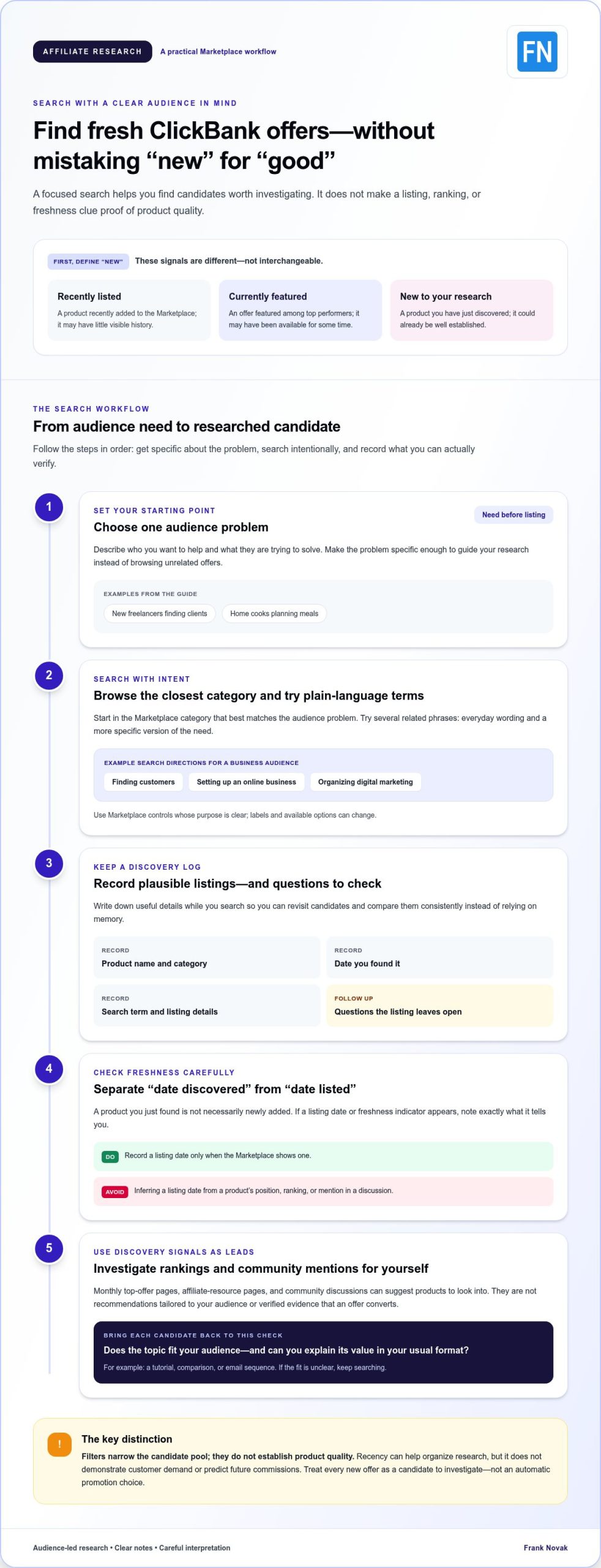
“New” can mean three different things: a product recently added to the Marketplace, an offer currently featured among top performers, or a product you’ve only just discovered. These signals aren’t interchangeable. A top offer may have been available for some time, while a recently listed product may have little visible history. And a product that’s new to you could already be well established.
The ClickBank Marketplace is a practical starting point for affiliate offer discovery. Its categories help you move from a topic your audience cares about to products that may address it. For background on the platform and its role in e-commerce and affiliate marketing, see the ClickBank Wikipedia article. Keep this distinction in mind: a new offer is a candidate to investigate, not an automatic promotion choice.
For a walkthrough of browsing offers, this video demonstrates one approach to finding ClickBank products:
Use the ClickBank Marketplace as your starting point
Begin with an audience problem, then browse the Marketplace category that most closely matches it. If your content helps readers build an online business, for example, explore relevant e-business or marketing offers instead of starting with a broad search across unrelated topics. For each plausible listing, note what it sells, who it appears to serve, and what information it provides to affiliates.
Marketplace labels and controls can change, so use the options you see rather than assuming a particular filter or metric is still available. Keep a discovery log with the product name, category, date you found it, listing details, and where you discovered it. That record helps you revisit candidates and distinguish a recently listed product from one that’s simply new to your research.
Check rankings and community discussions without following them blindly
ClickBank’s monthly top-offer page can show which products are receiving attention in a given period. Use it to generate ideas, then return to the Marketplace listing and assess each offer for yourself. Official affiliate-resource pages can also point you toward featured, best-selling, or niche-specific products. Rankings are discovery signals, not recommendations tailored to your audience.
Community discussions can surface offers you might not find through browsing alone. Treat posts as prompts to investigate, not verified evidence that a product converts or suits your channel. For each candidate, ask whether its topic fits your audience and whether you can explain its value through your usual format, such as a tutorial, comparison, or email sequence. If the fit isn’t clear, keep searching rather than letting a ranking or enthusiastic post make the decision.
How to search ClickBank for fresh affiliate offers
A focused search starts before you open the Marketplace. Decide who you want to help and what problem they’re trying to solve, then use that definition to guide your research. This keeps a search for fresh offers from becoming an unfocused tour of unrelated products. The goal is to find candidates for closer review, not to choose an offer based on a search result alone.
Use this repeatable workflow:
- Choose an audience problem. Make it specific enough to guide your search, such as helping new freelancers find clients or helping home cooks plan meals.
- Search the closest category. Browse the Marketplace category that best matches the problem, then try a few plain-language terms a potential customer might use.
- Record plausible listings. Add the product name, category, date found, search term, and useful listing details to a research sheet. Note questions to follow up on instead of relying on memory.
A simple record makes your process easier to repeat. It also shows whether an offer came from a targeted search, a broad category browse, or a freshness clue in the Marketplace. If you’re learning how to find new ClickBank products to promote, separating these discovery paths helps you compare candidates more fairly later.
Start with the audience problem, then search by category
Before browsing, describe the audience and its need in one sentence. Then brainstorm several related search phrases, including everyday wording and a more specific version of the problem. For an audience interested in starting a business, terms might focus on finding customers, setting up an online business, or organizing digital marketing. Search these phrases in the most relevant category and record listings that address the same need. You’ll have a more focused pool to investigate.
Use marketplace filters and freshness clues carefully
Marketplace controls and labels can change, so review the options currently displayed and use only those whose purpose is clear. If a listing date or another freshness indicator appears, record it and note what it actually tells you. A product you just found isn’t necessarily newly added. Search filters reduce the candidate pool, but they can’t establish product quality.
Be precise in your notes: distinguish “date discovered” from “date listed.” If the interface doesn’t show a listing date, don’t infer one from a product’s position, ranking, or mention in a community discussion. Recency can help organize research, but it doesn’t demonstrate customer demand or predict future commissions. To assess those questions, examine the offer and how well it fits your audience.
Once you have a small set of candidates, compare them using consistent criteria rather than choosing whichever listing looks newest. A deliberate search and record-keeping habit supports the audience-led approach Frank Novak shares through affiliate marketing guidance.
How to compare new ClickBank products before choosing one
Compare candidates against the same criteria instead of letting one attractive statistic decide. A listing can be new, popular, or well presented without being right for your readers. A strong audience-offer match matters more than novelty because promotion works best when the offer addresses a need your audience recognizes.
Assess audience fit and the offer itself
Review each product from a reader’s point of view. Does it address a clear problem your audience has? Can you explain what the product offers and who it’s for after reviewing the sales page? Are the claims clear and consistent, with an understandable next step? Then look at the affiliate resources, if provided. Text links may suit an email promotion, while visual assets or product details may support a video or tutorial. Record what’s available rather than assuming the seller will provide additional materials.
| Comparison area | What to assess | Notes to record |
|---|---|---|
| Audience fit | Does the product address a relevant, recognizable need? | Audience segment and problem it solves |
| Sales-page clarity | Are the offer, claims, and next step understandable? | Clear points and anything that could confuse readers |
| Affiliate resources | Are the available materials suitable for your publishing format? | Resources present and how you could use them |
| Marketplace metrics | What values or commission details does the current listing display? | Labels, values, and date checked |
This comparison turns “looks promising” into specific observations. If a product fits your audience but the sales page is hard to explain, record that concern instead of overlooking it because another feature looks attractive. If the offer is clear but the available materials don’t fit your channel, decide whether you can still create useful, accurate content without them.
Read marketplace statistics in context
ClickBank listings may show indicators such as Gravity, average payout, or recurring commission information. Labels, definitions, and availability can change, so check the current Marketplace explanations before interpreting a figure. Record the displayed label and value, along with the date you reviewed it. Don’t assume a metric means more than ClickBank’s current description says it does.
Compare like with like where possible. For example, review offers in a similar category and consider commission details alongside audience fit, rather than treating one number as the deciding factor. Statistics can help you organize candidates and spot differences, but they’re clues for comparison, not reliable guarantees of future results. No single Marketplace metric proves that an offer converts well for your audience or predicts what you’ll earn.
As you build a repeatable approach to how to find new ClickBank products to promote, focus on evidence you can actually observe. For additional perspective on aligning offers with a sustainable affiliate process, explore Frank Novak’s affiliate marketing guidance.
A practical process for shortlisting and testing new offers
After comparing candidates, resist the urge to promote every offer that passes an initial review. A small shortlist makes it easier to give each product a clear test and learn from the response. Include a candidate only when you can explain why it fits your audience, how you’d introduce it, and what you still need to learn.
Create a focused shortlist before promotion
For each candidate, write a brief selection note: the audience segment, the problem the offer addresses, your reason for considering it, and what remains unknown. Remove any product whose claims or messaging don’t meet your content standards. If you can’t describe the offer accurately or explain why it belongs in your content, it isn’t ready for your shortlist.
Next, pair each shortlisted offer with one audience segment and one suitable content or traffic approach. For example, if you serve people learning to manage a home-based bookkeeping practice, test one relevant offer through a practical educational article rather than promoting several unrelated products across every channel. Choose a channel that suits the audience and gives you room to explain the offer accurately. For more ideas on matching a channel to your promotion, see this strategic affiliate traffic guidance.
Review early signals and decide what to do next
Before you publish or launch, choose a review point that gives your test time to gather useful activity. Use tracking tools available to you to record clicks and any subsequent actions you can observe, such as visits to the offer page or completed sales where reporting makes that information available. Keep notes on the content and channel used so you can interpret the results in context.
Read early signals carefully. Clicks without further action may mean the message attracted attention but didn’t set the right expectations, or that the audience and offer aren’t aligned. A small number of interactions is weak evidence, not a confirmed pattern. Don’t treat one sale or a quiet start as a definitive verdict.
- Continue if the offer fits your audience and the available signals support a measured next test.
- Adjust if people engage but the content, audience targeting, or explanation may need refinement.
- Stop if the offer conflicts with your standards or repeated reviews show no useful reason to continue.
Apply the same review method to each test, and change one meaningful element at a time where possible. That makes it easier to see whether a change in content, audience, or channel affected engagement. Learning how to find new ClickBank products to promote becomes a practical routine: shortlist with purpose, test with focus, and expand only when the evidence supports it.
Turn a selected ClickBank offer into a sustainable promotion plan
A validated offer is a starting point, not a complete promotion strategy. Give it a fair, useful test by connecting it to a specific audience, a clear content idea, and a thoughtful way to follow up with interested people. This keeps promotion focused and helps you learn from the response before adding more products.
Build a simple plan around one audience and offer
Before creating promotional materials, write down who you’re speaking to, what problem the offer addresses, and which format will help you explain it. An educational article, for instance, could show readers how to approach a relevant task and then explain where the offer fits. Keep statements about the product accurate and consistent with the seller’s current information. Give readers useful context instead of simply repeating sales-page claims.
Plan the next step for interested readers, too. A follow-up sequence might offer related guidance, answer common questions, and give people a clear way to learn more about the product. Keep each message relevant to the original topic. An organized system can help you plan that experience; this automated marketing funnel guide explores how follow-up fits into a broader business process.
For affiliates organizing a ClickBank promotion, the ClickBank Super Funnel is a related resource for planning how content and follow-up work together. Use resources like this to organize your process, not as a promise of a particular outcome.
Decide when to expand beyond the first offer
Review the initial promotion before adding another product or channel. Consider the evidence you can observe, such as audience engagement and reported actions, alongside the quality and consistency of your content. If the response is unclear, refine the message or gather more information before drawing a firm conclusion.
Keep a record of where you found the offer, why it made your shortlist, what content you used, and what you observed. These notes make future decisions more grounded: you can see which discovery sources surfaced relevant offers and which promotion approaches earned further testing. Add another product only when it serves a distinct audience need or adds clear value to your plan.
A steady, audience-led process is the practical payoff of learning how to find new ClickBank products to promote. Choose one next step, such as outlining a helpful article or mapping a follow-up sequence, and build from what you learn. You can explore Frank Novak’s resources for further guidance as you shape your approach.
Make your next promotion a learning step
Your next move doesn’t need to be a large campaign. Choose one audience need, plan how you’ll help readers understand a relevant offer, and decide what you want to learn from the response. That gives your work a purpose beyond finding another listing. The process of how to find new ClickBank products to promote becomes more valuable when each choice helps you understand your audience and refine your judgment.
As you organize that plan, Frank Novak’s resources cover affiliate marketing and business automation. The ClickBank Super Funnel is one resource for organizing promotion after you’ve selected an offer. Use resources to support your decisions while keeping your audience’s needs and your own observations at the center.
Keep your next step manageable, stay curious about what your readers respond to, and let what you learn guide your next decision. Build a thoughtful promotion practice one informed choice at a time.
Frequently Asked Questions
How often does ClickBank add new products?
ClickBank doesn’t offer a dependable public release calendar that lets affiliates predict exactly when new listings will appear. Product availability can change as offers enter or leave the Marketplace, so treat discovery as a recurring research task rather than waiting for a launch day. Set a routine that fits your publishing schedule, and note the date you checked so you can distinguish fresh observations from old notes.
Do new ClickBank products always perform better than older offers?
No. A new listing may have limited performance history, while an older offer may already have an established audience or promotional resources. Age alone doesn’t tell you how well either product will suit your readers. Consider the offer’s relevance, how clearly it explains its value, and whether you can promote it responsibly. Treat listing age as context, not a ranking of likely results.
Can beginners promote new ClickBank products?
Yes. ClickBank affiliate sign-up is free, so beginners can explore offers without paying to join as an affiliate. Start with a topic you understand and a product you can explain accurately, rather than choosing an offer just because it’s new. Before promoting, review ClickBank’s current affiliate terms and the seller’s information. Learning how to find new ClickBank products to promote also means learning what makes an offer suitable for your content.
Can I promote ClickBank products without a website?
Yes, a website isn’t the only possible channel. Depending on your audience and the platforms’ current rules, you might use email, social media, or video content to share useful information and introduce a relevant offer. Focus on building trust and giving readers context instead of posting a bare affiliate link. Check the latest policies for both ClickBank and the channel you plan to use before publishing promotions.
What should I do if a new ClickBank offer has little performance data?
Consider it an offer with more uncertainty, not an automatic rejection. Look for information you can assess directly, such as whether the seller explains the product clearly and whether its claims meet your standards. If you decide to test it, define what you’ll track before publishing, such as visits and any reported follow-up actions. Avoid drawing a firm conclusion from a small amount of activity.
How many new ClickBank products should I promote at once?
If you’re new to testing offers, begin with one promotion at a time. That makes it easier to connect audience response to the content and offer you shared, rather than guessing which of several products drove an outcome. Once you’ve reviewed the test and can manage the follow-up, consider adding a related offer if it serves a distinct reader need. Keep your workload and audience experience in view as you expand.

Article by
Frank Novak
Frank Novak is an online marketing professional and coach who focuses on affiliate marketing and business automation. Through his website, frank-novak.com, he shares insights and strategies for leveraging social media platforms like Facebook to generate traffic and commissions.
Affiliate / Sponsored Content Disclaimer
This [website/post] contains affiliate links. If you click through and make a purchase, we may receive a commission at no additional cost to you. We only recommend products or services we believe will add value to our readers.