

Sending traffic straight to an offer link seems like the fastest path to a commission, but in 2026, it’s often the fastest way to lose your Facebook ad account. You’ve likely felt the frustration of watching your hard-earned ad spend vanish into clicks that don’t convert, or worse, waking up to a “permanently disabled” notification. It’s natural to want a simple setup that avoids the technical headache of building a site, yet relying on direct linking often leaves your business vulnerable to shifting platform policies and low consumer trust. To build something that lasts, mastering affiliate marketing landing page best practices is no longer optional; it’s the foundation of a professional career.
If you’re feeling uncertain about which path to take for your next campaign, you aren’t alone. This guide will clarify the critical differences between direct linking and landing pages so you can protect your accounts and maximize your commissions this year. We’ll walk through a clear decision-making framework that helps you choose the right strategy for every traffic source, ensuring your business model remains both profitable and sustainable for the long haul. By the end of this article, you’ll have a roadmap to move from tactical testing to strategic growth.
Key Takeaways
- Understand why direct linking is useful for rapid testing, while landing pages provide the strategic foundation needed for long-term business growth.
- Discover how following affiliate marketing landing page best practices can safeguard your ad accounts from bans on platforms like Facebook and Google.
- Learn to transition cold traffic into warm leads by using intermediary pages that build trust and pre-sell the visitor before they reach the offer.
- Explore how the ClickBank Super Funnel approach removes the technical hurdles of building landing pages, allowing you to focus on scaling your commissions through automation.
Understanding the Core: Direct Linking vs. Landing Pages
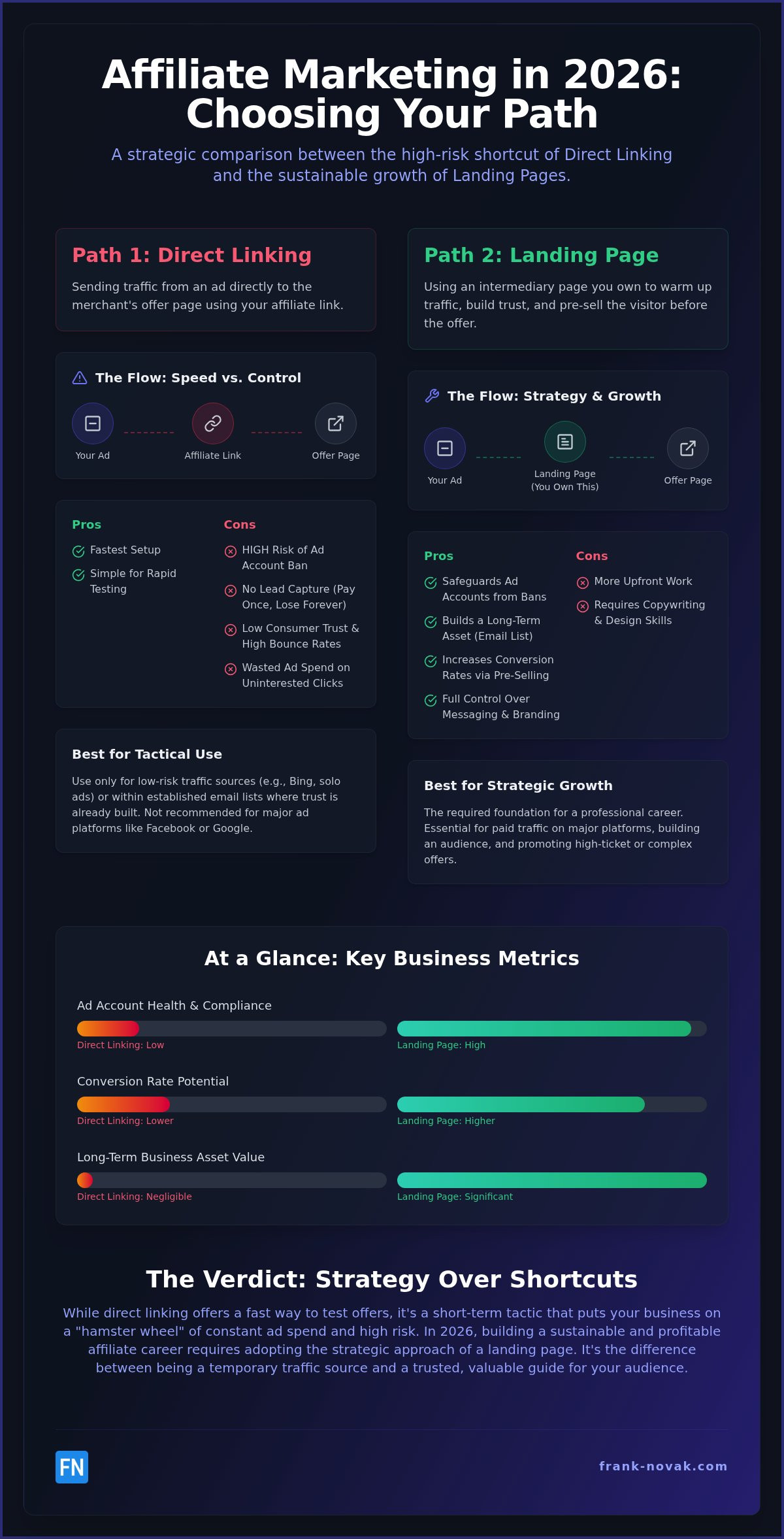
The core of your strategy rests on one fundamental question: how do you want the visitor to meet the offer? Affiliate marketing at its most basic level involves two distinct paths. Direct linking involves sending your traffic straight to a merchant’s sales page using your unique affiliate link. In contrast, a landing page acts as an intermediary bridge that you own and control. This choice isn’t just about technical preference; it defines whether you’re acting as a temporary traffic source or a trusted guide who provides genuine value. In 2026, building a sustainable business requires thinking beyond the next click to ensure your model can withstand platform changes.
What is Direct Linking in Modern Affiliate Marketing?
Direct linking remains popular because it’s the ultimate low-tech path for beginners. Behind the scenes, your ad or social post uses a tracking ID that triggers a series of redirects until the visitor lands on the merchant’s site. It’s fast to set up and works well for low-ticket impulse buys where the visitor doesn’t need much convincing. However, platforms like ClickBank have shown that while direct links can work for simple offers, they often fail for complex or high-ticket products. Without a bridge, you’re essentially asking a stranger to buy from another stranger, which frequently results in high bounce rates and wasted ad spend. It’s a fragile way to build a business because you’re entirely dependent on the merchant’s page to do the heavy lifting.
The Anatomy of an Effective Affiliate Landing Page
An effective bridge page is much more focused than a standard blog or a cluttered homepage. It’s designed with a singular purpose: to transition the visitor from a state of curiosity to a state of readiness. To do this, you must follow affiliate marketing landing page best practices, which include a compelling hook, a clear value proposition, and a strong call to action (CTA). These elements work together to frame the offer in a way that matches the specific needs of your audience. The pre-sell is the process of educating and emotionally preparing the visitor for the solution, which naturally increases the final conversion rate by filtering out uninterested clicks. If you want the benefits of a landing page without the technical hurdles, the ClickBank Super Funnel offers a streamlined way to implement these elements efficiently. By owning the visitor’s initial experience, you build a long-term asset rather than just renting space on an ad platform.
The Mechanics of Direct Linking: Speed vs. Risk
Many marketers start with direct linking because it offers the fastest way to test if an offer resonates with a specific audience. You don’t need to design layouts or write copy; you simply point your traffic at the merchant’s URL and watch the data. For low-ticket impulse buys, this lack of friction can sometimes lead to quick sales. If a product costs a small amount, a visitor might buy without needing a complex education process. It’s an appealing shortcut for those who want to see immediate results without a heavy upfront investment in time.
However, this speed comes with a significant long-term cost. When you link directly, you’re paying for a lead once and losing them forever. There’s no way to capture an email address or follow up if they don’t buy immediately. This creates a “hamster wheel” effect where your business only makes money as long as you’re pumping fresh ad spend into the system. It’s the opposite of following affiliate marketing landing page best practices, which emphasize building a list of assets you actually own. Without that list, you’re starting from zero every single morning.
The most dangerous aspect of direct linking in 2026 is the “Compliance Nightmare.” Modern AI on Facebook and Google scans destinations instantly. If the algorithms detect a direct affiliate redirect, they often flag the account as spam or low-quality. This degrades your “Account Health” score, making your ads more expensive and your account more likely to be shut down without warning. You’re essentially gambling with your ability to advertise just to save a few hours of setup time.
When is Direct Linking the Right Tactical Choice?
In specific scenarios, direct linking can be a useful tactic. For example, using “low-risk” traffic sources like Bing or certain solo ads might allow for direct paths without immediate penalties. It also works well when you’re promoting an offer within an existing email sequence. Since you’ve already established trust with your subscribers, they don’t necessarily need a bridge page to feel comfortable clicking. Just be wary of “Link Rot,” which happens when a merchant changes their sales page or goes offline, leaving your active ads pointing to a broken link. By implementing affiliate marketing landing page best practices, you create a buffer that protects you from these sudden merchant changes.
Account Health and the Banning Trap
Social platforms prioritize the user experience above all else. When you bypass a bridge page, you’re often sending users to aggressive sales letters that the platforms find intrusive. Direct linking to affiliate offers on Facebook frequently results in a permanent ad account ban because it violates their policy against “circumventing systems” or providing a poor landing page experience. Some marketers try to hide these links using “cloaking” software, but this is a dangerous game that often leads to a total loss of your business assets. Frank Novak strongly advises against these shortcuts, focusing instead on sustainable growth through proper systems. For those looking to scale safely, Online Success Coaching can provide the roadmap to avoid these common pitfalls.
The Strategic Value of the Affiliate Landing Page
If you want to move beyond the high-risk gamble of direct linking, you must embrace the strategic power of a dedicated bridge page. This intermediary step is where you transform a cold stranger into an educated buyer who is ready to take action. By following affiliate marketing landing page best practices, you create a professional environment that builds trust before the visitor ever sees the merchant’s sales pitch. This approach also provides a crucial compliance buffer; ad platforms like Facebook and Google require original content and a clear path for users, and a well-structured landing page satisfies these requirements better than a raw affiliate link.
Owning the landing page also means you own the data. You can place tracking pixels to build custom audiences, allowing you to retarget those who showed interest but didn’t buy on the first click. In 2026, where privacy regulations are tighter, having your own first-party data is essential for maintaining a sustainable ROI. You’re no longer just renting traffic; you’re building a database of prospects who know your brand. This shift in mindset from “chasing clicks” to “building assets” is what separates hobbyists from professional marketers.
Building Your Primary Asset: The Email List
The old saying that “the money is in the list” remains the golden rule for success in 2026. If you send traffic directly to a merchant, you lose the chance to speak to that visitor ever again. If you use a landing page, you can offer a valuable lead magnet, such as a checklist or a short guide, in exchange for an email address. This allows you to build a long-term asset that pays you repeatedly without needing to spend more on ads. Learning how to drive traffic to affiliate links effectively often starts with this simple shift in focus toward list building. It’s the only way to escape the treadmill of constant ad spend and create a business that can survive even if an ad account goes down.
Increasing Conversions Through Pre-Selling
A bridge page gives you the space to use testimonials and personal reviews that the merchant’s page might lack. You can address common objections early, explaining the value of the product before the visitor even sees the price tag. This creates a cohesive narrative that starts with your ad and flows smoothly into the final purchase. When the transition feels natural and helpful, your conversion rates will rise because you’ve removed the friction of uncertainty. You are acting as a helpful guide rather than a pushy salesperson, which builds the rapport necessary for a successful transaction.
Choosing Your Strategy: Ad Compliance and Conversion ROI
When you look at your dashboard, direct linking often shows a higher click-through rate (CTR) because there’s one less step between the ad and the offer. However, this is often a vanity metric that hides a significantly lower final conversion rate. Landing pages act as a critical filter for “tire kickers,” ensuring only high-quality traffic that is actually interested in the solution reaches the merchant’s sales page. If you’re using Facebook Ads for Affiliate Marketing, a compliant landing page isn’t just a recommendation; it’s a non-negotiable requirement for scaling your campaigns without getting shut down.
Compliance Comparison: Facebook vs. Google vs. Native
Ad reviewers in 2026 use sophisticated AI to check for original content and transparency. To structure a compliant page, you need more than just a headline and a button. You must include a clear Privacy Policy and an Earnings Disclaimer in the footer to meet platform standards. While Native ad platforms might be slightly more lenient than Google or Facebook, they still prioritize a positive user experience. Following affiliate marketing landing page best practices ensures your site looks like a legitimate business rather than a fly-by-night operation, which protects your long-term ability to buy traffic.
The ROI Calculation: One-Off Sale vs. Lifetime Value
Shifting your focus from a one-off sale to lifetime value is part of the “Success Mindset” that differentiates top earners. You might pay more upfront to acquire a lead for your list (Cost Per Lead) compared to a direct click, but that lead can be marketed to for years. When you calculate your ROI based on the backend value rather than the immediate commission, the cost per acquisition (CPA) becomes much more manageable. You’re investing in business infrastructure that provides stability. This approach allows you to outspend competitors who are only looking for a quick, single payout.
The Solution: Implementing the ClickBank Super Funnel
If you’ve spent months battling ad account bans or watching your commissions stall, it’s time for a more strategic approach. A hybrid model combines the efficiency of rapid testing with the ironclad security of a professional bridge page. The ClickBank Super Funnel represents this evolution, offering a structured path that follows affiliate marketing landing page best practices while keeping the technical workload to a minimum. This system helps you transition from a “link spammer” to a sustainable digital business owner who controls their own traffic and data. By implementing this framework, you ensure that every click you buy contributes to a long-term asset rather than a one-off gamble.
Why Automation is the Key to Scaling
The primary reason most affiliates fail isn’t a lack of effort; it’s “tech fatigue.” Designing high-converting layouts and managing complex tracking redirects can drain your energy before you ever launch a campaign. The ClickBank Super Funnel solves this by using pre-built templates that are already optimized for conversions and compliance. This automation manages the bridge between your traffic source and the merchant’s sales page, ensuring the user experience remains seamless and professional. It allows you to scale your business quickly without needing to become a full-time web developer or designer.
Your Roadmap to Affiliate Growth
Sustainable success in 2026 requires you to adopt the mindset of a mentor rather than just a salesperson. When you position yourself as a guide who helps people solve specific problems, your trust levels soar and your conversion rates follow. Online Success Coaching provides the personalized roadmap you need to navigate this transition effectively. It helps you integrate high-ticket offers into your funnel, allowing you to scale beyond small, inconsistent commissions into a high-revenue business model. Your next step is to see exactly how this automated system works in the real world. Join our next webinar to see the mechanics of a profitable funnel and start building your own sustainable digital empire today.
Building Your Sustainable Digital Business
Choosing between direct linking and landing pages is more than a technical decision; it’s a choice about the kind of business you want to run. While direct linking offers speed, the strategic use of bridge pages ensures your ad accounts remain safe and your revenue becomes predictable. By mastering affiliate marketing landing page best practices, you move from the uncertainty of chasing clicks to the stability of owning a professional digital asset.
The ClickBank Super Funnel provides a reliable middle ground, allowing you to automate commissions while maintaining strict Facebook Ad compliance. This system is already used by hundreds of entrepreneurs to simplify their workflow. It includes step-by-step coaching from Frank Novak to ensure you never feel lost in the process. If you’re ready to stop gambling with your ad spend and start building a sustainable foundation, the path forward is clear. You can start today.
Build Your Sustainable Business with the ClickBank Super Funnel
You have the vision and the tools to create a lasting professional landscape. Take that next step with confidence and steady encouragement.
Frequently Asked Questions
Is direct linking allowed on Facebook Ads in 2026?
Technically, Facebook doesn’t explicitly ban affiliate links, but their AI algorithms often flag direct redirects as low-quality user experiences. If you send traffic straight to a merchant’s page, you risk a permanent account ban for “circumventing systems” or violating bridge page policies. Using a dedicated landing page is the safest way to maintain your account health. It provides the original content and transparency that social platforms require to keep your ads active and profitable.
Do I need a website for affiliate marketing if I use landing pages?
You don’t need a complex, multi-page website, but you do need a professional domain to host your bridge pages. Owning your own digital space is one of the essential affiliate marketing landing page best practices. It allows you to place tracking pixels and build an email list. Without a domain, you’re essentially renting space on someone else’s platform, which makes your business vulnerable to sudden policy changes or service shutdowns that you can’t control.
What is the average conversion rate for an affiliate landing page?
Conversion rates vary by niche, but a high-quality bridge page usually sees a 15% to 25% opt-in rate for lead magnets. For actual sales, the conversion rate typically sits between 2% and 6% for mid-range products. These figures are generally much higher than direct linking because you’ve already built rapport. By filtering out non-buyers on your landing page, you ensure that only the most qualified traffic reaches the merchant’s final checkout page for the purchase.
Can I use a simple “Linktree” style page instead of a full landing page?
Linktree pages are helpful for social media bios, but they aren’t ideal for paid advertising. A true landing page focuses the visitor’s attention on a single solution rather than a list of generic links. When you use a focused bridge page, you can include testimonials and specific copy that addresses the reader’s pain points. This creates a much stronger emotional connection and results in significantly higher conversion rates compared to a simple list of external links.
Does direct linking work better for low-ticket or high-ticket offers?
Direct linking is most effective for low-ticket impulse buys, usually priced under $30. If the price point is low, the visitor might buy without needing a long education process. However, for high-ticket offers, a bridge page is mandatory. Buyers need to feel a sense of trust before spending larger sums of money. A landing page allows you to provide that trust through personal reviews and detailed explanations of the product’s benefits before they see the final price.
How much does it cost to set up an affiliate landing page funnel?
The cost varies depending on the tools you choose, but basic hosting and a domain usually cost a small monthly fee. If you want a more robust system without the technical struggle, the ClickBank Super Funnel provides an automated solution. It removes the need for expensive third-party software and complex coding. This allows you to focus your budget on traffic and growth rather than sinking money into technical setup and constant maintenance fees that eat your profits.
Which ClickBank products are best for direct linking?
Products with highly optimized Video Sales Letters (VSLs) in the health and e-marketing niches are often the best for testing direct links. If a merchant has a proven track record and a high gravity score, their page might convert cold traffic. Even so, you’re still missing out on the chance to build an email list. Most successful affiliates eventually move away from direct linking to ensure they can follow up with their leads through automated email sequences later.
What are the best practices for bridge page compliance on Google Ads?
Google Ads prioritizes a high-quality user experience and original content. To stay compliant, your bridge page must offer unique insights, such as a detailed product comparison or a personal case study. You also need to include clear links to your Privacy Policy and Contact pages in the footer. Adhering to these affiliate marketing landing page best practices shows Google that you’re a legitimate business owner, which helps keep your ad costs low and your account safe.

Article by
Frank Novak
Frank Novak is an online marketing professional and coach who focuses on affiliate marketing and business automation. Through his website, frank-novak.com, he shares insights and strategies for leveraging social media platforms like Facebook to generate traffic and commissions.
Affiliate / Sponsored Content Disclaimer
This [website/post] contains affiliate links. If you click through and make a purchase, we may receive a commission at no additional cost to you. We only recommend products or services we believe will add value to our readers.