
What if the secret to doubling your affiliate commissions in 2026 isn’t finding a cheaper email tool, but finding one that knows exactly when your lead is ready to buy? You’ve likely felt the sting of manual email fatigue or the frustration of low click-through rates on your hard-earned traffic. It’s common to worry about potential ESP bans or feel overwhelmed by technical setups that seem to require a computer science degree. When comparing ActiveCampaign vs ConvertKit for affiliate marketing, it’s easy to get lost in the feature lists while your actual growth stalls.
If you’re ready to move away from the daily grind and toward a scalable, hands-off commission engine, choosing the right platform is your first step. This guide will help you understand which of these automation powerhouses will transform your professional brand and provide the predictable lead nurturing you need. We’ll look at the latest 2026 updates, from ActiveCampaign’s advanced AI agents to the rebranding of Kit, formerly known as ConvertKit. By the end of this comparison, you’ll have a clear roadmap to decide which system will best support your journey toward a more automated and profitable affiliate business.
Key Takeaways
- Understand why transitioning from manual link sharing to automated behavioral nurturing is the only way to scale your affiliate income past the burnout barrier.
- Evaluate ActiveCampaign vs ConvertKit for affiliate marketing to see if your business model requires advanced site tracking or a simpler, newsletter-focused approach.
- Learn how to use conditional content to show different affiliate offers to your leads based on their specific browsing history and past engagement.
- Discover the essential “Bridge Page” strategy that keeps your affiliate promotions compliant with major advertising platforms while protecting your sender reputation.
- Identify how professional guidance and automated systems can help you overcome technical overwhelm and turn complex software into a predictable commission engine.
Scaling Your Affiliate Commissions: Why Automation is Non-Negotiable in 2026
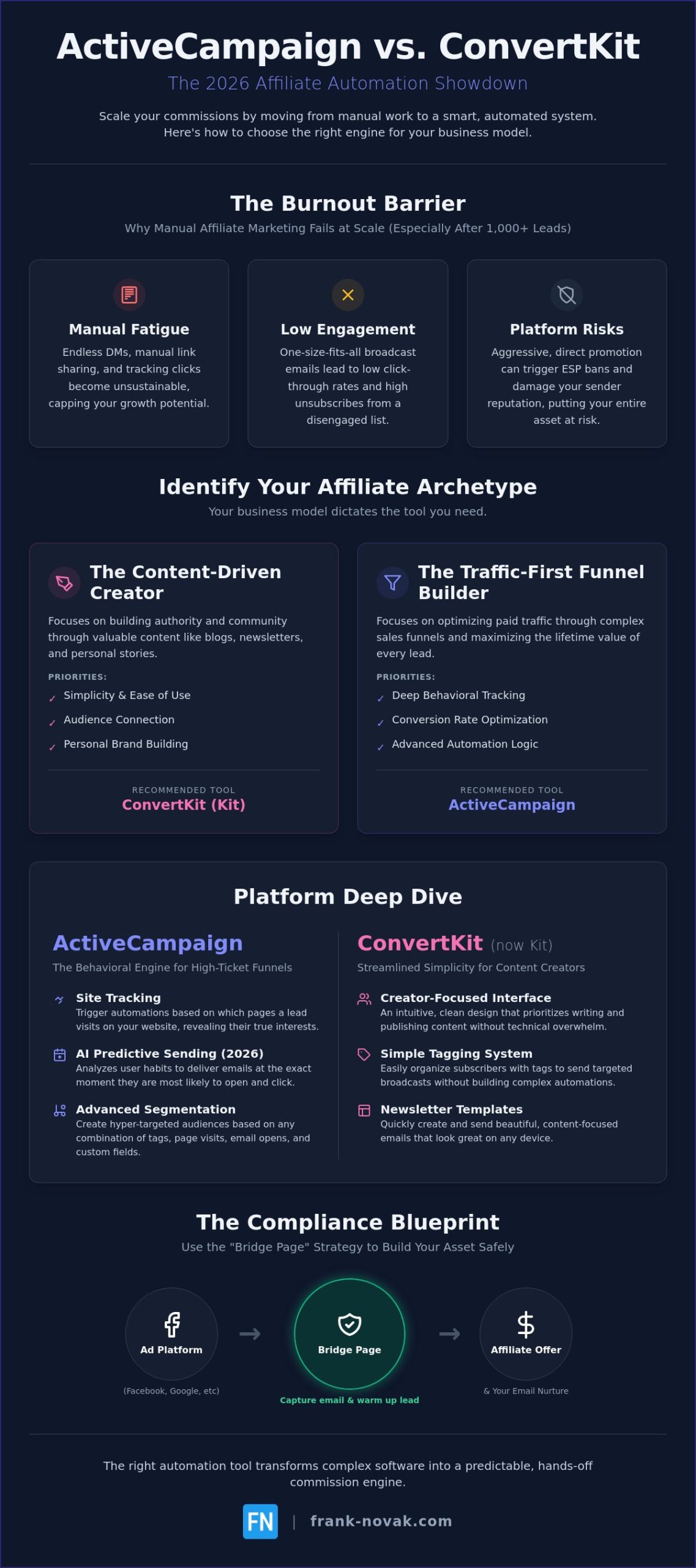
Scaling an affiliate business in 2026 requires more than just a list of email addresses; it requires a behavioral engine that understands your audience’s intent. While many beginners start by researching what affiliate marketing is to earn extra income, the most successful practitioners view their email list as a sustainable digital asset rather than a simple distribution channel. If you’re still sending one-off broadcast emails to everyone on your list, you’re likely leaving significant commissions on the table and risking the “Burnout Barrier” that hits once you cross 1,000 leads.
Manual link sharing simply isn’t scalable. When you try to keep up with hundreds of individual questions or manually track who clicked what, your growth stalls. To survive the intense inbox competition of 2026, you must adopt a trust-first approach. This means moving away from aggressive selling and toward behavioral nurturing, where your software delivers the right offer only after a lead has shown genuine interest. This is where the debate of ActiveCampaign vs ConvertKit for affiliate marketing becomes critical for your long-term strategy.
To better understand how these platforms function in a real-world setting, watch this helpful comparison video:
The Shift from Promotion to Systemization
Automation allows you to promote multiple high-ticket offers simultaneously without adding a single hour to your work week. By shifting from a list to a systemized audience, you create a sequence that greets, educates, and converts new leads automatically. This methodical approach is a cornerstone of the Online Success Coaching philosophy, which focuses on building systems that work for you rather than you working for the system. When your email platform handles the heavy lifting of segmenting users based on their actions, you can focus on high-level strategy instead of repetitive tasks.
Identifying Your Affiliate Business Model
Before choosing your tool, you need to identify if you’re a content-first blogger or a traffic-first funnel builder. Bloggers often prioritize personal authority and simple newsletters, while funnel builders need deep tracking to optimize every stage of a lead’s journey. Your specific model will ultimately dictate whether you need the advanced behavioral triggers of ActiveCampaign or the streamlined simplicity of Kit, formerly known as ConvertKit. Understanding your path now prevents the technical overwhelm that often comes from picking a platform that doesn’t align with your goals. This choice is the foundation of your hands-free commission engine and your future ActiveCampaign vs ConvertKit for affiliate marketing strategy.
ActiveCampaign: The Behavioral Engine for High-Ticket Affiliate Funnels
ActiveCampaign stands out because it doesn’t just send emails; it monitors how your leads interact with your entire digital presence. This platform is built for the affiliate who wants to move beyond basic broadcasts and into the world of deep behavioral tracking. Site tracking is a standout feature here, allowing you to see exactly which affiliate landing pages your leads are browsing in real time. If a subscriber spends several minutes on a specific product review page but doesn’t click your affiliate link, ActiveCampaign can trigger an automated follow-up email that addresses their potential hesitations before the lead goes cold.
The 2026 AI Agent feature updates have further refined this process by introducing predictive sending. This technology analyzes individual subscriber habits to determine exactly when a lead is most likely to open an email and click a link. Instead of sending a blast at 9:00 AM and hoping for the best, the system staggers delivery for each person on your list. While you’re managing the technical side, Navigating Compliance remains a priority to ensure your automated endorsements meet the latest transparency standards. When comparing ActiveCampaign vs ConvertKit for affiliate marketing, this level of technical sophistication is what allows high-ticket affiliates to maintain a professional brand image while scaling their operations.
Tag-Based Segmentation for Affiliates
One of the biggest mistakes in affiliate marketing is treating every subscriber the same way. ActiveCampaign allows you to tag leads based on specific interests, such as “Weight Loss” vs “Keto,” based on the content they consume. This prevents you from spamming your audience with irrelevant offers that hurt your deliverability. You can also automate the “exclusion” of leads who have already purchased a specific offer, ensuring they don’t receive promotional emails for a product they already own. For a deeper look at how to structure these triggers, you can refer to the Automated Marketing Funnel guide for setup tips that ensure long-term growth.
Complex Automation Logic
The true power of ActiveCampaign lies in its “If/Else” branching logic. You can build complex paths that react differently depending on whether a lead opened an email, clicked a specific link, or visited a specific page on your site. This allows you to build a “Scarcity Engine” that automates countdown timers for affiliate launches, creating genuine urgency without manual intervention. Behavioral tracking is the primary engine behind affiliate ROI in 2026 because it replaces guesswork with data-driven relevance. If you’re looking for a structured way to implement these advanced tactics, the ClickBank Super Funnel provides a bridge between this powerful software and actual profit.
When you use an advanced CRM to track the lifetime value (LTV) of an affiliate lead, you gain a clear picture of which traffic sources are actually profitable. This data is invaluable when deciding how much you can afford to spend on acquiring a new lead. While the learning curve is steeper than other tools, the ability to build a truly hands-off commission engine makes it a top contender in the ActiveCampaign vs ConvertKit for affiliate marketing debate.
ConvertKit: Streamlined Simplicity for Content-Driven Affiliates
While ActiveCampaign offers a high-powered behavioral engine, many affiliate marketers find that simplicity is the most direct path to profit. ConvertKit, which officially rebranded to “Kit” in 2024, is designed specifically for creators who rely on personal authority and consistent content. Its visual automation builder is widely considered the most intuitive in the industry, allowing you to map out your subscriber’s journey without getting lost in technical jargon. If you’re a blogger or a coach, this streamlined approach often means you spend less time troubleshooting software and more time crafting emails that convert.
One of the platform’s greatest strengths is its “newsletter-first” design. Unlike platforms that push heavy HTML templates, Kit encourages a plain-text feel that mimics a personal message from a friend. This aesthetic isn’t just about style; it’s a strategic choice for deliverability. By avoiding the code-heavy elements that often trigger “Promotions” tabs in Gmail, your affiliate offers are more likely to land in the primary inbox. As you build these sequences, remember that transparency is key. Following the FTC’s Endorsement Guides ensures that your recommendations remain ethically sound and legally compliant. When evaluating ActiveCampaign vs ConvertKit for affiliate marketing, this focus on clean deliverability is a major factor for those who prioritize long-term subscriber trust.
When Simplicity Wins the Game
In the fast-paced world of digital growth, “speed to market” is a massive advantage. With Kit, you can often set up a multi-step welcome sequence in under 30 minutes. This lack of technical friction is vital because it encourages consistency. If a tool is too hard to use, you’ll eventually stop using it. This platform is ideal for professional coaches, niche bloggers building personal authority, and course creators who use affiliate marketing as a secondary income stream. By reducing the number of steps between an idea and an email broadcast, you can react to market trends and new affiliate launches almost instantly.
ConvertKit vs ActiveCampaign Feature Comparison
Choosing between these two comes down to your personal “sweet spot” between automation depth and ease of use. For a list of 1,000 subscribers billed annually, Kit’s Creator plan starts at $33 per month, while ActiveCampaign’s Plus plan starts at $49 per month. While ActiveCampaign offers deeper CRM features, Kit provides built-in landing pages that can save you the cost of external funnel builders. This makes it an excellent choice for those who want an all-in-one feel without the complexity of a full-scale marketing suite.
It’s easy to fall into the trap of over-complicating your tech stack before you have the traffic to support it. Many entrepreneurs never succeed online because they spend months building complex “spiderweb” automations that they don’t actually need. If your business model relies on building a tight-knit community through your personal brand, the streamlined nature of Kit might be exactly what you need to scale. Ultimately, the best ActiveCampaign vs ConvertKit for affiliate marketing strategy is the one that you can actually maintain day after day.
Navigating Compliance and Traffic: The Facebook-to-Email Bridge
If you’re using paid traffic to fuel your affiliate business, the connection between your ads and your email list is your most critical infrastructure. One of the most dangerous mistakes you can make is emailing raw affiliate links directly to your list or sending traffic from a Facebook ad straight to an affiliate offer. This approach often leads to flagged ad accounts and poor email deliverability. Instead, professional marketers use a “Bridge Page,” which is a simple landing page that warms up the lead and provides the necessary disclosures before they click through to the final offer. When comparing ActiveCampaign vs ConvertKit for affiliate marketing, your choice should depend largely on how deeply you intend to integrate these two worlds.
ActiveCampaign offers a distinct advantage for traffic-heavy businesses through its Custom Audience sync. This feature allows you to automatically add or remove leads from specific Facebook ad sets based on their behavior within your emails. If a lead clicks a link in your email but doesn’t buy, you can immediately trigger a retargeting ad on Facebook to stay top-of-mind. Conversely, by automatically excluding current subscribers from your top-of-funnel Facebook ads, you can save up to 20% on your total ad spend. This level of synchronization ensures that your marketing budget is only spent on reaching new people or moving warm leads closer to a commission.
The 2026 Deliverability Checklist
As of 2026, mailbox providers like Gmail and Yahoo have made technical authentication mandatory for anyone sending bulk emails. To ensure your affiliate offers actually reach the inbox, you must have SPF, DKIM, and DMARC records properly configured. While technical, these settings act as a digital passport that proves you aren’t a spammer. Beyond the technical setup, maintaining list hygiene is vital; a clean list of 1,000 highly engaged leads will always outperform a “dirty” list of 10,000 leads who never open your messages. Regularly removing inactive subscribers protects your sender reputation and keeps your monthly software costs manageable. If you find the technical side of these setups overwhelming, seeking Online Success Coaching can provide the clarity needed to bridge the gap between software and profit.
Automating Ad Spend ROI
Managing your return on investment becomes much simpler when you use lead scoring to prioritize your follow-up. You can assign points to subscribers whenever they open an email, visit your bridge page, or click an affiliate link. Once a lead reaches a certain score, your system can move them into a “high-touch” automation sequence that features more direct calls to action. This automated approach ensures you’re focusing your best content on the people most likely to convert. By combining behavioral data with smart ad exclusions, you create a sustainable system that grows your brand while protecting your ad account from compliance issues. This strategic alignment is a key differentiator in the ActiveCampaign vs ConvertKit for affiliate marketing debate for those scaling with paid traffic.
Accelerating Results with Professional Systems and Coaching
Choosing between ActiveCampaign vs ConvertKit for affiliate marketing is a significant step, but the software alone won’t build your business. Even with the best tools, many entrepreneurs struggle with a steep learning curve that leads to leaky affiliate funnels and wasted ad spend. It’s common to feel overwhelmed by the technical setup or unsure if your automation logic is actually working. Professional coaching bridges the gap between owning software and generating consistent profit by providing the strategic oversight that standard tutorials often miss.
Instead of spending months in a trial-and-error phase, a “Done-With-You” model allows you to implement proven templates that have already been tested in the field. This approach ensures that your behavioral triggers, tagging systems, and bridge pages are set up correctly from day one. Positioning Online Success Coaching as your primary resource provides the ultimate shortcut in 2026, as it combines industry-specific expertise with a clear, actionable roadmap tailored to your goals.
The ClickBank Super Funnel Advantage
One of the most effective ways to bypass technical frustration is through a dedicated system like the ClickBank Super Funnel. This specific framework automates the entire ClickBank journey, utilizing advanced logic to ensure your leads receive the most relevant offers at the right time. Automation is the “unfair advantage” that separates high-earning affiliate entrepreneurs from those who are still manually sending links. When your system handles the heavy lifting of segmentation and follow-up, you’re free to focus on the creative aspects of your brand. You can explore the ClickBank Super Funnel today to see how it can transform your workflow.
Your 90-Day Automation Roadmap
Building a scalable affiliate engine is a methodical process that happens in distinct stages. Following a structured roadmap ensures you don’t skip the foundational steps that lead to long-term sustainability. If you follow this progression, you’ll avoid the common pitfalls of technical overwhelm:
- Phase 1: Tool Selection and Basic Integration. Finalize your choice in the ActiveCampaign vs ConvertKit for affiliate marketing debate and connect your domain, ensuring all 2026 authentication standards like DMARC are met.
- Phase 2: Behavioral Tagging and Nurture Sequences. Set up your core automation sequences and implement the tagging logic discussed earlier to begin segmenting your leads by interest.
- Phase 3: Scaling with Paid Traffic and Coaching. Once your funnel is converting, begin driving traffic through Facebook Ads and work with a coach to optimize your ad spend and lead scoring.
By the end of this 90-day period, your manual hustle will have evolved into a professional, automated asset. With the right systems and guidance in place, you can move forward with confidence, knowing that your business is built on a foundation of proven strategies and reliable technology. This transition isn’t just about software; it’s about building a future where your income is no longer tied to your hourly input.
Building Your Automated Affiliate Legacy in 2026
Choosing between the behavioral tracking of ActiveCampaign and the streamlined simplicity of Kit depends on how you intend to engage your audience. While one offers deep data and complex branching, the other provides the speed and clarity needed for consistent content growth. The decision regarding ActiveCampaign vs ConvertKit for affiliate marketing is ultimately about which tool you’ll actually use to replace your manual hustle with a scalable system.
If you’re ready to automate your success and move past the technical learning curve, Join Frank Novak’s Online Success Coaching. This mentorship reduces marketing busywork by up to 15 hours per week and provides you with proprietary ClickBank Super Funnel templates. You’ll work directly with a digital marketing veteran who has been scaling businesses from 2018 through 2026. With the right systems in place, you can finally build a predictable commission engine that works even when you don’t. Your journey toward professional growth starts with a single, structured decision today.
Frequently Asked Questions
Does ActiveCampaign allow affiliate links in emails?
ActiveCampaign does allow affiliate links, provided they are used within high-quality, educational content that adds genuine value to the reader. You should avoid sending emails that consist solely of links or promote prohibited industries like “get rich quick” schemes. By using a bridge page rather than a direct affiliate link, you stay compliant with their terms of service while protecting your sender reputation from potential flags.
Is ConvertKit or ActiveCampaign better for ClickBank affiliates?
When deciding between ActiveCampaign vs ConvertKit for affiliate marketing in the context of ClickBank, ActiveCampaign is generally the more powerful choice. Its advanced automation logic is ideal for implementing systems like the ClickBank Super Funnel, which requires precise behavioral tagging. Kit is a strong alternative if your strategy focuses on simple, personal newsletters rather than building a multi-step, high-ticket funnel architecture.
How do I prevent my affiliate emails from going to the spam folder in 2026?
Preventing spam folder placement in 2026 requires strict technical authentication through SPF, DKIM, and DMARC records. You must also maintain a high engagement rate by regularly removing inactive subscribers who haven’t opened your messages in the last 90 days. A clean list ensures that mailbox providers like Gmail view you as a trustworthy sender rather than a bulk marketer sending unwanted promotions.
Do I need a website to use ActiveCampaign for affiliate marketing?
You don’t strictly need a full website to use ActiveCampaign, as the platform allows you to create and host individual landing pages. However, having a dedicated domain is essential for setting up the professional email authentication required by modern inbox providers. Using these landing pages as bridge pages helps you maintain compliance with major ad platforms while warming up your leads before they see an offer.
Which tool has better Facebook Ad integration for affiliates?
In the debate of ActiveCampaign vs ConvertKit for affiliate marketing, ActiveCampaign wins on the traffic front due to its native Custom Audience sync. This feature allows you to automatically add or remove leads from specific Facebook ad sets based on their email behavior. Kit provides basic integration, but it lacks the deep, automated exclusion features that can help you save up to 20% on your total ad spend.
Is ActiveCampaign’s price worth it for a beginner affiliate?
ActiveCampaign’s price is worth the investment if you plan to scale quickly using paid traffic and complex funnels. While the monthly starting price for the Plus plan is higher than some entry-level tools, the time saved through advanced automation often offsets the cost. If you’re starting with a very limited budget and no immediate plans for paid ads, you might prefer a simpler tool until your commissions grow.
What is behavioral tagging and how does it increase sales?
Behavioral tagging is the process of automatically assigning labels to subscribers based on specific actions like link clicks or page visits. This increases sales by ensuring that your leads only receive offers they have already shown interest in. When you send a specific product offer only to those tagged with a relevant interest, your click-through rates and conversions naturally improve because the content is highly relevant.
Can I switch from ConvertKit to ActiveCampaign easily as my business grows?
You can switch from Kit to ActiveCampaign as your business grows, though it requires careful planning to migrate your existing automations and tags. Most professional marketers find that moving their contact list is simple, but rebuilding complex sequences takes time. If you anticipate needing advanced tracking and CRM features in the near future, starting with ActiveCampaign can save you the technical headache of a mid-growth migration.

Article by
Frank Novak
Frank Novak is an online marketing professional and coach who focuses on affiliate marketing and business automation. Through his website, frank-novak.com, he shares insights and strategies for leveraging social media platforms like Facebook to generate traffic and commissions.
Affiliate / Sponsored Content Disclaimer
This [website/post] contains affiliate links. If you click through and make a purchase, we may receive a commission at no additional cost to you. We only recommend products or services we believe will add value to our readers.