
Did you know that content-based affiliates currently convert at 2.4 times the rate of those relying on coupons? If you’ve been watching your Facebook ad spend climb while your commissions stay flat, it’s natural to feel a bit discouraged. You might find yourself searching for what is a good affiliate conversion rate only to be met with conflicting data that leaves you more confused than when you started. It’s a common hurdle, especially when you see high traffic numbers that simply don’t translate into the results you expected.
I want to help you clear up that confusion by providing the realistic benchmarks for success in today’s market. Whether you’re promoting SaaS products with a 3% to 7% benchmark or e-commerce items at 2.8%, knowing where you stand is the first step toward genuine growth. This article will show you exactly what targets to aim for and how to optimize your funnel to exceed industry averages. We’ll start by breaking down the 2026 performance data across different sectors and then move into a step-by-step roadmap to help you fix low-converting pages and secure a higher ROI on your paid traffic.
Key Takeaways
- Learn why industry averages vary and how to determine what is a good affiliate conversion rate for your specific niche and traffic source.
- Compare performance benchmarks across different sectors, from e-commerce physical goods to high-converting SaaS and digital info-products.
- Identify the common mismatch errors that cause most affiliate funnels to underperform, even when traffic volume is high.
- Discover the “Value-First” marketing strategy that builds trust and encourages your audience to take action before you ever present an offer.
- Understand how leveraging pre-built assets like the ClickBank Super Funnel can streamline your path to a higher ROI and sustainable growth.
Defining a Good Affiliate Conversion Rate in 2026
Affiliate marketing is fundamentally a performance-based game, yet “performance” is a relative term that shifts depending on your specific goals. At its core, your conversion rate is the percentage of people who click your affiliate link and then complete a desired action. While it sounds simple, the question of what is a good affiliate conversion rate doesn’t have a one-size-fits-all answer. If you are promoting a low-cost physical product, your numbers will look very different than if you are recommending a high-ticket service.
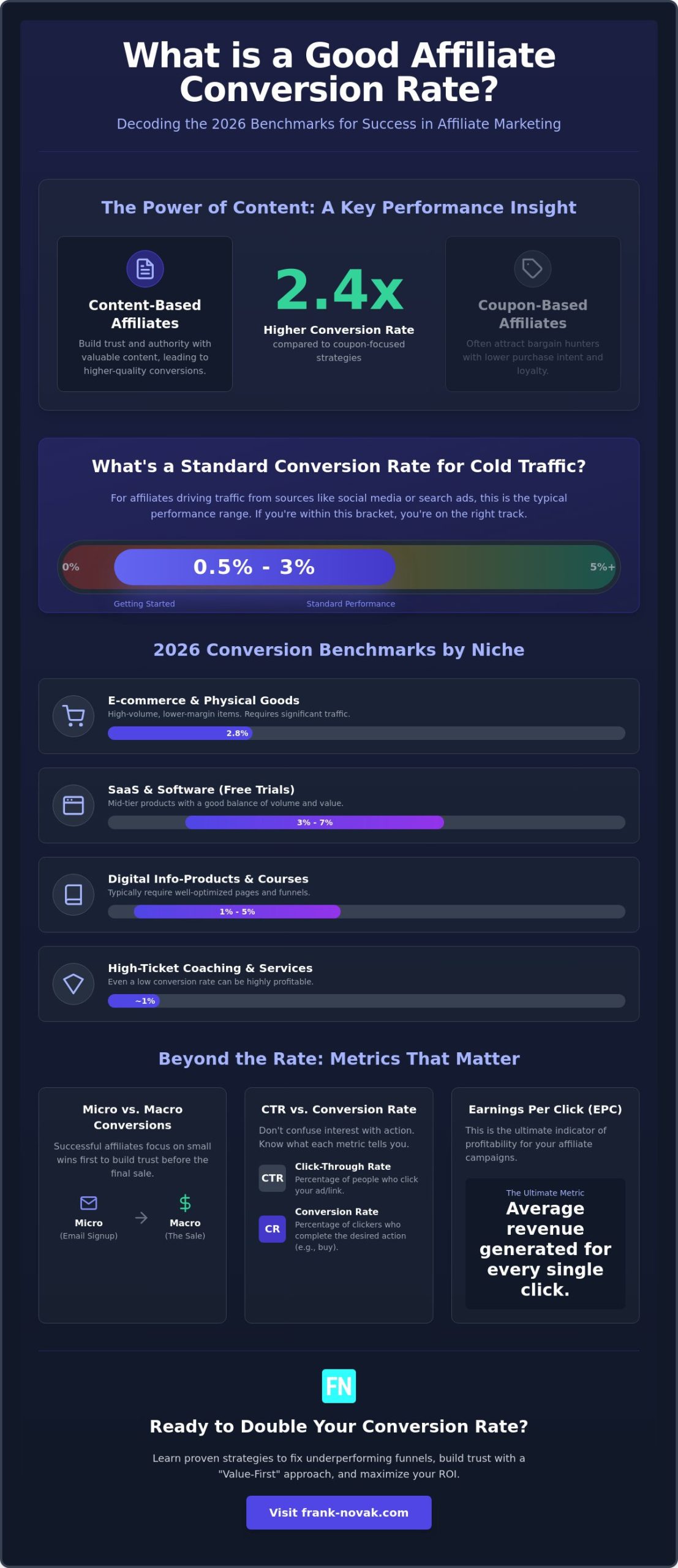
It’s helpful to understand that a high conversion rate doesn’t always equal a high profit. For instance, a 1% conversion rate on a high-ticket coaching offer can be incredibly lucrative, while a 10% rate on a low-margin retail item might barely cover your monthly subscription fees. For most affiliates driving cold traffic from social media or search ads, a baseline range of 0.5% to 3% is considered standard. If you’re hitting these numbers, you’re on the right track; if you’re above them, you’re ahead of the curve.
To better understand this concept, watch this helpful video:
To truly master your metrics, you should distinguish between micro-conversions and macro-conversions. A macro-conversion is the final sale that puts money in your pocket. A micro-conversion, such as an email sign-up or a lead magnet download, is a smaller step that builds trust. In 2026, the most successful affiliates focus on these smaller wins first, as they provide more opportunities to follow up and eventually secure the final sale.
The Mathematical Formula for Success
Calculating your performance is straightforward: take your total number of conversions, divide them by total clicks, and multiply by 100. It’s vital not to confuse this with your Click-Through Rate (CTR). While CTR tells you how many people are interested enough to click your ad, the conversion rate tells you how many of those people were actually convinced to buy. When evaluating what is a good affiliate conversion rate for your business, you should also track your Earnings Per Click (EPC). Your EPC is the ultimate indicator of profitability because it measures the average revenue generated by every single visitor you send to an offer.
Why Averages Can Be Deceptive
Averages can often lead to unnecessary worry because they don’t account for the quality of your traffic. Organic search traffic usually converts at a higher rate because those users are actively seeking a solution. Paid traffic, conversely, often starts “colder” and requires more persuasion. Additionally, 2026 tracking technologies have become increasingly privacy-focused. With stricter cookie regulations and tracking limitations, some of your sales might not be attributed to you correctly. This means your actual performance could be higher than what your dashboard currently shows, so it is wise to look at your overall bank balance alongside your analytics.
Industry Benchmarks: From Amazon Associates to High-Ticket Coaching
When you’re assessing what is a good affiliate conversion rate, it’s helpful to remember that benchmarks shift dramatically based on the price tag and category of the item you’re promoting. In the low-ticket tier, which includes Amazon Associates and mass-market retail, conversion rates tend to be higher because the financial barrier to purchase is relatively low. For instance, while Amazon’s commission rates saw significant cuts in May 2026, many physical products still convert at an average of 2.8%. It’s a high-volume strategy where you’ll see plenty of individual sales, though you’ll need substantial traffic to generate a significant income.
Mid-tier products like software and digital courses offer a middle ground between volume and value. SaaS affiliate programs often see conversion rates between 3% and 7% for free trials, while digital info-products typically range from 1% to 5% on well-optimized pages. If you’re looking for Proven Strategies to Double Your Conversion Rate, focusing on these mid-tier digital goods is often the most accessible path for affiliates who want to move beyond low-margin retail. These products often come with higher commission percentages, sometimes reaching 50% to 75% on platforms like ClickBank.
Digital Products and ClickBank Benchmarks
Promoting digital products requires a different tactical approach than retail. Since these products often solve specific, urgent problems, a well-crafted sales page can convert between 1% and 5% of targeted traffic. To hit the higher end of that range, successful marketers use a “bridge page” to warm up the audience and build trust before sending them to the vendor’s site. If you want to skip the trial and error of building these yourself, using a pre-built asset like the ClickBank Super Funnel can help you implement these high-converting structures immediately. It’s a practical way to ensure your traffic is being sent to a funnel designed for the digital market’s unique 2026 standards.
The High-Ticket Coaching Anomaly
High-ticket coaching and professional consulting operate on an entirely different scale. When you’re promoting a $5,000 package, a 0.1% conversion rate is actually a massive win. While the percentage seems low, the ROI is significantly higher because a single sale can equal dozens of smaller retail commissions. These offers require a multi-touch conversion process where you build a relationship over time rather than expecting a sale on the first click. For those ready to scale into this premium space, exploring Online Success Coaching can provide the necessary framework to handle these complex, high-value funnels. Understanding what is a good affiliate conversion rate in this context means looking at your bank balance rather than just the percentage in your dashboard.
Why Most Affiliate Funnels Fail to Meet Benchmarks
When you see high traffic numbers but zero commissions, it’s natural to assume you simply need more volume. This is often a misconception that leads to wasted ad spend and unnecessary frustration. If your current system isn’t converting at a basic level, adding more traffic is like pouring water into a bucket full of holes. It doesn’t help you understand what is a good affiliate conversion rate for your business; it just drains your budget faster while leaving you with the same poor results.
The real issue often lies in the “Mismatch” problem. This happens when there is a fundamental disconnect between the audience you are targeting and the offer you are presenting. If you’re sending people who are looking for free advice to a high-ticket sales page, your conversion rate will suffer regardless of how much you spend on ads. This lack of alignment is Why Most Affiliate Funnels Fail to gain traction. Success in 2026 requires a high degree of “Congruency,” meaning your ad, your landing page, and the final product must all speak the same language and solve the same specific problem.
If you don’t maintain this congruency, you also risk significant technical setbacks. Platforms like Facebook are increasingly sensitive to user experience. If your landing page has low-quality content or doesn’t match the intent of your ad, you’re much more likely to face an ad account ban. These platforms prioritize “conversion intent,” and if they feel your funnel is misleading or provides a poor experience, they will stop your traffic entirely. While trying to figure out what is a good affiliate conversion rate, you must first ensure your funnel is built on a foundation of quality and relevance.
The Leaky Funnel Syndrome
Leads are most frequently lost in the small gaps between the initial click and the final opt-in. In the fast-paced digital environment of 2026, page speed has become a non-negotiable factor. If your bridge page takes longer than two seconds to load, you’ve likely lost over half of your potential mobile visitors before they even see your headline. Another common leak is the lack of a clear Call to Action (CTA). Many affiliates provide great information but fail to tell the visitor exactly what to do next. Without a single, focused action for the user to take, your conversion benchmarks will always remain out of reach.
Ad Compliance and Trust Signals
Modern consumers are more skeptical than ever, and “get rich quick” vibes will kill your conversion rates instantly. To succeed today, you must incorporate clear trust signals and maintain strict ad compliance. This includes having visible privacy policies, terms of service, and realistic income disclaimers. Building this level of transparency not only improves your relationship with the audience but also keeps your ad accounts in good standing. For those who want to ensure their campaigns are built for longevity, reviewing a guide on Facebook Ads for Affiliate Marketing can provide the safety tips needed to maintain sustainable traffic and high trust levels.
Proven Strategies to Double Your Conversion Rate
Improving your results requires a shift from passive link-sharing to active funnel management. If you’ve been wondering what is a good affiliate conversion rate for your specific niche, you’ve likely realized that the answer depends on how well you guide your visitors. To double your current performance, you should start by optimizing your bridge page for a single, focused action. When you give users too many choices, they often choose nothing at all. By narrowing the focus to one clear next step, you remove the friction that typically kills a sale.
Implementing a “Value-First” approach is another powerful lever for growth. Since content-based affiliates convert at 2.4 times the rate of coupon-based sites, providing genuine help before the pitch is a proven winner. Instead of sending traffic directly to a sales page, try giving away a high-quality lead magnet. This builds immediate authority and allows you to capture contact information for future follow-up. You can then leverage social proof through Online Success Coaching case studies to demonstrate that the solution you’re recommending actually works for real people. Finally, never settle for your first draft; rigorous A/B testing of your headlines and CTA button colors can reveal small changes that lead to significant jumps in ROI.
The Power of Email Automation
It’s a common mistake to think the sale happens on the first visit. In reality, about 70% of conversions occur during the follow-up process rather than the initial click. This is why the “7-Touch Rule” remains so vital in the digital age. Most people need to see a message multiple times before they feel comfortable enough to make a purchase. By using Automated Marketing Funnels, you can handle this heavy lifting without manual effort. These sequences ensure that “not yet” buyers are nurtured with helpful content until they are ready to commit, which is essential for maintaining a healthy conversion benchmark.
Psychological Triggers for 2026
Modern audiences respond best to authenticity and transparency. While fake urgency can damage your reputation, using “Ethical Scarcity”—such as highlighting a genuine limited-time bonus—can encourage prompt action. Another 2026 conversion booster is the use of personalized video on your bridge pages, which creates a human connection that text alone cannot match. By leading users through a series of micro-commitments, you make the final purchase feel like a natural next step in their journey. If you’re ready to implement these high-level tactics without building everything from scratch, you can explore the ClickBank Super Funnel to see these professional strategies in action.
Maximizing ROI with the ClickBank Super Funnel
If you’ve followed the strategies outlined in the previous sections, you now understand that what is a good affiliate conversion rate is a dynamic figure that depends on your funnel’s architecture. Achieving sustainable growth isn’t just about hitting a specific percentage once; it’s about building a reliable system that consistently turns visitors into commissions. When your conversion rates are healthy, every dollar you spend on traffic becomes an investment rather than an expense. This stability is what allows you to scale your business with confidence, knowing that your infrastructure can handle the growth.
Frank Novak has developed a range of pre-built, high-converting assets specifically to help you skip the frustrating trial-and-error phase. Instead of spending months testing different headlines or bridge page layouts, you can leverage assets that have already been refined through years of practical application. This professional approach is often the fastest shortcut to success. If you’re currently auditing your performance, use this final checklist to see where your funnel might be leaking revenue:
- Does your bridge page load in under 2 seconds to prevent mobile bounce?
- Is there a single, focused Call to Action that guides the user to the next step?
- Are you using a “Value-First” lead magnet to capture email addresses?
- Do you have an automated sequence with at least 7 touches to nurture “not yet” buyers?
- Is the messaging on your ad perfectly congruent with your landing page?
Why Automation is the Ultimate Conversion Lever
The ClickBank Super Funnel is designed to remove human error from your marketing equation. For many beginners, the technical complexity of setting up tracking, bridge pages, and email triggers is where the process breaks down. A “Done-For-You” system ensures that every piece of the puzzle is perfectly aligned from day one. By using an automated framework, you can focus your energy on high-level strategy and traffic generation. This shift in focus is essential for anyone looking to achieve genuine financial freedom through an online business, as it moves you away from manual tasks and toward a scalable, automated income stream.
Your Next Steps Toward 6-Figure Conversions
If you’re ready to move beyond basic benchmarks, it’s time to stop guessing and start measuring with professional precision. While understanding what is a good affiliate conversion rate helps you set realistic goals, reaching a 6-figure level typically requires a more structured environment. Joining a specialized program like the Ambassador JV can provide the community and resources needed to scale. Professional coaching provides the clarity you need to identify specific bottlenecks that might be invisible to you right now. If you’re committed to building a business that lasts and want to skip the typical hurdles, Apply for Online Success Coaching with Frank Novak to start your journey toward higher ROI and sustainable growth.
Building Your Path to Sustainable Commissions
We have explored how the answer to what is a good affiliate conversion rate depends entirely on your specific funnel architecture and the price point of your offer. Whether you’re aiming for the 2.8% e-commerce average or the higher benchmarks of SaaS and digital products, the key is maintaining congruency from your first ad to the final click. By focusing on “Value-First” marketing and implementing a bridge page that builds genuine trust, you can move past the frustration of high traffic and zero commissions. These small, strategic shifts in your funnel are often what separate a struggling campaign from a highly profitable one.
Scaling an online business doesn’t have to be a journey of endless trial and error. As the founder of the ClickBank Super Funnel and an expert in Facebook ad compliance and automation, Frank Novak provides the methodical, step-by-step mentorship that entrepreneurs need to navigate the complexities of 2026. If you’re ready to stop guessing and start building a predictable, high-converting system, professional guidance is your most effective shortcut. Your potential for growth is limited only by the systems you put in place, and with the right roadmap, those six-figure benchmarks are well within your reach.
Ready to scale? Secure your spot in Frank Novak’s Online Success Coaching today.
Frequently Asked Questions
What is a realistic conversion rate for a ClickBank product?
A realistic conversion rate for a ClickBank digital product usually falls between 1% and 5% on a well-optimized sales page. If you’re promoting a niche offer with high demand, you might see numbers on the higher end of that scale. These digital products often solve specific problems, which allows for a more targeted sales message than generic retail items. This targeted approach is why digital offers can often outperform generic retail benchmarks.
How does traffic source affect my affiliate conversion rate?
Traffic source is one of the most significant factors in determining your results. Organic search traffic often converts at a higher rate because these users are actively looking for a solution. Conversely, social media traffic is usually “colder” and requires more persuasion. If you’re using paid ads, you’ll likely need a stronger bridge page to warm up the audience before they reach the final offer.
Why is my conversion rate high but my profit low?
This situation often occurs when you’re promoting low-ticket items with small commission margins or if your advertising costs are too high. While you might be wondering what is a good affiliate conversion rate for profitability, the percentage doesn’t tell the whole story. If your cost per acquisition exceeds the commission you earn, even a 10% conversion rate will result in a net loss for your business.
Can I improve my conversion rate without changing my landing page?
You can often see better results by refining your audience targeting or improving your ad copy without changing the page itself. If you send more qualified visitors to the same destination, your conversion rate will naturally rise. Additionally, strengthening your email follow-up sequence can capture sales from people who weren’t ready to buy during their first visit. This allows you to increase your commissions without touching the landing page design.
What is the “Average” conversion rate for Facebook Ads in affiliate marketing?
For cold traffic coming from Facebook Ads, an average conversion rate typically ranges from 0.5% to 3%. Achieving these numbers requires a high degree of congruency between your ad creative and your bridge page. If you’re trying to figure out what is a good affiliate conversion rate for your campaign, use this range as a baseline while you optimize your specific funnel components to build more trust.
How long should I wait before deciding my conversion rate is too low?
It’s best to wait until you have at least 100 to 200 unique clicks before deciding if your performance is too low. Making changes based on a handful of visitors can lead to inaccurate conclusions because the sample size is too small. Once you reach this threshold, you’ll have enough data to see if your results are aligning with the 2026 industry benchmarks we’ve discussed throughout this article.
Does using a bridge page always increase conversion rates?
While a bridge page is highly effective for digital products and cold traffic, it isn’t a universal fix for every scenario. For simple, low-cost retail items, an extra step might actually create unnecessary friction and lower your results. However, if you’re promoting complex services or high-ticket offers, a bridge page is essential for building the trust and authority needed to secure a sale in the modern digital landscape.

Article by
Frank Novak
Frank Novak is an online marketing professional and coach who focuses on affiliate marketing and business automation. Through his website, frank-novak.com, he shares insights and strategies for leveraging social media platforms like Facebook to generate traffic and commissions.
Affiliate / Sponsored Content Disclaimer
This [website/post] contains affiliate links. If you click through and make a purchase, we may receive a commission at no additional cost to you. We only recommend products or services we believe will add value to our readers.