

Imagine waking up to find that a high-ticket sale you tracked for weeks finally closed, but your affiliate dashboard still shows a balance of zero. It’s a gut-wrenching moment that many marketers face, especially when support responses are slow and you start to fear your hard-earned commissions are being “scrubbed” by a dishonest vendor. If you’ve ever felt the frustration of missing data or felt ignored by an affiliate manager, you know that these discrepancies feel like more than just a math error; they feel like a breach of trust. Learning how to handle affiliate commission disputes effectively is the difference between losing your profit and building a sustainable, professional partnership.
In this guide, you’ll learn the exact steps to resolve these discrepancies and protect your income without burning bridges. We’ll explore the technical side of tracking mechanics so you can speak the same language as the tech team, and we’ll provide a clear roadmap for documenting your claims with professional authority. By the end, you’ll understand how to turn a tense dispute into an opportunity for better alignment. We will also look at how moving toward more robust, automated systems like the ClickBank Super Funnel can help you avoid these manual tracking nightmares altogether, ensuring your business scales with confidence.
Key Takeaways
- Learn how to build a data-driven case by auditing raw click logs and cross-referencing Sub-ID tracking to provide clear evidence of missing sales.
- Discover exactly how to handle affiliate commission disputes by framing discrepancies as technical bugs, which helps resolve issues while protecting your professional reputation.
- Understand the impact of 2026 privacy-centric browsing and why waiting 48 hours for data to “settle” can prevent unnecessary friction with affiliate managers.
- Identify the right moment to involve network mediation or perform a cost-benefit analysis to decide if a disputed commission is worth a prolonged fight.
- Future-proof your business by implementing Server-to-Server (S2S) tracking and diversifying your offers to reduce your financial reliance on any single vendor.
What is an Affiliate Commission Dispute and Why Do They Happen?
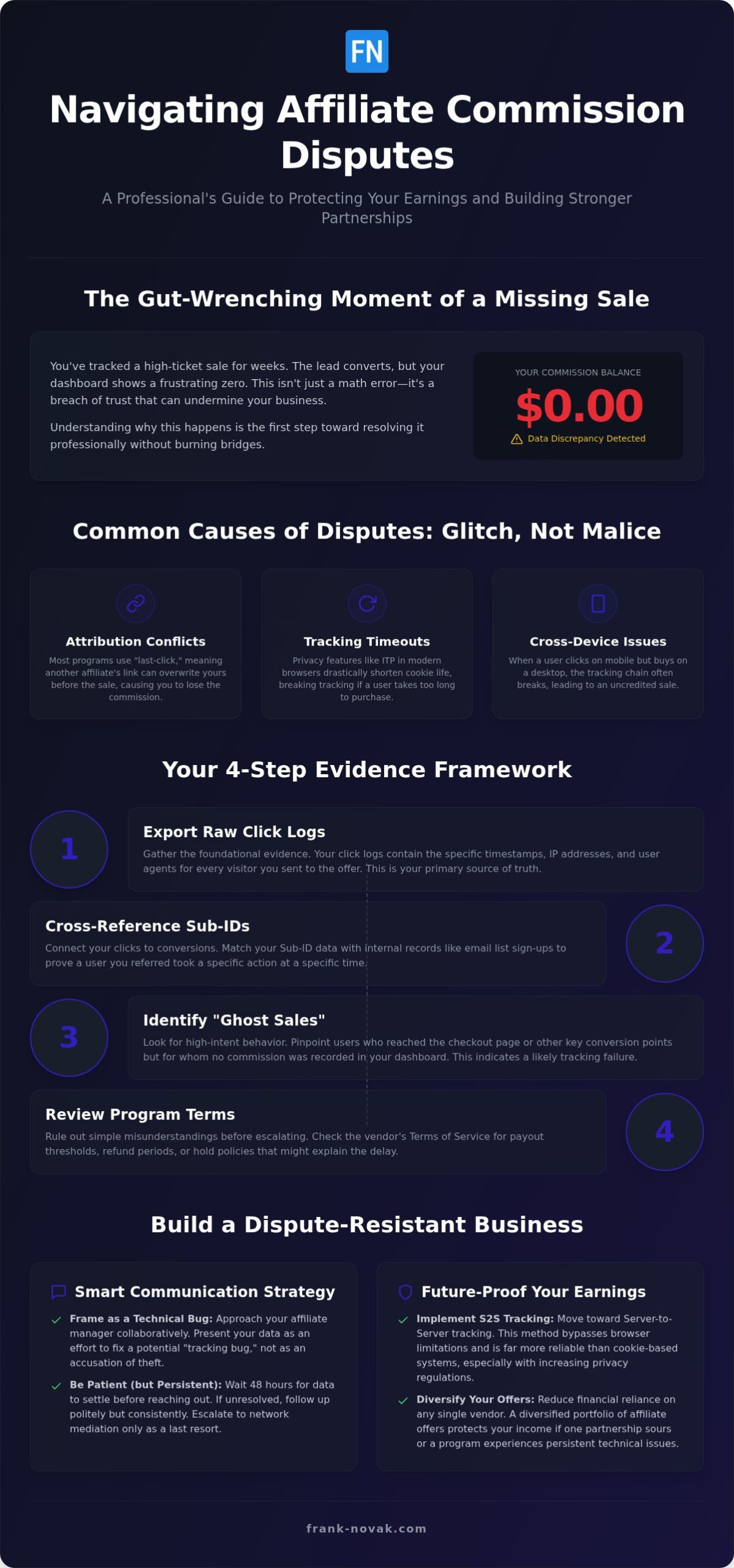
An affiliate commission dispute is essentially a professional disagreement that occurs when your recorded leads or sales don’t match the final payout report provided by a vendor. In the fast-paced digital environment of 2026, these discrepancies are becoming more frequent as the industry moves toward privacy-centric browsing. When your data shows a high-ticket conversion but your dashboard remains empty, it’s natural to feel a sense of unease. However, understanding the technical “why” behind these gaps is the first step in learning how to handle affiliate commission disputes with confidence and clarity.
Most issues stem from a handful of common root causes rather than intentional malice. Tracking timeouts, manual entry errors during payout processing, and “last-click” attribution conflicts often create the illusion of missing funds. While the term “scrubbing” is frequently tossed around in forums to describe intentional commission theft, the reality is that technical glitches are far more common. By treating these moments as alignment opportunities rather than personal attacks, you can maintain a productive relationship with your affiliate manager while you work to recover your earnings.
The Role of Attribution Models in Disputes
If you find yourself questioning a missing sale, the first place to look is the program’s attribution model. Many vendors still rely on “last-click” logic, meaning if a customer clicks your link but later clicks a different affiliate’s link before purchasing, you lose the commission. In 2026, we see a rise in “Linear” or “Time-Decay” models that split commissions across multiple contributors. If your dashboard shows a lower amount than expected, it might be because the commission was shared with another marketer who helped move the lead through the funnel. Understanding these back-end mechanics is a core part of the Online Success Coaching curriculum, as it helps you set realistic expectations for your income.
Technical Failures: When Cookies Crumble
Modern tracking is more fragile than it used to be. With the widespread adoption of Intelligent Tracking Prevention (ITP), the window for tracking a cookie has shrunk significantly. If a user starts their journey on a mobile device but switches to a desktop to complete the purchase, the tracking chain often breaks. This cross-device transition is a leading cause of disputes. To mitigate these risks, many professional marketers are moving toward server-side tracking, which is a key feature of the ClickBank Super Funnel. This method bypasses browser-based limitations, ensuring your hard work is recorded accurately regardless of the user’s privacy settings. Knowing how these systems fail allows you to provide specific, technical feedback when you are learning how to handle affiliate commission disputes effectively.
How to Audit Your Affiliate Data: A 5-Step Evidence Framework
Before you send that first email to support, you need to build a case based on hard data rather than assumptions. Learning how to handle affiliate commission disputes effectively starts with a thorough internal audit. If you can present clear evidence that a sale occurred through your link, you move the conversation from a vague complaint to a technical investigation. This professional approach shows the vendor that you’re a serious partner who understands the mechanics of the business.
Follow these five steps to create your evidence framework:
- Step 1: Export your raw click logs. These logs contain the specific timestamps and IP addresses of every visitor you sent to the offer.
- Step 2: Cross-reference your Sub-ID tracking with your internal lead generation records. If your email list shows a new subscriber at 2:00 PM and your logs show a click at 1:59 PM, you have a documented connection.
- Step 3: Identify “ghost sales.” These are instances where a user showed high-intent behavior, such as reaching a checkout page, but no credit appeared in your dashboard.
- Step 4: Review the “Terms of Service.” Sometimes, missing commissions are actually just delayed due to specific payout thresholds or hold periods you might have overlooked.
- Step 5: Compile a “Dispute Dossier.” This is a single document containing your logs, screenshots, and lead data to present to your affiliate manager.
Leveraging Your Own Funnel Analytics
Relying solely on a merchant’s dashboard is a common mistake that leaves you vulnerable to tracking gaps. By using tools like the ClickBank Super Funnel, you maintain an independent record of every click and conversion. This allows you to track the “Bridge Page” hop-link to prove exactly when the hand-off to the merchant occurred. Having this third-party verification makes it much easier to resolve discrepancies when they arise. If you want to master these back-end mechanics, Online Success Coaching can help you set up these systems for maximum transparency.
Identifying Patterns in Missing Commissions
Look for trends in your missing data to see if there’s a systemic issue. Is the discrepancy localized to a specific traffic source, such as Facebook Ads or a specific email sequence? Sometimes, certain platforms or “leaky” landing pages can inadvertently strip your affiliate tags during the redirect process. If you suspect a technical failure, try conducting a “test purchase” using a different device and network. This simple check verifies if the tracking is active and accurate. Understanding these nuances is vital when you’re figuring out how to handle affiliate commission disputes without damaging your professional reputation.
Communication Strategy: How to Approach Your Affiliate Manager
Once you’ve gathered your evidence, the way you present it determines how quickly you’ll see a resolution. The golden rule for how to handle affiliate commission disputes is to treat the discrepancy as a technical bug rather than a personal attack. Most affiliate managers are balancing hundreds of accounts; if you approach them with accusations of theft, they’re likely to become defensive. Instead, position yourself as a proactive partner helping them identify a potential tracking leak. This shift in perspective turns a conflict into a collaborative troubleshooting session.
Timing is just as important as your tone. It’s often best to wait at least 48 hours before sending that first email. Dashboards sometimes lag, and data needs time to “settle” in the system after a high-volume day. If the sale still hasn’t appeared after two days, it’s time to reach out. By providing your “Dispute Dossier” as a professional courtesy, you make it easy for their development team to trace the click and find the error. This data-driven approach is far more effective than a vague inquiry about missing funds.
The Professional Outreach Template
Your subject line should be clear and professional to ensure it gets opened quickly. Avoid emotional phrases like “Where is my money?” and opt for something like “Technical Inquiry: Missing Commission Data for [Date].” This signals that you’re focusing on facts rather than feelings. It sets the stage for a calm, logical discussion about the tracking mechanics.
In the body of the email, use a data-first approach. State the facts clearly: include timestamps, Sub-IDs, and the specific traffic source. For example, you might say, “I noticed a conversion on June 12th at 2:15 PM PST that hasn’t reflected in the dashboard.” Close with a collaborative tone. Remind them that you value the partnership and want to ensure the tracking is perfect so you can confidently scale your traffic. This mindset is a core part of the professional communication we teach in Online Success Coaching.
Managing the Follow-Up Process
Give the manager a reasonable window to investigate, usually about 72 hours. If you haven’t heard back, a polite follow-up is perfectly acceptable. If the dispute stalls, you can escalate to a Senior Manager, but do so without “burning the house down.” Simply state that you’d like another set of eyes on the technical logs to ensure everything is firing correctly. This keeps the door open for future growth.
In some cases, if a tracking error is confirmed but the specific sale can’t be recovered, you might suggest a “make-good” payment. Alternatively, a temporary commission bump on future sales can help recoup the lost income. This keeps the relationship intact while ensuring you’re fairly compensated. This high-level negotiation is much easier when you’re using a reliable system like the ClickBank Super Funnel, which provides the transparency needed to back up your requests. By staying professional, you prove that you’re a long-term asset to their program.
Escalation and Resolution: What to Do If the Dispute Stalls
If your initial outreach doesn’t yield a resolution, it’s time to move toward more formal escalation steps. Learning how to handle affiliate commission disputes requires a clear understanding of the systems designed to protect you. When communication with a vendor stalls, you shouldn’t feel like you’ve reached a dead end; instead, you should look toward the broader infrastructure of the affiliate network to find a solution. These systems are built to ensure fairness for both parties when technical errors occur.
Platforms like ClickBank or Impact act as neutral mediators between affiliates and vendors. Because these networks maintain their own tracking logs, they can verify data independently of the merchant’s dashboard. If you’ve provided your evidence and still haven’t received a response, filing an official ticket through the network’s support system is your most effective path forward. They have the authority to audit the vendor’s records and ensure you’re paid what you’re owed based on the raw server data.
Before you commit to a prolonged battle, it’s wise to perform a quick cost-benefit analysis. If the missing commission is small, your time is likely better spent generating new leads. However, for high-ticket sales or recurring revenue, the effort to escalate is always justified. You should also review your contract for legal considerations like arbitration clauses. Most modern affiliate agreements include these to provide a structured way to resolve disagreements without the need for traditional small claims court, keeping the process professional and private.
Working with Affiliate Networks
This neutral oversight is a primary reason why Online Success Coaching focuses on building businesses within reputable networks. These platforms offer a layer of accountability that independent programs often lack. When you submit a ticket, the network’s mediation team can often identify technical glitches that the vendor’s support staff might have missed. This process keeps the interaction professional and data-driven, which is essential for how to handle affiliate commission disputes without damaging your industry reputation.
Pivoting Your Traffic Strategically
If a dispute remains unresolved and you lose trust in a vendor, you need to be able to pivot quickly. One of the greatest benefits of using an automated marketing funnel is the flexibility it provides. You can swap out your affiliate links in a matter of minutes, directing your traffic to a “backup offer” that values your partnership. Your email list is your most powerful asset; as long as you maintain that connection with your audience, your revenue doesn’t have to stop just because one vendor failed to track a sale correctly.
Protect your income and automate your growth with the ClickBank Super Funnel.
Prevention: Building a Dispute-Resistant Affiliate Business
Building a business that is resistant to tracking errors is just as important as knowing how to handle affiliate commission disputes when they occur. Proactive prevention ensures that your income remains steady even when technical shifts happen in the background. One of the most effective ways to protect yourself is through diversification. You shouldn’t rely on a single vendor for more than 30% of your total income. If a dispute arises with one partner, your entire revenue stream won’t vanish overnight, giving you the leverage to negotiate from a position of strength.
To further fortify your business, consider implementing these high-level strategies:
- Server-to-Server (S2S) Tracking: Move away from browser-based cookies for high-ticket offers. S2S tracking communicates directly between servers, making it nearly impossible for privacy settings to “scrub” your data.
- Monthly Health Checks: Schedule a recurring audit of your tracking and payout reports. Compare your internal click logs against merchant payouts every 30 days to catch discrepancies before they become major losses.
- Direct Relationship Building: Top affiliates often have direct lines to their managers. When you build a personal rapport, most disputes can be resolved in less than an hour through a quick message rather than a long email chain.
Automation as a Safety Net
The ClickBank Super Funnel creates a transparent data trail that acts as your primary safety net. By using this system, you’re not just sending traffic; you’re creating an independent record of every hop-link and conversion. Many successful marketers also use third-party tracking software to verify merchant data in real-time. This allows you to set up automated alerts for “Conversion Rate Drops.” If your tracking suddenly stops firing, you’ll know immediately, allowing you to pause traffic and fix the issue before you lose hundreds in potential commissions. This level of automation is essential for anyone learning how to handle affiliate commission disputes through technical superiority.
The Power of Mentorship and Community
Beyond the technical setup, the right guidance can save you from partnering with unreliable vendors in the first place. The Online Success Coaching program provides a direct line to industry insights that you won’t find in public forums. You’ll stay updated on which vendors have “shady” tracking practices and learn the strict compliance rules that keep your account in good standing. Joining a mastermind or a professional community allows you to hear “whisper” reports about program reliability. When you know which programs are struggling with tracking before you start promoting them, you can pivot your traffic toward more stable and profitable opportunities.
Master Your Tracking for Long-Term Growth
Navigating the complexities of missing commissions doesn’t have to be a source of stress if you have the right systems in place. By shifting your focus from emotional reactions to data-driven investigations, you’ve already taken the most important step in professional growth. You now have a framework for auditing your click logs, a communication strategy that preserves your reputation, and a plan for escalating issues through trusted networks. Mastering how to handle affiliate commission disputes isn’t just about recovering lost funds; it’s about proving you’re a high-level partner who understands the back-end mechanics of digital marketing.
As you implement these monthly health checks and diversify your offers, you’ll find that technical discrepancies become minor hurdles rather than business-ending events. You deserve to work with systems that provide full transparency and reward your hard work with accuracy. Our coaching helps you navigate complex hurdles while providing access to automated tracking and the exact systems used by top ClickBank earners.
Scale your affiliate business with the ClickBank Super Funnel
With personalized support and high-conversion assets at your fingertips, you can scale your income with total confidence. Keep building, stay methodical, and watch your business thrive.
Frequently Asked Questions
What is the most common reason for a missing affiliate commission?
Most missing commissions result from technical tracking failures, such as Intelligent Tracking Prevention (ITP) or users switching from mobile to desktop devices. These interruptions break the cookie chain, preventing the sale from being attributed to your ID. While it feels like a loss of income, it’s often a limitation of browser-based tracking rather than intentional withholding by the merchant.
Can I sue an affiliate program for unpaid commissions?
You can technically pursue legal action, but most affiliate agreements include mandatory arbitration or mediation clauses that prevent traditional lawsuits. For smaller amounts, small claims court is a potential route, though it’s often more cost-effective to resolve the issue through network mediation. Always review your specific contract terms before considering legal escalation to understand your rights.
How long should I wait before following up on a commission dispute?
It is best to wait at least 48 hours for the network data to fully sync before initiating a dispute. Once you’ve sent your initial inquiry, give the affiliate manager another 72 hours to investigate their internal logs. This patient approach shows you understand the technical delays that can occur in high-volume systems and prevents unnecessary friction with the support team.
Will filing a dispute get my affiliate account banned?
Professional inquiries backed by data won’t get your account banned. Merchants value high-quality affiliates and want to ensure their tracking is accurate to keep you sending traffic. Bans usually only occur if an affiliate becomes abusive or cannot provide evidence for their claims. Knowing how to handle affiliate commission disputes with a calm, data-first attitude actually strengthens your professional standing.
How do I prove a sale happened if it’s not in the vendor’s dashboard?
To prove a sale occurred, you should provide raw click logs, timestamps, and Sub-ID data from your own tracking software. If you have lead generation records that match the time of the click, this creates a strong circumstantial case. Some affiliates also use customer confirmation emails, with sensitive data redacted, to show the vendor exactly which transaction is missing from the report.
What is ‘commission scrubbing’ and is it common in 2026?
Commission scrubbing is the intentional removal of valid sales by a vendor to avoid payouts. While this was a major fear in the past, it is relatively rare among reputable networks in 2026. Most modern discrepancies are caused by “cookie-less” browsing environments and privacy-centric updates that naturally hinder traditional tracking mechanics rather than intentional theft by the merchant.
Does using a VPN affect affiliate tracking and cause disputes?
Yes, VPN usage can interfere with tracking and lead to disputes. If a customer uses a VPN, it can mask their location or trigger fraud filters that automatically flag the transaction as suspicious. This is a common technical hurdle that can often be resolved by asking the manager to check their “flagged” or “pending” transaction logs for your specific Sub-ID.
Should I stop sending traffic to a vendor during a dispute?
You should consider pausing your high-spend traffic if the discrepancy represents a significant percentage of your daily revenue. Continuing to send paid traffic to a “leaky” funnel can quickly lead to financial loss. Redirecting that traffic to a backup offer while you learn how to handle affiliate commission disputes with the current vendor protects your ROI and keeps your business running smoothly.

Article by
Frank Novak
Frank Novak is an online marketing professional and coach who focuses on affiliate marketing and business automation. Through his website, frank-novak.com, he shares insights and strategies for leveraging social media platforms like Facebook to generate traffic and commissions.
Affiliate / Sponsored Content Disclaimer
This [website/post] contains affiliate links. If you click through and make a purchase, we may receive a commission at no additional cost to you. We only recommend products or services we believe will add value to our readers.