
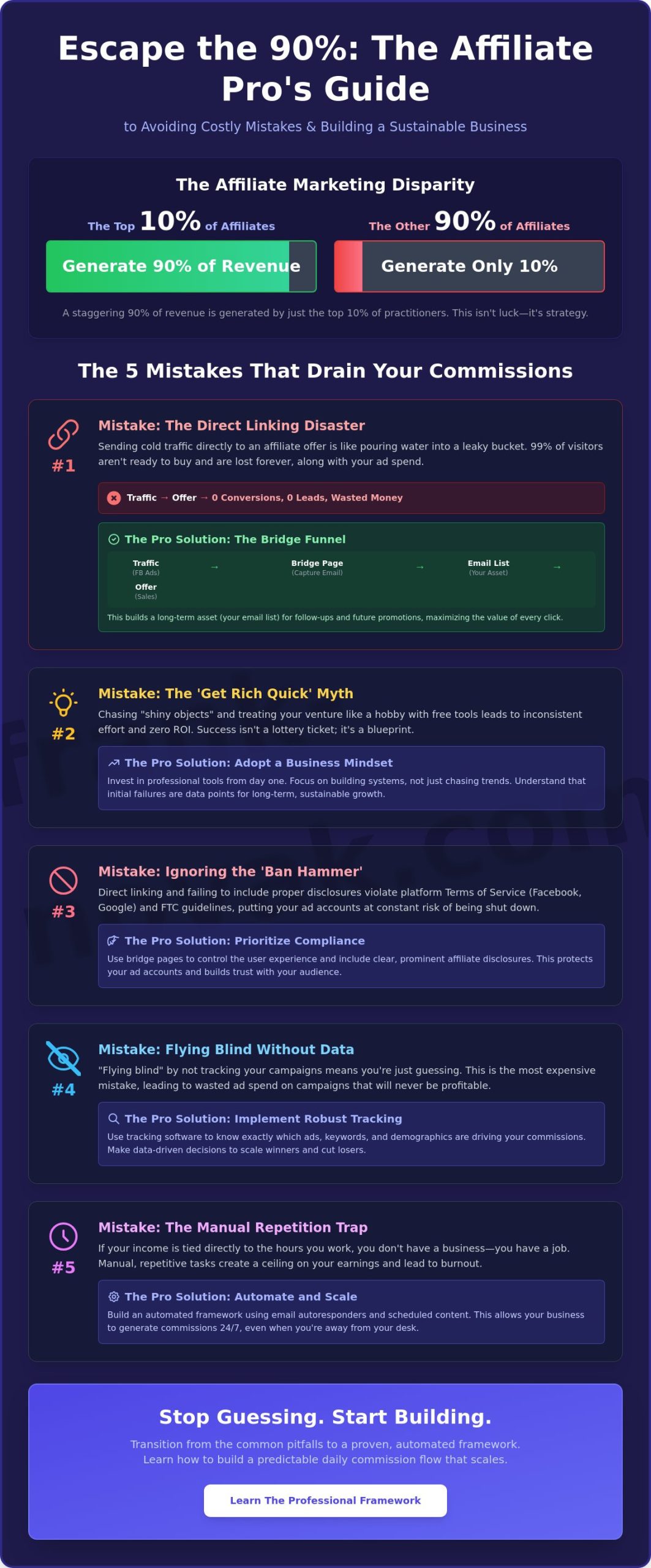
Did you know that while the global affiliate industry is projected to exceed $20 billion this year, a staggering 90% of revenue is still generated by just the top 10% of practitioners? If you have spent late nights staring at a stagnant dashboard or watching your Facebook ad budget vanish without a single sale, you’re likely feeling the weight of a few common affiliate marketing mistakes that separate the professionals from the struggling majority. It is exhausting to deal with the constant fear of account bans or the technical confusion that often comes with setting up a digital business from scratch.
If you feel like you are working harder than ever for diminishing returns, it is likely because your current model lacks a bridge between your traffic and your offers. In this guide, you will discover the critical pitfalls that drain commissions and learn a proven, automated framework to build a sustainable business. We will explore how to move away from manual guesswork and toward a predictable daily commission flow that runs smoothly even when you are away from your desk. This roadmap covers everything from updated FTC disclosure requirements to mastering high-converting funnels, providing the professional clarity you need to succeed in 2026.
Key Takeaways
- Learn how to shift from a lottery mindset to a professional business model to avoid the “shiny object syndrome” that stalls your progress.
- Understand why direct linking is one of the most common affiliate marketing mistakes, as it prevents you from building a valuable email list for long-term growth.
- Discover how to navigate platform compliance and avoid the “Ban Hammer” by using bridge pages instead of sending traffic straight to offers.
- Stop “flying blind” with your ad spend by implementing tracking systems that reveal exactly which efforts are generating your commissions.
- Transition from manual, repetitive tasks to an automated business framework that scales your daily commission flow without constant intervention.
The ‘Get Rich Quick’ Myth: Why Most Beginners Fail Before Their First Click
Many people start their digital journey with the hope of overnight success, often viewing the online landscape as a shortcut to wealth. This psychological trap is one of the most common affiliate marketing mistakes because it positions a professional business as a mere game of chance. If you approach Affiliate marketing with a lottery mindset, you are likely to abandon your efforts the moment the first obstacle appears. A true professional understands that building a digital asset requires patience and a “business owner” mindset rather than just a “hustler” mentality. While a hustler might jump from one trend to another, a business owner focuses on building systems that provide long-term value.
Avoiding these common affiliate marketing mistakes is about more than just strategy; it’s about your mental approach. Developing a “Success Mindset” means accepting that there is a learning curve and that initial failures are actually data points for future growth. If you can move past the need for instant gratification, you can begin to build a foundation that supports a sustainable income rather than a temporary win.
To better understand these psychological hurdles and how to avoid them, watch this helpful video:
Treating Affiliate Marketing Like a Hobby
If you only work on your business when you feel inspired, you will likely see inconsistent data and zero ROI. Treating this path as a hobby often leads to using “free” traffic methods that actually cost you your most valuable asset: time. Professional results require professional tools from day one. If you find yourself stuck in a cycle of starting and stopping, resources like Never Succeed Online can help you identify where your strategy is falling short and how to professionalize your daily routine.
The Myth of the ‘Magic’ Product
Many beginners fall into “shiny object syndrome,” believing that a specific “magic” product will fix a broken marketing process. However, even the best product cannot save a funnel that doesn’t convert. It is easy to get distracted by high commissions without checking for product-market fit. Success comes from identifying evergreen opportunities rather than chasing temporary fads that disappear as quickly as they arrived. By focusing on the mechanics of how you deliver value, you can avoid the graveyard of half-finished websites that many others leave behind.
The Direct Linking Disaster: Why Sending Traffic Straight to Offers Kills Conversions
If you have ever felt the frustration of watching your clicks climb while your commissions stay at zero, you are likely experiencing the “Leaky Bucket” syndrome. This happens when you send traffic directly to an affiliate offer without any buffer. It is one of the most common affiliate marketing mistakes because it ignores the fundamental reality that 99% of visitors aren’t ready to buy on their first visit. When you direct link, you lose the opportunity to reconnect with that visitor. You are essentially paying for traffic that disappears forever once they close their browser tab, leaving you with no way to follow up or build a relationship.
To solve this, professional affiliates use a “Bridge Page” to pre-sell the offer and establish trust before the customer ever sees a sales page. This intermediary step allows you to adhere to FTC disclosure guidelines by clearly stating your affiliate relationship. Transparency builds credibility, which is the foundation of any sustainable digital business. By identifying these common affiliate marketing mistakes early, you can pivot toward a more professional approach. If you want to move beyond the direct linking disaster, implementing a system like the ClickBank Super Funnel provides the structured framework necessary to capture leads and protect your business growth.
The Absence of a Lead Capture System
Your email list is the only traffic source you truly own and control. If a social platform changes its algorithm or a paid ad account gets flagged, your list remains your primary business asset. The math of affiliate success is clear: follow-up sequences can often triple your average customer value by providing multiple touchpoints. However, you must avoid the mistake of using low-quality lead magnets. If your “free gift” doesn’t solve a specific problem for your audience, you will only attract subscribers who are unlikely to ever make a purchase.
Failing to ‘Warm Up’ Cold Traffic
Cold traffic is naturally skeptical and requires a transition period before they feel comfortable making a purchase. A well-structured bridge page or a video sales letter (VSL) does the heavy lifting of moving a stranger from curious to ready to buy. For those who are promoting higher-priced products, using tools like Webinar Profit Engines can effectively automate this warming process. This ensures your traffic is properly primed, which significantly increases your chances of seeing a consistent commission flow.
The Traffic Quality & Compliance Gap: Common Mistakes with Facebook Ads
Entering the world of paid advertising feels like a shortcut to scaling, but it often reveals one of the most common affiliate marketing mistakes: prioritizing price over quality. If you find yourself hunting for the lowest cost-per-click without considering the intent of the visitor, you’re likely buying “junk” traffic that never converts. Beginners often fall into the trap of targeting a broad audience in hopes of catching a few sales, but this lack of focus drains your budget quickly. Professional marketers know that “cheap” traffic is actually the most expensive when it fails to produce a return on investment.
Meta’s advertising AI is incredibly sensitive to affiliate content, especially in niches like finance, health, or business opportunities. If you use a vendor’s raw affiliate link in your ad, you’re almost guaranteed to meet the “Ban Hammer.” This happens because platforms want to ensure a high-quality user experience and transparency. Following the FTC’s Endorsement Guides isn’t just about legal safety; it’s about building a brand that the platform trusts. By using compliant bridge pages, you create a “Safety Buffer” that protects your ad account while still guiding the customer toward the offer.
Ignoring Platform Compliance and Ad Safety
Most account bans stem from using aggressive, “get rich quick” language or making misleading claims in your ad copy. If you promise specific dollar amounts or unrealistic timelines, the compliance AI will flag your account immediately. You should never send traffic directly to a sales page that hasn’t been vetted for compliance. Instead, direct users to a high-quality landing page that provides value first. This approach keeps your account safe and ensures your traffic is actually interested in what you’re saying before they see the product.
Quantity Over Quality: The Bot Traffic Trap
It’s a common misconception that more traffic automatically equals more sales. In reality, 10,000 low-quality visitors from a generic source are worth significantly less than 100 laser-targeted prospects. If you want to scale effectively, you must use tools like the Facebook pixel to train the algorithm to find buyers rather than just clickers. For those looking to refine their approach, exploring Strategic Traffic Generation for Affiliate Links can provide the deep targeting tactics needed to avoid the bot trap. Focusing on quality over quantity is the only way to ensure your ad spend results in a positive return. Don’t let these common affiliate marketing mistakes derail your progress before you’ve had a chance to see real results.
The Data Blindness: Why Guesswork is the Most Expensive Mistake
Imagine a pilot trying to fly through a heavy storm without any instruments. This “Blind Pilot” approach is exactly how many beginners operate their digital businesses, and it remains one of the most common affiliate marketing mistakes. If you aren’t tracking where your clicks come from or which headlines actually drive sales, you’re essentially gambling with your budget. Many affiliates stop their campaigns just five minutes before they would’ve hit a “gold mine” simply because they couldn’t see the positive data trends buried beneath the surface noise.
To move from guesswork to professional clarity, you must learn to calculate your “True Profit.” This means looking beyond the raw commission number in your dashboard and accounting for every expense, including software subscriptions, ad spend, and the value of your own time. Without this level of detail, it’s impossible to know if your business is truly healthy or just keeping you busy. By identifying these common affiliate marketing mistakes early, you can begin to treat your data as the roadmap it’s meant to be.
Failing to Track the Customer Journey
If you don’t know where your leads are dropping off, you can’t fix the “hole” in your funnel. Professional systems rely on UTM parameters and tracking IDs to pinpoint exactly which traffic source is producing results. This is particularly vital for ClickBank products, where understanding your earnings per click (EPC) allows you to scale safely. If your EPC is higher than your cost per click, you have a green light to grow. If you’re ready to master these metrics, joining the Clickbank Profit Club can provide the professional guidance needed to interpret your data correctly.
The Myth of ‘Set It and Forget It’ Without Initial Optimization
While the ultimate goal is a business that runs on autopilot, reaching that stage requires a period of intense, active optimization. You can’t simply launch an ad and expect it to perform forever without adjustments. Success involves split-testing your headlines, images, and lead magnets to see what resonates best with your audience. You must be willing to “kill” losing ads quickly and double down on your winners without any emotional attachment to the original creative. Return on Ad Spend (ROAS) is the ratio that shows how much revenue you earn for every dollar spent on advertising, serving as the north star for every professional campaign. If you want to build a system that lasts, you have to do the work to optimize it first.
Designing Your Escape Route: How to Automate and Scale Your Affiliate Business
If you have spent months manually posting links in social media groups or responding to every comment yourself, you have fallen into a trap that feels more like a job than a business. This reliance on manual labor is one of the most common affiliate marketing mistakes because it simply does not scale. To find true professional freedom, you must transition into business automation. This shift allows you to move from being a “hustler” who trades time for pennies to becoming a business owner who manages systems designed for growth. By automating the repetitive parts of your workflow, you free up your energy to focus on high-level strategy and scaling.
Moving toward a sustainable model involves a clear three-step process. First, you must audit your current activities to identify where your time is being wasted on low-impact tasks. Second, you replace those manual steps with a structured funnel that captures leads and delivers value automatically. Finally, you use the data insights we discussed earlier to scale your budget into profitable territory. This structured approach is what separates those who constantly struggle from those who build six-figure assets. If you are tired of the cycle of uncertainty, it is time to build a system that works as hard as you do.
Leveraging Automated Marketing Funnels
Building a system that sells while you sleep or travel is the ultimate goal of any digital entrepreneur. A professional, automated marketing funnel follows a logical and reliable path: targeted traffic enters the system, a pre-configured funnel captures the lead, and an automated follow-up sequence builds the necessary trust to generate profit. This sequence ensures that no prospect is left behind and that every click has the maximum potential for conversion. For a comprehensive look at setting up these systems, you can review the Automated Marketing Funnel: The 2026 Guide to understand how to maintain growth in the current landscape.
The Role of Professional Mentorship
The role of professional mentorship is often the “shortcut” that prevents entrepreneurs from giving up too soon. Trying to reinvent the wheel in such a high-competition industry is another of those common affiliate marketing mistakes that costs both time and significant capital. A coach identifies the specific blind spots you cannot see from inside your own business, providing a steady hand during the complex scaling phase. Having a guide like Frank Novak ensures that you aren’t just working hard, but working on the right things. Engaging with Online Success Coaching offers a proven roadmap to sustainability, helping you avoid the pitfalls that frequently bankrupt new entrepreneurs before they reach their full potential.
Step Into Your Professional Future
Transitioning from a hobbyist to a business owner requires a fundamental shift in how you handle every click and conversion. By identifying the common affiliate marketing mistakes that keep most practitioners stuck in a cycle of manual labor, you have already taken the first step toward professional clarity. Success in 2026 isn’t about working harder; it’s about deploying systems like the ClickBank Super Funnel that capture leads and build trust automatically even when you’re away from your desk.
You don’t have to navigate the complexities of data tracking or Facebook Ad compliance strategies on your own. With a clear roadmap and one-on-one mentorship from Frank Novak, you can bypass the technical confusion and build a predictable commission flow. Ready to stop making rookie mistakes? Join my Online Success Coaching and let’s build your automated empire together. Your journey toward a sustainable digital business starts with the decision to stop guessing and start systematizing. You have the potential to reach your goals, and with the right guide, that success is well within your reach.
Frequently Asked Questions
What is the biggest mistake beginners make in affiliate marketing?
One of the most common affiliate marketing mistakes is direct linking to an offer without capturing a lead first. If you send traffic straight to a sales page, you lose the ability to follow up with the majority of visitors who aren’t ready to buy immediately. Building a bridge page allows you to establish trust and collect email addresses, turning a one-time click into a long-term business asset.
Can I do affiliate marketing without a website or funnel?
While you can technically share links on social media platforms, you shouldn’t try to build a professional business without a funnel. Relying on manual posts in groups is essentially a job rather than a scalable system. Using a structured funnel ensures that your marketing efforts are automated, which allows you to focus on high-level growth rather than constant manual labor.
How do I avoid getting my Facebook ad account banned for affiliate links?
You can avoid account bans by never placing raw affiliate links directly into your advertisements. Meta’s compliance AI requires ads to lead to high-quality, transparent landing pages that provide genuine value to the user. If you use a compliant bridge page that includes proper disclosures, you protect your ad account while effectively guiding users toward the final offer.
Is affiliate marketing still profitable in 2026 with all the competition?
Affiliate marketing remains highly profitable, with the global industry projected to exceed $20 billion in 2026. While competition has grown, the shift toward authentic content and sophisticated attribution models has created new opportunities for those who treat it as a profession. Success now depends on providing value and building trust with a specific niche audience rather than just chasing clicks.
How much money should I spend on ads before I see a return?
You should plan to spend enough to gather statistically significant data, which often means testing several different ad creatives and audiences. Instead of focusing on a fixed dollar amount, you should monitor your earnings per click compared to your cost per click. If your earnings are higher than what you pay for traffic, you have a profitable campaign that’s ready to scale.
Should I promote multiple affiliate products at once or focus on one?
You should focus on one high-quality product and a single proven system until you reach consistent profitability. Spreading your attention across multiple offers often leads to half-finished projects and confusion. Once you have an automated funnel that generates a predictable daily commission flow, you can then consider expanding into adjacent products to increase your overall revenue.
How do I know if an affiliate product is actually going to convert?
You can determine a product’s potential by looking at historical performance data, such as the “Gravity” score on ClickBank or the average earnings per click. If other professional affiliates are successfully promoting it and the sales page addresses a deep pain point for your audience, it’s a strong candidate. You should also verify that the vendor provides high-quality marketing materials for your funnel.
What is the fastest way to fix a failing affiliate marketing campaign?
The fastest way to fix a failing campaign is to audit your data to identify exactly where the “leak” in your funnel is occurring. If your click-through rate is high but your conversions are low, there’s likely a mismatch between your ad copy and the landing page. By adjusting one variable at a time, you can systematically solve these common affiliate marketing mistakes and return to a profitable state.

Article by
Frank Novak
Frank Novak is an online marketing professional and coach who focuses on affiliate marketing and business automation. Through his website, frank-novak.com, he shares insights and strategies for leveraging social media platforms like Facebook to generate traffic and commissions.
Affiliate / Sponsored Content Disclaimer
This [website/post] contains affiliate links. If you click through and make a purchase, we may receive a commission at no additional cost to you. We only recommend products or services we believe will add value to our readers.