
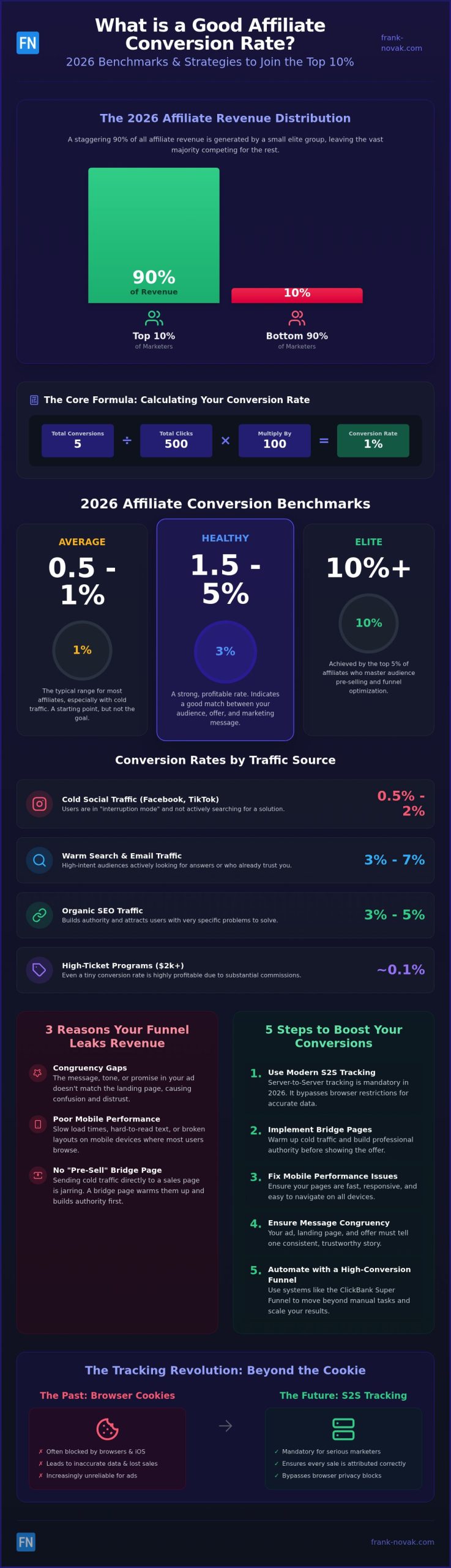
Did you know that in 2026, a staggering 90% of affiliate revenue is generated by just the top 10% of marketers? This leaves the majority of creators fighting over the remaining 10%, often while spending more on ads than they’re making in commissions. If you’ve been watching your dashboard and wondering what is a good affiliate conversion rate, you aren’t alone. It’s perfectly normal to feel a bit frustrated when your hard work doesn’t seem to match the success stories you see online, especially when technical hurdles make funnel optimization feel out of reach.
We understand that benchmarks can feel like a moving target, particularly when different niches report such wildly different numbers. This guide will provide you with the realistic 2026 benchmarks you need to measure your success accurately and with confidence. You’ll also learn the specific funnel strategies required to move your numbers from the average 1% mark to the elite 5% or higher seen by top performers. We will explore industry-specific data and a repeatable system for scaling, ensuring you have a clear roadmap to plug any leaks in your sales process.
Key Takeaways
- Learn the essential calculation formula and why modern S2S tracking is now required to maintain accurate data in the 2026 affiliate landscape.
- Understand exactly what is a good affiliate conversion rate by comparing current benchmarks for cold social traffic against high-intent search audiences.
- Identify the hidden “congruency gaps” and mobile performance issues that are likely causing your current marketing funnel to leak potential revenue.
- Discover how implementing bridge pages and following Facebook compliance standards can help you build the professional authority needed to drive more sales.
- Explore how the ClickBank Super Funnel allows you to move beyond manual tasks by automating a high-conversion journey from lead to commission.
What Is an Affiliate Conversion Rate and How Do You Calculate It?
To understand your performance, you first need a solid grasp of the math. At its core, Affiliate marketing is a performance-based game where the conversion rate serves as your primary scoreboard. You calculate it by taking your total number of conversions, dividing that by the total number of clicks you received, and multiplying the result by 100. For instance, if 500 people click your link and 5 of them buy the product, your conversion rate is 1%.
While the math is simple, the context behind the numbers is what truly matters. It’s helpful to distinguish between a “Click-to-Sale” rate and a “Lead-to-Sale” rate. The first measures everyone who landed on your page, while the second only counts people who already showed interest by giving you their contact information. Naturally, your Lead-to-Sale rate will be much higher, but both numbers are essential for identifying where your funnel might be losing people.
You should also be aware that a high conversion rate can sometimes hide a low return on investment (ROI). If you’re paying for premium traffic that costs $5 per click to achieve a 10% conversion rate, you might actually be less profitable than a marketer getting a 1% rate on low-cost or organic traffic. When you’re trying to figure out what is a good affiliate conversion rate for your specific situation, you must always look at your profit margins alongside the raw percentages.
The 2026 Tracking Reality: Beyond the Cookie
Tracking has become significantly more complex over the last few years. Since the major iOS privacy updates, standard browser cookies are often blocked or deleted quickly, which can make your data look less accurate than it really is. If you’re a serious marketer, server-to-server (S2S) tracking is now mandatory. It bypasses the browser entirely to ensure every sale is attributed correctly. When you’re running Facebook ads for affiliate marketing, tracking the entire journey is the only way to know which specific ads are actually putting money in your pocket.
Why ‘Good’ is Relative to Your Business Model
Your expectations should shift based on what you’re selling. A low-ticket $20 impulse buy should naturally convert at a higher rate than a $2,000 coaching program that requires weeks of consideration. Don’t ignore micro-conversions either. If someone joins your email list but doesn’t buy the main offer immediately, that’s still a win for your long-term strategy. Your conversion rate is a vital business health indicator that measures how effectively your marketing message turns curious observers into committed customers.
2026 Affiliate Conversion Benchmarks: What is ‘Good’?
When you ask what is a good affiliate conversion rate, the answer depends entirely on the temperature of your traffic. A 1% conversion rate might feel like a failure if you are mailing an engaged list, but that same number could represent a highly profitable campaign when running cold traffic from TikTok or Facebook. In 2026, the average affiliate conversion rate across all industries typically sits between 0.5% and 1%, while a rate between 1.5% and 5% is generally considered healthy. However, these broad averages don’t tell the whole story of your specific business model.
For cold traffic sources like Facebook or TikTok, a benchmark of 0.5% to 2% is the standard expectation. These users are in “interruption mode,” meaning they weren’t actively looking for a solution when they saw your ad. Conversely, warm traffic from search engines or email marketing should aim much higher, often landing between 3% and 7%. If you are promoting high-ticket coaching programs, don’t be discouraged by a 0.1% conversion rate. Because the commissions are so substantial, even a tiny fraction of a percent can lead to significant profits.
The “Elite” tier of affiliates, the top 5% who dominate their niches, often achieve rates of 10% or more. They don’t do this by finding “magic” traffic; they do it by mastering the art of the pre-sell. By warming up the audience before they ever see the vendor’s sales page, these marketers bridge the gap between curiosity and a purchase. If you find your numbers are consistently below these benchmarks, Online Success Coaching can help you identify exactly where your messaging is missing the mark.
Traffic Source Benchmarks for 2026
Organic SEO traffic remains highly effective, typically resulting in 3% to 5% conversion rates because the user has high intent. Social media ads often see lower initial intent, which is why they require a robust automated marketing funnel to nurture the lead. Email marketing continues to be the gold standard for many, with established lists frequently exceeding 10% conversion rates for relevant offers.
The Impact of Niche on Your Numbers
Your industry dictates your ceiling. Healthcare and wellness niches currently see average rates around 3.2%, while general e-commerce averages 2.3%. The wealth and business opportunity niche often faces higher skepticism, requiring more trust-building content to overcome resistance. In the SaaS sector, you might see 5% to 10% conversion for free trials, though the final conversion to a paid upgrade usually settles between 1% and 2%.
The 3 Hidden Reasons Your Conversion Rates Are Low
If you’ve analyzed your data and realized you’re falling short of what is a good affiliate conversion rate for your niche, it’s usually not a matter of bad luck. Most struggling campaigns suffer from “leaks” in the sales process that quietly drain potential profits. One of the most common mistakes is the ‘Direct Link’ trap. If you send cold traffic straight from a social media ad to a vendor’s sales page, you’re asking a stranger to make a purchase without any prior relationship. This approach often results in conversion rates near 0% because the audience hasn’t been properly introduced to the solution.
Another silent conversion killer is a lack of social proof. In 2026, consumers are more skeptical than ever. If your landing page features generic ‘buy now’ buttons but lacks genuine testimonials, case studies, or user reviews, you’ll struggle to build the trust necessary for a sale. People want to see that others have successfully used the product before they’re willing to part with their own money. Without this validation, even the most persuasive sales copy will often fail to move the needle.
The Congruency Gap: A Conversion Killer
Trust is built on consistency. When the ‘hook’ or promise in your advertisement doesn’t perfectly match the ‘header’ of your landing page, you create a congruency gap. This psychological disconnect causes visitors to feel like they’ve been misled, which leads to immediate bounces. You must ensure that your visual elements, such as colors and fonts, remain consistent throughout the journey. If you’re feeling overwhelmed by these details, using online success coaching can help you audit your funnel and identify exactly where these gaps are occurring in your business.
Technical Friction and Load Times
Technical performance is no longer optional. With over 80% of affiliate traffic now originating from mobile devices, a clunky or slow interface will destroy your results. Research indicates that mobile-optimized affiliate sites can achieve 64% higher conversion rates than those that aren’t. If your page takes too long to load, users will leave before they even see your offer. You should regularly check for broken links and 404 errors within your redirect chains. A clean, fast, and responsive mobile UI is the foundation of any high-performing affiliate campaign in the current landscape.
5 Steps to Boost Your Affiliate Conversions Today
Improving your results starts with moving beyond basic tactics. If you’ve been asking what is a good affiliate conversion rate while watching your traffic bounce away, it’s time to implement a more sophisticated approach. You can’t rely on the vendor’s sales page to do all the heavy lifting for you. Instead, you must take control of the pre-purchase experience by adding value before the click. By positioning yourself correctly, you turn a skeptical visitor into a confident buyer.
The Power of the Bridge Page
A bridge page acts as the essential middleman in your marketing funnel. By sharing a personal story or a detailed case study, you build the “Know, Like, and Trust” factor that cold traffic desperately needs. Using video content on this page is particularly effective, as it can increase engagement and keep visitors on your site longer. You’re positioning yourself as a helpful guide rather than just another salesperson, which significantly increases the likelihood of a conversion. This extra step provides the context your audience needs to understand why the product is the right fit for them.
Facebook Ad Compliance for Better Delivery
Operating on paid platforms in 2026 requires strict adherence to specific rules to ensure your ads actually reach your audience. If you use over-promising language or “get rich quick” hooks, you’ll likely trigger an immediate ad ban. Building a compliant landing page that search crawlers and social algorithms love is the key to business longevity. This means being honest about potential results and providing clear disclaimers. For a deeper look at the specific rules you need to follow to keep your accounts safe, check out this safety guide for Facebook compliance.
Beyond the bridge page, you should focus on A/B testing your headlines to find the specific emotional triggers that resonate with your audience. Sometimes a single word change can be the difference between a bounce and a sale. You might find that a headline focused on “avoiding loss” performs significantly better than one focused on “gaining a benefit.” Additionally, adding a high-value bonus, such as an exclusive PDF guide or a mini-course, gives people a compelling reason to buy through your link rather than a competitor’s. This differentiation is what helps you climb toward that elite 5% benchmark we discussed earlier.
Finally, you must implement retargeting. Since roughly 98% of visitors won’t buy on their first visit, staying in front of them with follow-up ads or emails is the most effective way to capture lost revenue. Retargeting allows you to address the specific objections that prevented them from buying the first time. When you combine these five steps, you’ll stop wondering what is a good affiliate conversion rate and start seeing your own numbers surpass the industry averages.
Scaling to Elite Rates with the ClickBank Super Funnel
Success in the 2026 affiliate landscape is less about working harder and more about building better systems. If you’re still manually building every landing page and sending every email, you’re likely stuck in a race to the bottom. While it’s natural to keep asking what is a good affiliate conversion rate, the answer for top-tier performers isn’t just a number. It’s a repeatable system. When you automate the process, you move from being a hobbyist to a professional business owner who can scale without burning out.
Data from this year shows that the 90/10 rule is in full effect, with 90% of affiliate revenue being generated by the top 10% of marketers. These elite individuals aren’t necessarily smarter; they simply use better tools to manage their funnels. By shifting your focus toward strategic traffic generation, you can spend your time where it matters most. You won’t have to worry about the technical tinkering that often leads to overwhelm and low returns on your ad spend.
What is the ClickBank Super Funnel?
The ClickBank Super Funnel is a ready-to-use digital asset designed specifically for automated lead generation. It bridges the gap between a curious visitor and a confirmed sale by managing the entire journey for you. By integrating automated email follow-ups that sell for you 24/7, you ensure that every lead is nurtured through a sequence designed to maximize its lifetime value. This level of automation is how you move your conversion rates from the average 1% toward the elite 5% or higher benchmarks seen by top practitioners.
The Role of Professional Mentorship
Even with the best tools, it’s easy to miss the “leaks” in your own sales process because you’re too close to the day-to-day work. This is where professional mentorship becomes invaluable. A coach provides an outside perspective, helping you see the technical friction or messaging gaps that are holding you back. If you’re ready to stop guessing and start following a structured 90-day plan, professional guidance is the fastest way to transition from zero to consistent profitability. It’s about building a sustainable business that grows steadily over time rather than chasing short-term wins.
To get a clear picture of where your business stands and how to improve your numbers, you can book an Online Success Coaching session to audit your conversion rates and identify your best path forward.
Moving Beyond Averages to Affiliate Mastery
Determining what is a good affiliate conversion rate for your specific niche provides you with a vital compass for your marketing journey. We’ve explored how cold traffic benchmarks differ from high-intent search audiences and why technical friction is often the hidden culprit behind low performance. By shifting your focus from manual tinkering to automated systems, you can stop reacting to fluctuating data and start predicting your results with confidence.
Sustainable growth in 2026 requires more than just a link and a dream. It demands compliant Facebook Ad strategies and proven automated lead generation systems that work while you’re away from your desk. Frank Novak’s expert mentorship provides the clarity needed to identify the specific leaks in your funnel. You have the benchmarks and the roadmap; now it’s time to take the next step toward elite performance.
Scale your commissions with the ClickBank Super Funnel
The journey to scaling your commissions is a marathon, not a sprint. With the right systems in place, you can build a reliable foundation that supports your long-term goals. You’re ready to turn these insights into action.
Frequently Asked Questions
Is a 1% conversion rate good for affiliate marketing in 2026?
If you’re asking what is a good affiliate conversion rate, a 1% return is a respectable starting point for cold traffic. While elite marketers often push for 5% or more, a 1% rate confirms your offer is relevant and your funnel is working. It’s a foundation you can build upon through testing and optimization rather than a signal to start over. Most successful campaigns begin at this level before scaling upward.
How do I find my conversion rate on ClickBank?
You can find this data within your ClickBank analytics dashboard by comparing your “Hops” to your total “Sales.” Simply divide the number of sales by the number of unique hops and multiply by 100 to get your percentage. Monitoring this number daily helps you identify which products are resonating with your audience and which ones might need a different promotional approach or a better bridge page.
What is the average conversion rate for Facebook ads to affiliate offers?
For cold Facebook traffic, the average usually ranges between 0.5% and 2%. Because social media users are browsing casually, they require a well-crafted bridge page or a lead magnet to move them toward a purchase. If you achieve anything above 2% with cold social traffic, your targeting and messaging are performing exceptionally well. It’s a sign that your audience finds your recommendation highly relevant.
Can I improve my conversion rate without increasing my ad spend?
Absolutely, and this is often the most effective way to scale your business. By A/B testing your headlines, improving your mobile page speed, or adding stronger social proof, you can convert more of the traffic you already have. Optimization is about plugging the leaks in your funnel rather than just throwing more money at the problem. Small changes in your copy can lead to big jumps in your commissions.
Why is my click-through rate high but my conversion rate low?
This disconnect often points to a mismatch between your marketing hook and the actual offer. While your ad is successfully grabbing attention, the landing page might not be delivering on that specific promise. If the visitor feels confused or misled when they arrive, they’ll bounce immediately. Aligning your messaging and visual style across the entire journey is the key to fixing this common issue and building trust.
Do high-ticket affiliate programs have lower conversion rates?
Yes, high-ticket offers typically convert at lower rates, often between 0.1% and 0.5%. Because these products require a larger financial commitment, the sales cycle is longer and involves more consideration. However, the much higher commissions mean that even a very low conversion rate can be significantly more profitable than high-volume, low-ticket sales. It’s about the quality of the lead rather than the raw quantity of clicks.
What is a bridge page and do I really need one?
A bridge page is a simple landing page that sits between your ad and the vendor’s sales page. It’s essential for warming up cold traffic by introducing yourself and sharing a personal recommendation or case study. Without one, you’re just another salesperson; with one, you become a trusted guide. This extra step is often the difference between a failing campaign and one that reaches elite benchmarks.
How does page load speed affect my affiliate commissions?
Load speed is a critical factor in your overall success. Since most affiliate traffic is mobile, a one-second delay can lead to a noticeable drop in sales. Users expect instant results, and if your page feels sluggish, they’ll likely return to their social feed. Maintaining a fast, clean mobile UI ensures you don’t leave easy commissions on the table due to technical friction that is easily avoidable.

Article by
Frank Novak
Frank Novak is an online marketing professional and coach who focuses on affiliate marketing and business automation. Through his website, frank-novak.com, he shares insights and strategies for leveraging social media platforms like Facebook to generate traffic and commissions.
Affiliate / Sponsored Content Disclaimer
This [website/post] contains affiliate links. If you click through and make a purchase, we may receive a commission at no additional cost to you. We only recommend products or services we believe will add value to our readers.