

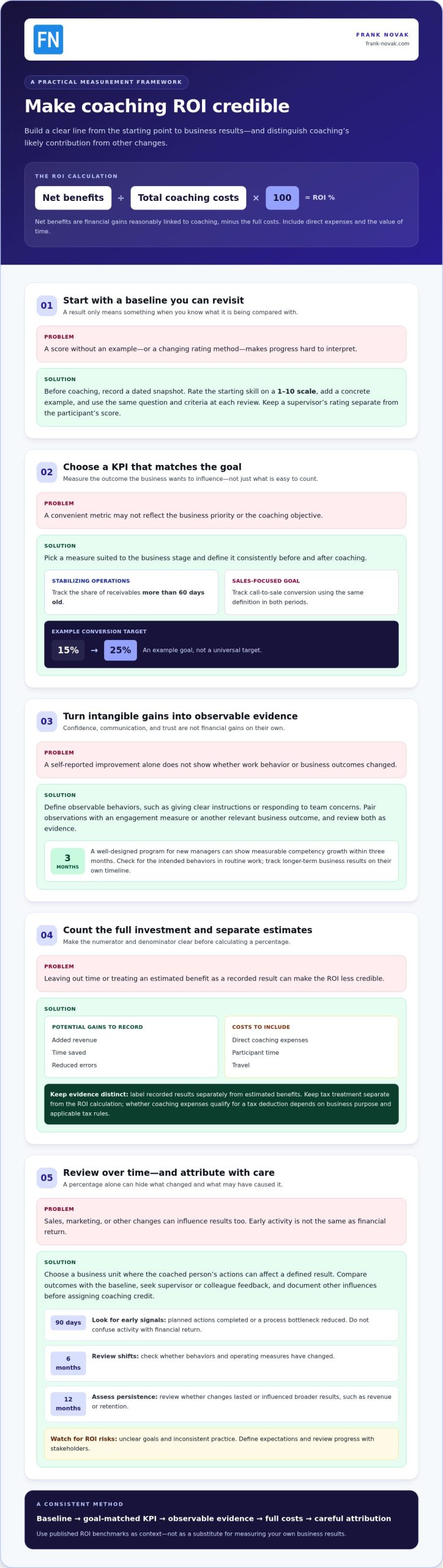
A coaching ROI is only as credible as the improvements you can fairly attribute to coaching. To understand how to measure the ROI of business coaching, calculate net benefits divided by total coaching costs, then multiply by 100 to express the result as a percentage. Net benefits are the financial gains you can reasonably link to coaching, minus the full costs, including direct expenses and the time involved.
It’s natural to want a clear figure when deciding whether coaching is helping your business. But a percentage alone can hide the difference between a genuine improvement and a change driven by other factors.
This guide shows you how to set a useful baseline, choose KPIs that match your business goals, and assess financial and less tangible gains. You’ll also learn to compare results over time and distinguish coaching’s likely contribution from other changes, such as sales or marketing activity.
With a consistent method, you can assess coaching’s value more thoughtfully and make better-informed decisions about what to continue, adjust, or measure next.
Key Takeaways
- Start with a clear baseline and choose KPIs that connect coaching to a specific business goal.
- Include direct expenses and the value of time when calculating the full investment.
- Translate improvements in confidence, engagement, or leadership into measurable business outcomes where there’s a reasonable link.
- Compare results over time and account for other factors, such as changes in sales or marketing, before assigning credit to coaching.
- Use published ROI benchmarks as context, not as a substitute for measuring your own business results.
What is the ROI of coaching and how is it measured?
Measure coaching ROI by comparing business benefits with the full investment, then assess which changes coaching plausibly influenced. A practical approach to how to measure the ROI of business coaching is to track financial, operational, people, and risk outcomes against defined goals.
-
Define coaching outcome categories
Choose the outcomes coaching should influence, such as profit, process speed, engagement, or fewer errors. A 90-day operational target might reduce rework incidents by 30% or approval cycle time by 40%. Compare coaching with consulting, training, or mentoring by the goal and method: consulting typically offers recommendations, training teaches skills, mentoring shares experience, and coaching supports behavioral change. Their ROI depends on the outcomes and costs being assessed.
-
Track early and later outcomes
Set checkpoints at 90 days, 6 months, and 12 months. At 90 days, look for early signals, such as completing planned actions or reducing a process bottleneck; don’t confuse activity with financial return. At 6 months, review whether behaviors and operating measures have shifted. At 12 months, assess whether changes persisted or influenced broader results, such as revenue or retention. Short-term objectives can span three months to one year.
-
Quantify tangible and intangible results
Record financial gains such as added revenue, time saved, or reduced errors, alongside indirect costs like participant time and travel. The coaching ROI formula is net benefits divided by total coaching costs, multiplied by 100. If you’re deciding how to measure the ROI of business coaching, distinguish recorded results from estimated benefits. Rate skills on a 1 to 10 scale and pair self-assessments with observed behavior.
In the United States, whether coaching expenses qualify for a tax deduction depends on their business purpose and applicable tax rules. Keep tax treatment separate from the ROI calculation.
-
Connect coaching to business-unit outcomes
Choose a business unit where a coached person’s actions can affect a defined result. Compare the result with its baseline and consider feedback from supervisors or colleagues, not just participant self-reports. Other influences, such as sales and marketing changes, can affect results too, so document them before assigning coaching credit. Risks to ROI include unclear goals and inconsistent practice; define expectations and review progress with stakeholders.
Establishing baselines and selecting stage-appropriate KPIs
Start with a dated snapshot of the business and the skill you want coaching to strengthen. This gives later reviews a reference point and connects personal development with business priorities.
- Rate the starting skill on a 1-10 scale, then document a concrete example behind the score. If the focus is delegation, note which decisions the manager currently keeps and which they pass to the team. A written example makes the rating easier to interpret during follow-up than a number alone.
Use the same question and criteria at every review. If a supervisor also rates the skill, record that perspective separately instead of averaging it with the participant’s score.
- Choose KPIs that reflect the business’s current stage and coaching objective. For a business working to stabilize operations, track the share of receivables more than 60 days old. For a sales-focused goal, track call-to-sale conversion using the same definition before and after coaching.
A sample target is to increase call-to-sale conversion from 15% to 25%. Treat this as an example of a measurable goal, not a universal target. The KPI should represent the outcome the business wants to influence, not simply a number that is easy to collect.
- Translate the coaching objective into an observable competency and a business measure. If the goal is stronger leadership communication, define behaviors such as giving clear instructions and responding to team concerns. Pair those observations with an engagement measure or another relevant business outcome, then review both rather than treating either as complete evidence on its own.
A well-designed program for new managers can show measurable competency growth within three months. At that point, assess whether the intended behaviors appear in routine work, while tracking longer-term business results on their own timeline.
- Write down how each KPI is calculated, where its data comes from, and who maintains it. For conversion, use a consistent count of completed sales divided by calls handled. A weekly review cadence can also be monitored; a sample target is 90% adherence over 90 days.
Consistent definitions are essential when deciding how to measure the ROI of business coaching. If the calculation or data source changes mid-review, document the change so it isn’t mistaken for business progress.
- Review the baseline, competency, and KPI together before coaching starts. Set a review date and record the starting value, target, owner, and evidence source. When explaining how to measure the ROI of business coaching, show how each measure connects to the goal and what would count as meaningful progress.
Entrepreneurs building an online business can consider Online Success Coaching while developing a practical way to track business goals.
Translating intangible improvements into financial metrics
Confidence, communication, and trust can influence business performance, but they aren’t financial gains on their own. Trace the path from an observed change to a business outcome, and keep estimates separate from recorded results.
- Separate direct results from indirect benefits. Direct results include recorded revenue, reduced operating time, or fewer costly errors. Indirect benefits include stronger confidence, improved morale, and clearer communication. For example, improved listening by a leader is an observed change; fewer unresolved team issues may be a related operational outcome.
Keep each measure distinct. If the same improvement appears as both saved time and increased productivity, don’t count both as separate financial benefits unless records show separate effects.
- Connect each intangible change to a business measure. Map the chain from behavior to operational effect to financial consequence. For example, clearer delegation may reduce approval delays, helping a team complete work sooner. Record the behavior and operational measure first; attach a monetary estimate only when business records support the connection.
This approach keeps the assessment objective. A confidence rating can show perceived progress, but it doesn’t establish additional revenue without evidence linking confidence to sales outcomes.
- Use a consistent method to value improvements. Identify the affected work, the observed change, and the records showing its business effect. If a team spends less time correcting avoidable errors, compare the time spent before and after the behavior change. Value recovered time only when it is actually redirected to productive work.
Distinguish measured gains from estimates. Label a recorded reduction in rework as direct evidence and a projected benefit from improved morale as an estimate. This helps decision-makers see how much of the return on investment rests on verifiable outcomes.
- Track cultural value without treating it as cash. A research estimate places cultural capital at 60-85% of an organization’s true value, but that estimate isn’t a cash return from coaching. Use it as context for why trust, safety, and collaboration matter, not as a multiplier for calculating financial benefits.
For example, pair survey feedback about team trust with retention or engagement metrics. Keep the qualitative feedback alongside those measures so a financial summary doesn’t erase meaningful changes that lack a direct monetary value.
- Apply a confidence adjustment before including estimated benefits. One approach is to ask participants how confident they are that a result followed from coaching, using a 0% to 100% scale. A reported 45% positive mindset shift about trust and safety illustrates a measurable perception, not a financial gain.
Treat a confidence measure as supporting evidence, then compare it with manager observations and business records. If the evidence doesn’t support a financial link, report the improvement as an intangible outcome rather than assigning it a dollar value.
Attributing business improvements to coaching with integrity
Before calculating financial impact, separate observed change from coaching’s contribution. A clear attribution process records the behavior, the business result, and other influences that could explain the change.
- Write down the expected behavior and business outcome before coaching begins. For example, if a leader practices clearer delegation, record changes in task ownership and any related delivery measure. This creates a traceable path from coaching practice to business change, rather than assigning credit after results appear.
Set qualitative and quantitative expectations, then share them with relevant stakeholders. A written goal gives the participant, line manager, and evaluator a common reference point for reviewing progress.
- Keep a behavior-and-impact log throughout the program. At each review, record the observed behavior, who observed it, the date, and the business measure that may have changed. A manager’s rating of improved communication provides useful context, but examples such as clearer handoffs or fewer unresolved decisions make the evidence more concrete.
Gather feedback from participants, supervisors, and colleagues. Comparing their perspectives helps show where a self-reported improvement matches workplace experience and where the evidence differs.
- Identify changes outside coaching before assigning a share of the result. Sales campaigns, pricing changes, staffing shifts, and new processes can all affect revenue or retention. If profits rise 20% and an evaluation attributes 80% of that rise to coaching, the portion attributed to the coaching program is a 16% increase.
Document the reasoning behind your attribution. If several initiatives changed at once, distinguish the evidence for coaching’s contribution from the effects of those other initiatives.
- Use comparison groups or business-unit comparisons when practical. For example, compare retention in teams led by coached managers with a similar group over 6-18 months. Review team context, leadership changes, and workforce conditions so the comparison doesn’t mistake unrelated differences for coaching effects.
If a comparison group isn’t available, use repeated records, stakeholder feedback, and timing. A consistent pattern across these sources supports a more careful interpretation than a single post-program rating.
- Present estimates with their assumptions visible. One example describes a company with 500 employees and a 70% retention rate, where retention improves by 30% after coaching. Using a replacement cost of $10,000 per employee, the example estimates approximately $1 million in annual savings.
Use that example as a calculation model, not a promise or universal forecast. State the measured change, attribution method, and limits of the evidence so decision-makers can distinguish recorded outcomes from estimated coaching impact.
What are typical ROI benchmarks for business coaching?
Published benchmarks provide context, not a target every business should expect to reach. Before using a figure to interpret results, compare its population and outcome with your own coaching goals.
- Use the Manchester Review result as one reference point: 100 executives who received coaching reported an average return of 5.7 times the investment. Treat this as an average from that group, not a forecast for an individual business. Your result depends on what you measure, the starting position, and which gains can be linked to coaching.
When comparing your own ROI, use the same formula and include the full investment. A benchmark is useful only if its definition of return matches yours.
- Put study figures beside their sample details. MetrixGlobal Associates reported a 529% return on investment in a study involving 43 executives at a Fortune 500 company. The company setting and participant group matter, so don’t assume that result transfers directly to a small business or a different coaching goal.
Check whether a figure measures individual performance, team results, or organizational change. These describe different levels of impact and shouldn’t be treated as interchangeable.
- Read productivity benchmarks with their intervention in view. Organizations combining training with coaching experienced an 88% increase in productivity. That finding relates to a combined approach, so it shouldn’t be presented as the isolated effect of coaching alone.
Similarly, reported expected results for executive coaching include a 70% increase in individual performance, a 50% increase in team performance, and a 48% increase in organizational performance. Use these as separate comparison points, not a single cumulative return.
- Distinguish perceived confidence in coaching from a measured financial return. In an FMI survey, 87% of respondents agreed that executive coaching has a high return on investment. Separately, 86% of organizations saw a return on investment from their coaching engagements.
Those percentages describe agreement and reported organizational outcomes, not the size of a return. Keep satisfaction, belief, and calculated financial value in separate columns when reviewing results.
- Build a comparison that reflects your business. Choose a published result with a similar coaching purpose, participant group, and outcome measure, then compare it with your baseline and recorded results. If a benchmark measures executive performance but your goal is sales conversion, use it only as broad context.
Keep the takeaway practical: benchmarks can frame expectations, while your own records show whether coaching contributed value. Use a consistent calculation and explain differences in scope before sharing a comparison.
Frank Novak: Online Success Coaching
Online Success Coaching can help you apply these measurement principles to an online business. Frank Novak offers practical guidance for entrepreneurs pursuing clearer business goals and growth in digital ventures, including affiliate marketing and business automation.
Before starting, identify the business outcome you want to improve and the measure you’ll use to track it. This gives your coaching work a practical focus and lets you review progress against your own records rather than relying on general benchmarks. If your goal is to build and scale an online business, Online Success Coaching is a relevant next step.
Visit frank-novak.com to learn more about Online Success Coaching.
Make your next coaching decision evidence-led
Use your next review as a decision point, not just a report of what changed. Before the review, decide what evidence would lead you to continue, adjust, or pause the current approach. This keeps the discussion focused on business priorities rather than defending a preferred conclusion.
A useful approach to how to measure the ROI of business coaching is to make the decision rule clear to everyone involved. Agree on who will review the results, which records they’ll consider, and how qualitative feedback will inform the discussion. If the evidence shows progress but not yet financial impact, identify the next outcome to track rather than overstating the return.
For an online business, measured planning can help turn learning into focused action. Take the next step by discussing your coaching goals and how you’ll evaluate them through Online Success Coaching.
A thoughtful measurement plan gives you a clearer basis for moving forward. Keep building with purpose, one well-supported decision at a time.
Frequently Asked Questions
How do you track ROI on coaching?
Track a business outcome alongside the behavior coaching aims to change, then review them together. For example, if a sales leader practices more focused coaching conversations, monitor team conversion and observe changes in those conversations. Keep dates, data sources, and review notes consistent. This creates a traceable record for assessing whether progress coincided with coaching, while keeping other business changes visible in the same review.
Leading indicators: is the coaching taking hold?
Look for repeated use of agreed behaviors, not just positive comments after a session. Examples include a manager preparing for feedback conversations, delegating decisions, or following through on commitments. Compare observations from the participant and a supervisor, and record concrete examples. If the behavior appears only in coaching discussions, not routine work, it may not yet be part of the person’s practice.
What is ROI?
ROI, or return on investment, expresses the net benefit of an investment relative to its cost. For coaching, it can capture financial outcomes, but it shouldn’t obscure operational or people-related changes that matter to the business. A useful report distinguishes cash-based results from outcomes such as stronger communication, then explains how each measure was assessed. That clarity helps readers interpret the percentage in context.
Who yields the greatest ROI from coaching?
BetterUp research identifies core managers two to three levels below the C suite who manage a team as yielding the greatest ROI on coaching. For an individual business, focus on roles where behavior can influence team performance or a defined business result. A manager who shapes how work is assigned, reviewed, and communicated may be a useful starting point for evaluating coaching impact.
How do you calculate ROI for business coaching?
Subtract total coaching costs from the net benefits attributed to coaching, divide that figure by total coaching costs, and multiply by 100 for a percentage. Include direct expenses and indirect costs, such as participant time and travel. Keep the calculation period and the definition of benefits consistent across reviews. If an outcome is estimated rather than recorded, label it clearly rather than presenting it as measured cash.
What metrics should you track before and after business coaching?
Choose measures that match the goal, then collect them before coaching and at planned follow-ups. Depending on the objective, useful measures may include revenue, productivity, retention, engagement, and a skill rating. Pair a leadership skill score with observed examples, or compare engagement trends across survey cycles. Keep definitions and data sources consistent so changes reflect performance rather than a revised measurement method.
How do you attribute revenue or profit growth to business coaching?
Compare financial records with the coaching goal, then account for changes that could also affect the result. A new campaign, price adjustment, or staffing change may influence revenue independently. Record when each change occurred and what evidence supports coaching’s contribution. When several factors overlap, report an attribution estimate and its basis instead of assigning the entire increase to coaching.
How long does it typically take to see results from business coaching?
Timing depends on the outcome being measured. A well-designed program targeting new managers can show measurable competency growth within three months, while meaningful engagement and retention improvements may appear within six to twelve months. Review early behavior changes separately from later business outcomes. For example, first assess whether a manager uses a new feedback practice, then track how relevant team measures develop over time.

Article by
Frank Novak
Frank Novak is an online marketing professional and coach who focuses on affiliate marketing and business automation. Through his website, frank-novak.com, he shares insights and strategies for leveraging social media platforms like Facebook to generate traffic and commissions.
Affiliate / Sponsored Content Disclaimer
This [website/post] contains affiliate links. If you click through and make a purchase, we may receive a commission at no additional cost to you. We only recommend products or services we believe will add value to our readers.