

Progress usually takes more than a burst of motivation. In practical terms, what an online success coach does is help you clarify goals, organize your time, and turn intentions into manageable actions. Coaching also gives you space to review what’s working and adjust your approach when you lose momentum.
When you’re deciding how to move an online business forward, it helps to know what an online success coach does. The role is not simply to tell you to try harder. A coach helps you clarify priorities and identify practical steps toward your goals.
This article explains how online success coaching can support goal-setting, time management, organization, and motivation. You’ll also learn what a one-on-one appointment may involve and how coaching differs from advising or counseling, so you can decide whether this kind of support fits what you need right now.
Key Takeaways
- Use clear priorities and simple planning habits to make your time and tasks easier to manage.
- Turn broad ambitions into focused goals, then review your progress to keep motivation connected to action.
- Understand how coaching differs from advising and counseling so you can choose the kind of support that fits your needs.
- In a one-on-one session, expect a focused conversation about your challenges, goals, and practical next steps.
- Consider Online Success Coaching when you want support applying goal-setting and organization to your online business progress.
Time management and organization support
An online success coach can help turn a crowded schedule into a workable plan. Start by listing fixed commitments, recurring tasks, and goals that need focused attention. For example, someone building an online business might separate course study, content creation, customer replies, and personal responsibilities. Seeing these tasks together makes conflicts easier to spot. A coach can then help identify which activities support the main goal and which can wait.
Organization also means creating a repeatable way to handle routine work. Online entrepreneurs may use onboarding documents, program templates, exercise demonstration videos, and social media content. These resources can make recurring tasks easier to prepare and manage. A coach can help you choose tools that fit your workflow instead of adding software you may not use effectively. The useful choice is the one that reduces confusion without creating another task to maintain.
Written procedures can make that structure more consistent. An online coach can help outline standard operating procedures for common activities, such as preparing a course module or responding to a client. A procedure does not need complicated software. A clear sequence of steps can show what to do, what information to record, and what comes next. If a task keeps getting delayed, reviewing its steps may reveal whether the process is too broad or unclear.
For an online coach, time planning can also include deciding where business effort belongs. The market guidance notes that copywriting makes up 80 percent of an online coaching business. That figure highlights why planning content work matters, from drafting useful messages to explaining a coaching offer. Coaches are also advised to focus on a niche that matches their strengths and expertise, then define the ideal clients they want to reach. A specific audience can make planning more focused than trying to serve everyone.
For instance, strength and conditioning for football goalkeepers is a micro-niche. It gives a coach a clear topic around which to organize program materials and communications. A schedule can then reserve time for writing, client support, and reviewing the coaching process. Clear, comprehensive replies are more useful than yes-or-no responses, so setting aside time for thoughtful communication can support a consistent client experience.
For someone applying these ideas to an online business, Never Succeed Online is a relevant next step. It connects the broader work of organizing priorities with progress in an online venture. A coach’s practical contribution is helping make the next action visible: define the task, choose when it fits, and build a routine that can be reviewed and adjusted.
Goal-setting and motivation
People who want progress with a personal, academic, or business objective may hire an online success coach. They might be starting an online venture, trying to complete a course, or working toward a career change. Coaching can help turn a broad ambition into a clear goal, identify obstacles, and choose actions that fit the person’s priorities.
A useful starting point is understanding what success means to you. “Grow my business” is difficult to act on until it becomes more specific, such as deciding which offer to develop or which audience to serve. A coach can help you examine the reasons behind the goal, the resources already available, and the next decision that would move it forward. This keeps your plan connected to your purpose rather than outside expectations.
At Arizona State University, success coaches encourage students to think independently about plans for success in classes. They also invite students to reflect on which resources or strategies have worked for them. That approach illustrates an important coaching distinction: the coach can guide reflection without taking ownership of the person’s decisions. A student might consider whether a study group, course materials, or a different weekly routine has helped before, then decide what to apply to the current goal.
Motivation can shift as people encounter difficult tasks or slow progress. A coach can help identify the obstacle more precisely. For example, if someone keeps postponing a business course, the issue might be uncertainty about its relevance, competing commitments, or not knowing how to apply each lesson. Naming the barrier creates a more useful discussion than simply demanding greater effort. The next step can then match the actual problem, such as clarifying the course’s purpose or choosing one lesson to put into practice.
Progress reviews make goals easier to adjust. A coach and client can compare intended actions with what happened, discuss what supported progress, and decide whether the goal or approach needs refinement. If a plan depends on motivation alone, a difficult week can derail it. Connecting actions to personal reasons, useful resources, and clear signs of progress gives the person more to work with.
Coaching is most useful when you want to think through a goal and take responsibility for your choices. If you’re exploring goals for an online venture, ideas for building an online business can provide a relevant starting point for reflection. The coach’s role is to help you examine possibilities and keep your next decision tied to the outcome you want.
How coaching differs from advising and counseling
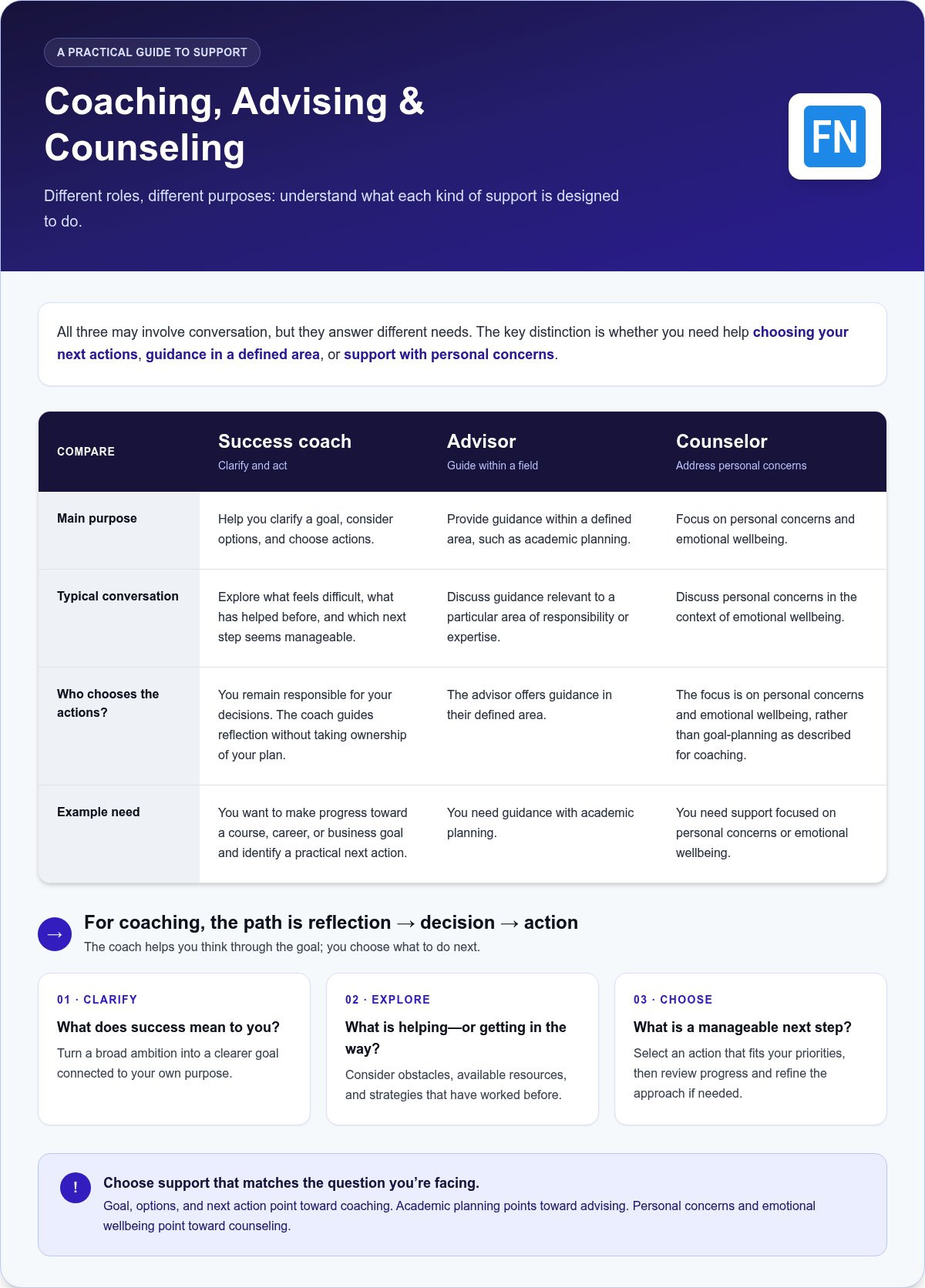
Coaching, advising, and counseling can all involve conversation, but they serve different purposes. An online success coach helps you clarify a goal, consider options, and choose actions. An advisor provides guidance within a defined area, such as academic planning. Counseling focuses on personal concerns and emotional wellbeing. Knowing the distinction helps you seek support that matches the question you’re facing.
Consider a student who wants to do better in a course. A success coach might ask what has helped the student learn before, what feels difficult now, and what action seems manageable. The student remains responsible for choosing a plan. This reflective approach helps build independent decision-making instead of handing over a ready-made answer.
Academic advising is more appropriate for specific institutional questions. Arizona State University success coaches recommend speaking with an academic advisor for answers about course registration. An advisor can address requirements and available course choices within the school’s processes. A coach can help the student think through priorities, but that conversation doesn’t replace an advisor’s role in registration.
Counseling has a different focus again. Someone dealing with personal distress may need a conversation centered on understanding that experience and finding suitable support. Success coaching instead concentrates on goals, choices, and practical next steps. For example, a person planning an online business might use coaching to identify the decision blocking progress. If the main concern is emotional wellbeing, goal planning alone may not address the need.
The roles can complement each other without becoming interchangeable. A student could speak with an academic advisor about registration, then use coaching to reflect on study strategies. Someone developing a business could work with a coach to define a next objective while consulting a relevant specialist for technical or professional guidance. The key is matching each question to the kind of expertise it requires.
Before an appointment, write down the decision you want to work through. “I need help with my course” is broad; “I’m choosing between two course options and need to clarify my priorities” gives the conversation direction. A coach can help examine your reasons and possible actions. An advisor handles registration details, while counseling addresses concerns that call for personal support.
This distinction also clarifies what coaching is not: it isn’t a source of every answer or a substitute for another role. A useful coaching conversation helps you think more clearly about a goal and your next move. If you need formal academic information, Arizona State University’s example points toward an advisor. If you want structured reflection on your own plans, coaching may fit that task.
One-on-one success coaching
One-on-one coaching centers on your specific goals, challenges, and decisions. Its value comes from focused attention and a plan that responds to your situation.
The One-on-One Coaching Relationship
A one-on-one coaching relationship is a working partnership where coach and client focus on the client’s progress. It matters because your goals and obstacles shape the discussion, rather than a general program alone. For example, a coach can help you identify one business challenge and explore a practical response before taking on another.
Useful coaching connects encouragement with honest feedback and action. A coach should help clarify the problem, agree on a workable next step, and review what happened. For tailored programming, detailed tracking, benchmarks, and regular check-ins can make progress easier to discuss. The coach should also show genuine investment in your development, not just offer motivation.
To choose and evaluate a coach, look for a clear explanation of their approach, relevant experience, and how they track progress. In an initial conversation, describe a goal and ask how the coach would help you explore it. Notice whether they listen, respond thoughtfully, and explain how feedback and follow-up work. Clear answers help you assess whether their method fits your needs.
Coach Costs and Qualifications
Cost and qualifications both affect the coaching arrangement. Understanding what shapes the fee and what a credential represents helps you make a more informed choice.
In the United States, the price depends on the case and is given after a quote request; factors include the coach’s experience, specialization, session format, and included support. Compare what the service covers, such as one-to-one discussions, progress reviews, or other forms of follow-up. A fee alone doesn’t explain the coaching method or whether it addresses your goal.
An online success coach doesn’t need certification to work as a coach. A base coaching qualification is described as 60 hours, and prospective coaches can consider programs accredited by the International Coach Federation. Treat credentials as one point of context, alongside relevant expertise, clear communication, and an approach you understand.
Coaching has limits: it supports goal-focused reflection and action, but it isn’t a guarantee of results or a substitute for every kind of professional support. Warning signs include promises of specific outcomes, pressure to make quick decisions, vague explanations of the process, or dismissal of reasonable questions. A sound working relationship makes the goal, next steps, and progress reviews clear. If feedback feels purely motivational, ask how the coach will help address the practical challenge and assess what changes over time.
What to expect in an appointment
An appointment focuses on a specific challenge and turns discussion into clear next steps. Online sessions also let a coach review progress and feedback without meeting in person.
Coaching Sessions and Tools
An online coaching session is a focused conversation about your goals, barriers, and possible actions. A structured discussion can help you leave with a clearer next move.
A coach can work through one specific client problem, then develop a solution before addressing another challenge. Benchmarks and regular check-ins help track progress against the plan. For example, if a client is testing a new business approach, coach and client can review what happened and use that information to adjust their next action.
Online work also depends on clear communication. A coach can use video calls to give verbal feedback and visual cues, helping recreate some of the interaction available face to face. Shared notes or progress records can keep agreed actions visible between conversations. The useful tools are the ones the coach and client can manage consistently.
During an appointment, expect questions that help clarify the issue, not only general encouragement. A coach might ask what you tried, what happened, and which obstacle remains. Honest feedback can help separate an action that needs refinement from a goal that needs reconsideration. This keeps the conversation focused on results and practical learning.
Expected Results and Timing
Results from online success coaching can include greater clarity, better-informed decisions, and progress toward goals. Realistic expectations keep attention on actions and learning rather than promises of instant outcomes.
Progress depends on the goal’s scope, the actions chosen, and how consistently they are followed. A focused business decision can be reviewed after trying an approach; a broader professional goal may involve several connected steps. Regular benchmarks help identify what is moving forward and where the plan needs adjustment.
At each check-in, compare the intended action with what actually happened. If a client planned to publish useful content but postponed it, the discussion can identify the barrier and shape a workable next attempt. If the action was completed, review the response and decide what to learn from it. This makes progress observable without relying on motivation alone.
Coaching also involves feedback that reflects genuine attention to the client’s development. A coach can acknowledge progress, ask direct questions, and help break a complex challenge into a manageable focus. When a new issue appears, addressing the current obstacle first can keep the work from scattering across competing priorities.
To get more from an appointment, bring one current challenge, relevant notes, and a decision you want to examine. Between sessions, record actions taken and questions that arise. Those details give the next conversation a concrete starting point and help both participants assess whether the approach is useful.
Frank Novak: Online Success Coaching
Frank Novak’s Online Success Coaching is a relevant next step if you want support pursuing goals for an online business. His focus on affiliate marketing and business automation offers practical guidance for developing a digital venture. Consider whether your current challenge involves defining a direction, building business skills, or following through on a plan.
Frank Novak also offers resources including Never Succeed Online, ClickBank Super Funnel, and Clickbank Profit Club. Choose the option that best matches the support or learning you’re seeking, while recognizing that coaching and resources do not replace the effort and decisions involved in building your business.
Choose a Next Step That Fits Your Goal
Understanding what an online success coach does can help you decide whether guided reflection fits your next stage. Before taking action, name the decision you’ve been postponing or the outcome you want to move toward. Then consider what kind of support would make that step clearer: a focused conversation, practical learning, or time to compare your options.
You don’t need a complete plan before seeking direction. A useful starting point can be an honest question about your priorities and what you’re ready to work on. From there, you can decide whether coaching aligns with your aims and how you want to approach your progress.
Take the next step at a thoughtful, manageable pace. Give your goals clear attention, then decide what support and action can help you move forward with greater purpose.
Frequently Asked Questions
Success Coaching: What is Coaching?
Coaching is a focused conversation that helps someone explore a goal, consider choices, and decide what action to take. In success coaching, that goal might involve learning, work, or an online venture. For example, someone exploring affiliate marketing could use a session to clarify what they want to learn before choosing a project. The coach guides the discussion, while the individual makes and owns the decisions.
How is coaching different from other resources?
A course, article, or checklist offers information, while coaching creates space to apply ideas to a specific situation. After reading about online marketing, for instance, a learner might bring a question about their audience or campaign approach to a coaching discussion. They can consider relevant options and decide what to explore next. Self-directed resources support learning; a coach helps connect that learning to the person’s current context.
What does an online success coach do day to day?
Day to day, what an online success coach does depends on their specialty and client work. Their work may include preparing coaching materials, writing useful content, responding clearly to client questions, and reviewing feedback. They may also refine how they organize recurring tasks or communicate their area of expertise. For example, a coach focused on online business could create educational material that helps aspiring entrepreneurs understand a marketing concept.
What services and support does an online success coach provide?
Support varies with the coach’s focus, so look for a clear connection between their expertise and your goal. Frank Novak’s Online Success Coaching focuses on affiliate marketing and business automation. Topics include evaluating affiliate marketing mastermind groups, connecting Google Ads with ClickBank campaigns, and building credibility in financial-services affiliate marketing. This focus may suit an online entrepreneur seeking practical guidance on digital marketing decisions rather than general support across unrelated goals.
How is an online success coach different from a life coach, business coach, or therapist?
The main difference is the focus of the work. A life coach may help someone consider personal goals, while a business coach focuses on business development. An online success coach may concentrate on progress in a digital venture, such as affiliate marketing. Therapy has a different purpose and focuses on mental health concerns. If your main question involves growing an online business, a coach with relevant digital-business expertise may fit better.

Article by
Frank Novak
Frank Novak is an online marketing professional and coach who focuses on affiliate marketing and business automation. Through his website, frank-novak.com, he shares insights and strategies for leveraging social media platforms like Facebook to generate traffic and commissions.
Affiliate / Sponsored Content Disclaimer
This [website/post] contains affiliate links. If you click through and make a purchase, we may receive a commission at no additional cost to you. We only recommend products or services we believe will add value to our readers.