

Have you ever felt like a “fake” when hitting the publish button on a product recommendation? If you’re struggling with audience fatigue or rising ad costs, mastering storytelling for affiliate marketers is no longer just a creative choice; it’s a survival strategy in 2026. With the global affiliate industry projected to exceed $20 billion this year, the competition for attention is fiercer than ever. It’s completely normal to feel frustrated when your carefully crafted posts are met with silence, especially if it feels like your audience has developed a sixth sense for being sold to.
We understand that you want to create content people actually want to read while building a business based on genuine trust. If you’ve noticed your conversion rates slipping despite your best efforts, the solution isn’t to shout louder, but to tell better stories. This article provides the exact frameworks to turn boring affiliate links into compelling narratives that capture attention and skyrocket your conversions. We’ll walk through how to navigate the latest FTC disclosure requirements while building automated, story-driven funnels that turn casual readers into loyal advocates for your recommendations.
Key Takeaways
- Master the art of storytelling for affiliate marketers to bridge the gap between a reader’s current problem and your recommended solution.
- Discover a four part framework that uses relatable pain points and shared frustrations to build an authentic connection with your audience.
- Learn how to leverage specific story archetypes to establish authority, even if you are just starting out and do not have a personal success story yet.
- Explore practical methods for injecting micro stories into your landing pages and automated email sequences to increase engagement and time on page.
- Understand how your unique personal narrative serves as a competitive advantage that helps you transition from a simple marketer to a trusted authority.
Why Storytelling is the Secret Engine of Affiliate Conversions
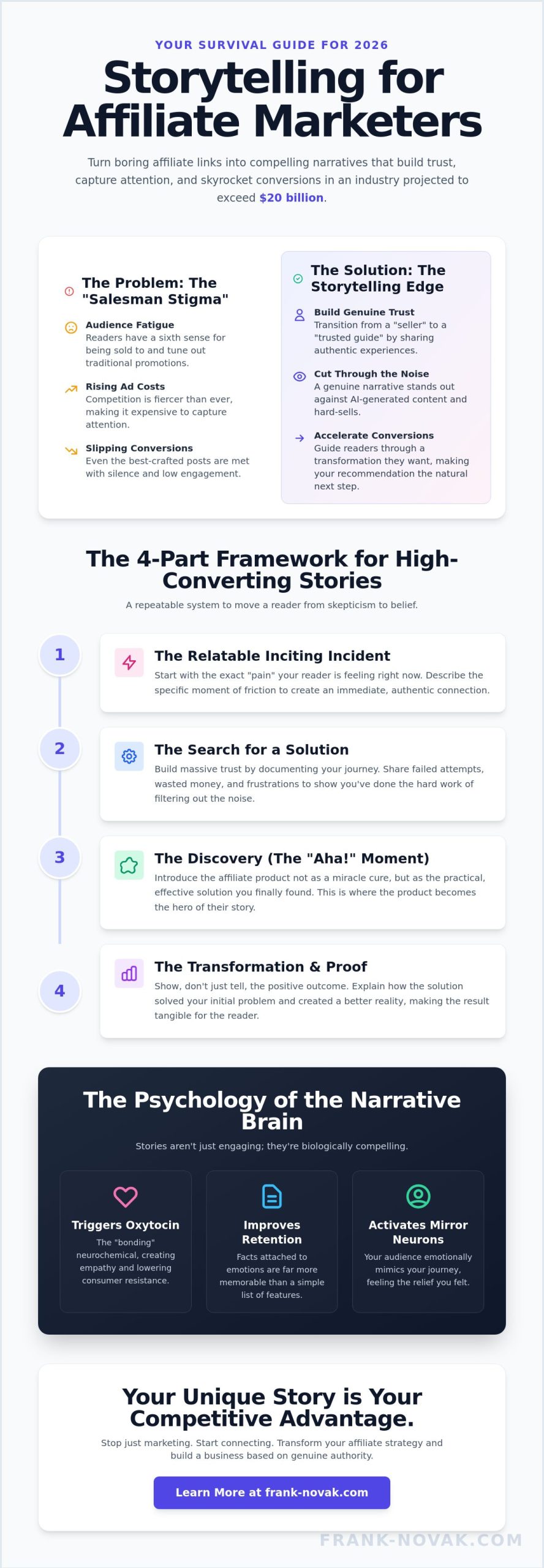
Storytelling for affiliate marketers is the essential bridge that connects a reader’s current pain point to the eventual solution you’re recommending. It’s the difference between simply shouting a price at someone and walking them through a transformation. In 2026, where consumers are bombarded by AI-generated noise, a genuine narrative is what accelerates the “Know, Like, and Trust” factor. People don’t just buy products; they buy the better version of themselves that the product promises to create.
When you rely on feature-based selling, you’re essentially asking the reader to do the heavy lifting of figuring out why a product matters. Narrative-based selling does that work for them by showing the product in action within a real-life context. This approach taps into the deep-seated human need to be entertained and understood, which naturally lowers consumer resistance. By focusing on empathy, you can cut through the ad fatigue that causes most people to scroll past traditional promotions.
To better understand this concept, watch this helpful video:
The Psychology of the Narrative Brain
Your brain is essentially a narrative processor. Scientific research shows that stories trigger the release of oxytocin, a neurochemical responsible for empathy and bonding. While a list of technical specifications might be forgotten in minutes, a well-told story improves information retention significantly because it attaches facts to emotions. We’ve evolved to tune out repetitive sales pitches, yet we’re biologically compelled to follow a plot until its conclusion. In the context of a recommendation, the mirror neuron effect means your audience actually mimics your emotional journey, feeling the same relief you felt when you finally found the right solution.
Overcoming the “Salesman Stigma”
Many creators hesitate to use affiliate links because they don’t want to feel like a “pushy salesperson.” Shifting to a story-driven approach changes your identity from a seller to a trusted guide. Instead of standing behind a counter, you’re walking alongside your reader as a partner. You build true authority not by pretending to be perfect, but by sharing your vulnerabilities and the lessons you’ve learned along the way. This transparency makes your final recommendation feel like helpful advice from a mentor rather than a cold, impersonal transaction. When you use storytelling for affiliate marketers, you aren’t just selling; you’re helping someone navigate a path you’ve already traveled.
The 4-Part Framework for High-Converting Affiliate Stories
Effective storytelling for affiliate marketers isn’t about being a literary genius; it’s about following a structured path that moves a reader from skepticism to belief. If you treat your narrative like a repeatable system, you can consistently produce content that resonates without waiting for a “spark” of inspiration. This framework provides the mechanics needed to build a bridge between your audience’s current frustration and the solution you’re providing.
- Step 1: The Relatable Inciting Incident. Every great story starts with a moment of friction. Instead of starting with the product, start with the exact moment you felt the “pain” your reader is currently experiencing. If you’re promoting a productivity tool, describe the specific Tuesday afternoon when you realized you’d spent four hours staring at a blank screen while your to-do list grew.
- Step 2: The Search for a Solution. This is where you build massive trust. Document your failed attempts, the money you wasted on “magic pills,” and the frustrations you encountered. When you admit that other things didn’t work, you’re no longer just a person with a link; you’re a fellow traveler who has done the hard work of filtering out the noise for them.
- Step 3: The Discovery (The “Aha!” Moment). This is where the affiliate product enters the scene. Don’t present it as a miracle, but as the turning point that finally made things click. Explain the specific feature or realization that changed your trajectory.
- Step 4: The Transformation. Show, don’t just tell, the “Before vs. After” results. If the product helped you earn your first commission or save ten hours a week, provide those concrete details. The goal is to let the reader visualize that same transformation happening in their own life.
Hooking the Reader in the First 3 Seconds
If you want to keep someone’s attention in a crowded feed, you should try opening your story “in media res,” or in the middle of the action. Instead of a slow buildup, start with a punchy sentence that drops the reader right into the conflict. You can also use “Open Loops” by posing a question or describing a problem without immediately giving the answer. This creates a psychological mechanism of narrative persuasion that keeps the reader scrolling to find the resolution.
The Bridge: Moving from Story to Sale
The most common mistake is the “clunky pivot,” where a heartfelt story suddenly turns into a stiff sales pitch. To avoid this, your transition should feel like the natural conclusion of your experience. If the story has done its job, the reader should already be wondering how they can get the same results. Use subtle calls-to-action that position the link as the logical next step in their journey. If you’re looking for a structured way to implement these narratives into a high-converting system, exploring a proven ClickBank Super Funnel can help you automate this entire process while maintaining that personal touch.
3 Story Archetypes for Marketers (Even Without a Success Story)
If you’re just starting out, you might feel like you lack the authority to recommend products because you haven’t reached your ultimate financial goals yet. This is a common hurdle, but you don’t need a massive bank statement to be effective at storytelling for affiliate marketers. In fact, many people prefer following someone who is just a few steps ahead of them rather than a distant expert. You can build significant trust by adopting specific narrative roles that don’t rely on your personal financial results.
- The Relatable Struggler: This archetype is powerful because it mirrors the reader’s current reality. By sharing your honest journey, including the mistakes and small wins, you position yourself as a peer. Developing a strong affiliate marketing success mindset allows you to turn these struggles into lessons that inspire others to keep going.
- The Investigative Reporter: You don’t need to be the creator to be the expert. In this role, you act as a filter for your audience. You might say, “I spent twenty hours researching the best email tools so you can make a choice in five minutes.” This provides immense value and establishes authority through effort rather than just results.
- The Success Proxy: If you haven’t reached your big breakthrough yet, you can highlight the achievements of a mentor or other students who use the same system. You’re essentially saying, “The path works; look at where it led them.” This keeps the focus on the effectiveness of the solution rather than your personal status.
Borrowing Authority Through Case Studies
When you lack your own data, you can borrow authority from the product creator or the existing user base. Most affiliate programs provide marketing materials filled with user transformation stories that you can curate into your own narrative. It’s vital to remain honest during this process. You aren’t claiming these results as your own; instead, you’re acting as a curator of evidence. By highlighting what’s possible for others, you provide the social proof necessary to help your reader make a confident decision without feeling like you’re overstepping your experience.
The “Us vs. Them” Narrative
Building a community often involves identifying a common “enemy” that your audience is tired of facing. This isn’t about attacking individuals, but rather about rejecting outdated methods, high ad costs, or overly complex jargon that keeps people stuck. When you position your recommended product as the tool for a “new way” of doing things, you create a sense of belonging. To create a tribal narrative safely, you should focus on uniting your audience against a shared challenge rather than fostering negativity toward specific people or competitors.
Integrating Narrative into Your Automated Sales Funnels
Building a narrative isn’t just for social media posts or one-off blogs. To scale your business effectively, you need to bring these elements into your automated systems. Storytelling for affiliate marketers becomes a powerful asset when it’s baked into your landing pages and email sequences. By injecting micro-stories into your sales pages, you increase time-on-page and pre-sell leads before they ever see a “Buy” button. This strategy humanizes your brand and makes the automated journey feel like a one-on-one conversation. This approach is a core part of how the ClickBank Super Funnel leverages narrative to drive consistent results without requiring your constant presence.
When you use micro-stories on a landing page, you don’t need a thousand words. A simple three-sentence anecdote about a specific frustration can be enough to make a reader feel seen. If you can describe their problem better than they can, they’ll instinctively trust that you have the solution. This builds a psychological bridge that makes the eventual product recommendation feel like a helpful suggestion rather than a cold pitch.
The 5-Day Email Story Arc
A classic way to automate trust is through a structured email sequence. Over five days, you guide your subscriber through a specific emotional arc that builds momentum. On Day 1, you set the hook with an intriguing scenario that mirrors their current situation. Day 2 brings the high drama, where you detail the lowest point of your journey or the “failed attempts” we discussed earlier. By Day 3, you share the epiphany and introduce the affiliate product as the turning point. Day 4 focuses on the hidden benefits and real-world applications, while Day 5 creates natural urgency based on the transformation they’re missing out on. Maintaining a consistent voice is crucial. If you sound like an approachable mentor in your first email, you shouldn’t switch to a corporate tone by the third. You should aim to balance educational value with the narrative so readers look forward to every message you send.
Story-Driven Facebook Ads
In 2026, long-form story ads are often outperforming short, punchy copy that feels too “salesy.” People are tired of being pitched and prefer to be persuaded through a narrative that feels authentic. When you use storytelling for affiliate marketers in paid traffic, you must match the story to the temperature of your audience. Cold leads need a story that focuses on the shared problem and the initial struggle. Warm leads respond better to stories about the specific results and the ease of use. For more details on keeping your narratives compliant with platform rules, you can check our guide on Facebook Ads for affiliate marketing. By aligning your ad story with your funnel story, you create a seamless experience that builds trust from the very first click.
Ready to build your own story-driven system? Get started with our ClickBank Super Funnel today.
Scaling Your Personal Brand Through Story-Driven Coaching
If you’ve followed the frameworks discussed in the previous sections, you’re already ahead of the majority of people in the digital space. However, the ultimate goal of storytelling for affiliate marketers isn’t just to sell a single product; it’s to transform your identity from a simple promoter into a trusted authority. While anyone can copy a product link or a set of features, nobody can replicate your unique history, your specific failures, or the way you view the world. In an era where AI can generate endless streams of generic content, your personal narrative is the only asset that cannot be commoditized or automated away.
As you build this trust, you’ll find that your audience stops asking “Which product is best?” and starts asking “What do you recommend I do next?” This shift opens the door to higher-level opportunities, such as transitioning from affiliate commissions to offering online success coaching. By positioning yourself as a guide who has already navigated the obstacles your readers face, you create a unique selling proposition (USP) that is entirely based on your lived experience. Your story becomes the foundation of a brand that people stay loyal to for years, rather than just for a single transaction.
Building the “Story Bank”
Your Next Steps: From Story to Success
The transition from a marketer to a mentor doesn’t happen overnight, but it does start with a single step. You can begin today by writing your first “struggle story” and sharing it with your audience, focusing purely on the emotional honesty rather than the sale. If you feel uncertain about how to structure your brand narrative, seeking professional feedback can be a significant shortcut. Refining your message ensures that every post, email, and ad you create serves the dual purpose of driving sales and building your legacy. If you’re ready to take your business to the next level, you can join the Online Success Coaching program to refine your brand story and build a sustainable, narrative-driven career.
Turning Your Narrative Into a Sustainable Business
By shifting your focus from simple product features to authentic narrative frameworks, you’ve already taken the first step toward building a resilient brand. We’ve seen how identifying relatable pain points and using specific story archetypes can establish authority, even if you’re just starting your journey. Mastering storytelling for affiliate marketers is about more than just making a sale today; it’s about creating a loyal audience that trusts your recommendations for years to come. When you integrate these stories into automated systems like the ClickBank Super Funnel, you create a business that works for you around the clock.
Since 2018, Frank Novak has been helping creators navigate the digital landscape with a focus on sustainable growth and business automation. If you’re ready to move beyond the “salesman stigma” and become a trusted guide in your niche, the right mentorship can make all the difference. You don’t have to navigate these complex systems alone. Master your narrative and scale your commissions with Online Success Coaching to refine your strategy and reach your goals. Your unique story is the one thing no competitor can copy, so start sharing it with the world today.
Frequently Asked Questions
Do I need to be a professional writer to use storytelling in affiliate marketing?
You don’t need to be a professional writer to succeed with storytelling for affiliate marketers. Most audiences actually prefer a conversational, imperfect style because it feels more authentic and relatable than polished corporate copy. If you can explain a problem to a friend over coffee, you have all the skills necessary to write a compelling marketing narrative. The focus should always be on the emotional connection rather than perfect grammar or literary flair.
What if I don’t have a “rags to riches” story to share?
You don’t need a dramatic transformation to build trust with your audience. Many successful marketers share small wins and daily lessons rather than massive financial breakthroughs. Readers often find a story about saving two hours a week more believable and attainable than a story about making millions overnight. Your honest, incremental progress is often your most persuasive asset because it feels achievable for the reader.
How long should an affiliate marketing story be?
The length of your story should match the platform and the temperature of your audience. For email sequences, you might write several hundred words to build deep rapport, while a landing page might only need a “micro-story” of three to four sentences. You should always aim to be as concise as possible while still conveying the necessary emotional arc. If a sentence doesn’t move the plot forward or build empathy, it’s probably better to remove it.
Can I use storytelling on platforms like Facebook without getting banned?
You can absolutely use storytelling for affiliate marketers on Facebook, provided you follow their advertising policies and the latest 2026 FTC disclosure guidelines. Narrative-driven ads often perform better because they look less like traditional pitches and more like organic content. By focusing on your personal experience rather than making “income claims” or “guarantees,” you lower the risk of triggering automated compliance flags.
How do I tell stories for products I haven’t personally used yet?
If you haven’t used a product yet, you can share the results of the creator or other successful students. You should always be transparent about your own experience to maintain your integrity. By curating verified user transformations and explaining the logic behind the product’s design, you provide value without needing personal results. This approach allows you to act as a knowledgeable guide who has done the research for your audience.
Is storytelling effective for low-ticket affiliate products?
Storytelling is highly effective for low-ticket products because it helps differentiate your recommendation from thousands of generic links. Even for a small purchase, consumers want to feel they’re making a smart choice based on a real person’s experience. A quick story about how a simple tool solved a specific annoyance can be the final push a reader needs to click. It builds the habit of trust, which is essential when you eventually recommend higher-ticket items.
How often should I tell stories versus just providing direct value/tips?
You should aim to weave narrative elements into almost every piece of content you create. While you don’t need a full-blown epic every time, even a single sentence of context can turn a dry tip into a memorable lesson. A good rule of thumb is to ensure your value-driven content is framed by a “why” that comes from your own perspective. This keeps your brand consistent and ensures you aren’t just another source of information.
What is the most common mistake affiliate marketers make when telling stories?
The most common mistake is the “clunky pivot,” where a sincere story suddenly turns into a high-pressure sales pitch. This sudden shift in tone destroys the trust you’ve built and makes the reader feel manipulated. To avoid this, your call-to-action should feel like the logical next step of the story you’ve just told. If your narrative has properly identified the problem and the solution, the link becomes a helpful resource rather than a forced intrusion.

Article by
Frank Novak
Frank Novak is an online marketing professional and coach who focuses on affiliate marketing and business automation. Through his website, frank-novak.com, he shares insights and strategies for leveraging social media platforms like Facebook to generate traffic and commissions.
Affiliate / Sponsored Content Disclaimer
This [website/post] contains affiliate links. If you click through and make a purchase, we may receive a commission at no additional cost to you. We only recommend products or services we believe will add value to our readers.