

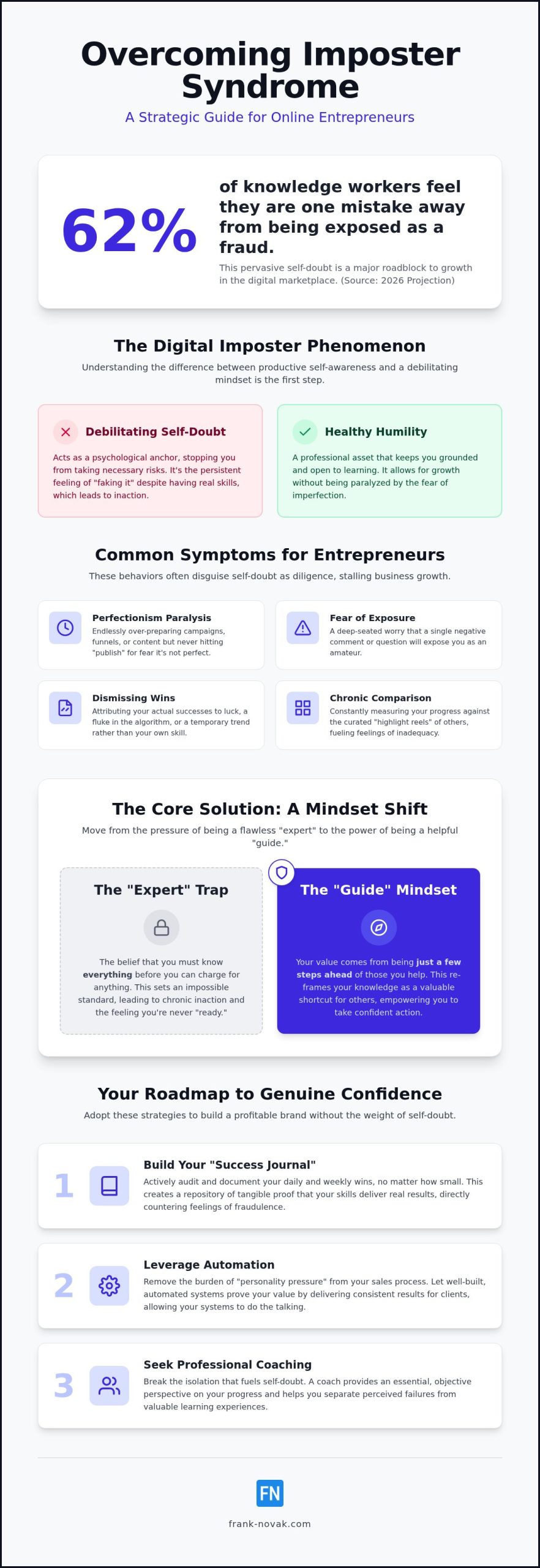
Did you know that as of 2026, a staggering 62% of knowledge workers worldwide still struggle with the persistent feeling that they’re just one mistake away from being exposed as a fraud? If you’ve ever found yourself paralyzed by analysis or constantly comparing your progress to a guru’s highlight reel, you aren’t alone. It’s easy to feel like you need to “fake it till you make it” just to stand a chance in the digital marketplace. You might even worry that posting on social media will lead to someone calling you out for not being a true expert yet.
We understand how heavy that weight can feel, but there’s a more sustainable way to move forward. In this guide, you’ll learn that overcoming imposter syndrome in online business isn’t about waiting for your self-doubt to disappear entirely. Instead, it’s about adopting specific mindset shifts and leveraging strategic automation to build a profitable brand with genuine confidence. We’ll walk you through how to silence your inner critic, reclaim your mental clarity, and transition into a reliable guide who lets systems do the talking. By the end, you’ll have a clear roadmap to stop the comparison trap and start taking the consistent action your business deserves.
Key Takeaways
- Identify how “screenshot culture” and information overload contribute to self-doubt, helping you separate digital noise from your actual potential.
- Transition from the “Expert Trap” to the “Guide” mindset, where your value comes from being just a few steps ahead of those you help.
- Master practical methods for overcoming imposter syndrome in online business, such as auditing your daily wins to build a “Success Journal” of tangible proof.
- Explore how automation can remove the burden of “personality pressure” from your sales process, allowing your systems to prove your value for you.
- Understand why professional coaching is a vital tool for breaking the isolation that fuels self-doubt and gaining an objective perspective on your progress.
What is Imposter Syndrome in the Online Business World?
To understand the journey of overcoming imposter syndrome in online business, we first need to look at what’s happening beneath the surface of your daily routine. At its core, What is Imposter Syndrome? It’s the persistent inability to believe that your success is deserved or has been achieved through your own genuine effort. In the digital economy, where “perceived status” is often built on curated social media feeds and high-gloss branding, this feeling becomes rampant. You aren’t alone in this experience; research shows that even top-tier CEOs and PhDs face these feelings regularly, regardless of their documented accolades.
It’s helpful to distinguish between healthy humility and debilitating self-doubt. Healthy humility is a professional asset because it keeps you open to learning and helps you stay grounded. Debilitating self-doubt, however, acts as a psychological anchor. It doesn’t just make you feel bad; it actively stops you from taking the risks necessary to scale your reach. If you’ve ever felt like you’re “faking it” despite having the skills to back up your work, you’re experiencing a common byproduct of the high-pressure digital landscape. This internal friction can make even the smallest tasks feel like a mountain to climb.
To better understand this concept, watch this helpful video:
The Symptoms of a ‘Digital Imposter’
Digital entrepreneurs often manifest these feelings through specific, repetitive behaviors that stall growth. You might find yourself over-preparing every detail of a funnel or ad campaign, yet never actually hitting the “publish” button. This is procrastination disguised as diligence. When you do see a win, you likely attribute it to luck, a fluke in the algorithm, or perhaps a temporary trend. You might also harbor a deep fear that a single negative comment on a Facebook ad will expose you as an amateur. These symptoms create a cycle of “paralysis by analysis” that prevents you from gathering the real-world data you need to grow.
Why High-Achievers Struggle Most
Ironically, high-achievers are often more susceptible to these feelings due to the “Dunning-Kruger Effect” in reverse. As you gain more knowledge and experience, you become more aware of the vast amount of information you don’t know yet. This awareness can lead to a perfectionism trap where you feel you must know everything before you can charge for anything. Many entrepreneurs fall into Never Succeed Online cycles because they set impossibly high standards that no human could meet. The link between high standards and the feeling of being a fraud is strong. When your internal bar is set to “perfect,” anything less feels like a failure, even if your clients are actually seeing great results from your work.
The Root Causes of Self-Doubt for Digital Entrepreneurs
The feeling of inadequacy often stems from specific environmental triggers unique to the digital space. One of the most pervasive stressors is what we call “Screenshot Culture.” When you see a peer post a high-revenue ClickBank dashboard, it’s easy to feel like you’re falling behind. These images rarely show the years of trial, the massive ad spend, or the failed attempts that came before that single winning day. By focusing on these curated peaks, you inadvertently create a false reality where everyone else is succeeding effortlessly. This “guru” narrative creates immense pressure to appear as a finished product, which makes overcoming imposter syndrome in online business feel even more out of reach.
Information overload also plays a significant role in fueling your inner critic. If you find yourself buying course after course, you might be trying to “buy” the confidence you think you lack. This cycle actually makes you feel less capable because it reinforces the idea that you don’t know enough to start. When you combine this with the isolation of working from home, self-doubt can spiral. Without a team or a community to provide perspective, small setbacks feel like proof of your incompetence rather than simple learning opportunities.
The Comparison Trap on Social Media
Social media is designed to be a highlight reel, not a behind-the-scenes documentary. Facebook’s algorithm naturally prioritizes “overnight success” stories because they generate high engagement, which can skew your perspective on what a typical business journey looks like. If your feed is filled with people showing off a finished product, you’ll naturally feel like a work in progress. To protect your mental clarity, try curating your feed to include more practitioners who share the “messy middle” of their business. Seeing the reality of daily operations is a powerful step in overcoming imposter syndrome in online business.
Technological Overwhelm and Competence
Many entrepreneurs feel they aren’t “tech-savvy” enough to manage complex systems. If you’ve looked at a ClickBank Super Funnel and felt a wave of anxiety, it’s easy to misinterpret that learning curve as a lack of fundamental business intelligence. This overwhelm often leads to “shiny object syndrome,” where you jump to a new tool the moment things get difficult. It’s a coping mechanism to avoid the discomfort of not being an expert immediately. Remember that technical skills are just mechanics; they don’t define your value as a leader. If you find yourself stuck in these loops, seeking Online Success Coaching can provide the objective reality check you need to stay focused on what truly moves the needle.
Reframing Your Role: From ‘Expert’ to ‘Guide’
One of the biggest hurdles in overcoming imposter syndrome in online business is the “Expert Trap.” This is the internal belief that you must possess an encyclopedic knowledge of your niche before you’re allowed to charge for your services. If you wait until you know everything, you’ll never start. The digital landscape moves too fast for anyone to be a total expert, which is why shifting your perspective is so vital for your mental health and your bottom line.
Instead of trying to be an unreachable authority, we encourage you to adopt the role of a “Guide.” A Guide doesn’t need a PhD or a decade of experience; you only need to be two steps ahead of the person you’re helping. If you’ve just figured out how to set up an email sequence or run your first ad, you’re the perfect person to help someone who is still staring at a blank screen. This shift removes the pressure to be perfect and replaces it with the simple mission to be useful.
Documenting your journey, often called “Building in Public,” is another powerful tool for growth. When you share your actual progress, including the mistakes and the learning curves, you build more trust than a polished facade ever could. Authenticity is the ultimate antidote to feeling like a fraud because you aren’t pretending to be anything other than a dedicated practitioner. You aren’t claiming to have all the answers; you’re simply sharing the ones you’ve found so far.
The Value of the ‘Relatable Leader’
Beginners often find “gurus” intimidating and out of touch. They prefer learning from someone who understands their current struggle and speaks their language. In Online Success Coaching, we see that vulnerability is actually a bridge to your audience. When you’re honest about your path, you become a relatable leader. This allows you to maintain an “Ethical Affiliate” mindset, where you recommend tools and strategies because they actually work, not just because they pay a high commission.
Focusing on Results Over Credentials
In 2026, a working automated marketing funnel is far more valuable to a client than a traditional marketing degree. Your audience cares about whether you can solve their specific problem, not where you went to school or how many certifications you’ve collected. Shift your internal dialogue from “Who am I to do this?” to “How can I help them get from point A to point B?” This focus on the end-user’s success is the fastest way to quiet your inner critic. The “Result-First” mindset is the commitment to prioritizing the tangible progress of your clients over the accumulation of your own professional credentials.
Practical Strategies to Overcome Imposter Syndrome
Moving from theory to action is the most effective way of overcoming imposter syndrome in online business. While mindset shifts are essential, creating a track record of tangible achievements provides the objective evidence your inner critic cannot easily dismiss. By implementing a few structured steps, you can start to dismantle the feeling of being a fraud and replace it with a sense of quiet, earned competence.
- Audit your wins: Keep a “Success Journal” where you record small daily achievements, such as a positive customer email, a successful ad tweak, or even just completing a difficult technical task. These entries serve as an objective record of your actual progress.
- Leverage automation: Use systems to handle the repetitive parts of your business, which reduces the emotional burden and “personality pressure” of every individual sale.
- Join a peer community: Connecting with others in your field helps you realize that even high-earners deal with these same internal struggles, proving your feelings are universal.
- Set micro-goals: Break your larger objectives into tiny, manageable tasks to build a consistent chain of completed projects, providing you with frequent “proof of competence.”
- Seek professional mentorship: Working with someone who has already navigated these waters can help you shortcut the trial-and-error phase, giving you the clarity to make decisions without constant second-guessing.
Automation as a Confidence Builder
If you’ve ever felt a wave of anxiety before a sales call or a product launch, you know how heavy that pressure can be. Systems like Webinar Profit Engines help by taking the personal rejection out of the sales process. When a system is doing the heavy lifting, a “no” from a prospect is simply a data point for the funnel, not a reflection of your worth as an entrepreneur. A consistent flow of leads generated by automation is often the best cure for the anxiety that fuels imposter syndrome. It allows you to look at your business through the lens of statistics and conversion rates rather than fleeting emotions.
Developing Mental Resilience
Building a sustainable business requires a routine that separates your self-worth from your daily commission report. You might try treating every outcome as a piece of information that helps you refine your strategy rather than a personal failure. While it’s natural to feel discouraged by a failed ad campaign, resilient entrepreneurs view these moments as necessary steps toward a more refined business model. For those looking to dive deeper into these techniques, seeking structured guidance can provide the objective perspective needed to maintain focus during difficult seasons.
Scaling Beyond the Fear with Online Success Coaching
Isolation is often the primary fuel for self-doubt in the digital world. When you’re working alone from a home office, your inner critic can quickly become the loudest voice in the room. Without a team or a mentor to provide a second opinion, it’s easy to lose perspective on your actual progress and the value you provide to your clients. Moving from a “solopreneur” mindset to becoming a true business owner requires a support system that offers an objective reality check. This transition is a key component of overcoming imposter syndrome in online business, as it replaces internal speculation with external validation.
Frank Novak’s coaching approach is designed to address both the technical hurdles of business automation and the mental blocks that prevent scaling. By providing a structured environment, coaching helps you move past the “fake it till you make it” mentality. Instead, you’ll focus on the mechanics of growth, letting your systems and results speak for your competence. This steady, guided path ensures that you aren’t just building a business, but also the confidence required to lead it effectively.
The Power of an Outside Perspective
A seasoned coach can identify the blind spots that you’re simply too close to see. If you’re stuck in a repetitive loop of self-criticism, a mentor can validate your skills and help you recognize the milestones you’ve already achieved. This is why many of the most successful digital marketers continue to invest in professional guidance. They understand that an outside perspective is an investment in faster decision-making and the avoidance of costly, doubt-fueled mistakes. In 2026, the shift toward structured coaching packages reflects a growing understanding that consistent accountability is vital for long-term mental resilience.
Your Roadmap to Sustainable Growth
Success becomes much more attainable when you have a customized plan that aligns with your specific strengths. This alignment naturally reduces the “imposter” feel because you’re operating from a place of genuine capability rather than trying to mimic someone else’s model. If you feel you lack the established authority to lead your niche, the Ambassador JV program allows you to leverage existing credibility while you build your own foundation. This strategic partnership helps you prove your value to yourself and your audience simultaneously, creating a sustainable model for growth.
Ready to silence the doubt? Explore Online Success Coaching with Frank Novak.
Your Path to Digital Confidence
The journey toward overcoming imposter syndrome in online business isn’t about the sudden disappearance of fear. It’s about building a foundation of objective results that your inner critic can’t argue with. By shifting your perspective from an all-knowing expert to a helpful guide, you create space for authentic growth. Implementing systems like the ClickBank Super Funnel allows you to let data and automation speak for your value, taking the personal pressure off every transaction.
Sustainable growth requires moving beyond the isolation that fuels self-doubt. When you have a clear roadmap and a support network in place, the “fake it till you make it” mentality becomes a thing of the past. Personalized mentorship from Frank Novak provides the outside perspective needed to identify your blind spots and validate your progress. You’ve already taken the first step by recognizing these patterns. Now, it’s time to replace analysis paralysis with a structured plan for long-term success.
The digital landscape of 2026 offers incredible opportunities for those who lead with honesty and resilience. You have the potential to build something meaningful, and we’re here to help you navigate every step of that transition.
Frequently Asked Questions
Is imposter syndrome common in affiliate marketing?
Imposter syndrome is exceptionally common in affiliate marketing because the industry often relies on visible proof of success like revenue dashboards. When you see others posting high-commission screenshots, it’s natural to feel like your own progress is inadequate. This environment creates a false reality where everyone else seems to be succeeding effortlessly. Understanding that these are curated highlights is a vital step in overcoming imposter syndrome in online business and focusing on your own growth.
How do I start a coaching business if I don’t feel like an expert yet?
You don’t need to be a world-renowned authority to help others; you just need to be a few steps ahead of your clients. By adopting the “Guide” mindset instead of the “Expert” trap, you can provide immense value based on the problems you’ve already solved. Documenting your actual journey and building in public creates a level of relatability that polished gurus often lack. This approach builds genuine trust while you continue to develop your professional skills.
Can business automation really help with imposter syndrome?
Automation is a powerful tool for building confidence because it removes the direct emotional impact of sales and rejection. When you use a system like the ClickBank Super Funnel, the results are driven by data and mechanics rather than your personal charisma. This shift allows you to view your business through an objective lens. If a campaign doesn’t perform, it’s a technical adjustment to make rather than a personal failure or proof that you’re a fraud.
What is the difference between imposter syndrome and just being a beginner?
Being a beginner is a temporary state of limited knowledge and skill, whereas imposter syndrome is a psychological pattern where you doubt your accomplishments despite evidence of success. Beginners rightfully feel uncertain because they’re learning new mechanics. However, if you’re consistently getting results but still feel like you’re “faking it,” you’re likely dealing with the imposter phenomenon. Recognizing this distinction helps you decide whether you need more training or a mindset shift to move forward.
How long does it take to overcome imposter syndrome in online business?
There isn’t a specific timeline for overcoming imposter syndrome in online business because it’s often a recurring feeling that triggers during new growth phases. However, most entrepreneurs find that the intensity decreases as they build a “Success Journal” and accumulate objective proof of their competence. By focusing on micro-goals and daily wins, you can significantly reduce the frequency of these thoughts within a few months of consistent, guided action and professional mentorship.
Should I tell my audience that I am still learning?
Sharing your learning process is actually one of the most effective ways to build a loyal audience in 2026. People are increasingly drawn to authentic, relatable leaders who are honest about their challenges. When you admit you’re still refining your strategies, you remove the pressure to be perfect and position yourself as a trusted peer. This transparency acts as a shield against being “exposed” because you’ve already been honest about where you stand.
How do I stop comparing my business to people on Facebook?
You can stop the comparison trap by actively curating your social media feed to include more “behind-the-scenes” reality rather than just highlight reels. It’s helpful to remember that Facebook’s algorithm prioritizes extreme success stories, which skews your perception of what’s normal. If you find certain accounts trigger feelings of inadequacy, don’t hesitate to mute or unfollow them. Focus instead on your own analytics and the tangible progress you’re making within your specific business model.
Does imposter syndrome ever go away completely?
For most high-achievers, these feelings never disappear entirely, but they do become much easier to manage over time. Even seasoned CEOs and professionals with advanced degrees report feeling like frauds when they step into new roles or reach higher levels of success. The goal isn’t to reach a state of total fearlessness, but rather to develop the mental resilience to act despite the doubt. It eventually transforms from a paralyzing fear into a form of healthy humility.

Article by
Frank Novak
Frank Novak is an online marketing professional and coach who focuses on affiliate marketing and business automation. Through his website, frank-novak.com, he shares insights and strategies for leveraging social media platforms like Facebook to generate traffic and commissions.
Affiliate / Sponsored Content Disclaimer
This [website/post] contains affiliate links. If you click through and make a purchase, we may receive a commission at no additional cost to you. We only recommend products or services we believe will add value to our readers.