

Did you know that 75% of weekly Pinterest users are actively shopping on the platform? While most marketers are exhausting their budgets on expensive paid ads or fighting for visibility on saturated social feeds, a quiet group of creators is building long term wealth. If you’ve been struggling with the high cost of traffic or the constant fear of account bans, promoting affiliate products on Pinterest offers a refreshing and stable alternative. It isn’t about chasing the latest viral trend. Instead, it’s about positioning your offers where people are already looking to buy.
It’s understandable if you feel hesitant about starting on a new platform, especially when the rules for disclosures and content originality feel so strict. You want a system that works without risking your reputation or your bank account. In this guide, we’ll show you how to master the art of driving high intent visual traffic to your affiliate offers using the search engine power of Pinterest. You’ll learn to move beyond simple posting and start indexing your content for years of passive traffic. We’ll also explore how automated tools like the ClickBank Super Funnel can turn that interest into a repeatable stream of commissions.
Key Takeaways
- You will learn how to treat Pinterest as a visual search engine rather than a social network, ensuring your content generates organic traffic for months instead of hours.
- We will explore the technical side of Pinterest SEO, including how to optimize your titles and descriptions to reach high intent shoppers who are ready to buy.
- You will understand the critical difference between direct linking and using bridge pages when promoting affiliate products on Pinterest to protect your account and build a long term asset.
- This guide explains how to integrate your visual traffic with the ClickBank Super Funnel, turning simple pins into a consistent and automated engine for conversions.
- You’ll see how Online Success Coaching can help you bridge the gap between complex technical systems and sustainable growth through professional, one on one mentorship.
Why Pinterest is the Secret Weapon for Affiliate Marketers in 2026
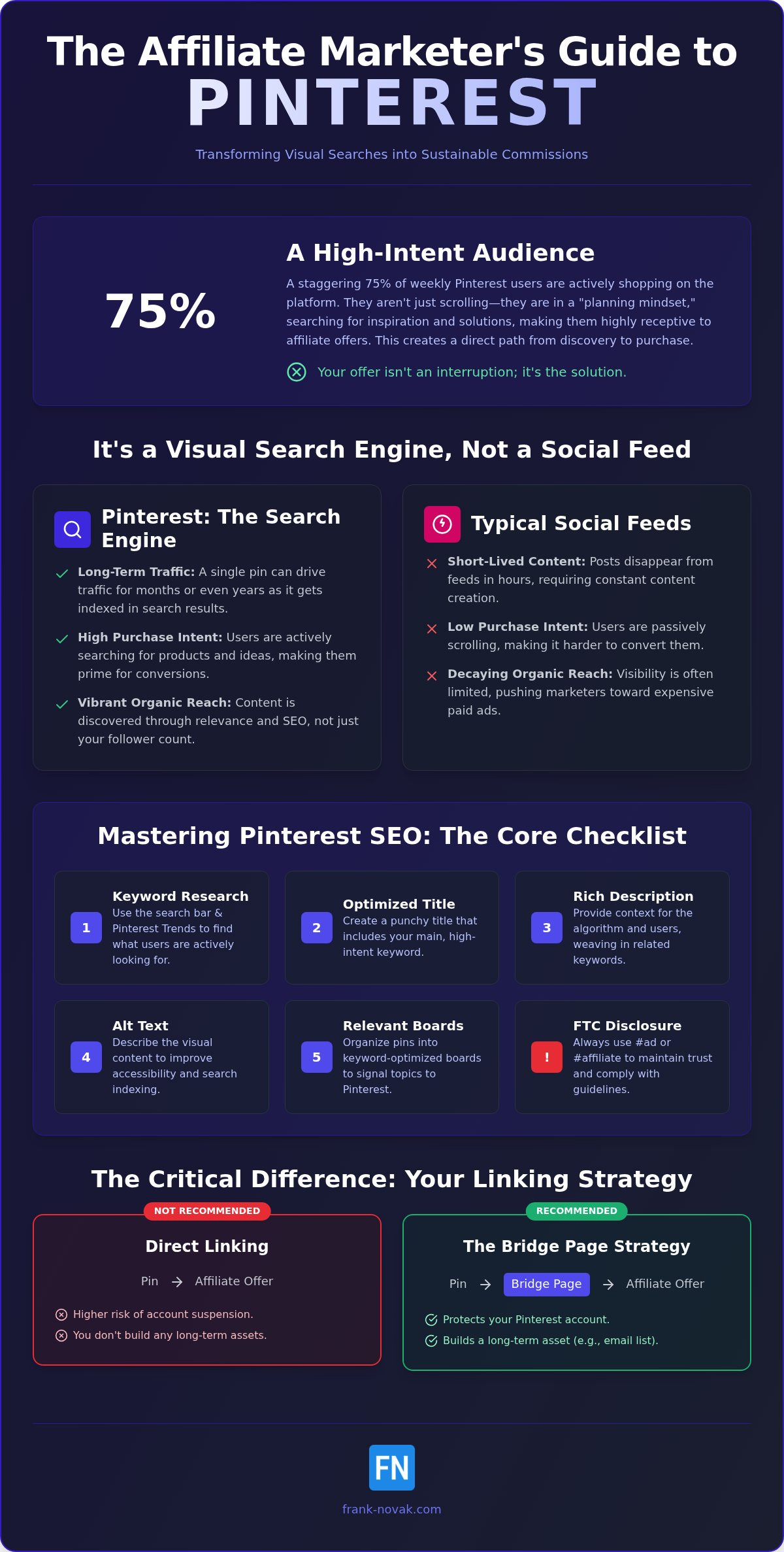
Pinterest affiliate marketing is the practice of using visual ‘pins’ to drive traffic to tracked product links. It’s a specific method within the broader world of affiliate marketing that focuses on discovery rather than interruption. While other platforms prioritize the “now,” Pinterest functions as a visual search engine. This fundamental difference means your content has a much longer shelf life than a post on Facebook or X. If you are interested in promoting affiliate products on Pinterest, it’s helpful to understand that this platform functions more like a library than a social feed.
If you’re tired of the constant treadmill of content creation, promoting affiliate products on Pinterest offers a more sustainable path. A pin you create today can continue to surface in search results for months or even years. This longevity is paired with an incredibly high-value audience. A large portion of the platform’s user base falls into the $100,000+ household income bracket; research shows that 75% of weekly users are actively shopping. By 2026, Pinterest’s improved shopping integration has made it easier than ever for these users to move from browsing to buying.
The Psychology of a Pinterest User
Users don’t visit Pinterest to scroll mindlessly through news updates. They visit to plan their future. Whether they are designing a home office or searching for the best digital tools, they are in a “planning” mindset. This intent-based browsing is a goldmine for affiliates. Because users are looking for inspiration and solutions, they actually expect to see products and helpful links. Your affiliate offer isn’t an interruption; it’s the answer to their search query. This mindset shift moves the user from inspiration to transaction much faster than a standard social scroll.
Organic Reach: The Last Frontier of Free Traffic
While organic reach has decayed on most social sites, it remains vibrant on Pinterest. You don’t need a massive following to get seen. If your pin is relevant and well-optimized, the algorithm will show it to people interested in that topic. A single pin can gain massive momentum through “re-pins,” which act as a free distribution network. This steady stream of organic traffic is the perfect way to fuel a conversion engine like the ClickBank Super Funnel, allowing you to scale your business without the stress of rising ad costs.
Mastering Pinterest SEO: How to Get Your Pins Found
If you want to succeed with promoting affiliate products on Pinterest, you have to stop thinking like a social media manager and start thinking like a search engine optimizer. Pinterest SEO is the process of matching visual metadata to user search queries. This ensures that when someone types a specific problem into the search bar, your pin is there to provide the solution. Unlike other platforms where content disappears in hours, an optimized pin can act as a permanent traffic source for your business.
The most effective way to start your research is by using the Pinterest search bar itself. As you type in your niche, the platform suggests autocomplete phrases that real users are searching for right now. These suggestions are your primary keywords. To take it a step further, the Pinterest Trends tool allows you to see the cyclical nature of these searches. If you notice a specific topic starts trending every October, you can prepare your affiliate content months in advance to catch the wave of interest.
Your pin’s metadata acts as the bridge between your content and the user. A strong title should be punchy and include your main keyword, while the description provides the context the algorithm needs to categorize your post. This is also where you must follow FTC disclosure guidelines by clearly stating that your link is an advertisement. Using hashtags like #ad or #affiliate at the end of your description is a standard practice that builds trust with both the platform and your audience. Don’t forget to fill out the Alt Text field, as this helps the search engine understand the visual components of your image.
Keyword Mapping for Affiliate Niches
Finding long-tail keywords that signal buying intent is the secret to high conversion rates. Instead of targeting broad terms like “fitness,” try mapping out specific phrases like “best ergonomic chairs for home offices.” These longer phrases attract users who are further along in the buying cycle and ready to make a purchase. By using Pinterest Trends to time these promotions, you can align your content with seasonal shifts in consumer behavior.
The Power of Authority Boards
While individual pins are important, your boards act as the filing cabinets for your profile. A board title that uses relevant keywords signals authority to the algorithm, helping all pins within that board rank higher. In 2026, the “fresh content” rule is more important than ever. This means you should create new, unique image designs even if they lead to the same affiliate offer or bridge page. Collaborative boards can be useful for reach, but only if they are high-quality and strictly moderated.
Beyond text, Pinterest uses “Lens” technology to visually scan your images. The AI identifies objects, colors, and even the text overlays on your graphics to determine where to show your pin. If you’re looking for a way to simplify this technical setup, Online Success Coaching can provide the one on one guidance needed to master these systems effectively. By aligning your visual elements with your metadata, you create a powerful signal that helps your affiliate offers stand out in a crowded feed.
Direct Linking vs. The Bridge Page Strategy
While Pinterest officially allows direct linking to many affiliate offers, relying solely on this method is often a short sighted strategy. If you’re promoting affiliate products on Pinterest, sending users straight to a checkout page can feel abrupt and even intrusive. This “interruption” can lead to lower conversion rates because the user hasn’t been properly introduced to the solution you’re offering. More importantly, Pinterest’s security bots are highly vigilant; if they perceive your links as part of a spammy pattern, your account could face an instant ban.
A bridge page serves as a helpful “buffer” between your pin and the final offer. This is a simple landing page where you can provide extra value, such as a brief tutorial, a list of benefits, or a personal recommendation. By providing this context, you warm up the visitor and build a sense of trust. This intermediate step is a cornerstone of conversion rate optimization because it shifts the user’s focus from “being sold to” to “solving a problem.” When a visitor understands the value of a product before seeing the price, they’re much more likely to complete the purchase.
Compliance is another critical factor in your long term success. To stay in Pinterest’s good graces, you must adhere to the Federal Trade Commission’s disclosure guidelines. This means being completely transparent about your commercial relationship. Transparency isn’t just a legal hurdle; it’s a way to build credibility with your audience. If people feel you’re being honest with them, they’ll be more receptive to your future recommendations.
Building a Sustainable Asset: The Mailing List
The biggest downside of direct linking is that you lose the chance to follow up with your visitors. If you want to build a real business, every pin should ideally lead to an opt-in form on your bridge page. This allows you to capture leads and build a mailing list, which is a sustainable asset you own. For more insights on how to balance these elements, you can explore our detailed guide on how to drive traffic to affiliate links. Using a “value-first” approach with a free lead magnet ensures your Pinterest traffic feels supported rather than pressured.
Pinterest Ad Compliance for Affiliates
Understanding the “disclose” rule is vital. You should always use tags like #ad or #affiliate in your pin descriptions to maintain clarity. Additionally, stay aware of prohibited niches; Pinterest strictly regulates content related to weight loss claims, financial schemes, and adult products. Avoid using “link cloakers” or complex redirect chains. These tools often trigger security bots that flag your content as suspicious, potentially leading to the suspension of your entire profile.
Step-by-Step Guide to Your First Affiliate Pin
To begin promoting affiliate products on Pinterest with a professional edge, you must first convert your personal profile into a Pinterest Business Account. This simple change unlocks the analytics dashboard, which is your most valuable tool for understanding user behavior. If you don’t have access to this data, you’re essentially flying blind. Once your account is set up, you can start building the visual assets that will fuel your funnel.
Pin Design for Non-Designers
Pinterest is a mobile first platform, so your designs must cater to the vertical scroll. The 2:3 aspect ratio is the industry standard because it maximizes the space your content takes up on a phone screen. To stop a user from scrolling past your offer, you need a “pattern interrupt” in your text overlay. This means using bold colors or provocative questions that force a moment of pause. If you’re promoting a high ticket offer, try A/B testing different designs for the same link. You might find that a lifestyle image outperforms a graphic with heavy text. This iterative process helps you refine your brand’s visual voice over time.
Automation and Scheduling Tools
Maintaining a steady presence is the only way to satisfy the Pinterest algorithm. If you only post sporadically, your reach will suffer. Scheduling tools allow you to plan your content weeks in advance, ensuring your pins go live at optimal times for your target audience. This is a key part of promoting affiliate products on Pinterest without burning out. There is, however, a danger in relying too heavily on automation. If your profile feels cold or robotic, you’ll struggle to build the trust necessary for conversions. It’s helpful to spend a few minutes each week manually interacting with the platform to keep that human touch alive.
As you analyze your data, prioritize “Outbound Clicks” over “Impressions.” While high impressions feel good, they don’t always translate to sales. Outbound clicks indicate that your visual and your message were strong enough to move someone to action. Data doesn’t lie. If a specific pin design is successfully driving traffic to your conversion engine, use those same principles for your next campaign. This data driven approach turns guesswork into a repeatable system for growth.
Build your automated traffic engine with the ClickBank Super Funnel
Scaling with the ClickBank Super Funnel and Online Success Coaching
Once you’ve mastered the basics of creating pins and optimizing your metadata, the next logical step is to move away from manual labor. If you’re promoting affiliate products on Pinterest, your goal isn’t just to get clicks; it’s to build a system that converts that traffic into revenue without requiring your constant attention. This is where the ClickBank Super Funnel becomes a vital part of your strategy. By plugging your high intent Pinterest traffic into an automated conversion engine, you can shift your focus from simple posting to strategic scaling.
Why Automation is Mandatory for Growth
Many marketers fall into the Never Succeed Online trap, where they spend hours every day manually pinning images for tiny returns. If you want to build a business that truly provides freedom, you need systems that run while you sleep. The Webinar Profit Engines are designed to do exactly that. These systems take the warm traffic you’ve generated on Pinterest and guide them through a sophisticated sales process that builds trust and delivers value automatically. This transition from manual tasks to automated systems is what separates a hobby from a professional digital business.
Getting Expert Guidance
The digital landscape is always shifting, and Pinterest is no exception. While the platform offers incredible organic reach, its algorithm and compliance rules can change overnight. This is why having a steady, reliable guide is so important. Engaging in Online Success Coaching can help you navigate these changes without the costly trial and error that often leads to banned accounts. If you’re looking for a higher level of partnership and support, the Ambassador JV program offers a way to work alongside seasoned practitioners who understand the mechanics of sustainable growth.
To keep your momentum going, it’s helpful to establish a simple daily routine. While your systems handle the heavy lifting, a small amount of focused effort ensures your profile stays healthy and relevant. If you follow this checklist, you’ll maintain the consistency required for long term success with promoting affiliate products on Pinterest.
- Review your Analytics: Spend five minutes checking which pins are driving the most outbound clicks.
- Queue New Content: Use your scheduling tool to ensure at least 3 to 5 fresh pins are set for the next 24 hours.
- Check for Compliance: Ensure all new links are properly disclosed and lead to high quality bridge pages.
- Engage Briefly: Repin one or two pieces of high quality content from others in your niche to signal activity to the algorithm.
Building Your Sustainable Pinterest Engine
You now have the foundational knowledge to turn Pinterest into a high intent traffic source. By focusing on search engine optimization and utilizing bridge pages, you’re moving away from risky short term tactics and toward a stable business model. This shifts your focus from chasing likes to building a mailing list that you truly own, ensuring your growth isn’t dependent on a single platform’s whim.
If you stay consistent with promoting affiliate products on Pinterest, you’ll find that your content gains momentum over time. This approach allows you to reach a high income audience that is already in a shopping mindset, making your conversion process much smoother. With the right systems in place, you can transform this visual discovery engine into a predictable source of growth for your digital business.
Scale your commissions with the ClickBank Super Funnel today!
Frank Novak’s expertise in business automation and proven lead generation systems can help you bridge the gap between where you are now and where you want to be. Expert mentorship helps you navigate platform changes and technical hurdles with confidence. You’ve got the roadmap; now it’s time to take the first step toward a more automated and rewarding professional landscape. You’ve got this.
Frequently Asked Questions
Is affiliate marketing allowed on Pinterest in 2026?
Yes, affiliate marketing is fully supported on Pinterest in 2026, provided you adhere to their spam policies and disclosure requirements. The platform prioritizes high quality, original content that serves the user’s intent. If you focus on providing value rather than just dropping links, you’ll find the environment very welcoming. It’s a great way to build a sustainable income while helping users discover products that solve their specific problems.
Do I need a blog to promote affiliate products on Pinterest?
You don’t necessarily need a traditional blog, but using a bridge page is a much more effective strategy than direct linking. This intermediate step allows you to capture email addresses and build a mailing list, which is a long term asset you own. If you only use direct links, you lose the chance to follow up with your audience. A simple landing page can serve as your professional home base on the platform.
How many pins should I post per day for affiliate marketing?
Aiming for 3 to 5 fresh pins per day is a healthy balance for most creators. Consistency matters more than sheer volume, as the algorithm rewards accounts that provide a steady stream of new content. If you try to post too many pins at once, you risk being flagged as spam. Using scheduling tools can help you maintain this rhythm without needing to be online at all hours of the day.
Can I use Amazon Associates links on Pinterest?
Yes, you can use Amazon Associates links, but you must be careful to follow both Amazon’s operating agreement and Pinterest’s community standards. This means you should create your own unique images rather than just pulling photos from the Amazon product page. Clear disclosure is also mandatory. If you fail to include an “ad” tag, you risk losing your affiliate account and your Pinterest profile simultaneously.
What are the best niches for Pinterest affiliate marketing?
Visual and aspirational niches tend to perform exceptionally well on this platform. Categories like home organization, DIY crafts, health and wellness, and professional development tools see high engagement. If your niche allows for “how to” content or “before and after” transformations, you’ll find it much easier to attract high intent traffic. The key is to match your affiliate offers with the planning mindset of the typical Pinterest user.
How do I disclose affiliate links on Pinterest to stay compliant?
To stay compliant while promoting affiliate products on Pinterest, you must include a clear and conspicuous disclosure in your pin description. The most common method is adding #ad or #affiliate at the beginning or end of your text. This transparency is required by the FTC and helps build trust with your audience. If you aren’t honest about your commercial relationships, you risk significant legal penalties and account suspension.
Why is my Pinterest traffic not converting into sales?
Low conversion rates often happen when there is a mismatch between the pin’s visual hook and the destination page. If your pin promises a specific solution but your link goes to a generic homepage, users will leave immediately. Promoting affiliate products on Pinterest requires a “warm up” phase, where your bridge page provides the necessary context to turn a casual browser into a confident buyer. Ensuring your messaging is consistent is vital.
Should I use a personal or business account for affiliate marketing?
You should always use a Pinterest Business account for any affiliate activity. This type of account is free and grants you access to Pinterest Analytics, which is essential for tracking your outbound clicks and overall reach. It also allows you to use features like Rich Pins and the Pinterest Trends tool. If you’re serious about scaling your business, the data provided by a business profile is your most important asset.

Article by
Frank Novak
Frank Novak is an online marketing professional and coach who focuses on affiliate marketing and business automation. Through his website, frank-novak.com, he shares insights and strategies for leveraging social media platforms like Facebook to generate traffic and commissions.
Affiliate / Sponsored Content Disclaimer
This [website/post] contains affiliate links. If you click through and make a purchase, we may receive a commission at no additional cost to you. We only recommend products or services we believe will add value to our readers.