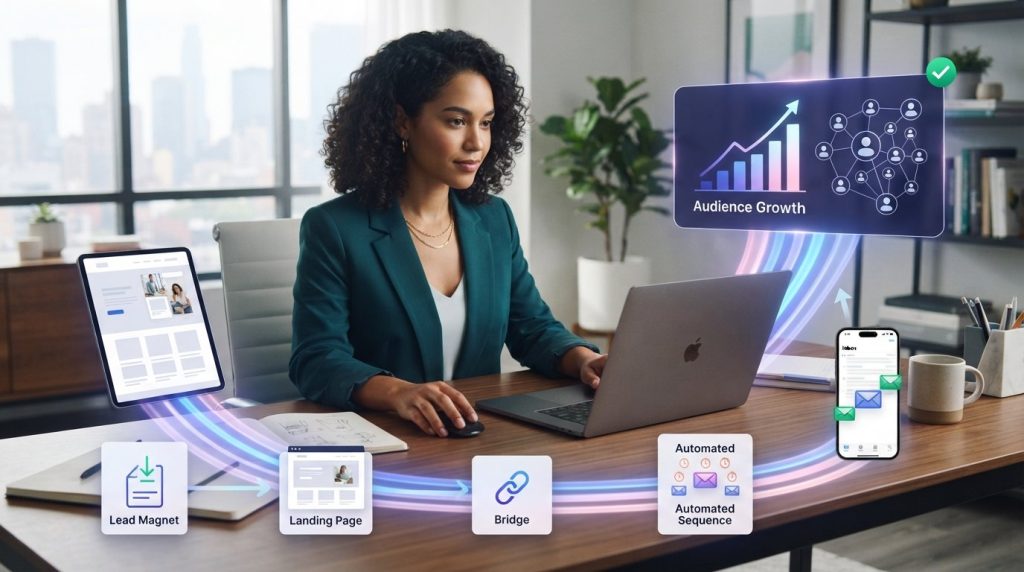

What if the audience you’ve spent years building on social media disappeared tomorrow because of a single algorithm update or an unexpected account ban? If you feel like you’re constantly walking on eggshells with platforms like Facebook, you aren’t alone. It’s incredibly frustrating to see your reach plummet while you’re trying to share offers that could truly help your audience. Many marketers struggle with low conversion rates on direct links, but building an email list from scratch for affiliate marketing is the most reliable way to regain control and secure your financial future.
In this guide, you’ll learn the exact, step-by-step process to build a profitable and automated email list that generates affiliate commissions without relying on fickle social media algorithms. If you’ve been overwhelmed by the technical side of funnels or autoresponders, I’ll show you how to simplify the setup. We’ll explore how to create a “set-and-forget” system that grows daily, ensuring you own your data and earn higher commissions through repeated, helpful exposure to your offers. From domain authentication to high-converting bridge pages, this is your roadmap to a sustainable digital business.
Key Takeaways
- Understand why owning your audience data is the only way to protect your business if you’re worried about sudden social media algorithm changes or account bans.
- Learn how to create “Micro-Win” lead magnets that solve a specific problem in minutes, which is the most effective way to start building an email list from scratch for affiliate marketing.
- Design a compliant bridge page that protects your ad accounts while establishing trust with new subscribers before they’ve even seen an offer.
- Master interest-based Facebook targeting to find high-quality leads who are actually looking for the solutions your affiliate products provide.
- Implement a “First 7 Days” automated email sequence to build authority and generate consistent commissions without needing to do manual work every day.
The Foundation: Why Your Email List is the Only Affiliate Asset You Truly Own
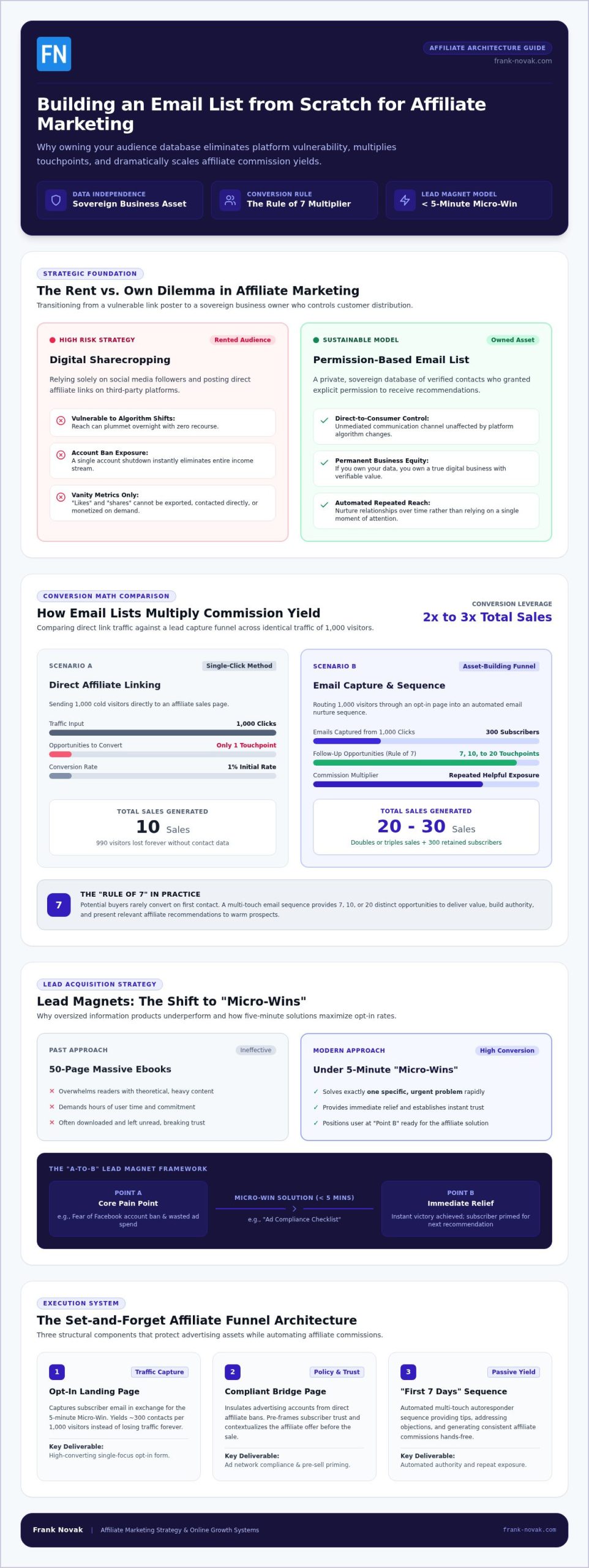
Many beginners start their journey by posting links directly on social media, hoping for a quick sale. This approach is often called “digital sharecropping” because you’re building your business on land that belongs to someone else. If a platform decides to change its algorithm or shut down your account, your entire income stream can vanish in an instant. Building an email list from scratch for affiliate marketing is the only way to ensure you have a direct-to-consumer channel that remains independent of third-party whims.
To better understand this concept, watch this helpful video:
The Rent vs. Own Dilemma in Affiliate Marketing
When you rely solely on social media followers, you’re essentially renting your audience. You don’t have their contact details, and you can’t reach them unless the platform’s code allows it. In contrast, an email list is a private database of people who have given you explicit permission to contact them. This is why permission-based email marketing is so effective; it creates a stable environment where you control the narrative. Transitioning from a “link poster” to a “business owner” means prioritizing asset ownership over temporary vanity metrics like likes or shares. If you own the data, you own the business.
How Email Lists Multiply Your Commissions
The math of affiliate success changes dramatically when you move away from direct linking. Most people don’t buy on the first click. In 2026, the “Rule of 7” still applies; potential customers often need multiple touchpoints before they feel comfortable making a purchase. While a direct link has only one chance to convert a visitor, a multi-touch email sequence provides seven, ten, or even twenty opportunities to provide value and present the offer. This nurturing process moves a cold stranger into a warm lead who trusts your professional recommendations.
Consider the difference in ROI. If you send 1,000 clicks to a direct affiliate link with a 1% conversion rate, you get 10 sales. However, if you send those 1,000 people to an opt-in page, you might capture 300 emails. Over the next month, those 300 subscribers receive a sequence of helpful tips and offers. Because you have multiple chances to convert them, your total sales could easily double or triple compared to the single-click approach. An email list is a sovereign business asset that acts as the primary engine for long-term growth. This shift in strategy is exactly why online success coaching is your shortcut to growth in 2026, as it helps you avoid common technical pitfalls while building your foundation.
Creating the ‘Lead Magnet’ That Converts Strangers into Subscribers
In the past, marketers often offered massive ebooks to entice people to join their lists. By 2026, that strategy has largely lost its charm. Most users don’t have the time or patience to read a fifty-page guide. They want what I call a “Micro-Win.” This is a resource that solves one specific, urgent problem in under five minutes. When you’re building an email list from scratch for affiliate marketing, your goal is to provide immediate relief to a burning question. This builds instant trust and sets the stage for your future recommendations.
Finding Your Audience’s Core Pain Point
To create something truly irresistible, you need to know what keeps your audience up at night. Use forums, social media comments, and keyword research tools to discover their primary struggles. The “A-to-B” Framework is a reliable way to structure this. You move the user from Point A (their current problem) to Point B (a small, immediate victory). For instance, if your niche is digital advertising, a “Facebook Ad Compliance Checklist” is a perfect Micro-Win. It prevents a sudden account ban, which is a major fear for many affiliates. By solving this one issue, you prove your value immediately.
Delivering Value Instantly: Lead Magnet Best Practices
Efficiency is key. A one-page PDF template, a checklist, or a short video “mini-blast” often converts better than a dense guide. It’s much easier for a subscriber to consume and implement right away. Always ensure your lead magnet is mobile-friendly. Many people will opt in while scrolling on their phones during a break. While you provide this value, you must also follow CAN-SPAM Act compliance guidelines. This includes being transparent about who you are and providing a clear way for them to opt out later. Ethical list building starts with transparency from day one.
Your lead magnet should act as a natural bridge to your main affiliate offer. If the checklist solves a small problem, the product you’re promoting should solve the bigger one. For example, a compliance checklist is the perfect prerequisite for the ClickBank Super Funnel. It prepares the subscriber for a more comprehensive system. If you feel stuck on which “Micro-Win” to choose for your niche, online success coaching can help you identify the highest-converting bait to attract the right audience. By focusing on quality over quantity, you turn strangers into loyal subscribers who actually look forward to your emails.
Building Your High-Conversion Funnel: Landing Pages and Compliance
Once you have identified your “Micro-Win” lead magnet, the next step is creating the structure to capture those leads. In 2026, a high-converting landing page is defined by its simplicity. It typically consists of three main parts: a clear headline that addresses a pain point, a hook that promises a solution, and “the ask,” which is your opt-in form. This streamlined approach ensures that visitors aren’t distracted by unnecessary links or heavy graphics. When you focus on these core elements, the email marketing return on investment can be significantly higher than traditional direct-linking methods.
You also need a “Bridge Page” to sit between your opt-in form and the actual affiliate offer. This page is crucial because it introduces you as a helpful guide and pre-frames the product you’re recommending. It is also the legal home for your compliance elements, such as your Privacy Policy, Terms of Service, and affiliate disclaimers. These aren’t just boxes to tick; they’re essential trust signals that protect your business. For a more detailed breakdown of this architecture, you can explore our guide on the Automated Marketing Funnel: The 2026 Guide to Sustainable Business Growth.
The Technical Stack: Simple Tools for Beginners
Choosing the right tools is often where beginners feel the most overwhelm. It’s vital to select an autoresponder that is explicitly “affiliate-friendly.” Some popular platforms have strict policies against affiliate marketing and may shut down accounts without warning if they detect promotional sequences. For your pages, drag-and-drop landing page builders are generally superior to custom-coded sites for those just starting out. They allow for rapid testing and mobile optimization without needing technical expertise. Your “Thank You” page should be the final piece of this stack, delivering the lead magnet and providing a warm transition to your primary offer.
Compliance: Avoiding the “Instant Ban”
If you plan on using paid traffic, compliance is your highest priority. Platforms like Facebook and Google are very protective of their user experience and will often ban accounts that link directly to affiliate sales pages. Success in building an email list from scratch for affiliate marketing requires “congruency.” This means your ad copy, your landing page, and the affiliate offer must all use similar language and maintain a consistent promise. This is a major reason why the Never Succeed Online course warns so strongly against direct linking. By using a compliant funnel, you satisfy the ad platform’s requirements while building a sustainable asset that you control entirely.
Driving Targeted Traffic: Bridging the Gap Between Facebook and Your Inbox
Once your funnel is live, you need to bring in the right people. While SEO is a powerful long-term strategy, it’s often too slow for beginners who want to validate their system quickly. Using Facebook is one of the most efficient ways to start building an email list from scratch for affiliate marketing because it allows you to target specific interests with extreme precision. The first step is identifying “Interest-Based” targeting. If you’re in the fitness niche, don’t just target general terms like “exercise”; look for specific brands, authors, or influencers your audience follows. This ensures your ads appear in front of people who are already primed for your message.
Your ad copy must focus entirely on your “Micro-Win” lead magnet rather than the final affiliate sale. If you try to push a product too early, your conversion rates will suffer and you risk an account ban. Once you’ve gathered your first 100 subscribers, you can leverage Facebook’s “Lookalike Audiences” to find more people with similar profiles. Throughout this process, it’s vital to track your Cost Per Lead (CPL). If you spend $100 to acquire 50 leads, your CPL is $2. If those leads eventually generate $150 in commissions, you’ve created a profitable engine that can be scaled with confidence.
Organic vs. Paid Traffic: Finding the Balance
If you’re on a tight budget, you can seed your list for free using Facebook Groups. By providing genuine value and answering questions without being “spammy,” you can naturally invite people to download your lead magnet. For a deeper dive into these methods, see our guide on How to Drive Traffic to Affiliate Links: The Strategic Guide for 2026. Eventually, you’ll want to transition from this manual hustle to scalable paid ads. This shift allows you to grow your business while you sleep, moving away from the “time-for-money” trap of organic outreach.
Facebook Ad Compliance for List Building
Maintaining a healthy ad account is the foundation of a sustainable business. You should avoid aggressive “get rich quick” language or unrealistic claims, as these trigger automated flags. Meta policies in 2026 are strict regarding data collection; you must disclose the exact legal entity collecting data on your landing page. Following a Facebook Ads for Affiliate Marketing: The 2026 Guide to Sustainable Traffic framework ensures you’re building on solid ground. Frank Novak’s coaching emphasizes ad account longevity because a stable, daily flow of leads is worth far more than a short-term spike followed by a permanent ban.
Scaling with Automation: From First Lead to Consistent Commissions
Once you have successfully started building an email list from scratch for affiliate marketing, your focus should shift toward automation. You don’t want to spend all day manually sending individual messages. Instead, you want a system that builds trust and delivers value while you’re away from your desk. A well-structured automation sequence is what turns a simple list into a reliable profit engine. It allows you to nurture every new subscriber with the same level of care, ensuring no lead is left behind.
The Anatomy of a High-Converting Email Sequence
The “First 7 Days” sequence is your opportunity to establish authority. In your first email, you must deliver the promised lead magnet immediately. This is also the perfect time to use an “open loop,” which is a storytelling technique that hints at a solution you’ll reveal in the next message. This strategy significantly improves your open rates for the rest of the week.
Emails two through four should focus on providing pure value. Share specific case studies or “why it works” explanations that validate the affiliate product you’re eventually going to recommend. By the time you reach emails five through seven, you can introduce a “soft sell.” If you include a hard deadline for a specific bonus or a limited-time offer, you provide the gentle nudge that many subscribers need to make their first purchase. This methodical approach builds a relationship first and makes the sale a natural next step.
Scaling to High-Ticket Success
In 2026, the size of your list is often less important than the quality of your engagement. A list of 1,000 highly engaged subscribers who actively open your emails is worth far more than 10,000 “zombie” accounts that never interact with your content. You can maximize your ROI by segmenting your list. By separating “clickers” from “non-openers,” you can send more specific, high-intent offers to those who have already shown interest in a particular topic. This “Evergreen” approach allows you to keep providing value and selling to the same list for years.
Building an automated business requires a strong foundation of persistence and clarity. If you find yourself feeling overwhelmed by the technical setup, it helps to focus on your long-term vision. You can learn more about staying focused in our guide on the Affiliate Marketing Success Mindset: The 2026 Guide to Mental Resilience. As you gain experience, you may choose to transition from a list builder to a “Success Coach” using the models we provide. If you’re ready to skip the trial-and-error phase and master high-ticket commissions, moving into Online Success Coaching is the most direct path to scaling your digital business.
Your Roadmap to Sustainable Affiliate Growth
Taking the first step toward list ownership is the most significant decision you can make for your professional longevity. By focusing on building an email list from scratch for affiliate marketing, you’re no longer at the mercy of sudden algorithm shifts or social media bans. You now have a clear framework for creating irresistible lead magnets, maintaining strict Facebook ad compliance, and using automation to nurture your subscribers into loyal customers. These building blocks transform affiliate marketing from a game of chance into a predictable, scalable business model.
Ready to automate your commissions? Discover the ClickBank Super Funnel today.
If you’re feeling a bit overwhelmed by the technical details, remember that every successful marketer started exactly where you are. With the proprietary ClickBank Super Funnel system and professional Online Success Coaching, you don’t have to navigate this landscape alone. You have the tools and the strategy; now it’s time to take action and build the business you’ve always envisioned. Your future self will thank you for the foundation you’re building today.
Frequently Asked Questions
Is it possible to build an email list for affiliate marketing for free?
Yes, you can start for free, but it’s more challenging in 2026. Organic traffic from social media or YouTube can drive leads, but free tiers for tools are shrinking. For instance, MailerLite now limits free plans to 250 subscribers. While you can begin without a budget, building an email list from scratch for affiliate marketing usually requires a small investment in a domain and a professional email service provider to ensure long-term reliability.
Which email marketing platform is best for affiliate marketers in 2026?
Kit (formerly ConvertKit) is a top choice because it supports up to 10,000 subscribers on its free tier for basic broadcasts. However, if you want to use automated drip sequences, you’ll need their paid “Creator” tier. Other providers like AWeber are also popular because they’re generally friendly toward affiliate links. It’s vital to choose a platform that won’t shut down your account for promoting products from systems like the ClickBank Super Funnel.
How many emails should I send to my list every week?
Sending two to four emails per week is a healthy balance for most niches. This frequency keeps your brand fresh in the minds of your subscribers without becoming a nuisance. If you’re in the middle of a specific promotion, you might increase this to once daily. Consistency is more important than volume; it’s better to stick to a predictable schedule than to send five emails in one week and none the next.
Do I need a website to build an email list for affiliate marketing?
You don’t need a complex multi-page website, but you do need a dedicated landing page or bridge page. These single-page sites host your opt-in form and provide the legal disclaimers required by platforms like Meta. Using a bridge page also helps build trust before you send a subscriber to an affiliate offer. This simple setup is the core foundation for anyone building an email list from scratch for affiliate marketing without technical overwhelm.
What is the best lead magnet for ClickBank products?
The most effective lead magnets for ClickBank offers are “Micro-Wins” like one-page checklists or simple templates. These resources solve a single, immediate problem for your audience in under five minutes. For example, if you’re promoting a fitness offer, a “5-Minute Morning Mobility Routine” PDF is highly effective. It provides instant value and naturally leads the subscriber toward the more comprehensive solutions found in the ClickBank products you are recommending.
How do I avoid my emails going to the spam folder?
You must set up technical authentication, including SPF, DKIM, and DMARC records, to stay out of the spam folder. Google and Yahoo now strictly enforce a user-reported spam complaint rate below 0.3%. If you exceed this threshold, your deliverability will plummet. You should also use clear subject lines and include a functional one-click unsubscribe mechanism. High-quality content and regular list cleaning are also essential for maintaining a healthy sender reputation in 2026.
Can I build an email list without showing my face?
You can certainly build a profitable list without ever showing your face. Many successful affiliates use brand names or niche-specific personas to provide value. You can build trust through high-quality written content, helpful tutorials, or curated resources. As long as your emails solve problems and offer genuine recommendations, your subscribers will value your insights. Faceless marketing allows you to focus entirely on the mechanics of growth and the quality of your automated sequences.
How much money do I need to start building an email list with Facebook ads?
You can start testing your funnel with as little as $5 to $10 per day on Facebook. However, a monthly budget of $200 to $500 is better for gathering enough data to optimize your campaigns. This investment helps you identify which “Interest-Based” audiences are providing the lowest cost per lead. If you want to skip the trial-and-error phase, professional coaching can help you scale your ad spend safely while maintaining strict compliance with Meta standards.

Article by
Frank Novak
Frank Novak is an online marketing professional and coach who focuses on affiliate marketing and business automation. Through his website, frank-novak.com, he shares insights and strategies for leveraging social media platforms like Facebook to generate traffic and commissions.
Affiliate / Sponsored Content Disclaimer
This [website/post] contains affiliate links. If you click through and make a purchase, we may receive a commission at no additional cost to you. We only recommend products or services we believe will add value to our readers.