

A focused affiliate marketing plan gives you 90 days to build a foundation, test your approach, and improve it using results. Creating a 90-day plan for affiliate marketing success means dividing the work into 30-, 60-, and 90-day phases, with clear priorities and milestones for each. The goal isn’t to do every marketing activity at once, but to connect the right audience, channels, and actions to your revenue goals.
It’s understandable if planning feels difficult when you’re balancing content, partner choices, and sales targets. A practical plan makes those decisions easier by starting with who you want to reach and what you want your marketing to achieve, then choosing channels that support those outcomes.
In this guide, you’ll learn how to define your audience, connect marketing goals to revenue targets, choose strategies such as affiliate marketing, SEO, and paid advertising, and review performance at the end of the cycle. You’ll also see how to build, test, and refine your approach in each phase, using what you learn to guide your next steps.
Key Takeaways
- Break the 90-day roadmap into clear phases, starting with an audit of your brand, website, content, and social media.
- Define your audience by its needs and interests, then assess affiliate programs for relevance and commission structure.
- Connect marketing goals to revenue targets and focus on KPIs your efforts can influence.
- Choose channels that fit your audience and goals, balancing affiliate marketing with SEO or paid advertising where appropriate.
- Review performance across the customer journey, identify what needs improvement, and use those findings to shape the next cycle.
What Is a 30-60-90 Marketing Plan?
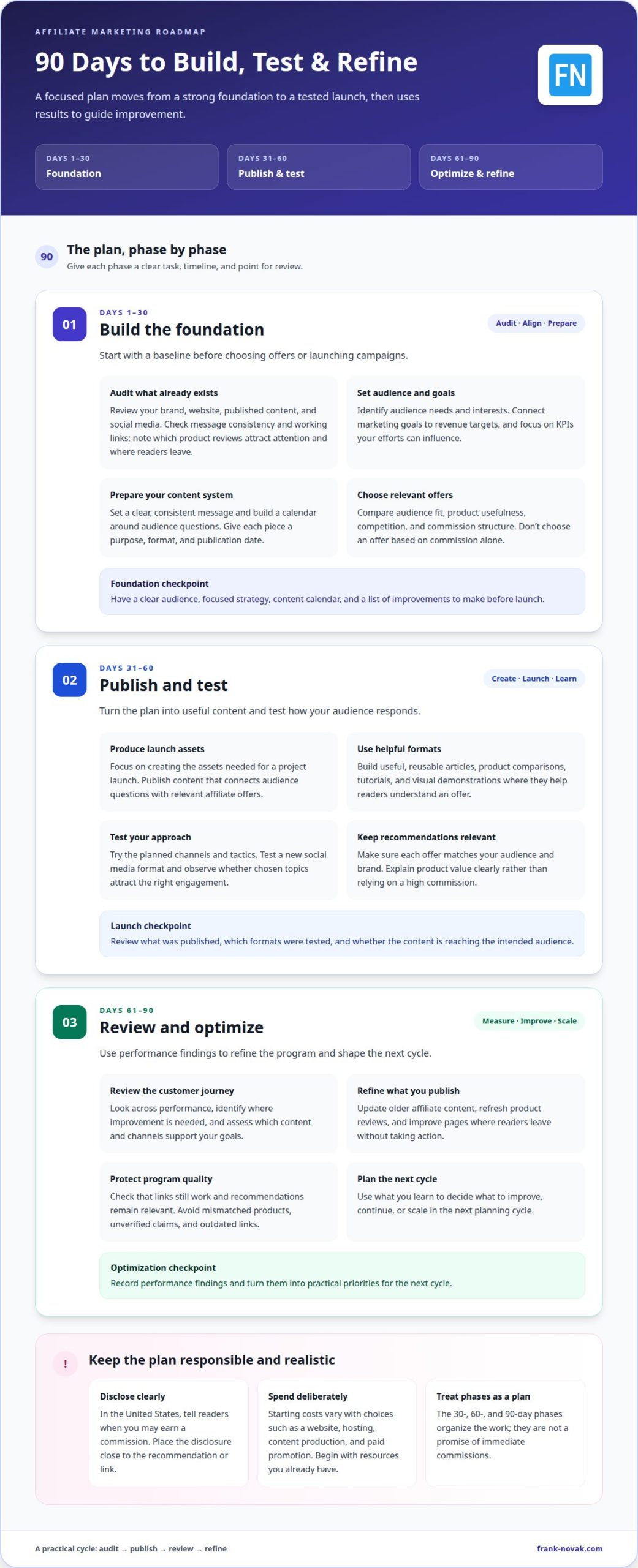
A 30-60-90-day plan divides your first three months into foundation, launch, and optimization phases. For affiliate marketing, it turns an audit, content schedule, and performance review into one practical sequence.
Audit the Brand and Existing Content
Before choosing affiliate offers, review your brand, website, published content, and social media. Check that your message is consistent, links work, and existing pages answer real audience questions. Note, for example, which product reviews attract attention and where readers leave without taking action. This audit gives you a baseline and shows what to improve before launch.
Set Brand Messaging and Content Calendars
Set a clear message and build a content calendar around your audience’s questions. Keep your voice consistent across your website and social media, and give each article or post a purpose, format, and publication date. Schedule product comparisons, tutorials, and visual demonstrations where they help readers understand an offer. A calendar also makes it easier to update older affiliate content.
- Map the three phases. Use days 1-30 to audit your brand and prepare content, days 31-60 to publish and test, and days 61-90 to review results and refine. These are planning phases, not a promise of immediate commissions. Set a specific task for each phase, such as refreshing a product review or testing a new social media format.
- Build useful, reusable content. Choose affiliate topics that match your brand and create articles, comparisons, or tutorials that keep helping readers after publication. This is the basis for potential passive income, but content still needs updates, working links, and relevant recommendations. Add visuals, such as a labeled product image or a simple comparison chart, when they make the choice clearer.
- Make disclosures clear. In the United States, tell readers clearly when you may earn a commission from an affiliate link. Place the disclosure close to the recommendation or link, rather than relying on a distant profile or footer. Keep the wording easy to notice and understand.
- Plan spending and manage risks. Starting costs vary with choices such as a website, hosting, content production, and paid promotion; begin with the resources you already have and add expenses deliberately. Avoid promoting mismatched products, publishing unverified claims, or leaving outdated links in place. The core steps are to audit, set goals, choose relevant offers, publish, and review performance.
In the first month, set goals, define your strategy, and create assets to support your campaigns. In the second month, focus on producing assets for a project launch. For each phase, specify tactics, timelines, responsibilities, and points for collaboration so the plan can be put into action.
The first phase covers days 1-30 and focuses on building the foundation; days 61-90 are for optimizing, protecting, and scaling the affiliate program.
How can businesses define their target audience for marketing?
Use the 90-day planning window to connect audience needs with useful content and relevant affiliate offers. Work through these steps before committing your marketing efforts to a niche or program.
-
Research the Audience and Existing Strategy
Start by examining your audience, products, competitors, and current marketing strategy. Look for recurring needs in website questions, social media comments, email replies, and content engagement. For example, a cooking site might find that readers often ask how to choose compact camping stoves. Compare those needs with your existing topics and competing content, then record gaps your next launch could address.
-
Define Target Audiences and Buyer Personas
Turn those observations into a specific target audience, then draft a buyer persona to guide content decisions. Describe the persona’s problem, experience level, preferred content, and purchase concerns. A persona for new campers, for example, might need plain-language comparisons and help understanding stove size. Tie each detail to observed behavior, and don’t treat assumptions about age or income as evidence.
-
Choose a Focused Niche
Beginners can choose a profitable niche by matching a clear audience need with products people can evaluate and relevant affiliate programs. For example, a camping site could focus on lightweight cooking gear if its readers already seek practical equipment advice. Compare audience interest, the usefulness of available products, competition, and the commission structure before selecting a focus. Creating a 90-day plan for affiliate marketing success starts with choosing a niche that serves a real audience need.
Profitability depends on more than the commission rate. Consider whether an offer genuinely solves your audience’s problem, whether your content can explain its value, and whether the program’s terms suit your publishing approach. A high commission on an irrelevant product is not a strong audience match.
-
Match Offers to Audience Needs
Compare potential affiliate programs with your audience persona and the content you can produce. Check which products you’ll promote, how commissions are structured, and whether the offer fits your brand message. For a beginner-focused camping guide, a detailed stove comparison may serve readers better than a general outdoor-products page. Don’t choose an offer based on commission alone.
When creating a 90-day plan for affiliate marketing success, use the cycle to test whether chosen topics attract the right engagement. Track which articles prompt meaningful questions, clicks, and conversions, then refine your audience definition. If readers respond to compact cooking gear but ignore broad camping content, narrow future topics around that demonstrated interest.
Reviewing results and planning the next cycle
Review the full customer journey, not just clicks, before changing a campaign. Use the final phase of your 90-day plan to identify what performed, where prospects dropped off, and what to implement next.
-
Review Affiliate Results
Start by comparing performance across your chosen platform and content types. Track clicks alongside approved conversions, revenue, acquisition cost, average order value, refunds, cancellations, repeat purchases, and time to conversion. These measures show whether a campaign generates valuable customers, not merely traffic. During days 61-75, review partner quality and look for patterns that explain which sources bring relevant buyers.
When reviewing DAZN’s first-quarter affiliate results, organize the available figures by partner, content placement, and conversion outcome. Compare these measures instead of treating one headline result as proof of overall performance. If clicks rise but approved conversions do not, investigate the journey from referral to purchase before deciding what to change.
-
Adjust Campaigns Based on Results
Choose one clear issue in the data, then adjust the campaign to address it. If a comparison page attracts visitors but generates few conversions, improve the offer explanation or make the next step easier to find. If a partner brings conversions but also high refunds, examine audience fit and customer expectations before expanding the partnership.
Use funnel gaps to decide whether to improve traffic, lead quality, or conversion. Change one element at a time, such as a headline or call to action, so the next review can connect the adjustment with its outcome. During days 76-82, include a risk and compliance review alongside performance checks; avoid scaling placements that create poor-quality referrals.
-
Plan Campaign Ramp-Up and the Next Cycle
Set the next cycle’s priorities using results from the entire strategy, rather than judging success by one tactic. Affiliate income timing varies: some beginners see first commissions within weeks, while meaningful income may develop over 3-6 months. Treat early earnings as one signal, and keep reviewing conversion quality, refunds, and repeat purchases before expanding efforts.
During days 83-90, build a scale plan around the strongest evidence. Identify which content to refresh, which partner relationships to develop, and which weak placements to pause. Then assign each action an owner, a measurement, and a review point for the next cycle. If results remain limited, revisit the audience match or conversion path instead of simply publishing more content.
- Document the next test. Record the change, why you’re making it, and the result you’ll evaluate. For example, if a review page gets clicks but few approved conversions, test clearer product comparisons before adding more traffic. This keeps the next campaign focused and makes the results easier to learn from.
Aligning marketing goals with sales and revenue targets
A 30/60/90-day plan connects marketing and sales objectives across a three-month period. Use these steps to tie each campaign to revenue priorities and measurable outcomes.
- Start with the revenue outcome. Write down the business result your marketing should support during the three-month period. Then identify the customer action that contributes to it, such as purchasing through an affiliate link or making another purchase. Focus on outcomes you can influence, rather than listing every possible marketing activity.
Translate that outcome into a small set of KPIs. For affiliate content, these might include qualified traffic, approved conversions, revenue, and average order value. Link each measure to a decision: if traffic grows without conversions, review the offer and customer journey before increasing promotion.
- Get input from sales and customer success. Ask sales teams where prospects hesitate or leave the buying process. Their feedback can show whether content needs clearer comparisons, stronger product explanations, or answers to common objections. Customer-success teams can identify which customers may retain, renew, or consider an upgrade.
Use those observations to refine your marketing message. If sales teams repeatedly hear that buyers struggle to compare features, plan an affiliate guide that explains the differences in plain language. If customer-success feedback suggests interest in repeat purchases, prioritize content that helps existing customers choose relevant complementary products.
- Match the channel and budget to the goal. Assign each priority a channel, a specific tactic, and a way to assess progress. A search-focused product comparison may support purchase intent, while social media can introduce a topic and encourage engagement. Keep evergreen activity running alongside the plan’s focus strategies.
Marketing budget references range from 2% of overall company revenue for slow growth to 21% for aggressive growth, with 9% cited as an allocation. Treat these figures as context, not a universal spending target. For an affiliate campaign, decide what resources it needs by weighing the goal, channel, content workload, and available capacity.
- Set milestones for each phase. At the 30-day mark, confirm goals, messaging, and campaign assets. By day 60, review whether planned activities are reaching the intended audience and supporting sales priorities. At day 90, compare outcomes with the original KPIs and decide what to continue, adjust, or pause.
Record an owner and review point for each action. If a campaign produces clicks but few approved conversions, assign someone to review the offer and landing experience. If customer-success feedback highlights a useful topic, schedule content addressing it in the next cycle.
Choosing strategies such as affiliate marketing, SEO, and paid advertising
Choose channels by matching their role to your goal, resources, and audience behavior. For beginners, useful SEO content and social media can attract relevant visitors. Paid advertising is another option when you can manage the spend and track outcomes.
- Choose one primary growth engine. Decide which channel will receive most of your attention during the plan, and explain why it fits. SEO can support search-led guides and comparisons, while social media can introduce useful content to people who follow related topics. Affiliate marketing can connect those visitors with relevant products. The right combination depends on your audience’s habits and the action you want them to take.
Affiliate programs are used by 80% of companies to generate more sales. That makes affiliate marketing a familiar strategy, but it still needs a clear role in your plan. Treat it as a way to monetize relevant recommendations, not as a substitute for helpful content or a defined audience.
- Pair supporting channels with the primary one. If SEO is your main channel, use social media to share new guides and learn which topics prompt engagement. If social media is the focus, develop supporting pages that answer questions raised in comments. Choose pairings that reinforce the same message rather than creating disconnected campaigns.
For example, a review article can reach people comparing products, while a short social post highlights one practical difference and directs interested readers to the full explanation. Keep the promise consistent across both formats. If social messaging doesn’t match the landing page, it can weaken trust and interrupt the path to conversion.
- Use paid advertising with a defined test. Set a specific campaign goal before promoting affiliate content. Decide which audience or offer the ad supports, what action you want visitors to take, and which results you’ll measure. Paid traffic can create faster exposure, but clicks alone don’t show whether a campaign produces approved conversions or useful revenue.
Start with a focused test instead of spreading effort across several offers and audiences. Compare campaign costs with the value of its outcomes, including refunds and cancellations. If the path from ad to purchase is unclear, improve the content or landing experience before increasing promotion.
- Protect evergreen activity while testing. Identify strategies that can continue alongside your focus channel. A useful product guide or search-focused tutorial may keep attracting readers after publication, while another campaign tests a new offer or format. Maintain and update these assets instead of assuming published content will stay relevant without attention.
For each strategy, write down the audience, intended action, content format, and performance measure. Review the fit during the 30-, 60-, and 90-day checkpoints. Keep what supports the goal, adjust what shows a clear gap, and avoid adding channels without a reason.
Frank Novak: Online Success Coaching
Frank Novak’s Online Success Coaching can help you apply your affiliate marketing plan. Bring your audience definition, revenue goals, channel choices, and performance measures into a clear working strategy. If you’re planning your next cycle or turning an online business idea into practical actions, coaching can help you work through those decisions. Frank Novak also offers ClickBank Super Funnel, Never Succeed Online, and Clickbank Profit Club for readers exploring those specific resources. Choose the support or resource that fits your plan instead of adding tools that don’t.
Make Your Next Cycle More Focused
Let your first cycle become a working reference, not a document you set aside. Keep a record of the decisions you made, what you learned from audience responses, and which questions remain unresolved. Those notes will help you choose a clearer priority for the next cycle instead of starting from scratch. The work of creating a 90-day plan for affiliate marketing success becomes more useful when each cycle builds on what came before. Set aside time to review your assumptions, refine your approach, and choose the next action that best serves your audience and business goals. If you’d like support turning those decisions into a practical direction, take the next step at a pace that works for you.
Start your next cycle with one thoughtful decision, then keep moving forward with purpose.
Frequently Asked Questions
Why is it important to tailor messaging to the target audience?
Tailored messaging helps readers see how an offer relates to their needs. A beginner comparing budgeting tools, for example, may need plain explanations of setup and everyday use, while an experienced marketer may prioritize integrations and reporting. Addressing different questions makes affiliate content more relevant and helps readers assess offers against useful criteria. It also prevents broad claims that fail to explain who a product suits.
What content should affiliate marketers publish in their first 90 days?
Publish connected content that guides readers from learning about a problem to comparing possible solutions. A home coffee site, for example, could start with a guide to choosing a brewing method, explain key equipment differences, and later update its recommendations based on reader questions. Link related pieces clearly so visitors can continue exploring without searching for the next useful article.
What affiliate marketing goals and KPIs should be tracked each month?
Track publishing progress alongside commercial outcomes, and compare each month with the previous period. Measure whether planned content went live, whether qualified visitors clicked affiliate links, and how much approved revenue each page contributed. Revenue per visitor can help compare pages with different traffic levels. Review results by topic or channel so a strong overall figure doesn’t hide a page that needs attention.
How to find and compare affiliate programs by commission rates and cookie duration?
Compare commission rates against average order value, gross margin, acquisition cost, refund rate, and customer lifetime value, and make sure the offer fits your audience. Prefer programs with cookie durations of at least 30 days.

Article by
Frank Novak
Frank Novak is an online marketing professional and coach who focuses on affiliate marketing and business automation. Through his website, frank-novak.com, he shares insights and strategies for leveraging social media platforms like Facebook to generate traffic and commissions.
Affiliate / Sponsored Content Disclaimer
This [website/post] contains affiliate links. If you click through and make a purchase, we may receive a commission at no additional cost to you. We only recommend products or services we believe will add value to our readers.