

What if your online business is making progress before the revenue numbers show it? Celebrating small wins in your online journey can help you spot evidence that’s easy to miss when results are slow or inconsistent. A useful reply from a reader, a steady publishing habit, or a clearer funnel can all signal that your efforts are moving in a meaningful direction.
If you’ve compared your progress with another entrepreneur’s or wondered whether a busy week actually helped your business, you’re not alone. Not every task is a milestone, and a growing follower count doesn’t always tell you what to do next. The key is to recognize progress that reflects audience connection or supports a specific business goal.
This guide will help you identify meaningful wins, build a simple habit for acknowledging them, and use what you learn to choose your next useful action. You’ll see how to track practical signals, such as consistent publishing, audience engagement, and funnel improvements, without relying on constant outside approval. Small wins won’t guarantee growth, but they can make progress visible and help you keep building with purpose.
Key Takeaways
- Define a small win by how it supports a business goal, not by how impressive the number looks.
- Separate activity, learning, and outcome indicators to understand what your progress is telling you.
- Use a brief weekly routine for celebrating small wins in your online journey and choosing a useful next step.
- Let each win guide whether to repeat an action, improve it, or reconsider your approach.
- Pair recognition with evidence and a clear goal to make it a practical habit, not just a feel-good moment.
What counts as a small win in your online journey?
Online progress can feel invisible before you reach a major audience or revenue milestone. You might be publishing consistently, learning how visitors find your site, or refining an offer without seeing an immediate change in sales. Those steps still matter when they move work toward a clear business goal.
A small win is an observable step toward a larger business goal, not a promise that the goal will be achieved. This distinction keeps recognition grounded: you can acknowledge progress without assuming that one post, email, or adjustment proves your strategy will succeed. The idea connects with The Progress Principle, which describes the motivational value of making progress through meaningful work.
A short talk about tiny habits offers another useful perspective on making manageable actions part of a routine:
Which early milestones are worth recognizing?
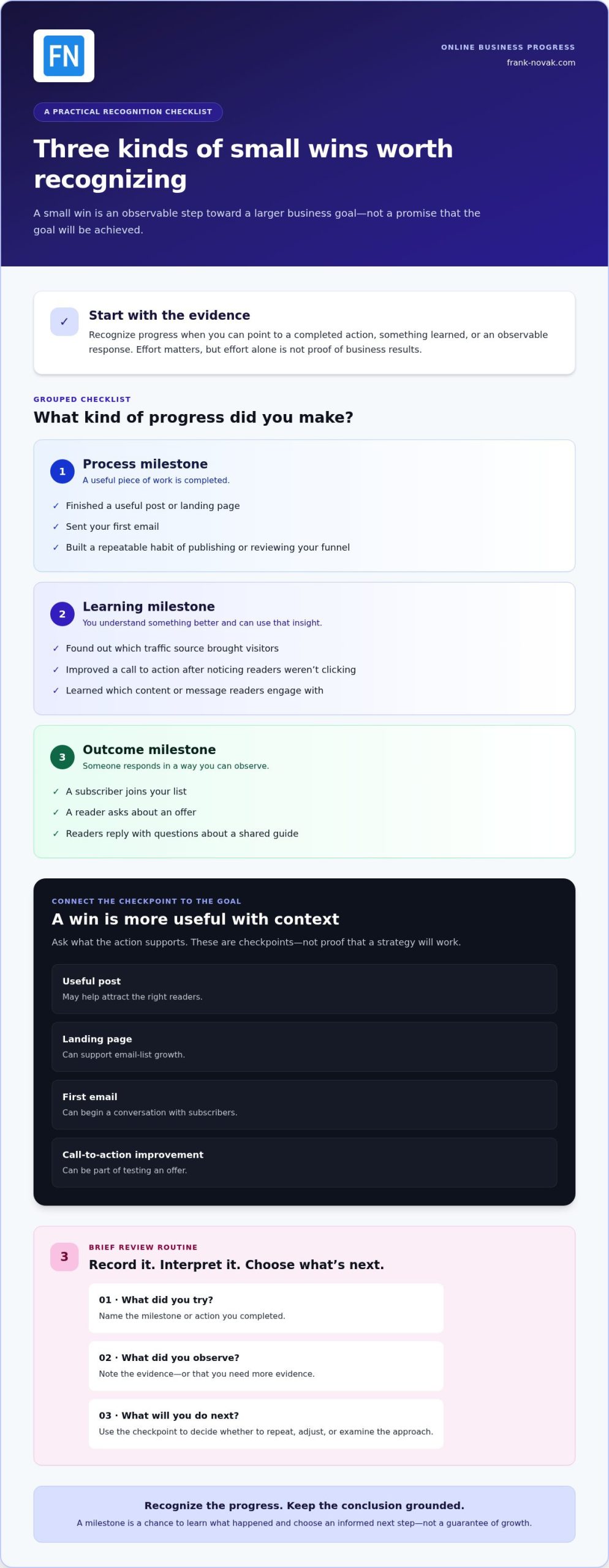
Early wins can take different forms. A process milestone is completing a useful post, finishing a landing page, or sending your first email. A learning milestone is understanding which traffic source brought visitors or improving a call to action after noticing that readers weren’t clicking. An outcome milestone is an observable response, such as a subscriber joining your list or a reader asking about an offer.
Repeatable habits count, too. Setting aside time to publish or review your funnel builds a process you can learn from, even before it leads to measurable sales. When celebrating small wins in your online journey, recognize both the completed action and what it taught you. Effort matters, but it isn’t by itself proof of business results.
How do small wins fit into a longer business goal?
Connect each milestone to the larger goal it supports. A useful post may help attract the right readers; a landing page can support email-list growth; and a first email can begin a conversation with subscribers. Improving a call to action can be part of testing an offer. These are checkpoints, not proof that a particular strategy will work. Use them to decide what to repeat, adjust, or examine next.
If you’re building an affiliate marketing business, mindset guidance can help you stay steady while progress develops. Frank Novak’s online business mindset resource offers a related perspective on continuing through the early stages.
Why celebrating small wins can support steady online progress
Online results can arrive unevenly. You may put thoughtful work into your business for a while before seeing a clear change in traffic, engagement, or sales. During that stretch, pausing to notice what you completed can make your effort easier to review. The point isn’t to convince yourself that everything is working. It’s to look at what happened and decide what to do next.
Keep that pause simple: record the milestone, note the evidence, and ask what it suggests. If you changed a call to action, write down what you changed and whether readers responded differently. If there isn’t enough evidence yet, that’s useful to know, too. You can give the test more time, collect a clearer signal, or choose a different adjustment.
In The Power of Small Wins, Harvard Business Review discusses Teresa Amabile and Steven Kramer’s work on progress and motivation. For your online business, the practical takeaway is to treat recognition as a moment for reflection, not as proof that a particular tactic will succeed.
How recognition can turn effort into useful feedback
Keep a brief record of what you tried, what you observed, and what you’ll do next. Concrete notes are more useful than relying only on the temporary feeling that a task went well. For example: “I shared a guide with my email list; several readers replied with questions about one section; next, I’ll make that topic clearer.”
Over time, these entries can help you see which actions are repeatable and which need refining. A content experiment may show that readers engage with practical explanations. An audience test may reveal that a message reaches people outside your intended group. A funnel adjustment may need more observation before you draw a conclusion. Each milestone is a checkpoint, not a verdict.
Why comparison can make progress harder to notice
Someone else’s visible results rarely show their starting point, earlier experiments, or the work behind the scenes. If you use their milestones as your main measure, your own learning can seem insignificant. Compare your current work with your earlier baseline instead. What can you complete more consistently, explain more clearly, or assess with better evidence than before?
When discouragement makes that perspective difficult to hold, the Never Succeed Online resource offers related mindset guidance. You can also explore Frank Novak’s online business guidance for support in building structure around your next steps. Celebrating small wins in your online journey is most useful when recognition leads to an informed action, not an assumption of guaranteed growth.
Small wins versus vanity metrics: how to recognize real progress
A number can look impressive and still leave you unsure what to do next. A vanity metric is a figure that appears encouraging but lacks context or a clear connection to your current goal. Followers, impressions, and total likes may offer background, but by themselves they don’t show whether you’re reaching the right audience or moving your business forward.
Instead of labeling a metric useful or useless in isolation, consider what role it plays. A count of published posts might help you assess consistency, while relevant email sign-ups can signal audience interest. Neither tells the whole story without knowing what you were trying to learn or achieve.
Which online-business milestones show useful progress?
Match each indicator to a specific purpose. If your content goal is to explain a topic clearly to potential customers, publishing more often is an activity milestone, not proof that the content is working. If your goal is to build an email list with people interested in a particular offer, relevant sign-ups may tell you more than total social impressions. A funnel adjustment can be a learning milestone: you’ve made a change and can observe what follows, without assuming conversions will rise.
Harvard Summer School’s article on recognizing small wins offers a broader perspective on noticing incremental progress. For an online business, connect that recognition to evidence and a defined goal.
When is a number only a vanity metric?
Ask three questions: Does this number relate to a goal I’ve set? Does it describe the audience or behavior I care about? Could it guide a business decision? If the answer is no, treat it as context rather than a milestone. A brief spike in impressions, for example, may not indicate lasting progress unless you understand what caused it and whether it reached the intended audience.
Choose a small set of indicators you can review consistently, and interpret each alongside the experiment and timeframe. That makes celebrating small wins in your online journey more grounded: you’re recognizing evidence, not mistaking a single number for the whole picture.
How to celebrate small wins in your online journey each week
A weekly review can help you notice progress without turning reflection into another major task. Set aside a brief moment to look at what you intended to do, what you actually completed, and what the evidence suggests. You don’t need to document every detail of your business. Make your effort visible enough to guide one useful next step.
Try this simple routine:
- Choose a goal: Pick one focus for the week, such as publishing useful content or learning more about how visitors reach your site.
- Record evidence: Note the actions you completed and any observable response or lesson.
- Acknowledge progress: Name what you did well, including steady effort or a useful discovery.
- Select a next step: Choose one realistic action to continue, adjust, or investigate.
What should you record in a weekly wins log?
A simple document or spreadsheet is enough. For each milestone, write down the action, the goal it was meant to support, and the result or lesson you observed. For example: “Published a guide to support email-list growth; readers asked questions about one section; clarify that section in the next update.” This captures both the process and the response without requiring a complicated tracking system.
Keep the record honest. If a test didn’t lead to a clear result, write that down. Note what remains unknown, too. A completed funnel change might be a process milestone, while any response to it is an outcome to observe over time. Don’t treat the change itself as proof that the funnel is performing better.
How can you celebrate without losing focus?
Choose a personal, proportionate way to mark the effort. You might add a note to your log, step away for a planned break, or recognize that you kept a useful work habit during a demanding week. The celebration acknowledges the action; it doesn’t declare an experiment successful or guarantee future results.
Close the review by naming one manageable next action. If you published consistently, you might plan the next piece around a question readers raised. If you’re still gathering evidence, decide when and how you’ll review it again. That small commitment keeps celebrating small wins in your online journey focused on learning and forward movement, rather than adding pressure to do more.
For added structure and accountability as you develop your online business, explore Frank Novak’s online success coaching.
Turn small wins into lasting momentum for your online business
A milestone is most useful when it helps you decide what comes next. After noticing progress, check whether the action served its intended purpose. Did the content reach the audience you had in mind? Did the change teach you something about your offer? Did you get enough evidence to make a sensible decision, or is it too early to tell?
Use your answer to choose among three paths: repeat an action that appears useful, adjust one part of an experiment, or stop and try a different approach. For example, if an email prompts relevant questions from readers, you could explore that topic in future content. If a funnel update has produced too little information to assess, continue observing it rather than assuming it succeeded. For more context on assessing funnel steps, read this automated marketing funnel guide.
How can you keep moving through setbacks?
Some experiments won’t support the goal you had in mind. That doesn’t erase the work or the learning, but it may mean the next step is to revise the message, audience, or approach. Persistence is valuable when it includes reflection. Continuing the same strategy without considering evidence isn’t automatically progress, just as an unexpected result doesn’t mean your wider online-business goal is out of reach.
Recognition can help you notice progress, but evidence and a clear goal are what make it useful for deciding what to do next. That’s the practical value of celebrating small wins in your online journey: not a promise of revenue or growth, but a way to connect completed work with better-informed choices.
When can coaching help you keep perspective?
If you find it difficult to assess your experiments alone, an outside perspective can help you clarify goals, review what you’ve tried, and build accountability around next steps. Frank Novak’s online success coaching focuses on digital-business growth, affiliate marketing, and automation. It can provide structure as you assess your progress, without guaranteeing a particular result.
You can keep applying the reflection routine on your own, or consider whether guidance would help you move forward with more structure. Choose one experiment, define what evidence you’ll review, and set a time to check in with yourself.
Make Your Next Step Count
Your online progress doesn’t have to wait for a major revenue milestone to be worth recognizing. A useful win is one connected to a business goal, whether it reflects a consistent work habit, a lesson from an experiment, or an observable audience response. Record what happened, consider what it tells you, and decide whether to repeat, adjust, or rethink your next action.
That’s the practical value of celebrating small wins in your online journey: it helps you notice progress without mistaking activity for results or assuming one success guarantees the next. Keep your review simple, focus on evidence, and measure your path against your own goals rather than someone else’s visible outcomes.
If you’d benefit from more structure, Frank Novak’s online success coaching focuses on online-business growth and automation, with practical guidance on affiliate marketing, traffic, and building a mailing list.
Keep learning from each step, and give yourself credit for the progress you can see. Steady, thoughtful action gives you a clearer foundation for what comes next.
Frequently Asked Questions
What counts as a small win in an online business?
A small win is an observable step that supports a larger business goal. It might be publishing a useful article to attract a defined audience, completing a landing page for an email-list campaign, or learning which traffic source brings relevant visitors. Wins can involve action, learning, or outcomes. They’re worth recognizing as checkpoints, but they don’t prove a strategy will succeed or guarantee sales.
How do I celebrate progress when I have not made my first sale?
Recognize the steps that build a foundation for future learning, such as publishing consistently, completing your first email, or making your offer clearer. In celebrating small wins in your online journey, connect each action to a goal and record what you observed. Mark the effort with a brief note or a planned break. Acknowledge progress without treating activity as evidence that a sale is guaranteed.
Can celebrating small wins help me stay consistent with affiliate marketing?
It can give you a regular chance to review your affiliate-marketing work and choose a manageable next action. For example, note that you published a product guide, learned more about a traffic source, or clarified a call to action. Then assess whether the action served your goal. Recognition doesn’t guarantee commissions, but evidence-based reflection can help you decide what to repeat, improve, or reconsider.
How often should I review and celebrate online-business milestones?
A weekly review is a practical starting point for many online-business routines. Look at the goal you set, the actions you completed, and any results or lessons you observed. If a project has a different pace, choose a review schedule that gives you enough information to reflect without checking constantly. Keep the habit brief and consistent, and adjust the frequency if it becomes burdensome or unhelpful.
What happens if I celebrate a milestone but my results do not improve?
A milestone can be meaningful even if the result you hoped for hasn’t changed. Recognizing that you completed a test or learned something new is different from declaring the strategy successful. Review the evidence, consider whether you allowed enough time to assess it, and decide whether to continue, adjust one element, or stop. The purpose of celebration is to support honest reflection, not to guarantee improvement.
How can I tell a meaningful business milestone from a vanity metric?
Ask whether the number connects to a clear goal, the audience you want to reach, or a decision you need to make. Total likes or impressions may lack context on their own. Relevant email sign-ups, conversions, or feedback tied to an experiment may provide more actionable information. Still, interpret any metric alongside its timeframe and what you changed. One figure rarely explains the full picture.
Is it useful to track small wins in a journal or spreadsheet?
Yes. A simple journal or spreadsheet can help you remember what you tried and learn from it over time. For each entry, note the action, the goal it supported, any observable result, and what remains uncertain. Include tests that didn’t produce the result you wanted, too. This record can help you spot patterns and choose a next step without relying only on memory or mood.

Article by
Frank Novak
Frank Novak is an online marketing professional and coach who focuses on affiliate marketing and business automation. Through his website, frank-novak.com, he shares insights and strategies for leveraging social media platforms like Facebook to generate traffic and commissions.
Affiliate / Sponsored Content Disclaimer
This [website/post] contains affiliate links. If you click through and make a purchase, we may receive a commission at no additional cost to you. We only recommend products or services we believe will add value to our readers.