

What if the competitor with the most visible content isn’t the one you should learn from? If you’re wondering how to analyze your affiliate marketing competitors, compare businesses that serve a similar audience and promote offers through channels you could realistically use. That gives you a more relevant picture than trying to track every affiliate site, social post, or ad in your niche.
It’s easy to feel overwhelmed by public evidence, especially when you can’t see a competitor’s actual traffic, conversions, or commissions. You don’t need to guess those private numbers. Instead, observe what’s visible, separate facts from assumptions, and turn useful patterns into ideas you can test in your own business.
This guide shows you how to identify relevant competitors, compare their positioning, content, traffic channels, offers, and funnel experiences, then turn your observations into ethical, measurable experiments. You’ll have a repeatable process for deciding what to investigate, what may be worth adapting, and how to learn from the results without copying someone else’s strategy.
Key Takeaways
- To learn how to analyze your affiliate marketing competitors, begin with businesses that target a similar audience. Shortlist them across search, social, and funnel touchpoints.
- Make your research dependable by recording each finding’s source, date, observation, interpretation, and confidence level.
- Compare audience, promise, content format, offer type, and funnel entry point. Treat public visibility as evidence of activity, not proof of profitability.
- Turn one useful observation into a focused experiment: state your hypothesis, change one element, and choose a measure before you review the result.
- Use your comparison notes to build a manageable 30-day learning plan. Consider structured coaching if you’d like support organizing implementation.
How to Analyze Your Affiliate Marketing Competitors Without Guessing
Competitors leave clues in their articles, social posts, ads, offers, and landing pages. They rarely reveal the sales and conversion data behind them. If you’re learning how to analyze your affiliate marketing competitors, don’t try to estimate what they earn. Study their visible choices and use them to form useful questions about your own business.
Affiliate marketing connects merchants, affiliates, and consumers, with affiliates earning compensation for referred actions or sales. This neutral overview of affiliate marketing can help clarify those roles. Competitor analysis focuses on how businesses position offers, publish content, attract attention, and guide potential customers through a journey.
For a visual introduction to researching what competitors make visible, watch this video:
Affiliate competitor analysis is structured research into rival businesses’ positioning, offers, content, traffic sources, and customer journeys. It uses public evidence to identify testable opportunities without assuming access to private performance data. A visible review page, for example, shows a content approach. It does not prove that the page generates revenue.
Which affiliate competitors should you include?
Choose businesses that serve a similar audience with a related need in the same market. A large brand may rank highly, but its resources, audience, or business model could make it a poor comparison for a smaller affiliate operation.
Separate competitors into two useful groups:
- Direct offer competitors: affiliates promoting the same or closely related products to a similar audience.
- Attention competitors: publishers or creators competing for the same search queries, social feeds, or audience interest, even if their offers differ.
Start with a manageable shortlist. Beside each name, write why it belongs, such as a shared audience, overlapping topic, or similar offer. That context will help you interpret what you observe later.
What can public competitor research actually reveal?
You can review a competitor’s stated positioning, published articles and videos, visible offers, public ads, and the path from a post or search result to a landing page. These clues show how the business presents its value and invites people to take the next step.
SEO tools may estimate traffic or show keyword visibility, but treat those figures as directional indicators, not verified business results. Public evidence cannot establish another marketer’s commissions, conversion rates, or customer lifetime value. Record what you can see separately from what you infer, and label uncertain interpretations as hypotheses. A polished funnel or prominent ranking is evidence of visibility, not proof of profitability.
How to Research Affiliate Competitors Across Search, Social, and Funnels
A repeatable research process turns scattered screenshots and search results into a useful comparison. As you learn how to analyze your affiliate marketing competitors, tie each finding to where and when you observed it. A ranking, post, or ad is a snapshot, not a complete picture of a business.
How to find relevant competitors and their traffic channels
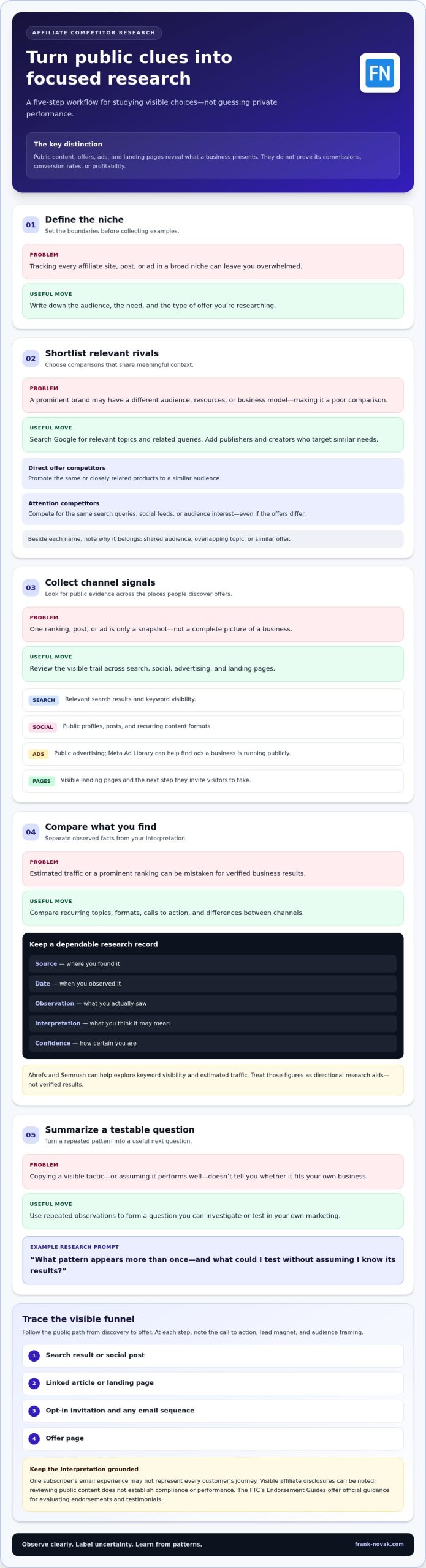
Use this five-step workflow to build a focused research file:
- 1. Define the niche. Write down the audience, need, and type of offer you’re researching.
- 2. Shortlist rivals. Search Google for relevant topics and related queries, then add publishers and creators targeting similar needs.
- 3. Collect channel signals. Review organic search results, public social profiles, advertising, and visible landing pages. Meta Ad Library can help you find ads a business is running publicly.
- 4. Compare what you find. Note recurring topics, formats, calls to action, and differences between each competitor’s channels.
- 5. Summarize a useful question. Identify a pattern worth investigating or testing in your own marketing.
SEO platforms such as Ahrefs or Semrush can help you explore keyword visibility and estimated traffic. Use their figures as directional research aids, not verified results. For each observation, record the source, date, what you saw, your interpretation, and your confidence. For example, note the search query and date beside a ranking, then distinguish the observed position from your guess about its business value. Repeated observations are more useful than one-off snapshots because they show whether a pattern persists.
How to map the competitor’s affiliate funnel
Trace the public path from discovery to offer: a search result or social post, any linked article or landing page, an opt-in invitation, and the offer page. At each step, record the call to action, lead magnet, and audience framing. If you opt into a public email sequence, note the messages you receive and when they arrive. One subscriber’s experience may not represent every customer’s journey.
Also note whether affiliate relationships are disclosed in visible content. The FTC’s Endorsement Guides offer official guidance for evaluating endorsements and testimonials. This review helps you understand what is presented publicly, but it does not establish compliance or performance.
Once you’ve mapped a few journeys, organize them by funnel stage to identify where your own path needs attention. If you’d like support turning observations into a growth plan, explore online success coaching.
How to Compare Competitor Offers and Content When Results Are Hidden
A polished page or popular post can look like a proven playbook, but public visibility doesn’t reveal whether it generates sales. Compare what you can assess: how clearly content serves its audience, how well an offer fits the problem, and how easy the next step is to understand. That makes how to analyze your affiliate marketing competitors a matter of evaluating evidence, not guessing at earnings.
Which comparison criteria matter for affiliate marketers?
Use the same fields for each business so you’re comparing like with like. A simple table can reveal patterns without treating one post as a complete strategy.
| Criteria | What to record | What to assess |
|---|---|---|
| Audience | Who the page or post addresses | Is the audience specific and relevant to your market? |
| Promise | The need or outcome emphasized | Is the value clear and connected to the audience’s problem? |
| Content format | Review, tutorial, comparison, video, or other format | Does it answer a real question with useful depth and evidence? |
| Offer type | The product or action being promoted | Does the offer align with the content and audience need? |
| Funnel entry point | Search result, social post, ad, or landing page | Is the next step clear and easy to follow? |
For example, if a tutorial explains a problem in detail before presenting a related offer, record that as an observation. Then assess whether the explanation is genuinely helpful, whether its claims are supported, and whether the promotion feels relevant rather than abrupt. Compare recurring themes across several pages before drawing conclusions about a competitor’s broader approach.
How to interpret competitor data without false certainty
Keep observations separate from hypotheses. “The post has visible comments” is an observation. “The post drives affiliate sales” is an unverified hypothesis. Third-party traffic estimates and engagement counts can add context, but they don’t confirm revenue, conversion rates, commissions, or customer value.
Be careful about cause and effect. A popular offer appearing beside a certain content format doesn’t prove that the format made the offer successful. Audience, timing, promotion, and other factors may also matter. Label uncertain conclusions clearly, then use them to form a question you can test in your own business.
Once your comparison points to a channel worth exploring, use an affiliate traffic strategy guide to consider how that channel could fit your own plan.
How to Turn Affiliate Competitor Research Into a Practical Test Plan
Research becomes useful when it leads to a focused experiment. Rather than copying a competitor’s visible tactics, use them to ask a question about your own audience. This is the practical next step in learning how to analyze your affiliate marketing competitors: turn an observation into a hypothesis, change one thing, and decide in advance what you’ll measure.
How to prioritize which competitor insights to test
Start with an insight connected to a real audience need and your current business goal. Then weigh four factors: relevance to your audience, effort required, potential learning, and strength of evidence. A small test of a content angle or call-to-action placement is usually easier to interpret than changing several parts of a funnel at once.
For example, you may observe that several publishers answer a specific beginner question before introducing an offer. That’s an observation, not proof their approach converts. A testable hypothesis could be: “If I answer this question clearly before presenting a relevant offer, more readers will click through.” Create or update one piece of content, keep other elements stable, and set a review period and success measure before publishing or promoting it.
Use a simple experiment record to keep the reasoning clear:
| Observation | Hypothesis | Test | Measure | Learning |
|---|---|---|---|---|
| Several competitor guides answer a specific question before promoting an offer. | A direct answer may make my content more useful and encourage relevant next steps. | Add a concise answer before the existing call to action in one relevant article. | Compare qualified affiliate clicks and engagement during the planned review period. | Record what changed, what stayed constant, and whether the result supports another test. |
Adapt the principle, not the execution. Don’t copy another business’s brand voice, creative assets, claims, or funnel pages. Build an approach that fits your audience, and use accurate, supportable statements about the offer you promote.
How to measure learning without claiming guaranteed results
Choose measures that match the test. Depending on your goal, these might include qualified clicks, opt-ins, engagement, or affiliate conversions. Compare like with like where possible, and note differences in traffic source, timing, audience, and offer. If several conditions changed, treat the outcome as suggestive rather than conclusive. A test can still be valuable if it shows what to investigate next.
If paid social is the channel you’re evaluating, include channel-specific questions in your test plan. For example, record which audience need an ad addresses, what action it invites, and whether the landing page continues the same message.
Apply Competitor Analysis to Your Affiliate Marketing
Your comparison sheet is most valuable when it helps you decide what to do next. Instead of acting on every competitor signal, use the next 30 days to explore one audience, one channel, and one funnel question. The aim is focused learning, not a promise of a particular result.
What should your competitor-analysis action plan include?
Turn the clearest evidence-backed insight into a small plan. For example, if your research suggests that your audience needs more explanation before seeing an offer, investigate that need in one channel and test a relevant content change. Before publishing or promoting it, record your current baseline so you have a fair point of comparison.
- Days 1-7: Choose one audience segment, one channel, and one question about the customer journey. Review your comparison notes and select an observation connected to your business goal.
- Days 8-14: Record the current baseline for the measure that matters, such as qualified clicks, opt-ins, or engagement. Note the traffic source and offer so you can interpret results in context.
- Days 15-23: Run one focused test based on the observation. Keep other elements as consistent as practical, and avoid changing several parts of the funnel at once.
- Days 24-30: Review the measure you chose in advance. Keep findings supported by your own evidence, revise ideas that remain uncertain, and set aside assumptions the test didn’t support.
This plan works for independent research if you can choose a clear priority, run the test, and interpret what happened. If your comparison sheet raises more questions than it answers, or you’re unsure how to connect content, traffic, and funnel steps, structured guidance can help you shape the findings into a growth plan suited to your business.
When coaching or funnel resources can support implementation
Personalized online success coaching can help organize competitor observations around your goals and identify a practical next step. If your research points toward improving how visitors move from discovery to an offer, the ClickBank Super Funnel can provide relevant funnel-planning context as you consider your own system. Use competitor journeys to inspire questions, not to copy pages or tactics.
You now have a repeatable way to research, compare, and test. If structured support fits your goals, you can explore online success coaching.
Turn Competitor Insights Into Your Next Smart Move
Effective competitor research doesn’t require access to private sales data. Start by choosing comparable businesses, gathering public evidence across their content and funnels, and separating what you observe from what you can only infer. Then turn one relevant insight into a focused experiment for your own audience.
As you continue learning how to analyze your affiliate marketing competitors, keep comparisons consistent and tests small. Track a baseline, change one element at a time, and use the results to decide what to explore next. If funnel observations point toward changes in your customer journey, the ClickBank Super Funnel can offer relevant planning context.
If you’d like help connecting your research to a tailored growth plan, Online Success Coaching focuses on digital business scaling and automation.
You don’t need to copy a competitor to learn from the market. With a clear process and steady testing, each observation can help you make a more informed next move.
Frequently Asked Questions
How do you analyze your affiliate marketing competitors?
To learn how to analyze your affiliate marketing competitors, choose businesses that serve a similar audience, then compare their positioning, content, offers, traffic channels, and customer journeys. Record what you directly observe separately from your interpretations, including the source and date. Look for recurring patterns, not just one successful-looking post, then use a relevant observation to form a small experiment for your own audience.
What should you look for when researching affiliate competitors?
Look at who each competitor speaks to, the problem they address, the content they publish, and how they introduce an offer. Follow the visible journey from a search result or social post to a landing page, opt-in, or offer. Assess whether the content answers a useful question and whether the next step fits the audience’s needs. Treat estimated traffic and visible engagement as context, not proof of sales.
Can you find out how much your affiliate competitors earn?
Usually, no. Public research can show visible offers, content, advertising, and some audience engagement, but it can’t verify private commissions, conversion rates, customer lifetime value, or total revenue. A traffic estimate or popular post doesn’t reveal how many visitors buy. If a business voluntarily shares earnings, assess the claim in context rather than treating it as a benchmark for what another affiliate marketer can earn.
Which tools can help analyze affiliate marketing competitors?
Start with Google Search and related queries to find publishers targeting similar topics. Review public social profiles and Meta Ad Library for visible content and advertising patterns. SEO platforms such as Ahrefs and Semrush can help explore keyword visibility and estimated traffic, but those figures are directional, not verified performance. A spreadsheet or document is also useful for consistently recording sources, dates, observations, interpretations, and confidence.
How many competitors should you analyze?
Start with a manageable shortlist rather than attempting to track every business in your niche. A practical starting point is three to five relevant competitors, including direct offer rivals and publishers competing for the same audience’s attention. This is a working guideline, not a fixed rule. Add another business when it provides a useful comparison, such as a different content format or a distinct funnel approach you can study.
How often should affiliate marketers review their competitors?
Set a review rhythm that matches your publishing and testing pace. A monthly check can help you notice new content, changing offers, or shifts in visible advertising, while a deeper quarterly review can reveal broader patterns. These are practical planning intervals, not requirements. Revisit important findings before acting on them, record when you checked, and avoid changing your strategy based on a single post or short-lived ranking shift.

Article by
Frank Novak
Frank Novak is an online marketing professional and coach who focuses on affiliate marketing and business automation. Through his website, frank-novak.com, he shares insights and strategies for leveraging social media platforms like Facebook to generate traffic and commissions.
Affiliate / Sponsored Content Disclaimer
This [website/post] contains affiliate links. If you click through and make a purchase, we may receive a commission at no additional cost to you. We only recommend products or services we believe will add value to our readers.