

Gen Z and Millennials don’t need completely separate affiliate strategies. The more useful question is how their needs and habits differ within your audience, and what your own research can confirm. That’s the practical starting point for affiliate marketing for different generations (Gen Z vs Millennials), without turning age groups into stereotypes.
If you’re unsure whether to prioritize short-form video, reviews, blogs, or another channel, you’re not alone. Generational advice can sound confident while overlooking differences in interests, buying intent, and trust. A channel that works for one audience segment may not work for everyone in the same age group.
This article will help you identify useful audience-level distinctions, then use research and first-party data to decide which content and channels deserve your attention. You’ll also see how to connect discovery and evaluation to a clear, trustworthy affiliate recommendation, with transparent disclosures along the way. The goal isn’t to guess what a generation wants. It’s to build a path that responds to the people you’re trying to reach.
Key Takeaways
- Use generational labels as starting hypotheses, then check what your audience actually needs and values.
- Compare discovery habits, information needs, and trust signals without assuming they apply to every Gen Z or Millennial shopper.
- Choose affiliate channels based on audience evidence, product fit, creator strengths, and whether you can measure results.
- Build a focused test: define an audience, make a hypothesis, track goal-aligned metrics, and refine based on what you learn.
- Use affiliate marketing for different generations (Gen Z vs Millennials) to shape a relevant path from discovery to recommendation, with clear disclosures throughout.
Affiliate Marketing for Different Generations: Why Gen Z and Millennials Need More Than Labels
Generational marketing can help affiliate marketers form an initial idea about what content or channels to test. But affiliate marketing for different generations (Gen Z vs Millennials) works best when cohort labels are treated as hypotheses, not answers. Affiliate marketing involves partners promoting products or services and earning commissions, as outlined in this affiliate marketing overview. Knowing someone’s generation doesn’t tell you whether they’re ready to buy, what information they need, or which recommendation they’ll trust.
Gen Z and Millennials are broad groups, not audiences with uniform habits. Definitions of where one generation ends and another begins also vary by source, so use cohort boundaries consistently and explain the source if you choose to define them. The video below offers broader context on marketing to social generations. Treat it as a prompt for questions, not a set of rules for every audience.
For a general introduction to generational marketing, watch this video:
What does generational marketing mean for affiliate marketers?
Use cohort context to decide what to investigate first. For example, test whether a short video or a detailed comparison helps a particular audience understand an offer. Then check that idea against your audience research and campaign results. Before you publish, state what you expect each format to do: introduce the product, answer a question, or help someone compare options.
Keep age separate from other factors that affect a buying decision. Life stage can shape someone’s immediate priorities; purchasing power can affect which offers feel realistic; platform behavior varies with personal habits; and product category can change what information a person needs. A generation label is not evidence of a preference or purchase intent. Look instead at relevant signals, such as what people search for, which content they engage with, and whether they take the next step.
Why broad claims about Gen Z and Millennials can mislead
Income, interests, location, and the product itself can matter more than age. Two Millennials considering the same software offer, for instance, may respond differently: one might want a feature-by-feature comparison before clicking, while another may care most about whether it fits an existing workflow. Their shared cohort doesn’t make their needs identical.
Before relying on a generational statistic, check who conducted the research, when it was collected, who participated, and what the question actually measured. A finding about social media discovery, for example, doesn’t automatically show that a group trusts a recommendation or will buy. Start with audience behavior, then test your assumptions. The practical takeaway is simple: examine needs, behavior, and intent before changing a campaign for a generation.
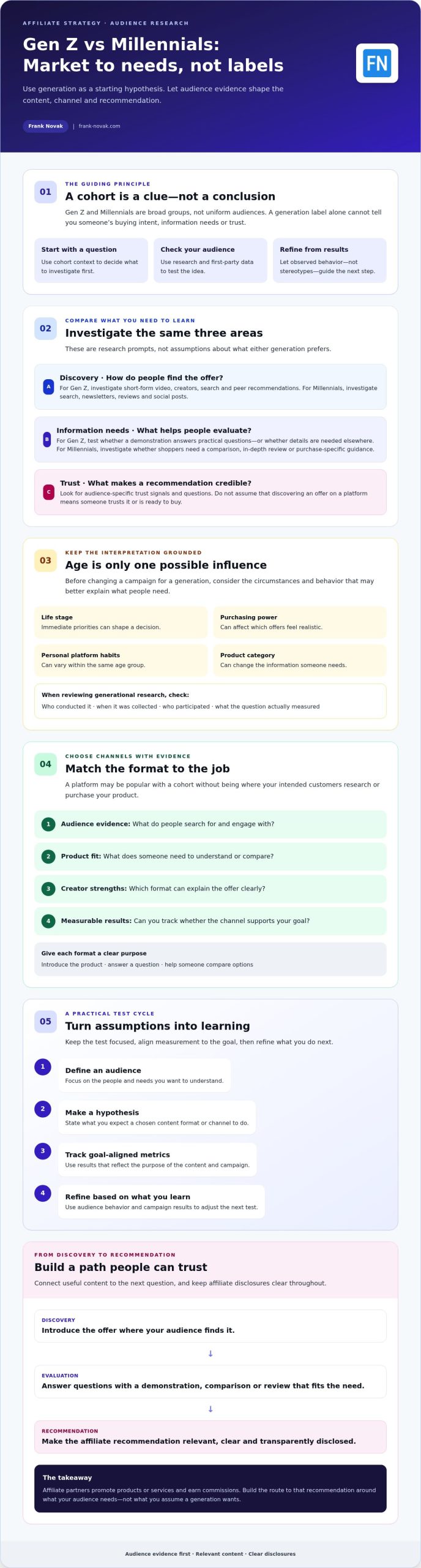
Gen Z vs. Millennials in Affiliate Marketing: Compare Needs, Discovery, and Trust
Rather than assigning each generation a preferred channel, compare the questions you need to answer about your specific buyers. This keeps affiliate marketing for different generations (Gen Z vs Millennials) grounded in evidence. A platform may be popular with a cohort without being where your intended customers research or purchase your type of product.
| Research area | Questions to investigate for Gen Z | Questions to investigate for Millennials |
|---|---|---|
| Discovery | Do short-form videos, creators, search, or peer recommendations introduce the offer? | Do search, newsletters, reviews, or social posts bring people to the offer? |
| Information needs | Does a demonstration answer practical questions, or do shoppers want details elsewhere? | Do shoppers need a comparison, in-depth review, or guidance suited to the purchase? |
| Trust signals | Do clear disclosures, firsthand product demonstrations, or community discussion help build confidence? | Do transparent reviews, relevant experience, or clear evidence help people assess the recommendation? |
| Purchase context | Are people browsing, actively comparing, or ready to buy when they encounter the content? | Does the decision involve a considered purchase, a recurring need, or a specific life-stage priority? |
How might Gen Z discover and evaluate affiliate recommendations?
Treat short-form video, creator content, search, and peer recommendations as test options, not established preferences for every Gen Z buyer. The linked Gen Z consumer behavior study can offer research context, but check its methods, sample, and scope before applying its findings to your niche. For a product that’s hard to understand from a description, test a demonstration. For a higher-consideration decision, see whether transparent detail or community discussion better supports evaluation.
How might Millennials discover and evaluate affiliate recommendations?
Search, newsletters, reviews, and social content can each play a different role in a buyer’s journey. Don’t assume one Millennial profile: life stage and purchase complexity may affect whether someone wants a quick overview or a detailed comparison. Compare results across formats, including qualified clicks, subscriptions, and conversions, rather than treating engagement alone as proof of purchase intent.
Audience behavior matters more than cohort labels because observed needs and actions show which content helps the intended buyer move toward a decision. Record what each format is meant to do, then assess results within your niche before shifting budget or effort. If you’d like support applying audience research to your digital business, explore online success coaching.
Which Affiliate Channels and Content Should You Test for Each Audience?
Choose channels by asking whether they can reach the intended audience, support the product decision, and give you useful results to measure. A platform’s popularity alone doesn’t show that it will bring qualified visitors to your offer. In affiliate marketing for different generations (Gen Z vs Millennials), treat channel choices as testable hypotheses, not rules attached to age groups.
Match content format to the audience’s decision process
Start with the questions a prospective buyer needs answered. A demonstration can show how something works; an explainer can make an unfamiliar idea easier to grasp; a review can weigh benefits and drawbacks; and a personal story can add useful context when it’s based on genuine experience. Match the format to the decision, not a generational stereotype.
Complex or high-consideration purchases may call for detailed evidence regardless of the buyer’s age. A short video might introduce a product, while a thorough review or comparison helps someone assess whether it fits their needs. Creators should also choose formats they can sustain and present authentically. Clear, useful content in a maintainable format is more valuable than rushed videos that don’t answer the audience’s questions.
Choose platforms using evidence instead of assumptions
Before prioritizing a platform, check current audience research and your own analytics. Look for evidence that your intended buyers are present, then consider whether organic reach, paid promotion policies, and your production capacity make the channel practical. No platform belongs exclusively to one generation, and high reach doesn’t guarantee buyer intent.
Compare channels using the same purpose and measurement where possible. For example, assess whether each brings qualified clicks or leads, rather than comparing one channel’s views with another’s conversions. Then test one variable at a time, such as the content format, message, or call to action. If you change all three together, it becomes harder to tell what influenced the result.
- Audience evidence: Does research or analytics show that the intended buyers use this channel?
- Product fit: Can the format answer the questions people have before choosing?
- Creator fit: Can the creator make this content credibly and consistently?
- Measurement: Can you track the action that matters to the campaign?
Use the results to guide your next test, not to declare one generation loyal to a channel. For a practical framework for evaluating traffic sources, see the strategic traffic generation guide.
How to Build and Measure a Generational Affiliate Marketing Test
A useful test turns an audience assumption into a question you can answer. For affiliate marketing for different generations (Gen Z vs Millennials), use a repeatable cycle: define the audience, form a hypothesis, test it, measure the outcome, and refine your approach. For example, ask whether a product demonstration brings more qualified clicks than a written review for a clearly defined audience segment.
How to create a fair comparison between audience segments
Keep the offer, landing page, and measurement period consistent where practical. If you’re comparing formats, change the format while holding the other elements steady. If the offer or landing page also changes, you won’t know which difference influenced the result.
Write down how you defined each segment and what signals support that definition. Don’t infer someone’s age from interests, browsing behavior, or a platform they use. Use only audience data you’re permitted to collect, and check applicable platform rules and data-handling requirements before tracking or comparing people.
Which results should change your affiliate strategy?
Choose metrics that match the test’s purpose. If the goal is to attract likely buyers, look at qualified clicks. If you’re building an email audience, assess sign-ups; if you’re evaluating offer performance, track conversions. Views and likes can help explain how content is being received, but they don’t prove that it’s bringing the intended audience closer to a decision.
Interpret early results carefully. Small samples can make a handful of actions look like a meaningful difference, while changes in timing, promotion, or audience mix can affect performance. There’s no universal observation threshold that guarantees a reliable conclusion. Record the conditions around the test, gather enough relevant observations to make a cautious comparison, and repeat or refine the test when the evidence is unclear.
Qualified clicks, sign-ups, and conversions show how defined audience segments respond under comparable campaign conditions, giving you a stronger basis for optimization than generational assumptions alone.
For additional ideas on connecting traffic to a structured follow-up journey, read the automated marketing funnel guide.
Turn Gen Z and Millennial Insights into a Trustworthy Affiliate Funnel
Audience research becomes useful when it shapes a clear path from discovery to a decision. Whether someone finds your content through search, a creator post, or a recommendation, the next steps should connect naturally: helpful information, an offer that fits the reader’s needs, and follow-up that answers remaining questions. In affiliate marketing for different generations (Gen Z vs Millennials), the funnel should respond to observed interests and actions, not assumptions about age.
Use audience insight to make recommendations more relevant
Start with the problem your audience is trying to solve. Explain who may benefit from the recommended product, why it could be a fit, and what limitations or alternatives readers should consider. If you’ve used the product, distinguish your personal experience from facts you’ve independently verified. That gives readers useful context without asking them to take a recommendation on faith.
Be clear about affiliate relationships. The Federal Trade Commission’s endorsement guidance explains how endorsements and material connections should be handled. Review applicable guidance and platform rules, and make disclosures easy to notice near the recommendation. A clear statement that you may earn a commission helps readers understand the relationship.
Keep your voice natural. You don’t need to adopt slang or imitate a generation to make content feel relevant. Use first-party responses, such as subscriber questions, feedback on content, and actions in your funnel, to learn what people need clarified. If readers repeatedly ask about setup, for example, add useful setup information rather than changing your tone based on a cohort label.
Choose a practical next step for sustainable affiliate growth
A useful funnel isn’t simply a chain of links. Each step should give the audience a reason to continue: discovery content introduces a relevant problem, a deeper resource helps evaluate potential solutions, and follow-up provides additional context without pressure. Review responses over time, then adjust the message or content where evidence points to a real information gap.
If a ClickBank offer fits your niche and audience, consider whether a related resource or automated process supports that journey. Frank Novak’s ClickBank Super Funnel is one resource to explore as you consider your funnel approach. The right choice depends on your offer and how your audience makes decisions; no funnel structure guarantees results. Keep testing, disclose clearly, and let real audience feedback guide refinements.
If you’d like tailored guidance as you apply audience research to your digital business, explore online success coaching.
Build Your Next Campaign Around What You Learn
Generational labels can help you decide what to investigate, but they can’t tell you what every person will trust, click, or buy. Strong affiliate marketing for different generations (Gen Z vs Millennials) starts with audience questions, then uses real behavior to shape the channel, content, and recommendation.
Keep your tests focused: define the audience, change one element at a time, and measure outcomes that match your goal. As you learn, use those insights to make each step from discovery to affiliate offer more relevant and transparent. Clear disclosures and helpful information support trust across age groups.
Frank Novak focuses on affiliate marketing and business automation. Online Success Coaching is available for entrepreneurs who want guidance applying these ideas to their digital business.
You don’t need to get every decision right on the first try. Start with a useful question, learn from your audience, and let the evidence guide what you improve next.
Frequently Asked Questions
Is affiliate marketing different for Gen Z and Millennials?
Affiliate marketing can call for different approaches when audience needs, discovery habits, or buying context differ, but generation alone doesn’t prove what will work. Use affiliate marketing for different generations (Gen Z vs Millennials) as a research question: check how people find information, what they need to evaluate an offer, and which content helps them take the next step. Then adapt based on observed behavior, not assumptions about age.
How do Gen Z and Millennials respond to affiliate marketing?
Responses vary among individuals in both generations, so there’s no single pattern to rely on. One person may value a quick demonstration, while another wants a detailed review, regardless of cohort. Assess whether your content answers the audience’s questions, whether the recommendation feels relevant, and whether people take meaningful actions such as clicking through or converting. Treat platform and format preferences as hypotheses until your own research supports them.
Which social media platform is best for Gen Z affiliate marketing?
There isn’t one platform that’s best for every Gen Z audience or offer. Start by checking current platform research and your own analytics to see where your intended buyers discover relevant content. Then consider whether the platform’s formats suit your product and whether you can create useful content consistently. Test a focused campaign and compare qualified clicks or conversions, rather than choosing a platform based on popularity alone.
Can the same affiliate content work for Gen Z and Millennials?
Yes, if it addresses a shared need and gives both audiences enough information to assess the offer. A useful review, for example, can explain who a product suits, how it works, and what to consider before buying. You may find that different audiences need distinct introductions, examples, or follow-up content. Test those elements and keep what helps people understand the recommendation, rather than rebuilding content based only on generational labels.
What matters more in affiliate marketing: generation or buyer intent?
Buyer intent is usually more useful for deciding what to say next because it indicates where someone is in the decision process. A person exploring options may need a clear introduction, while someone comparing products may want detailed evidence. Generation can help you form questions to investigate, but it doesn’t confirm intent. Use search behavior, content interactions, and campaign results to understand what people need at each stage.
How can I avoid stereotyping generations in affiliate marketing?
Build audience segments around relevant needs and behaviors, not assumptions about personality or preferred platforms. Ask what problem people are solving, review the questions they submit, and analyze how they respond to different content. If you use generational research, check its source, date, sample, and scope before applying it to your niche. Treat any broad finding as a starting point, then validate it with first-party feedback and campaign evidence.
Do affiliate marketers need different funnels for Gen Z and Millennials?
Not necessarily. A clear path from useful content to a relevant offer and helpful follow-up can serve people across age groups. Adapt parts of the funnel only when evidence shows that an audience segment needs different information, content, or pacing. For example, test whether one group responds better to a demonstration before a detailed review. Keep recommendations relevant and disclose affiliate relationships clearly, whatever funnel structure you use.

Article by
Frank Novak
Frank Novak is an online marketing professional and coach who focuses on affiliate marketing and business automation. Through his website, frank-novak.com, he shares insights and strategies for leveraging social media platforms like Facebook to generate traffic and commissions.
Affiliate / Sponsored Content Disclaimer
This [website/post] contains affiliate links. If you click through and make a purchase, we may receive a commission at no additional cost to you. We only recommend products or services we believe will add value to our readers.