
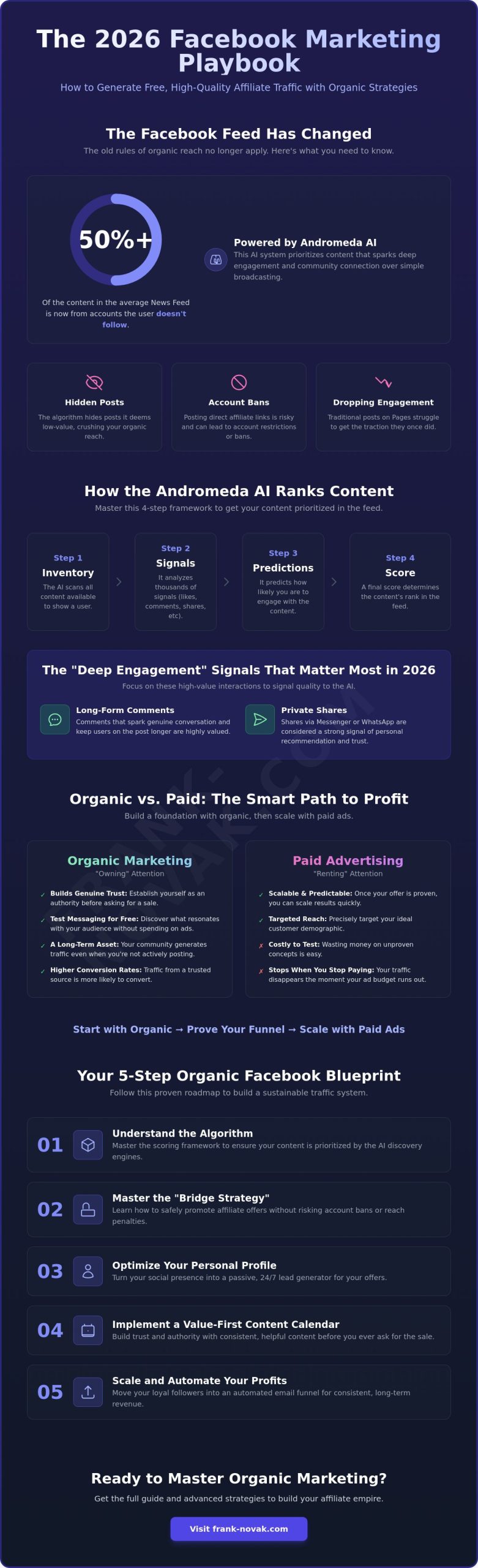
Did you know that over 50% of the content in the average Facebook News Feed now comes from accounts the user doesn’t even follow? This shift, driven by the Andromeda AI system, means that the old rules of organic Facebook marketing have been completely rewritten. If you’ve felt the frustration of the algorithm hiding your posts or the constant worry that a single affiliate link might get your account banned, you aren’t alone. It’s a common struggle for affiliates who see their Page engagement dropping while trying to find a reliable way to promote their offers.
The good news is that these changes actually provide a massive opportunity for those who know how to work with the system rather than against it. In this guide, you’ll learn how to generate a consistent, daily flow of high-quality traffic for your affiliate offers without spending a dime on paid advertising. We’ll explore how to leverage “deep engagement” signals like Messenger shares and how to use the latest 2026 partnership tools to promote ClickBank products safely. This roadmap will guide you through building a value-driven ecosystem that feeds your sales funnel automatically and builds lasting trust with your audience.
Key Takeaways
- Understand the 2026 algorithm’s scoring framework to ensure your content is prioritized by the latest AI discovery engines.
- Master the “Bridge Strategy” to safely promote affiliate offers without risking account bans or reach penalties.
- Learn how to optimize your personal profile for passive discovery, turning your social presence into a 24/7 lead generator.
- Implement a value-first content calendar that uses organic Facebook marketing to build trust before you ever ask for a sale.
- Discover how to scale your efforts by moving followers into an automated email funnel for consistent, long-term profits.
What is Organic Facebook Marketing and Why Does It Matter in 2026?
Organic Facebook marketing is the practice of building an audience and generating traffic through authentic engagement instead of paying for ad space. While paid ads allow you to “rent” attention, organic strategies focus on “owning” it by creating a value-driven ecosystem. For many new entrepreneurs, this represents a fundamental trade-off between cost and time. If you don’t have a massive advertising budget, your time becomes the currency you invest to build a sustainable foundation. By 2026, the rollout of the Andromeda AI system changed the game by shifting focus toward creative content and deep engagement signals. Facebook now favors creators who facilitate real conversations and community connections over those who simply broadcast marketing messages.
To better understand how these dynamics play out in modern monetization, watch this helpful video:
To grasp how this works, it’s helpful to look at how organic search results function in other digital spaces. Just as a search engine rewards relevance and quality, Facebook’s AI now prioritizes content that sparks meaningful interaction. One of the most effective ways to leverage this is by using your personal profile as a professional landing page. By optimizing your profile for discovery, you create a space where potential leads can learn about your expertise and affiliate offers without feeling like they’re being sold to.
The Benefits of Going Organic First
Starting with an organic approach allows you to build genuine trust before you ever ask for a sale. When you provide consistent value, you establish yourself as a helpful guide rather than just another salesperson. This phase is also perfect for testing your messaging. You can see which “hooks” resonate with your audience for free, which saves you from wasting money on unproven concepts later. Over time, your organic presence becomes a long-term asset. Unlike an ad that stops working the moment you stop paying, a well-built community continues to generate traffic even when you aren’t actively posting.
Organic vs. Paid: Choosing Your Path
Organic traffic often converts at a much higher rate because you’ve already established a rapport with the reader. They aren’t clicking on a random ad; they’re following a recommendation from someone they trust. This makes organic social a vital component of a strategic traffic generation plan. Once you’ve proven that your funnel works and your messaging converts, you can then choose to scale with paid ads. This transition ensures that every dollar you eventually spend on advertising is backed by data from your successful organic efforts. To understand exactly how to navigate that next step, our paid traffic for affiliate marketing comparison guide breaks down the top platforms and strategies for 2026.
How the Facebook Algorithm Works for Affiliates Today
Understanding the internal mechanics of the platform is the first step toward consistent traffic. The algorithm operates on a specific framework: Inventory, Signals, Predictions, and Score. First, it looks at the available content (Inventory). Then, it examines “Signals” like who posted it and how people interacted. Based on these, it makes “Predictions” about whether a user will find the post valuable. Finally, it assigns a “Score” that determines where the post appears in the feed. If you want to master organic Facebook marketing, you must focus on providing the right signals to the Andromeda AI system.
One of the biggest hurdles for affiliates is the “reach tax” on external links. Facebook wants to keep users on its platform, so it often penalizes posts that lead people away to outside websites. While organic reach has been declining for years, you can bypass this penalty by focusing on dwell time and deep engagement. Instead of dropping a link in the main post, focus on sparking a conversation that keeps people on the page longer. High-quality signals in 2026 include long-form comments and private shares via Messenger or WhatsApp, which the algorithm now values more than simple likes.
Engagement Bait vs. Genuine Conversation
In the past, you might have seen posts asking you to “Comment YES” to receive a guide. By 2026, the algorithm has become sophisticated enough to throttle the reach of any content using these “engagement bait” tactics. To get better results, try asking “open-loop” questions. These are inquiries that require a thoughtful, multi-sentence response rather than a one-word answer. If you can encourage a meaningful discussion, the algorithm will view your content as high-value. It’s also helpful to reply to every comment within the first 60 minutes. This early activity signals to the AI that your post is generating active interest, which can trigger a wider distribution.
The Power of Facebook Reels and Live
If you are looking to reach people who don’t follow you yet, Reels are your best friend. With over 200 billion plays per day across the Meta ecosystem, short-form video is the primary driver of discovery. You can create “educational loops” in your Reels, where you provide a quick tip and then invite viewers to visit your profile for the full story. This approach is a cornerstone of modern organic Facebook marketing because it leverages the AI’s preference for native video content. For those looking to build deeper trust, Facebook Live is an incredible tool. It allows you to connect with your audience in real-time, making it easier to introduce high-level concepts like Online Success Coaching. This personal connection is often what turns a casual viewer into a dedicated lead.
The Bridge Strategy: How to Promote Affiliate Links Safely
If you’ve ever felt the sting of a restricted account, you know how vital it is to stay in Facebook’s good graces. The number one question most affiliates ask is whether Facebook will ban them for posting affiliate links. The short answer is that while the platform isn’t inherently against affiliate marketing, its automated systems are highly sensitive to “spammy” behavior. If you drop raw ClickBank links directly into your posts, you’re essentially asking for a reach penalty or a permanent ban. To succeed in organic Facebook marketing, you must adopt the “Bridge Strategy.” This approach involves sending traffic to a middle page that you own, rather than sending it straight to a vendor’s sales page.
In 2026, the most effective way to share these links is through a “link in bio” or by placing the URL in the first comment of your post. This helps you avoid the reach penalty that occurs when the algorithm detects an external link in the main post body. Understanding the nuances between paid and organic content is helpful here, as organic posts are held to a much higher standard of “community value.” By using a bridge page, you provide that value first. This keeps your account safe and allows you to capture lead information before the visitor ever sees the affiliate offer.
Building Your Organic Lead Magnet
Instead of trying to sell a product immediately, focus on offering a free resource like a PDF guide or a checklist. This is what we call a lead magnet. You can use “Hand-Raiser” posts to identify hot leads. These are simple text or image posts where you describe a specific problem and ask people to comment if they want your free solution. Once they comment, you can move them into an automated marketing funnel. This process turns a casual social interaction into a structured business asset that works for you even when you’re offline.
Messenger Marketing: The Secret Conversion Engine
Messenger has become the ultimate “safe zone” for link sharing in 2026. When someone interacts with your post, moving the conversation to a private Direct Message (DM) creates a high-trust environment. Use the “Two-Step” method: wait for them to express interest publicly, then send a message asking if they’d like the link. When you script these messages, make sure you don’t sound like a bot. Keep your tone helpful and personal. If you treat Messenger as a place to solve problems rather than just a place to pitch, your conversion rates will naturally climb. This personal touch is a cornerstone of effective organic Facebook marketing because it builds the rapport needed for high-ticket sales.
Your 5-Step Organic Facebook Marketing Blueprint
Transitioning from understanding the algorithm to generating actual leads requires a structured daily workflow. While many affiliates struggle with inconsistent results, a methodical approach ensures you aren’t just posting into the void. This blueprint focuses on turning your daily activity into a predictable engine for growth. By following these five steps, you can transform your presence into a professional resource that attracts high-quality leads through organic Facebook marketing.
Optimizing Your Profile for Conversions
In 2026, your personal profile acts as your digital storefront. To optimize for passive discovery, your bio must clearly state who you help, what problem you solve, and how you do it. This five-second elevator pitch tells visitors exactly why they should follow you. Additionally, use your Featured Photo section as a visual call-to-action. By cleaning up your timeline to remove off-brand or personal clutter, you ensure that anyone who clicks your name sees a professional coach rather than a hobbyist.
The “Value-First” Content Strategy
Content is the fuel for your organic Facebook marketing efforts, but it must be balanced correctly. You should focus on three pillars: educational posts that teach a skill, social proof that shows results, and lifestyle content that builds trust. This approach relies on the 80/20 rule, which dictates that 80% of your posts should provide pure value through education or inspiration, while only 20% should include a direct call to action. When you use storytelling to describe how a product solved a specific problem, the transition to an affiliate offer feels like a natural recommendation rather than a sales pitch.
Winning in Facebook Groups
Groups remain the best place to find high-intent audiences who are already asking the questions your affiliate products answer. Instead of dropping links, use the “Helper” method. By providing detailed, thoughtful answers to community questions, you build authority. When people find your advice useful, they naturally click on your profile to learn more, which triggers the passive discovery you’ve already set up. To get the most out of this approach, it’s worth developing a dedicated Facebook group marketing strategy that turns these communities into a consistent source of leads and commissions. If you want to see exactly how this blueprint fits into a proven system, you can explore the ClickBank Super Funnel to streamline your results.
The final two steps involve “priming the pump” and analyzing your data. Before you post anything, spend twenty minutes engaging with other people’s content. This “Engagement Hour” signals to the AI that you’re an active community member, which can boost the initial reach of your own post. Finally, track your results by looking at which posts generated the most Messenger shares or private inquiries. If you notice a specific topic resonating, iterate on that theme to keep your lead flow consistent and growing.
Scaling Your Success: From Organic Reach to Automated Profits
If you’ve been following the blueprint provided in the previous sections, you’re likely seeing the first signs of life in your feed. It’s helpful to think of your initial efforts in organic Facebook marketing as a starter motor. It gets the gears turning and proves your concept, but it isn’t designed to carry the full weight of a growing business on its own. To reach a level where your income doesn’t depend entirely on your daily active posting, you must eventually transition from manual labor to an automated engine. This means moving your audience off the platform and into a system you control.
While Facebook is an incredible discovery tool, you don’t own your followers there. If the algorithm changes or your account faces a temporary restriction, your traffic could disappear overnight. By moving your audience onto an email list, you secure a long-term asset that allows for consistent monetization. This shift is what separates hobbyists from professional affiliates. Once you have a lead’s email address, you can continue to provide value and recommend products without worrying about whether a specific post will be shown in their News Feed.
Why Most People Fail at Organic Marketing
Many beginners drop out because they hit a consistency gap. It often takes the first 30 days of regular, high-quality posting before the Andromeda AI fully categorizes your profile and starts recommending your content to the right people. During this initial phase, it’s easy to fall into the trap of “Vanity Metrics.” You might feel discouraged by a low like count, but you should remember that 10 high-quality leads in your Messenger inbox are far more valuable than 1,000 likes from people who never buy. To avoid the common Never Succeed Online pitfalls, you must stay focused on lead generation rather than chasing viral fame.
Next Steps: Automating Your Lead Flow
Once you’ve proven that your messaging resonates with your audience, the logical next step is to implement the ClickBank Super Funnel. This system is designed to take the traffic you generate through your organic Facebook marketing and guide it through a structured path toward a sale. It removes the manual burden of constant pitching and ensures that every new lead is nurtured properly. As your results grow, your own organic wins become the perfect case studies for your brand. When you’re ready to amplify those results further, exploring paid traffic for affiliate marketing is the natural progression to scale your commissions predictably.
If you find that you’ve mastered the basics and are ready for a higher level of growth, you might consider transitioning into Online Success Coaching. Using your own journey as a roadmap allows you to mentor others while building a business that feels personal and sustainable. Starting your organic journey today might feel like a small step, but by building these blocks one by one, you’re creating a professional landscape that will support you for years to come.
Building Your Sustainable Affiliate Future
Success in the modern digital landscape requires a blend of community building and smart technical strategies. By mastering the Andromeda AI’s preference for deep engagement and protecting your links with the Bridge Strategy, you’ve already moved ahead of the average marketer. These pillars of organic Facebook marketing are the foundation for a business that doesn’t rely on expensive ad budgets. While the journey starts with a single post, the ultimate goal is a system that works while you sleep.
As the founder of the ClickBank Profit Club and a specialist in automated lead generation systems with over 5 years of digital business scaling expertise, I’ve seen how these steps transform lives. Transitioning from a daily workflow to a scalable engine is the final step in your journey. If you’re ready to move beyond manual effort and start building a long-term asset, the right tools are within your reach. You don’t have to navigate this landscape alone when a proven roadmap is available.
Ready to turn your Facebook traffic into a commission machine? Explore the ClickBank Super Funnel today!
You have everything you need to start making an impact. Take that first step today and watch your community grow.
Frequently Asked Questions
Is organic Facebook marketing still effective in 2026?
Yes, it’s highly effective because the Andromeda AI now prioritizes content quality over follower counts. Since over 50% of news feed content comes from accounts users don’t follow, your potential for discovery is higher than ever. If you focus on creating native, high-intent content, you can tap into this massive discovery engine even if you’re starting with zero followers.
How often should I post on Facebook for the best organic reach?
You should aim for 3 to 5 high-quality posts per week. The 2026 algorithm evaluates your brand based on your last 9 to 12 posts to determine who should see your content. If you post daily but with low-effort material, you risk confusing the AI and diluting your reach; consistency in theme is far more important than high frequency.
Can I get banned for posting affiliate links on my Facebook profile?
You can certainly face penalties or bans if you post direct affiliate links to sales pages or ClickBank offers. To stay safe, you should always use a bridge page or leverage the official Facebook Affiliate Partnerships program for branded content. This approach keeps you in compliance with Meta’s policies while building a professional reputation that the algorithm trusts.
What is the best type of content for Facebook organic reach?
Reels are currently the most powerful format for reaching new people. The algorithm specifically looks for high completion rates and “deep engagement” signals, such as shares to Messenger or WhatsApp. If you produce short-form vertical videos that solve a specific problem, you’ll see significantly more reach than you would through standard text or image posts.
How do I get people to join my email list from a Facebook post?
The most effective method is using a “Hand-Raiser” post to offer a free resource like a checklist or guide. Instead of posting a link publicly, ask people to comment if they want the resource. Once they reply, you can move the conversation to Messenger and provide the link to your capture page, which helps you build your list safely while increasing your post’s engagement score.
Do I need a Facebook Business Page or a Personal Profile for affiliate marketing?
While Business Pages are necessary for running ads, Personal Profiles and Groups are often better for organic Facebook marketing. The average reach for a Group post is between 20% and 40%, whereas the median reach for a Page is only 2.2%. Using an optimized profile allows you to build the personal rapport that is essential for coaching and high-ticket affiliate sales.
How long does it take to see results from organic Facebook marketing?
It generally takes about 30 days of consistent activity to see a steady flow of leads from organic Facebook marketing. This period allows the AI to learn your content themes and identify your ideal audience. If you stay patient and focus on meaningful social interactions rather than vanity metrics like likes, you’ll build a much more sustainable business foundation.

Article by
Frank Novak
Frank Novak is an online marketing professional and coach who focuses on affiliate marketing and business automation. Through his website, frank-novak.com, he shares insights and strategies for leveraging social media platforms like Facebook to generate traffic and commissions.
Affiliate / Sponsored Content Disclaimer
This [website/post] contains affiliate links. If you click through and make a purchase, we may receive a commission at no additional cost to you. We only recommend products or services we believe will add value to our readers.