

What if the value of a solo ad isn’t the number of clicks you buy, but what those clicks teach you about your audience and funnel? If you’re considering solo ads for list building and affiliate sales, it’s reasonable to wonder whether a vendor’s subscribers are genuine, interested in your niche, and likely to engage beyond the opt-in. Click volume alone can’t answer those questions, and it can’t guarantee affiliate commissions.
A more useful approach is to treat paid email traffic as a measured test. This guide will show you how to vet and compare vendors, create a relevant landing page that turns interested visitors into permission-based subscribers, and connect tracking across the path from click to affiliate conversion. You’ll also learn how to set clear test measures, so you can assess lead quality and follow-up engagement rather than judging a campaign by the first sale alone. With a practical process, you can make more informed decisions about whether a vendor and funnel deserve another test.
Key Takeaways
- Assess a solo ad vendor’s audience, niche fit, traffic sourcing, placement, and reporting before committing to a test.
- Use solo ads for list building and affiliate sales as a measurable audience test, not a shortcut to guaranteed commissions.
- Build a relevant opt-in path that connects the vendor’s email to your landing page, subscriber follow-up, and affiliate offer.
- Track each stage of the campaign so you can judge lead quality and downstream outcomes, not just click volume.
- Compare solo ads with organic and other paid traffic based on your goals, resources, timeline, and how well each source fits your offer.
What Are Solo Ads, and How Can They Support List Building and Affiliate Sales?
A solo ad is a paid email promotion in which a vendor sends your offer to people on their email list. You’re paying for access to a placement, not buying the list or gaining control of the vendor’s subscribers. That distinction matters: your opportunity to build an audience of your own begins only if a reader chooses to visit your page and sign up.
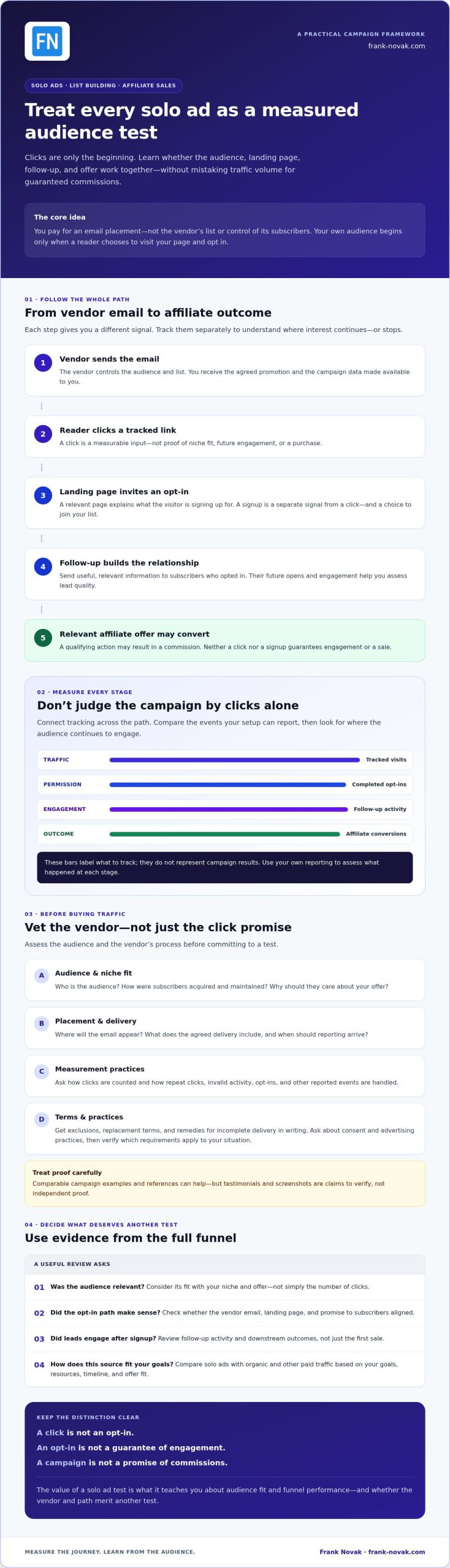
The path is straightforward, but every step matters: a vendor sends the email, a reader clicks a tracked link, and your landing page invites them to opt in. You can then follow up with useful information and, where relevant, an affiliate offer. In affiliate marketing, a commission may result from a qualifying action, but neither a click nor a signup guarantees engagement or a sale.
For a practical overview of solo ads in affiliate marketing, watch this video:
What happens during a solo ad campaign?
You provide the vendor with the offer and the email copy or other placement details agreed for the campaign. The vendor sends the message to their audience, while your tracking link directs readers to a destination page, usually an opt-in page. From there, tracking can help distinguish visits, completed signups, follow-up activity, and affiliate conversions, depending on the tools and setup you use.
The vendor controls the email audience and its list. You receive the agreed promotion and the campaign data made available to you, not direct access to those subscribers. A click is a measurable input; an opt-in is another. Whether a subscriber opens future emails, trusts the offer, or makes a purchase remains uncertain.
Why use solo ads for an affiliate email list?
Solo ads can introduce an offer to an existing audience without requiring you to first build the same reach through organic content. The advantage depends on relevance: readers interested in the vendor’s topic should have a clear reason to care about your landing page and follow-up.
If a visitor understands what they’re signing up for and chooses to join your list, you can continue the relationship with relevant emails. That permission is separate from the vendor’s relationship with their subscribers. For example, someone interested in affiliate marketing may be more receptive to a related resource than an unrelated product. A focused offer and helpful follow-up can support that match, but funnel quality and audience fit matter more than raw click volume. In short, solo ads for list building and affiliate sales are best treated as a test of the whole path, not a promise of commissions.
How to Vet Solo Ad Vendors Before You Buy Traffic
A vendor’s click promise tells you little unless you know who is likely to click, how the audience was built, and what happens if delivery falls short. Before buying traffic for solo ads for list building and affiliate sales, assess audience relevance and the vendor’s process, not just the size of the package or the strength of a sales claim.
Questions to ask a solo ad provider
Ask for a clear description of the audience, how its subscribers were acquired and maintained, and how the vendor decides whether they fit your offer. A list of people interested in online business, for example, may be a closer match for an affiliate marketing resource than a broad audience with no clear connection to it. Request examples from comparable campaigns or references, but treat testimonials and screenshots as claims to verify, not independent proof.
- Placement and delivery: Where will the email appear, what does the agreed delivery include, and when should you expect reporting?
- Measurement: How are clicks counted? Ask how repeat clicks, invalid activity, opt-ins, and other reported events are handled.
- Terms: Get any exclusions, replacement terms, and remedies for incomplete delivery in writing before you pay.
- Practices: Ask what consent and advertising practices the provider follows. Review the FTC guidelines on advertising for U.S. context, then independently verify which privacy, consent, and advertising requirements apply to your situation.
Clear answers help you compare vendors on consistent criteria. If a provider can’t explain how its audience matches your offer or how the campaign is measured, you won’t have a reliable basis for evaluating the results.
Warning signs when evaluating traffic quality
Be cautious if the audience description is vague, reporting is unclear, or you’re pressured to buy a larger package before you can assess a smaller test. A provider should be able to explain its sourcing and delivery process without relying only on sales screenshots. Ask how the vendor distinguishes delivered clicks from meaningful visitor activity, and confirm what data you’ll receive to review the campaign.
Promises of specific commissions or effortless profit deserve particular skepticism. A vendor may control the email placement, but your landing page, offer, follow-up, and audience fit all affect what happens after a click. High click volume alone doesn’t prove genuine interest, subscriber engagement, or intent to buy.
Use the answers to decide whether a vendor is suitable for a controlled test, rather than treating testimonials or bold claims as a forecast. For more perspective on planning an affiliate business and evaluating traffic, explore Frank Novak’s online business guidance.
Are Solo Ads Worth It? Compare Traffic Quality, Funnel Fit, and Affiliate Outcomes
Solo ads can bring visitors to an offer quickly, but clicks and subscribers alone don’t show whether the campaign is profitable. To judge solo ads for list building and affiliate sales, follow the results beyond the opt-in: check whether subscribers engage and whether tracked affiliate actions follow. There’s no universal traffic source that works best for every offer. The right choice depends on audience fit, timeline, available resources, and how much control and measurement you need.
| Traffic source | Control | Setup | What to measure |
|---|---|---|---|
| Solo ads | You control your offer, landing page, and follow-up; the vendor controls the email audience and placement. | Prepare a relevant page, tracking links, and follow-up before the send. | Delivered clicks, opt-ins, email engagement, and tracked affiliate actions. |
| Organic content | You control the content and destination, while reach depends on discovery and audience response. | Requires useful content and ongoing publishing; traffic may build gradually. | Visits by content source, opt-ins, engagement, and affiliate actions over time. |
| Other paid traffic | Control varies by platform, including available audience targeting and ad placement. | Usually requires ad creative, campaign setup, and ongoing review. | Trackable visits, page response, subscriber activity, and affiliate actions by campaign. |
What should you measure beyond clicks and opt-ins?
Review results in stages. First, check delivery and click reporting. Next, assess the landing page response by comparing visits with completed opt-ins. Then review email engagement, such as opens or clicks where your reporting tools provide them. Finally, examine tracked affiliate actions, including conversions reported by the affiliate platform. Each stage helps locate friction: if clicks arrive but few people sign up, review page relevance; if subscribers join but don’t engage, revisit expectations and follow-up.
Use consistent campaign names and tracking links so you can distinguish one vendor, placement, or test from another. Attribution can still be incomplete. A person may click on one device and purchase on another, or encounter your content through multiple channels before acting. Treat reported conversions as useful evidence, not necessarily a complete record of every influence. For broader strategies for growth and ROI, connect traffic decisions to the full affiliate journey.
When might another traffic source be a better fit?
If you can invest in content and accept slower audience growth, organic traffic may help build a durable discovery path. Other paid channels may offer different targeting controls, but they also require suitable creative and careful campaign measurement. Solo ads may make sense if the vendor’s audience closely matches your offer and you can evaluate the entire funnel, not just the initial delivery. For a wider view of strategic affiliate traffic generation, weigh the channel against your goals and capacity before committing.
Compare like with like, and don’t rely on a universal opt-in or conversion benchmark. Your own audience, offer, and follow-up provide the context for deciding whether a source merits another test.
How to Run a Solo Ad Test and Improve the Follow-Up Funnel
A controlled test helps you learn whether the traffic, page, and follow-up work together. Before spending, define what you can afford to lose and write down the conditions you’ll test. That limit keeps an uncertain campaign from expanding before you have evidence to support the decision.
- Choose one audience and offer. Focus on a specific audience need and an affiliate offer that addresses it.
- Prepare a relevant opt-in page. In most cases, send visitors to a page that explains the signup and value clearly, rather than assuming a direct affiliate link is the right destination.
- Set up tracking. Use a distinct campaign identifier and links to connect vendor traffic with visits, signups, email engagement, and reported affiliate actions.
- Document the test. Record the vendor, placement, audience description, page version, offer, and your loss limit before ordering traffic.
- Review the results. Check delivery and page behavior before deciding whether the issue is the vendor, the page, or the offer.
- Decide what to change. Stop, adjust one meaningful variable, or cautiously test again based on your goals and evidence.
Prepare the opt-in page and email sequence
Keep the vendor email’s promise, landing-page message, signup incentive, and affiliate offer aligned around one audience need. Tell subscribers what they’ll receive and how often, and make it easy for them to manage their preferences. A welcome sequence can deliver the promised value first, set expectations, then introduce a relevant offer transparently. For more on connecting these steps, see this guide to building an automated marketing funnel.
Automation can help deliver a consistent sequence, but it can’t make an irrelevant offer useful or turn poor-fit traffic into an engaged audience. Make sure affiliate relationships are disclosed appropriately, and verify the requirements that apply to your situation.
Review the test and decide what to change
Start with delivery: did the vendor report the agreed activity, and do your tracking records show visits? Then check whether the page converts those visits into opt-ins. Review follow-up engagement and tracked affiliate actions against the goals and baseline you set before the test. If the page receives visits but few signups, inspect the message match before blaming the vendor. Change one meaningful variable at a time so the next test can teach you something.
For solo ads for list building and affiliate sales, the useful outcome of a test may be clearer evidence about audience fit and funnel performance, not an immediate commission. If the data is weak or tracking is incomplete, pause and investigate rather than scaling on click volume alone.
Turn Solo Ad Leads into a Measurable Affiliate Funnel
A reliable funnel connects each decision, from the audience you want to reach to the follow-up you send after signup. Before you order traffic, make sure the vendor’s audience aligns with your offer. Then check that the email placement leads to a relevant opt-in page, the signup sets clear expectations, and tracking lets you review what happens afterward.
This joined-up view helps you locate weak points. If visitors click but don’t sign up, investigate the page and message match. If subscribers join but don’t engage, review what they expected and what your emails deliver. If people engage but don’t take the tracked affiliate action, reassess the offer’s relevance and how you present it. Automation can make follow-up more consistent, but it can’t fix poor-fit traffic or an unsuitable offer.
Where a funnel resource may fit
If you’re considering a digital resource as part of your funnel planning, explore the ClickBank Super Funnel details. Review the current information to confirm its contents and intended use before deciding whether it fits your needs. It’s a resource to evaluate, not a source of solo ad traffic or a promise of affiliate sales.
For broader implementation context, focus on how each stage connects: the promise in the email, the signup experience, the subscriber’s expectations, and the follow-up. Any resource or process should support that plan rather than replace audience research and campaign measurement.
Choose a next step that matches your experience
If you’re new to email marketing, start with the essentials: choose a relevant audience, explain clearly what subscribers will receive, and track visits and signups. You don’t need to automate every step before you understand the basic path from click to opt-in.
If you’re already testing paid traffic, review your campaign records to identify the weakest stage before scaling. Compare the vendor and placement, landing-page response, email engagement, and tracked affiliate actions. If measurement is incomplete, improve the tracking before drawing firm conclusions. This gives you a more useful basis for deciding whether to stop, adjust, or run another controlled test.
Solo ads for list building and affiliate sales are easier to evaluate when you treat audience fit, follow-up, and measurement as one system. Take time to review your funnel approach first. If you want guidance as you consider your next steps, you can explore online success coaching, or continue researching and make a plan that fits your experience and goals.
Build Your Next Test with a Clearer Plan
Solo ads can be useful when the audience, offer, and follow-up fit together, but clicks alone can’t tell you whether the path is working. For solo ads for list building and affiliate sales, make your next decision from the full journey: review the vendor, assess the opt-in experience, and track subscriber engagement and affiliate actions before considering a larger test.
If you’re still shaping your approach, focus on the next practical step rather than trying to perfect everything at once. Frank Novak offers Online Success Coaching for digital business growth, and the ClickBank Super Funnel is a related digital resource. Review its current details before deciding whether it fits your needs, and don’t assume any resource can guarantee results.
Choose a small, measurable improvement you can evaluate, whether that means clarifying your signup promise or strengthening your tracking. A steady process will help you learn from each test and make more informed choices about traffic and follow-up.
With a clear plan and realistic expectations, you can move forward with greater confidence, one decision at a time.
Frequently Asked Questions
Are solo ads good for building an email list?
They can be useful for list building if the vendor’s audience matches your topic and your landing page gives visitors a clear reason to subscribe. The vendor’s list remains theirs, so your own email audience grows only when people choose to opt in to your list. Explain what subscribers will receive, then track signups and follow-up engagement to see whether the leads are relevant, not just numerous.
Can you make affiliate sales with solo ads?
Yes, affiliate sales are possible, but a solo ad doesn’t guarantee them. Results depend on whether the audience is interested in your offer, whether the landing page sets the right expectations, and whether your follow-up builds trust and introduces relevant products. For solo ads for list building and affiliate sales, track the journey from click through signup and later affiliate action instead of judging success by initial traffic alone.
How do I choose a reliable solo ad vendor?
Ask how the vendor built and maintains the audience, what topics subscribers respond to, and how the list fits your offer. Confirm the email placement, delivery terms, click-counting method, reporting, and any replacement conditions in writing. Request examples or references relevant to your niche, but treat testimonials and screenshots as claims to check. Be cautious if the audience is vaguely described or you’re pressured to buy a larger package.
How much should I spend on a solo ad test?
There isn’t one suitable test budget for everyone. Set a loss limit you can afford before ordering, based on your resources and what you need to learn, and confirm the vendor’s current terms and delivery details. Keep the test focused on one audience and offer. The aim is to gather enough useful information to evaluate delivery, opt-ins, engagement, and tracked affiliate actions, not to spend more in pursuit of a guaranteed return.
Should I send solo ad traffic directly to an affiliate link?
Usually, a relevant opt-in page is a better starting point than assuming a direct affiliate link will suit the campaign. The page lets you explain the value of signing up and set expectations before sending follow-up emails. A direct link may bypass that relationship-building step and give you less insight into subscriber behavior. Whichever destination you choose, make sure the email promise, page content, and offer are aligned.
What metrics matter when testing solo ads?
Review the campaign in stages: reported delivery and clicks, landing-page visits and opt-ins, email engagement, then tracked affiliate actions. Use distinct campaign links or identifiers so you can compare vendors and tests. Clicks and signups show activity, but they don’t establish engagement or profitability. Attribution can also be incomplete if someone switches devices or interacts with your offer through more than one channel, so interpret results with care.
Do solo ads guarantee affiliate commissions?
No. A vendor can arrange an email placement, but cannot guarantee that subscribers will engage, trust your offer, or buy through your affiliate link. Commission outcomes also depend on the offer, funnel experience, follow-up, and tracking. Be skeptical of claims promising specific commissions or effortless profit, and verify the terms of any campaign independently. Treat a test as a way to learn about traffic and funnel fit, not as assured income.

Article by
Frank Novak
Frank Novak is an online marketing professional and coach who focuses on affiliate marketing and business automation. Through his website, frank-novak.com, he shares insights and strategies for leveraging social media platforms like Facebook to generate traffic and commissions.
Affiliate / Sponsored Content Disclaimer
This [website/post] contains affiliate links. If you click through and make a purchase, we may receive a commission at no additional cost to you. We only recommend products or services we believe will add value to our readers.