

The launch window matters as much as the review. Launch jacking means creating timely, useful content about a product around its release, then including an affiliate link for readers who want to learn more or buy. A practical approach to using launch jacking for affiliate commissions starts with choosing a product you can assess honestly and preparing content that helps people decide whether it suits them.
A new release can be worth covering when interest is building, but timing alone won’t make a review useful. Readers need clear information, a fair assessment, and an easy way to find the offer if they’re interested. Original, helpful content adds more value than simply repeating the seller’s claims.
This guide explains how to research launches and products, select relevant keywords and images, prepare content for the launch period, and place affiliate links where readers can find them. You’ll also learn how to review offers fairly, support informed decisions, and give your affiliate promotion a clear structure.
Key Takeaways
- Assess a product’s quality, reputation, offer, refund policy, and customer support before deciding whether to promote it.
- Choose search terms that match what prospective buyers want to know, and use relevant images that support your original content.
- Prepare your review for the launch window, then make affiliate links easy to find without letting them replace useful guidance.
- Compare available launch listings and affiliate platforms to find products that fit your audience and promotion approach.
- Understand how commission terms work and focus on helping readers decide whether the product meets their needs.
Affiliate links, images, and keyword selection
To create launch-jacking content that can rank, match a specific search need with original, timely information about the product. Create affiliate links through the relevant platform, use its available tracking options, and review the reporting dashboard to understand clicks and conversions.
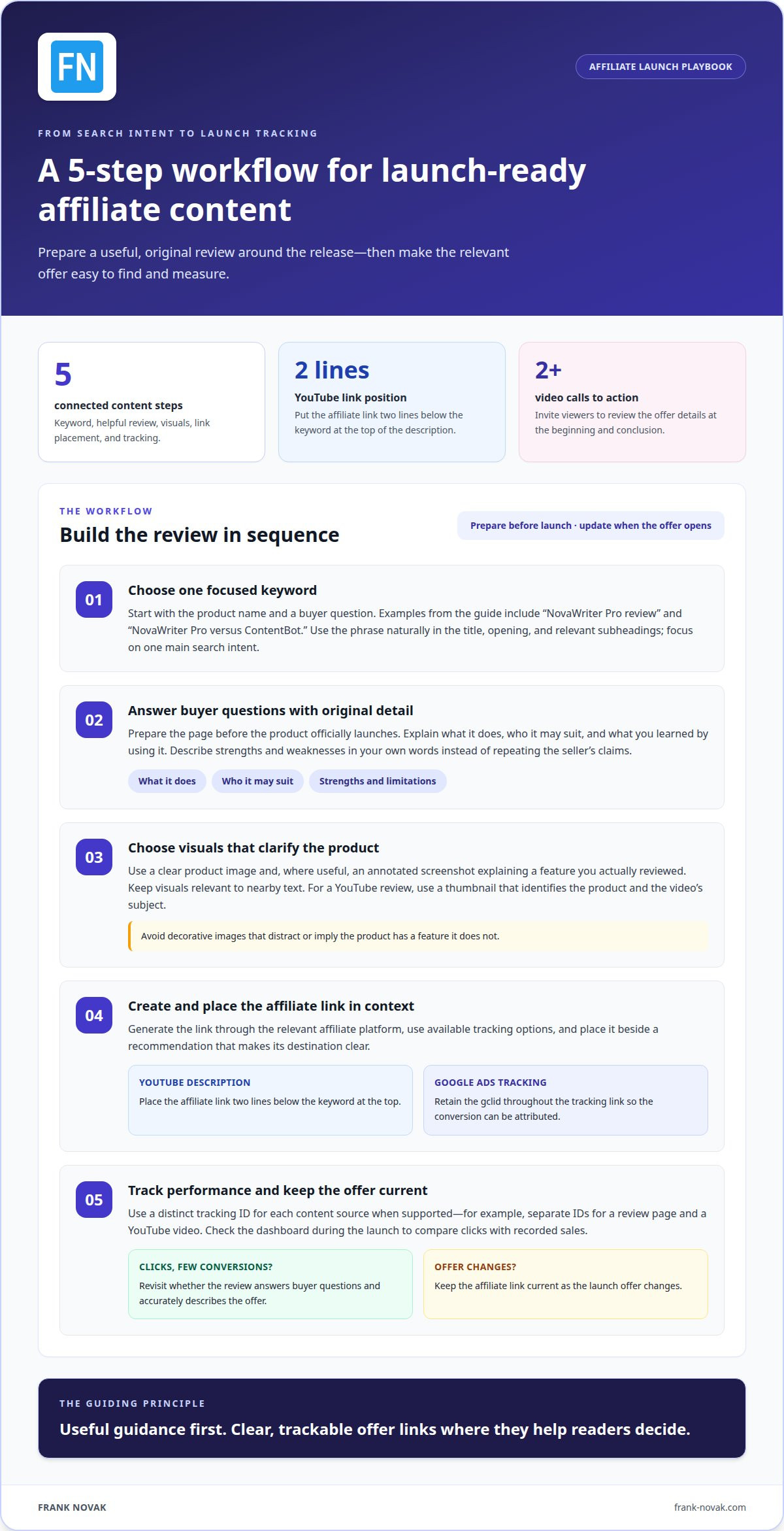
- Choose a focused keyword. Start with the product name and a question a potential buyer might ask. A review could target a phrase such as “NovaWriter Pro review,” while a comparison could address “NovaWriter Pro versus ContentBot.” Use the phrase naturally in the title, opening, and relevant subheadings. Focus the page on one main search intent instead of repeating keyword variations without adding useful information.
- Build content around buyer questions. Prepare the page before the product officially launches so it’s ready when the offer becomes available. Explain what the product does, who it may suit, and what you learned by using it. Describe its strengths and weaknesses instead of reworking the seller’s description. Original analysis gives search visitors a reason to read your review rather than another page repeating the same launch claims.
- Select relevant visuals. Choose a clear product image that helps readers recognize the offer, then add a useful visual, such as an annotated screenshot, if it explains a feature you’ve actually reviewed. Keep each visual relevant to the nearby text. Avoid decorative images that distract from the product or imply it has a feature it doesn’t. For a YouTube review, use a thumbnail that identifies the product and makes the video’s subject clear.
- Create and place the affiliate link. Generate a link through the affiliate platform for the specific product, then use its tracking options. Place the link beside a relevant recommendation and make its destination clear. For YouTube, put the affiliate link two lines below the keyword at the top of the video description. Include at least two calls to action in the review video, such as inviting viewers to read the offer details at the beginning and at the conclusion. If you’re promoting through Google Ads, retain the gclid throughout the tracking link so the conversion can be attributed.
- Track clicks and conversions. Use a distinct tracking ID for each content source when the platform supports it, such as separate IDs for a review page and a YouTube video. Check the reporting dashboard during the launch to compare clicks with recorded sales. If a page receives clicks but few conversions, revisit whether its review answers buyer questions and accurately describes the offer. Keep the affiliate link current as the launch offer changes.
Researching products, launches, and competitors
Research the offer, its launch timeline, and competing products before deciding what to promote. These checks help you find a useful angle and avoid endorsing an offer you can’t describe accurately.
-
Research Products and Launches
Start by reviewing the product itself, its sales offer, and the planned launch period. Launch timing can vary, and announcements may come before a product is available. Record the launch dates and key changes, such as a new offer or bonus, so your content is ready for the right moment. Read contest rules before joining any launch promotion, and avoid promising benefits the product page doesn’t support.
-
Assess Product Quality and Risks
Assess the product’s quality, reputation, customer support, sales offer, and refund policy before promoting it. Refunds and cancellations are typically handled within a 30-60-day window, while chargebacks can follow buyer dissatisfaction or disputed transactions. These outcomes can affect commission credit under a program’s terms. Don’t rely on launch claims alone; use the product where possible, note its limitations, and describe concerns clearly instead of treating a high commission as proof of quality.
- Compare competing offers. Identify products that solve the same problem, then compare their features, intended users, support, and sales terms. For example, if a launch promotes a planning tool, consider how alternatives handle templates, collaboration, or reporting. Use the comparison to explain the new product’s actual advantages, not to make unsupported claims that it’s better. A fair comparison helps readers understand which option fits their needs.
- Find a distinct review angle. Study competing reviews to see which buyer questions remain unanswered. If existing examples repeat the creator’s sales copy, add original detail: explain how a feature works, who benefits from it, or when a limitation matters. Don’t copy another affiliate’s structure or claims. A useful review earns attention through substance, while an accurate account protects your credibility if the offer changes during the launch.
- Match timing to your content plan. Prepare research and a draft before the product becomes available, then update the page when the launch opens. Keep the launch period in view, since a review published too late can miss the strongest audience interest. Revisit the offer and product details as they change. For a practical framework for online marketing decisions, explore online marketing guidance.
Affiliate link placement
Place each affiliate link where it supports the reader’s next decision, rather than interrupting useful information. Context helps readers understand why a link belongs in a review or launch update.
- Match the link to the page’s purpose. On a product review, place the affiliate link near the section that explains the offer and who may benefit. In a comparison, put it beside the specific product being discussed instead of using one link for every option. For example, a review of a planning tool can link from the paragraph describing its scheduling features. The surrounding text should accurately explain what readers will find after clicking.
- Use clear, descriptive link text. Choose wording that signals the destination, such as “view the product details” or “see the current offer.” Avoid vague labels like “click here,” which tell readers nothing about the next page. Keep the wording consistent with the surrounding claims. If a paragraph describes a product demonstration, don’t use anchor text that implies a discount or bonus unless the offer actually includes one.
- Give links room to be useful. Place an affiliate link after a relevant explanation, not in the middle of a sentence or before readers understand the recommendation. A link near the review’s conclusion can help readers who have finished comparing features. A second contextual link can help someone who’s ready earlier, but repeating links in every paragraph can make the page harder to read.
- Connect each placement to its source. If the affiliate platform supports tracking IDs, use distinct IDs for separate content sources. For example, identify a review page separately from a newsletter placement. Then review the platform’s reporting to see which sources receive clicks and record conversions. If the dashboard shows activity from one placement but little from another, revise the weaker placement’s explanation before changing the offer itself.
- Check the link during the launch. Open each affiliate link on the published page and confirm that it reaches the intended offer. Launch pages can change as a promotion progresses, so review the destination and surrounding claims whenever the offer is updated. If a bonus or sales page changes, update the relevant paragraph and link together. This keeps your recommendation aligned with what readers actually see.
- Use a simple placement test. Compare two reasonable positions, such as a link beside a feature explanation and one near the review summary. Change one placement at a time, then compare available click and conversion reports. Keep the version that makes the next step clearer without reducing the page’s usefulness. Record the location and change so later launch updates build on evidence rather than guesswork.
Affiliate platforms and launch directories
Use affiliate platforms to discover products and launch directories to organize upcoming offers. ClickBank, Warrior Plus, JVZoo, and Digistore24 offer digital products across various niches, giving you several places to explore.
- Choose platforms that fit your topic. Start with the audience you serve, then explore relevant categories on ClickBank, Warrior Plus, JVZoo, or Digistore24. For example, a business software audience may respond to different offers than a fitness audience. Treat each platform as a discovery source, not a signal to promote every listed product. A clear niche makes it easier to develop focused content and build a consistent approach to affiliate marketing.
- Search for launch information. Look through platform product listings and launch announcements for offers with a defined release period. Record the product name, launch date, sales page, and affiliate terms in a simple spreadsheet. If a listing provides launch materials or contest rules, review them before planning promotion. These details help distinguish an upcoming release from an offer that’s already available, so you can schedule research and content appropriately.
- Compare the offer details. For each candidate, review what the product does, its intended audience, sales presentation, and refund policy. Compare similar offers across platforms instead of choosing based only on commission appeal. For example, two productivity products may target different users or solve different workflow problems. Note those distinctions to give your review a specific angle and help readers understand the product’s advantages without relying on broad claims.
- Organize listings by launch stage. Use a simple status column, such as “announced,” “preparing,” or “live,” beside each offer in your tracking sheet. Add the platform name, content deadline, and next research task. If an announcement appears well before the product is available, keep it in a future-launch group instead of publishing a premature review. This basic system helps you manage your schedule and keep launch details easy to find.
- Review and refine your selection. Revisit your shortlist before committing to a promotion. Remove products whose audience, quality, or sales offer doesn’t meet your content standards. Then compare the remaining options by how clearly you can explain their purpose and differences. A product with a distinct use case, for example, may support a more useful review than a lookalike offer. Track what you learn from each launch and use those notes to improve future product searches.
Launch jacking definition and affiliate commissions
Launch jacking means creating timely reviews around new product releases and using affiliate links to earn commissions on qualifying actions. It connects interest in a launch with traffic, leads, and sales by helping readers assess the offer. Using launch jacking for affiliate commissions means pairing useful launch content with the seller’s tracked buying path.
Unlike evergreen affiliate marketing, launch jacking focuses on a product’s release window. Evergreen content can attract interest beyond that period, while launch content depends more on timing and current demand. A balanced approach can use both: launch reviews address immediate interest, while evergreen guides answer broader, ongoing questions.
For U.S. content, clearly disclose that you may earn a commission when readers buy through your link. Put the disclosure near the recommendation, and make the financial relationship easy to understand. Using launch jacking for affiliate commissions should not mean presenting a paid endorsement as independent advice.
There’s no single typical commission rate or cookie duration for product launches. Check which action earns credit, how referrals are tracked, and whether the program’s attribution rules fit your content plan.
- Connect the launch to a reader need. Choose a new product that addresses a problem your audience already wants to solve. Explain who may benefit, what the offer does, and where it may fall short. This gives launch traffic a practical reason to engage instead of relying on release-day excitement alone.
- Understand the commission action. Read the program’s terms to learn which action earns a commission, such as activating a trial or completing a sale. Make sure your content describes the offer accurately and doesn’t imply that every click earns money.
- Set launch timing around availability. Prepare a review before the offer becomes available, then publish or update it when readers can take action. Launch announcements may appear months ahead, and product launch periods commonly last 1-3 months. Use the announced schedule to plan updates, while keeping details aligned with the live offer.
- Keep claims and disclosures together. Place the commission disclosure where readers encounter your recommendation and affiliate link. For example, a review paragraph recommending a product should make the financial relationship clear nearby. Separate factual product details from personal assessment, and avoid promises about results that the offer doesn’t substantiate.
- Evaluate the method after the launch. Compare traffic, link clicks, and recorded commissions to understand how the content performed. A high click count with few sales may point to a mismatch between the review and the sales page. Use these observations to refine future launch choices while keeping useful content that can continue serving readers. Don’t treat one sale as a forecast of future performance.
develop your online business approach
Frank Novak
Frank Novak helps aspiring entrepreneurs build their understanding of affiliate marketing and online business. If you’re turning launch research into a practical promotion plan, Online Success Coaching can help you develop your approach and work through questions about traffic, content, and commissions.
For structured learning, Never Succeed Online, ClickBank Super Funnel, and Clickbank Profit Club are also available. These offerings support broader online business development, while the launch-jacking steps in this guide provide a starting framework for evaluating products and planning timely content.
Build your next launch plan with purpose
Make your next step a focused experiment. Choose a product that fits your audience, decide what your content should help readers understand, and set a clear way to evaluate performance. Using launch jacking for affiliate commissions becomes more sustainable when each promotion teaches you something about your audience and editorial process. Keep your standards consistent, even when launch excitement makes quick promotion tempting.
As you gain experience, refine your process around what readers respond to and where they need more clarity. Frank Novak’s Online Success Coaching can support your broader online business development, while ClickBank Super Funnel and Never Succeed Online offer additional learning paths for aspiring entrepreneurs.
Build steadily, learn from each launch, and let useful content guide your progress.
Frequently Asked Questions
What is Launch Jacking?
Launch jacking is an affiliate promotion approach focused on products near their release. An affiliate creates timely content to help potential buyers understand a new offer, then earns a commission if a qualifying action is credited through the affiliate link. For example, a hands-on walkthrough can show how a newly released software tool handles a specific task, giving readers information beyond the product’s promotional copy.
What are effective affiliate commission strategies?
Effective strategies start with audience and product fit, then make the buying path clear. Choose an offer that addresses a real reader need, explain its trade-offs, and use trackable links in relevant content. For example, a comparison can connect each product’s features to a different use case. Review recorded clicks and conversions together, since clicks alone don’t show whether readers completed the commission-earning action.
What is launch jacking in affiliate marketing?
In affiliate marketing, launch jacking applies launch-focused content to product promotion. The affiliate earns a commission when a reader follows a tracked link and completes an action covered by the program’s terms. It’s more than announcing a release: useful content might explain who a tool is designed for, demonstrate a workflow, or identify a limitation that matters to prospective buyers.
How does launch jacking generate affiliate commissions?
A launch review attracts people interested in a new product and directs interested readers to the seller through an affiliate link. The affiliate program records eligible activity and credits commissions according to its attribution rules. For example, a reader may discover a product through a review, follow its tracked link, and purchase from the offer page. The program’s terms determine which actions qualify and how credit is assigned.
How do affiliates find upcoming product launches and launch dates?
Affiliates can look through launch announcements and product listings on platforms such as ClickBank, Warrior Plus, JVZoo, and Digistore24. Track each relevant announcement in a calendar or spreadsheet, recording the product, platform, stated release timing, and planned research task. Because announcements can appear months before availability, distinguish a future launch from an offer already open, and update your schedule when the seller changes its dates.
How can you evaluate a product launch before promoting it?
Assess the product, seller reputation, sales offer, refund policy, customer support, and intended audience before deciding to promote it. If possible, use the product and note specific strengths, limitations, and unanswered questions. Then compare it with alternatives to identify a meaningful distinction. A strong commission or polished launch page alone doesn’t show that an offer suits your readers. Base your recommendation on the product’s actual usefulness.

Article by
Frank Novak
Frank Novak is an online marketing professional and coach who focuses on affiliate marketing and business automation. Through his website, frank-novak.com, he shares insights and strategies for leveraging social media platforms like Facebook to generate traffic and commissions.
Affiliate / Sponsored Content Disclaimer
This [website/post] contains affiliate links. If you click through and make a purchase, we may receive a commission at no additional cost to you. We only recommend products or services we believe will add value to our readers.