

What if the reason your visitors ignore your recommendations has nothing to do with where you paste your URLs, and everything to do with their immediate emotional state? If you have spent hours crafting thorough content only to see healthy traffic generate zero clicks, you know how frustrating that silence can be. Learning how to increase affiliate link click-through rate isn’t about littering your pages with aggressive buttons or worrying that you will come across as spammy. In fact, pushing too hard often produces the exact opposite result.
You already know that building genuine trust is the foundation of any sustainable digital business, yet bridging the gap between an interested reader and an active click can feel puzzling. In this guide, you will discover the psychological triggers and clean technical setups that transform overlooked links into high-performing assets, helping you lift your earnings per click without compromising your integrity. We will explore practical link placement frameworks, ethical cloaking methods, and automated funnel structures that turn everyday engagement into consistent, long-term commissions.
Key Takeaways
- Understand why click-through rate serves as your primary measure of reader trust and audience resonance rather than a mere traffic statistic.
- Discover technical placement tactics, such as positioning recommendations above the fold and implementing clean, branded cloaking to eliminate user hesitation.
- Master psychological copywriting techniques that tap into utility and the curiosity gap to ethically encourage action without resorting to aggressive sales tactics.
- Learn how to increase affiliate link click-through rate by utilizing pre-sell bridge pages that filter and prepare paid traffic before sending visitors to an offer.
- Explore how systematic automation, through tools like the ClickBank Super Funnel, ensures your links consistently meet potential buyers at moments of peak intent.
Understanding Affiliate Link CTR: The Pulse of Your Business
Every online venture relies on a steady heartbeat, and in performance marketing, that vital sign is your click-through rate (CTR). While many creators view this metric as a detached operational number, it actually measures how deeply your recommendations resonate with real people. If hundreds of visitors read your reviews but refuse to interact with your links, traffic volume means very little. Real progress occurs when you understand the mental shift required to guide a passive browser into an engaged buyer.
Generating thousands of impressions on an unfocused page usually yields disappointing outcomes. In contrast, attracting a modest group of highly aligned readers creates substantial momentum. This dynamic highlights why understanding how to increase affiliate link click-through rate matters: an effective recommendation serves as a “Click Bridge,” providing the natural bridge between a user’s pressing challenge and a dependable solution.
To see these mechanics in action, watch this helpful breakdown of practical strategies:
The Math Behind the Momentum
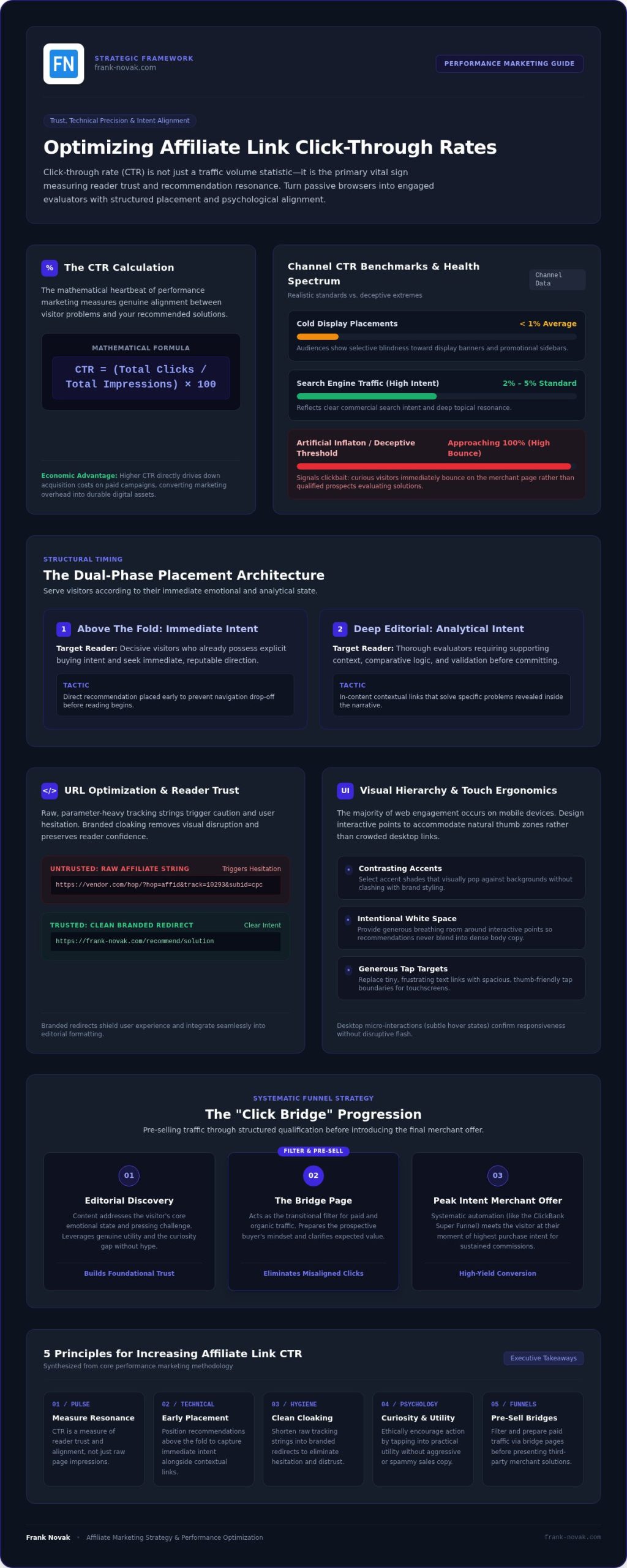
Calculating this metric is straightforward: divide total clicks by total impressions and multiply by 100. Across digital channels, performance standards shift considerably. While search engine traffic often averages between 2% and 5% due to clear intent, cold display placements frequently hover well below 1%. Yet, aiming for an artificially inflated rate can mislead you. If your CTR approaches 100%, your messaging likely acts as clickbait, pushing curious visitors who immediately bounce on the merchant page rather than qualified prospects ready to evaluate a solution.
Why Clicks are the First Step to Success Coaching
A sluggish response often traces back to underlying hesitation in the creator’s approach, mirroring the limiting patterns addressed in Frank Novak’s guide to the entrepreneur mindset. When you hesitate to make clear recommendations out of fear, your audience senses the ambiguity. Improving your CTR directly lowers acquisition costs on paid campaigns, turning marketing expenses into sustainable assets. It validates that your guidance matches real demand, establishing the foundational clarity needed for lasting online growth.
Technical Tactics for Optimizing Link Visibility
Placing an affiliate link where readers can actually discover it requires a thoughtful balance between timing and presentation. Positioning a direct recommendation above the fold serves visitors who arrive with immediate buying intent. At the same time, analytical readers often need supporting context deeper down the page before taking action. Raw, parameter-heavy tracking strings can trigger caution, so shortening them into clean, branded redirects protects reader confidence. Aligning these technical choices with the psychology of consumer behavior allows you to present recommendations naturally, avoiding the visual disruption common with unformatted affiliate code.
Traditional display ads have steadily lost effectiveness as modern audiences develop selective blindness toward promotional sidebars. Integrating recommendations directly into your editorial flow removes that friction. Because the majority of web engagement occurs on mobile devices, ensuring link targets accommodate natural thumb movements is crucial. Tiny, crowded links invite frustration, whereas generously sized tap zones make interaction effortless.
Visual Hierarchy and Button Design
Design choices should guide attention without clashing with your site styling:
- Contrasting Accents: Select button colors that pop against your background while respecting your primary palette.
- Intentional White Space: Give interactive elements breathing room so they do not blend into surrounding body copy.
- Micro-Interactions: Subtle color shifts on hover confirm to desktop readers that the element is responsive.
Link Formatting: Text Links vs. Image Links
Contextual text links woven into honest assessments routinely generate higher interaction than flashy graphical banners. When you master how to increase affiliate link click-through rate through layout optimization, formatted product summary cards offer a clean compromise. These cards highlight key features, pricing context, and clear call-to-action buttons without looking like random third-party ads. If you feel overwhelmed balancing layout rules with your marketing systems, exploring mentorship through Frank Novak can help you streamline your technical setup into a reliable, consistent engine.
The Psychology of the Click: Copywriting That Converts
A button’s shade or dimensions mean very little if the phrasing around it fails to connect with what your reader desires. When evaluating how to increase affiliate link click-through rate, your primary lever is the language you use. Readers rarely click out of passive interest; they click because they feel understood. Three emotional impulses typically govern this action: practical utility, the curiosity to solve an ongoing frustration, and the desire to avoid missing a valuable advantage.
Generating interest works best when you establish a curiosity gap rather than demanding an outright purchase. If your anchor text reads “click here to buy,” you ask the visitor for an immediate financial commitment before they are fully convinced. Framing that same link around the solution, such as “see how this framework automates split-testing,” changes the dynamic completely. Moving away from aggressive pitches toward empathetic guidance allows your recommendations to feel like natural assistance from a trusted colleague.
The micro-copy positioned right next to your link carries enormous weight. Those brief surrounding phrases can either validate an impulse or trigger hesitation. Consider these key elements:
- Friction reducers: Phrases like “no credit card required” or “takes two minutes to set up” remove psychological resistance.
- Specific context: Clarifying what waits behind the link prevents the jarring surprise that leads to immediate bounces.
- Natural transitions: Weaving links directly into the middle of explanatory sentences instead of isolating them on bare lines.
Framing the Solution, Not the Product
Conditional language meets readers precisely where they stand. Writing “if you struggle to diagnose why campaigns stall, this diagnostic checklist reveals the missing variable” uses logical framing to qualify the visitor. It opens a mental loop that can only be resolved by reviewing the resource. Instead of pitching generic software, you introduce a direct pathway to solving an irritating problem.
Building Trust Before the Ask
Upfront transparency about commercial relationships actually improves response rates. Clear disclosures reassure readers that you have nothing to conceal, which elevates your credibility before they evaluate your suggestions. Backing your advice with relatable social proof, such as mentioning the peer groups actively using a workflow, reinforces that confidence. Pairing honest disclosures with strategic traffic generation ensures that the people arriving on your page are already primed to value your perspective, turning standard links into welcome resources.
The Bridge Page Strategy: Pre-Selling the Click
Direct linking often seems like the quickest path to commissions, yet sending cold prospects straight to a vendor page creates serious friction. When users leave an informative social thread or blog post and land abruptly on a high-pressure sales pitch, they usually bounce. A bridge page acts as a purposeful buffer, providing a brief transition where you frame the problem and validate the proposed answer. Inserting this intermediary step is a proven method when mastering how to increase affiliate link click-through rate, because visitors evaluate the offer with genuine intent rather than immediate skepticism.
Relying on direct links across paid channels like Facebook creates an exceptionally leaky funnel. If an unprimed visitor leaves a merchant site without buying, that advertising spend vanishes permanently. A dedicated bridge page lets you offer a simple lead magnet first, capturing an email address before revealing your outbound recommendation. This value-first approach delivers a small, actionable win upfront, building the goodwill required to turn casual browsers into receptive buyers.
Structuring Your Bridge Page for Maximum CTR
A high-converting bridge layout keeps visitor attention tightly focused without unnecessary distractions:
- Clear Promise Headline: Validate the exact reason the reader arrived, speaking directly to their immediate challenge.
- Short Context Video: Deliver two to three minutes of genuine insight showing how the tool addresses the issue.
- Focused Call-to-Action: Provide a singular button leading directly to the merchant, eliminating competing menus or outbound links.
Message match requires carrying identical language, imagery, and core promises across your ad, your bridge page, and the final vendor destination.
Compliance and the “Safe” Click
Major ad networks penalize destination URLs that seem deceptive or pushy. Using an intermediary page provides the transparency required for sustained Facebook ad compliance, allowing you to display legal disclosures and control the user experience. This deliberate space helps warm cold traffic, ensuring prospects arrive on the merchant page with realistic expectations and the focus needed to complete a purchase.
Explore the ClickBank Super Funnel System
Scaling Your CTR with the ClickBank Super Funnel
Relying on manual link placement across sporadic blog posts or social updates quickly hits an operational ceiling. When you explore how to increase affiliate link click-through rate across an entire venture, the real breakthrough comes from implementing an automated infrastructure. The ClickBank Super Funnel provides a pre-built architecture designed specifically to optimize engagement. Instead of guessing where an interactive button belongs, the framework automatically delivers recommendations at moments when visitor attention and commercial intent are highest.
Deploying pre-tested marketing assets eliminates the costly trial-and-error cycle of building funnels from scratch. These resources have been refined through rigorous split testing, meaning headlines, layout spacing, and call-to-action designs are already weighted for responsiveness. Coupled with personalized Online Success Coaching, this structured setup allows you to identify engagement bottlenecks quickly. An experienced mentor can evaluate your tracking metrics, diagnose drop-off points, and adjust copy angles before ad budgets burn away on unresponsive traffic.
Why Systems Outperform Single Links
Scattering isolated affiliate links across different networks creates an unstable model that requires constant maintenance. Moving from a casual link promoter to a structure built for sustainable business growth requires a self-sustaining asset. The ClickBank Super Funnel handles this transition by managing the pre-sell bridge automatically. If a visitor declines to click during their initial visit, an automated email follow-up sequence continues delivering value, recovering clicks that single-page content routinely loses.
Taking the Next Step in Your Affiliate Journey
Graduating from manual placement to an integrated system fundamentally changes how your business operates. With the right architecture in place, lifting your performance metrics stops feeling like guesswork. Professional mentorship guides you through complex technical tracking, audience segmentation, and compliance updates, giving you the clarity needed to scale. Ready to automate your commissions? Explore the ClickBank Super Funnel today.
Transforming Your Link Strategy Into Lasting Growth
Mastering how to increase affiliate link click-through rate comes down to aligning technical precision with genuine audience empathy. When you swap generic sales banners for clean, contextual recommendations and warm up traffic with dedicated bridge pages, your engagement naturally lifts. Sustainable success does not require aggressive selling or complicated technical workarounds; it simply demands a cohesive system that respects your reader’s journey from their first glance to the final click.
You don’t have to assemble these complex pathways on your own. By combining proven, high-converting funnel templates with founder-led guidance from Frank Novak, you can confidently deploy compliant Facebook traffic campaigns that run on dependable automation.
Join the ClickBank Super Funnel and Start Automating Your Success
With the right tools and steady mentorship in place, turning quiet pages into active, commission-generating assets becomes an achievable, rewarding reality.
Frequently Asked Questions
What is a good click-through rate for affiliate marketing in 2026?
A good click-through rate typically falls between 2% and 5% for targeted search and content traffic, though numbers vary by channel. In display or cold social feeds, average rates often settle closer to 1%. If you want to know how to increase affiliate link click-through rate sustainably, prioritize intent over raw volume. Highly qualified visitors will consistently interact at much higher rates than broad, unsegmented audiences.
Does link cloaking hurt or help my affiliate link CTR?
Link cloaking generally helps your click-through rate by turning long, suspicious tracking strings into clean, branded domain paths. Users feel far more comfortable clicking a tidy URL that matches your brand than a raw redirect loaded with cryptic affiliate parameters. Just ensure your setup redirects transparently to compliant destinations, maintaining visitor trust while keeping your analytics accurate.
How many affiliate links should I include in a 2,000-word blog post?
Including four to six strategically placed affiliate links across a 2,000-word article provides sufficient coverage without overwhelming the reader. Distribute them across different intent levels: place an early link near the top for quick decision-makers, contextual text mentions throughout the body, and a structured product box or button near the conclusion. Crowding every paragraph with hyperlinks dilutes attention and triggers reader fatigue.
Why is my CTR high but my conversion rate low?
A high click-through rate paired with low vendor conversions almost always points to a breakdown in message match. If your copy promises an outcome that the merchant page does not reflect, visitors bounce immediately after clicking. Misaligned price expectations or misleading anchor text inflate initial interest but destroy buying intent. Ensure your pre-sell framing mirrors the exact pricing, features, and tone of the vendor site.
Can I use affiliate links directly in Facebook ads without getting banned?
Direct linking in Facebook ads frequently triggers compliance flags and account bans because automated review systems reject raw affiliate redirects. The safest, most effective approach involves routing ad traffic to an intermediate bridge page on your own domain. This compliant buffer gives you full control over required disclaimers, lets you collect email leads upfront, and warms cold traffic before sending users to the merchant offer.
What are the best “power words” to increase link clicks?
The most effective trigger words reduce perceived friction and clarify immediate utility. Words like “instant,” “checklist,” “framework,” “verified,” and “step-by-step” clearly define what waits on the other side of the link. Rather than relying on generic imperatives like “buy now,” pair outcome-focused verbs with specific solutions, such as “access the setup checklist” or “inspect the testing template.”
How do I track which specific link on a page is getting the most clicks?
You can track individual link performance by appending unique UTM parameters or tracking IDs (SubIDs) to each placement on the page. Labeling your top-of-page link differently from your mid-body contextual link reveals exactly where readers engage. Modern analytics platforms and Google Tag Manager also allow you to monitor link click events based on CSS classes or button positions.
Is it better to use buttons or text links for affiliate offers?
A hybrid approach works best because different visitors interact with content in distinct ways. Contextual text links blend seamlessly into informational paragraphs, making them ideal for analytical readers who prioritize objective context. Standalone buttons work exceptionally well for mobile users scanning for an immediate solution. Testing both formats helps you determine how to increase affiliate link click-through rate across diverse user segments.

Article by
Frank Novak
Frank Novak is an online marketing professional and coach who focuses on affiliate marketing and business automation. Through his website, frank-novak.com, he shares insights and strategies for leveraging social media platforms like Facebook to generate traffic and commissions.
Affiliate / Sponsored Content Disclaimer
This [website/post] contains affiliate links. If you click through and make a purchase, we may receive a commission at no additional cost to you. We only recommend products or services we believe will add value to our readers.