
If you knew that every dollar you spent on your business could return $6.50 or more, would you still feel hesitant about making your first investment? It’s completely normal to feel paralyzed by the fear of burning through your hard-earned savings on “shiny object” software or ads that simply don’t convert. You’ve likely encountered a mountain of information that leaves you wondering if you need every tool on the market just to get started. Calculating affiliate marketing ROI for beginners doesn’t have to be a guessing game based on hope; it’s a logical process of prioritizing your spending in the right order.
I understand the pressure of trying to build a sustainable income while protecting your bank account. In this guide, you’ll learn exactly how to distribute your first marketing dollars to build a profitable business without wasting money on useless subscriptions. We’ll move past the confusion by creating a concrete monthly spending plan that focuses on a scalable automated foundation. By the end of this article, you’ll have a clear roadmap for your budget that balances essential tools with the paid traffic strategies needed to see real growth in 2026. This approach ensures every cent works toward your long-term success.
Key Takeaways
- Identify your marketing budget as the essential capital needed to build a reliable bridge between your target audience and high-converting products.
- Discover how to balance your spending between foundational technical setup and the conversion engines that capture leads and generate revenue.
- Learn the exact formula for calculating affiliate marketing ROI for beginners to ensure your traffic costs never outweigh your commissions.
- Compare the specific spending requirements for organic bootstrap strategies versus momentum-based plans that incorporate automated paid traffic.
- Explore how professional coaching and automated funnel systems can accelerate your 90-day growth plan while protecting you from common financial pitfalls.
The Reality of Affiliate Marketing Costs in 2026
When you first look into What is Affiliate Marketing?, it is easy to view it as a zero-cost path to wealth. In reality, your affiliate budget is the essential capital required to build a bridge between a specific audience and the products they need. If you think of your business as a physical storefront, your budget covers the rent, the signage, and the flyers that bring people through the door. Without this bridge, you are essentially shouting into a void and hoping someone hears you. Professional marketers don’t view these costs as losses; they view them as the necessary tools to construct a profitable system.
You’ve likely seen advertisements claiming you can start this journey for free. While it is technically possible to post links on social media without spending a dime, this “start for free” myth often leads to immense frustration and slow growth. If you don’t invest in the right infrastructure early on, you’ll likely spend months spinning your wheels without seeing a single conversion. Calculating affiliate marketing ROI for beginners becomes much easier when you accept that small, strategic investments are the fuel that moves your business forward. It’s better to spend a little to grow fast than to spend nothing and stay stuck.
A helpful shift in perspective is to adopt a “Data over Dollars” mindset. During your first few months, your spending isn’t just about chasing immediate profit. You’re actually buying market intelligence. Every dollar spent on a click or a lead tells you what your audience likes and what they ignore. This data is the foundation of your future success. If you know exactly which headline gets people to click, that information is worth far more than the few dollars it cost to find out.
Fixed vs. Variable Affiliate Expenses
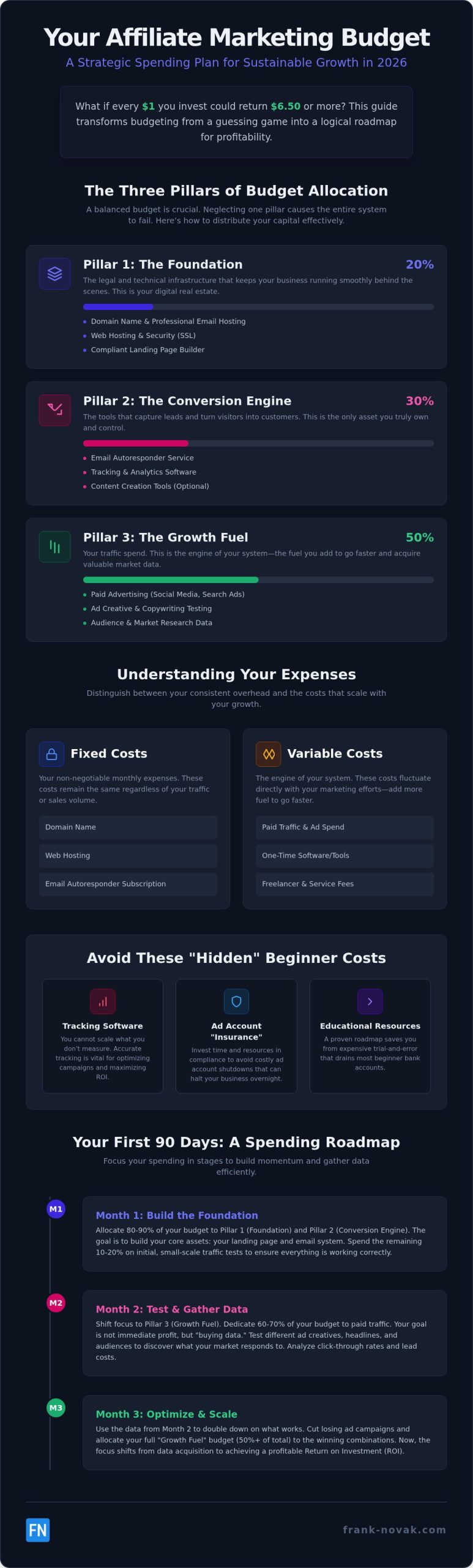
Understanding your expenses starts with distinguishing between fixed and variable costs. Fixed costs are your non-negotiable digital real estate, such as your domain name and hosting. These stay the same every month regardless of your sales. You also need an email autoresponder, which is the only asset you truly own and control. Variable costs, on the other hand, primarily consist of your traffic spend. This is the engine of your system. If you want to go faster, you add more fuel by increasing your ad spend. If you need to slow down, you simply turn the dial back.
The “Hidden” Costs Beginners Often Overlook
Many new marketers fail because they ignore “quiet” expenses that eventually add up. Tracking software is vital because you cannot scale a campaign if you don’t measure its performance accurately. You should also budget for “ad account insurance,” which means spending time and resources on compliance to avoid sudden bans. Finally, investing in educational resources can prevent you from falling into the Never Succeed Online trap. A proven roadmap saves you from the expensive trial and error that drains most beginner bank accounts before they ever see a profit.
The Three Pillars of Beginner Budget Allocation
If you want to build a business that lasts, you cannot treat your spending like a trip to a casino. Most beginners fail because they pour all their money into a single area while neglecting the others. If you spend your entire budget on traffic but don’t have a funnel to capture leads, you’re essentially throwing money away. Calculating affiliate marketing ROI for beginners starts with a balanced approach. Think of your budget as a three-legged stool; if one leg is missing, the whole thing collapses. To see real progress, you should divide your capital into three distinct pillars: the foundation, the conversion engine, and the growth fuel.
Skipping even one of these pillars causes your budget to leak money through technical errors or unoptimized traffic. When these three areas work together, they create a closed loop where every dollar spent has a specific purpose. This structure allows you to track exactly where your profit is coming from and where you need to make adjustments.
Allocating for Your Foundation
The first 20% of your budget belongs to your foundation. This includes the legal and technical infrastructure that keeps your business running smoothly behind the scenes. You should prioritize professional email hosting over generic free accounts. Free email addresses often trigger spam filters, which can kill your reach before you even send your first promotion. You also need a clean, compliant landing page builder that satisfies the strict requirements of modern ad networks. Beyond the software, you must invest time in developing a Success Mindset. Managing initial losses is much easier when you view them as the cost of your professional education rather than a reason to quit.
Investing in the Conversion Engine
Next, about 30% of your capital should go toward your conversion engine. This is the system that turns a curious visitor into a lead and eventually a customer. While you could try to build every page and email sequence from scratch, using a ClickBank Super Funnel is often much more cost-effective. It saves you dozens of hours of technical work and prevents the “lead leakage” that happens with poorly designed funnels. You’ll also want to allocate funds for high-quality lead magnets that provide genuine value. In 2026, people are more protective of their data, so your offer must be compelling. Consider the ROI of professional copywriting as well; words that connect with a reader’s pain points will always outperform generic text.
The final 50% of your budget is your growth fuel. This is your strategic traffic generation and testing phase. If you have the foundation and engine ready, this half of your budget is what drives people into your system to generate commissions. If you’re feeling unsure about how to balance these pillars, checking out Online Success Coaching can help you avoid the common traps that drain beginner budgets.
Bootstrap vs. Scaled: Comparing Budget Tiers
Every successful affiliate marketer starts at a different financial baseline, and your path to profitability depends entirely on your starting resources. Calculating affiliate marketing ROI for beginners becomes much easier when you know which budget tier you currently occupy. Instead of comparing your day one to someone else’s day one thousand, you should focus on the specific strategies that work for your current capital. Whether you are starting with a few hundred dollars or a few thousand, there is a clear roadmap to follow. The goal is to move through these tiers systematically as your revenue grows, ensuring you never overextend your cash flow.
The Bootstrap Strategy: Maximum Sweat Equity
If you are starting with a budget between $100 and $500 per month, you are in the bootstrap tier. This stage is defined by trading your time for data and momentum. Your primary focus should be on Organic Facebook Marketing to validate your offers before you ever spend a cent on ads. At this level, you only invest in the absolute essentials: a professional autoresponder and a basic funnel builder. Every commission you earn during this phase should be reinvested 100% back into the business. This disciplined approach allows you to build a small but sturdy foundation without the pressure of high monthly overhead. It’s a period of learning the mechanics of how your audience responds to different messages.
The Momentum Strategy: Buying Speed
Once your business generates consistent revenue, you can transition into the momentum tier, which typically requires a budget of $500 to $2,000 per month. This is where you begin “buying speed” by introducing Facebook Ads for Affiliate Marketing at a controlled daily rate. The shift here is from manual labor to semi-automated systems. You are no longer just looking for a sale; you are building an asset. By using automation, you free up your time to focus on high-level strategy and optimization. To avoid the Never Succeed Online trap, many marketers at this stage seek professional guidance to ensure their ad spend is actually returning a profit. This tier is about refining your process and preparing for a larger scale.
The Pro Tier begins when your budget exceeds $2,000 per month, allowing for aggressive ad spend and high-ticket coaching. Transitioning between these tiers requires a careful eye on your bank balance. If you move too quickly into paid traffic before your funnel is fully optimized, you risk burning your capital. Always ensure your organic conversions are steady before you turn on the paid traffic tap. By calculating affiliate marketing ROI for beginners at every step, you can confidently decide when it’s time to level up. This steady, logical progression keeps your business safe while you build toward a scalable automated foundation.
Your First 90 Days: A Step-by-Step Spending Plan
The first 90 days of your journey are the most critical because they set the pace for your future growth. If you try to do everything at once, you’ll likely exhaust your budget and your energy before seeing a single lead. Instead, you should view this period as a structured build where each month has a specific financial and operational goal. Calculating affiliate marketing ROI for beginners is impossible if your data is messy, so the early focus must be on precision over speed. By following a step-by-step spending plan, you protect your capital while building a system that can eventually scale.
Month 1: Building the Digital Home
During your first thirty days, your primary goal is to secure your digital real estate. This means purchasing your domain and setting up a professional email account that won’t get flagged as spam. You should also focus on setting up your primary sales funnel, such as the ClickBank Super Funnel, to ensure your technical foundation is solid. This is also the time to establish your tracking parameters. If you don’t know exactly where a click came from, you can’t determine if that click was worth the cost. Spending this month on infrastructure ensures that every dollar you spend later is fully accounted for.
Months 2 & 3: From Testing to Scaling
Once your home is built, Month 2 shifts toward content creation and lead generation. You are now focused on building your list, which is the most valuable asset in your business. When you reach Month 3, you move into traffic testing and optimization. This is where calculating affiliate marketing ROI for beginners becomes active. You should start with a “micro-budget” for ads, perhaps only $5 to $10 per day, to test different creative elements and headlines. Small tests allow you to see how the market reacts without risking your entire savings.
Identifying the winning ad and funnel combination is essential before you even think about increasing your spend. If a specific ad isn’t returning data that suggests future profit, you stop it and try another. You should never spend your entire traffic budget in the first week of a campaign; instead, use that time to gather small amounts of data. Maintaining a consistent, manageable budget over several months is far more effective than making a large, one-time splash that leaves you with no room to pivot. Consistency in your budget allows the algorithms to learn and your audience to grow familiar with your brand.
Get the roadmap to avoid common beginner pitfalls.
Reducing Costs Through Automation and Coaching
Building a profitable business isn’t just about how much you earn; it’s about how much you keep. Many new marketers lose a significant portion of their potential earnings through lead leakage, where interested visitors drop out of the process because of manual follow-up delays or broken links. If you implement Automated Marketing Funnels, you ensure that every prospect is nurtured through a consistent, proven sequence. This automation acts as a 24/7 sales team that doesn’t require a salary, which significantly improves your bottom line from day one.
Another common drain on your budget is the “Subscription Trap.” It’s easy to sign up for ten different tools that all claim to be essential, but you’ll often find that you’re paying for overlapping features. If you consolidate your tools into a single, high-performance system, you can easily save $200 or more every month. When you’re calculating affiliate marketing ROI for beginners, these small savings often make the difference between a month that’s in the red and one that’s in the black. Every dollar you save on redundant software is a dollar you can reinvest into traffic that actually generates revenue.
The ROI of Professional Guidance
While it might seem counterintuitive to spend money on a coach when you’re trying to save, the cost-benefit analysis usually leans in favor of expert help. An Online Success Coach helps you avoid the catastrophic mistakes that kill budgets, such as accidental ad account bans due to compliance errors. Instead of spending years trying to figure out why your ads aren’t converting, you can shorten that learning curve to just a few weeks. You should view coaching as an investment that pays for itself by preventing the expensive trial and error that causes most people to quit before they see a profit.
Next Steps: Get Your Budget Working
Your path to a self-sustaining affiliate business starts with a clear decision. Review the budget tiers we discussed earlier and pick the one that matches your current resources. Don’t wait for the “perfect” time to start; set up your first automated funnel today so you can begin gathering the data needed for calculating affiliate marketing ROI for beginners. Consistency is the only way to build a scalable foundation that eventually runs on autopilot. If you focus on the mechanics of how things work and stay patient with the process, the results will follow.
Ready to skip the guesswork? Apply for Online Success Coaching with Frank Novak
Take Charge of Your Marketing Future
You now have a clear roadmap for distributing your first marketing dollars effectively. By focusing on the three pillars of budget allocation, you ensure that your foundation is solid before you ever spend a cent on traffic. This methodical approach takes the guesswork out of calculating affiliate marketing ROI for beginners and helps you avoid common traps. You can save hundreds on monthly tool subscriptions by consolidating your systems into one efficient workflow. Using proven Facebook-compliant strategies and receiving personalized guidance from Frank Novak will help you scale with confidence.
Automate your commissions with the ClickBank Super Funnel
Your success depends on your willingness to take that first step with a structured plan in hand. You have the tools and the strategy; now it’s time to put them into action. Remember that every seasoned professional started exactly where you are today. Stay patient, keep your eyes on the data, and watch your business grow.
Frequently Asked Questions
How much money do I need to start affiliate marketing for beginners?
You can start effectively with a budget between $100 and $500 per month if you follow a bootstrap strategy. This amount primarily covers your essential technical foundation, such as your domain name, professional email hosting, and a basic autoresponder. While some affiliate networks like ShareASale or Impact.com have specific fees for merchants, joining as an affiliate is typically free, meaning your initial capital is mostly spent on the tools that build your audience bridge.
Can I start affiliate marketing with $0 in 2026?
Technically, you can start with $0 by using organic social media platforms to share links, but this path often leads to slower growth and higher frustration. You must also remain aware of FTC disclosure guidelines, which require clear labels like “#ad” or “Sponsored” on all promotional content to avoid potential fines of over $51,000 per violation. Investing even a small amount in a professional foundation usually provides a much more reliable and professional path to building trust with your audience.
What percentage of my budget should go to Facebook ads?
You should aim to allocate approximately 50% of your total budget to growth fuel, which includes Facebook ads and other traffic sources. If you are just starting out, it’s best to use a micro-budget of $5 to $10 per day to test your creative elements and headlines. This controlled approach is a vital part of calculating affiliate marketing ROI for beginners, as it allows you to gather market intelligence without risking your entire savings on unproven campaigns.
Is it worth buying an affiliate marketing course or coaching?
Investing in professional coaching or a structured course is often worth the cost because it prevents expensive mistakes like ad account bans or lead leakage. A coach provides a roadmap that can shorten your learning curve from years to weeks by showing you exactly what works in the current market. If you want to avoid the “Never Succeed Online” trap, having a steady guide who understands compliance and automation can pay for itself through the time and money you save on avoided errors.
How long does it take to see a return on my marketing budget?
Most beginners begin to see a measurable return on their marketing budget toward the end of their first 90 days. The first two months are typically dedicated to setting up your infrastructure and building your initial email list, while the third month focuses on traffic testing and optimization. Industry averages suggest a healthy ROI is generally considered to be above 300%, but reaching that level requires the patience to let your data guide your spending decisions.
Which tools are absolutely necessary for an affiliate marketing beginner?
The absolute necessities for any beginner include a custom domain, a professional email account, an email autoresponder, and a high-converting landing page builder. Using a consolidated system like the ClickBank Super Funnel can help you avoid the “Subscription Trap” by providing your technical infrastructure in one place for a lower total cost. These tools ensure that you own your list and your tracking data, which are the only assets that provide long-term business stability.
How do I avoid losing my entire budget on failed ad campaigns?
You can protect your budget by using tracking software and never spending your entire traffic allocation in the first week of a campaign. If you set up specific tracking parameters for every link, you’ll know exactly which ads are generating leads and which are simply wasting money. Calculating affiliate marketing ROI for beginners becomes much safer when you only increase your spending on campaigns that have already proven they can convert on a small scale.
Should I focus on free traffic or paid traffic first?
If your budget is under $500, you should focus on free organic traffic first to validate that your offer and funnel actually resonate with people. Once you have a system that converts organic visitors into leads, you can then transition into paid traffic to buy speed and scale your results. This logical progression ensures that you aren’t pouring money into a funnel that hasn’t been tested against real human behavior yet.

Article by
Frank Novak
Frank Novak is an online marketing professional and coach who focuses on affiliate marketing and business automation. Through his website, frank-novak.com, he shares insights and strategies for leveraging social media platforms like Facebook to generate traffic and commissions.
Affiliate / Sponsored Content Disclaimer
This [website/post] contains affiliate links. If you click through and make a purchase, we may receive a commission at no additional cost to you. We only recommend products or services we believe will add value to our readers.