

What if the social media platform where you’ve built your entire following disappeared tomorrow? For many entrepreneurs, this thought is a constant source of anxiety, especially when low conversion rates and the fear of sudden account bans make your business feel fragile. It’s exhausting to feel like a salesperson constantly chasing cold traffic that doesn’t seem to trust your voice. If you’re tired of being at the mercy of a single algorithm, it’s time to learn how to build a community around your affiliate niche.
We all agree that the old model of “link dropping” is failing as audiences in 2026 crave real connection and expert guidance. This guide will show you how to transform that cold traffic into a loyal tribe that trusts your recommendations and drives consistent commissions. We’ll walk through the transition from “rented” land to “owned” digital campfires, look at the latest platform trends, and provide a clear roadmap for building a sustainable business model that puts you back in control. By the end, you’ll have a practical strategy to move from a salesperson to a trusted mentor who leads a thriving, profitable audience.
Key Takeaways
- Shift your strategy from temporary “churn and burn” traffic to a sustainable community model that prioritizes long-term member trust over one-off sales.
- Evaluate the pros and cons of major platforms like Facebook and Discord to find the “digital campfire” that best suits your audience’s habits and technical comfort.
- Master the 5-step framework for how to build a community around your affiliate niche by defining a clear transformation and providing value before asking for a sale.
- Adopt a “curator mindset” to ethically recommend products, ensuring your audience views you as a helpful expert rather than a pushy salesperson.
- Identify the right moment to move from a manual operation to an automated system, using professional coaching to navigate the complexities of scaling your tribe.
Why Community is the Ultimate Affiliate Asset in 2026
In the current digital environment, an affiliate niche community is far more than a simple list of email addresses or a database of past customers. It is a living ecosystem of individuals brought together by a shared challenge, interest, or desired transformation. When you understand how to build a community around your affiliate niche, you stop treating people as metrics and start seeing them as members of a tribe. This shift in perspective is the foundation of a sustainable business model that survives long after a single ad campaign ends.
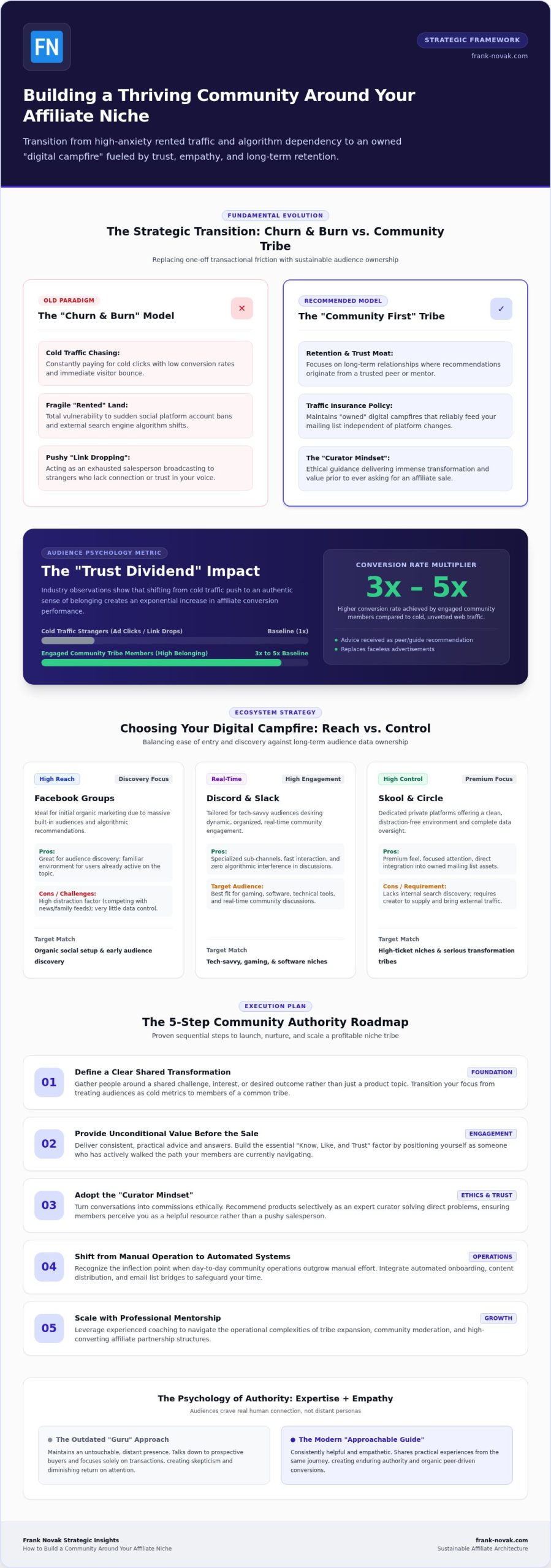
Most affiliates rely on a “churn and burn” model where they pay for cold traffic, hope for a quick click, and never see that visitor again. In contrast, the “community first” approach focuses on retention and relationship building. This creates what we call the “Trust Dividend.” While cold traffic often struggles to convert, industry observations suggest that community members who feel a sense of belonging often convert at 3 to 5 times the rate of strangers. This happens because the recommendation comes from a peer or a trusted guide, not a faceless advertisement.
To better understand this concept, watch this helpful video:
The Psychology of Niche Authority
The era of the untouchable “guru” has faded in favor of the approachable “guide.” People don’t want to be talked down to; they want to follow someone who has walked the path they’re currently on. By maintaining a consistent, helpful presence, you naturally build the “Know, Like, and Trust” factor that’s essential for affiliate success. Niche authority is the intersection of expertise and empathy.
Community as a Traffic Insurance Policy
Relying solely on SEO or social media platforms puts your income at the mercy of external algorithm shifts and sudden ad account bans. A community acts as a protective moat, providing “owned” traffic that you can reach without paying for every individual click. By understanding online community dynamics, you can create a space that feeds your mailing list and ensures your message reaches your audience regardless of platform changes. This stability allows you to focus on growth rather than constant damage control.
Choosing Your Digital Campfire: Where to Host Your Tribe
Selecting the right environment is the first major decision in how to build a community around your affiliate niche. You need a space that balances ease of entry for new members with the long-term control you need as a business owner. While it’s tempting to jump onto the newest platform, the most successful communities are built where the audience already feels comfortable and active.
Facebook Groups remain a dominant choice because of their massive built-in audience and powerful recommendation algorithms. If you are just starting your journey, organic Facebook marketing is often the most efficient way to find people who are already interested in your specific topic. However, you must account for the “distraction factor.” Facebook is designed to keep users clicking, which means your helpful post is always competing with family photos and trending news. It’s a great place for discovery, but it can be difficult to maintain deep, focused attention over time.
For tech-savvy or high-engagement niches like gaming and software, Discord and Slack offer a more streamlined experience. These platforms excel at real-time conversation and organized sub-channels. If you’re targeting high-ticket affiliate niches, you might consider private platforms like Skool or Circle. These “digital campfires” provide a premium feel and better access to social media platform adoption data, though they usually require you to bring your own traffic rather than relying on internal search engines.
Platform Comparison: Reach vs. Control
When you evaluate these options, you’re essentially weighing organic reach against data ownership. Facebook gives you incredible reach but very little control over your audience data. Conversely, a “newsletter-first” community-where you build a tribe through interactive, two-way email marketing-gives you total control but requires more effort to grow. The best platform is ultimately the one where your specific niche “hangs out” online. If they’re already active on a certain site, don’t make them download a new app just to talk to you.
The Hybrid Model: Social Front-End, Email Back-End
A highly effective strategy for sustainable growth is the hybrid model. You use social groups as a “front-end” to find and attract new people, then move them into an automated marketing funnel on the “back-end.” This ensures that even if a social platform changes its rules or bans your account, you still have a direct line to your tribe through your email list. Mastering how to build a community around your affiliate niche is less about the specific software and more about the consistent value you provide. If you’re feeling unsure about which technical path to take, professional Online Success Coaching can help you identify the shortcut that fits your goals.
The 5-Step Framework for Building Community Authority
Once you have selected your platform, the next step is to establish yourself as a helpful guide rather than a distant expert. Learning how to build a community around your affiliate niche requires a deliberate strategy to move members from passive observers to active participants. This framework ensures that your authority grows naturally alongside the group’s engagement.
- Step 1: Define the Transformation. Every successful community helps its members move from Point A to Point B. You must clearly communicate what result your tribe is helping people achieve, whether it is mastering a new hobby or scaling a business.
- Step 2: Seed the Value. Provide “results in advance” by offering free guides, checklists, or mini-trainings. If a member experiences a small win because of your free advice, they are much more likely to value your paid recommendations later.
- Step 3: Establish the Rules. Create a safe, spam-free environment where real questions are encouraged. Clear boundaries prevent your group from becoming a wall of unsolicited links.
- Step 4: Facilitate Peer-to-Peer Engagement. A community is only sustainable if members talk to each other. Tag members in relevant threads or ask for their specific expertise to foster a sense of belonging.
- Step 5: Introduce the Bridge. This is the moment you transition from helpful advice to a specific affiliate solution. When you do this, always adhere to the FTC influencer and endorsement disclosure guidelines to ensure your commissions are disclosed clearly and conspicuously.
Content Pillars for Community Growth
Consistency is the engine of authority. If you follow the 80/20 rule, where 80% of your posts focus on education and connection and only 20% on promotion, you will avoid the “salesperson” trap. You can use “Member Spotlights” to celebrate the wins of your tribe, which builds social proof for your niche without you having to brag. Simple “Question of the Day” posts are also highly effective for boosting organic reach on platforms like Facebook, as they encourage quick, easy interactions that keep your group visible in the algorithm.
Moderation Without the Headache
Maintaining a high-value space doesn’t mean you have to be glued to your screen. If you use automation tools to filter common spam keywords and welcome new members, you can save hours of manual work. It’s also vital to cultivate a “Success Mindset” when dealing with the occasional troll or negative feedback. If you stay professional and stick to your established rules, the community will often step in to defend the culture you’ve built. This structured approach allows you to scale without losing the personal touch that makes niche communities so profitable.
Turning Conversations into Commissions Ethically
The bridge from community member to customer is built entirely on trust. When you understand how to build a community around your affiliate niche, you adopt a “Curator Mindset.” This means you’re no longer just an affiliate; you’re a filter for your tribe. They trust you to sift through the noise and only recommend products that actually work. This role is far more valuable than being a simple traffic driver because it positions you as a helpful peer rather than a salesperson.
Using “Soft Launches” is a great way to test interest without being pushy. Instead of a hard pitch, ask the group if they’d be interested in a specific solution to a problem they’ve been discussing. This interaction ensures you aren’t forcing products on people who don’t want them. You can also share “Behind the Scenes” content. If members see you using a tool in your daily routine, the recommendation feels like a natural tip from a friend. If you want to know how to build a community around your affiliate niche that lasts, you must prioritize the member’s experience over the immediate payout.
The Art of the ‘Un-Salesy’ Recommendation
When someone asks a question, don’t just drop a link. Provide a thoughtful answer first, then mention the tool as a way to implement the solution. Sharing personal case studies or results creates a narrative that people can follow. Interestingly, being honest about a product’s minor flaws can actually increase your conversion rate. It shows you aren’t just after a commission; you’re being objective. This transparency is key to maintaining long-term authority within your digital campfire.
Automating the Monetization Journey
As your group grows, manual outreach becomes impossible. You can integrate the ClickBank Super Funnel to handle the technical side of your recommendations. This system allows you to introduce your primary affiliate solution through automated welcome sequences that nurture new members from day one. It’s essential to ensure that you’re always matching the specific offer to the member’s current stage of their professional journey.
For more complex offers, using Webinar Profit Engines helps you provide deep-dive value before you ever ask for a sale. This educational approach ensures that the member feels supported rather than sold to. By automating these touchpoints, you ensure no one falls through the cracks while you focus on leading the conversation and growing your tribe.
Automate your affiliate commissions with the ClickBank Super Funnel
Scaling Your Niche Tribe with Professional Mentorship
If you’ve reached the point where your group is active and profitable, you’ve already done the hardest part of learning how to build a community around your affiliate niche. The challenge now shifts from finding your first members to managing a growing population without losing your personal freedom. When you move from a solo operation to a moderated, automated community, your role shifts from being the only voice to becoming the architect of the environment. This transition is essential if you want to build a sustainable lifestyle where your funnels do the heavy lifting while you focus on high-level strategy.
Once your community has a proven track record of converting members into buyers, you can use paid traffic like Facebook Ads to “pour gasoline” on the fire. Because you’ve already established a “Trust Dividend” and a working “Bridge,” every dollar spent on ads becomes much more predictable. Instead of sending strangers to a cold sales page, you’re inviting them into a warm, supportive ecosystem where they’re more likely to stay and contribute. Applying Online Success Coaching strategies helps you navigate this scaling phase without making the expensive mistakes that often derail growing businesses.
Avoiding the ‘Community Burnout’ Trap
A common fear among creators is that more members will inevitably lead to more work. However, if you implement “Success Systems,” you can actually step away while the community continues to thrive. These systems include clear moderation guidelines, automated onboarding, and the cultivation of “Super Users” who help answer questions on your behalf. Building this level of leverage requires a specific mindset focused on long-term resilience. If you don’t protect your time, you can’t lead your tribe effectively. By letting automation handle the repetitive tasks, you ensure the community remains a source of income rather than a source of stress.
Your Roadmap to a 6-Figure Niche Community
The journey from a beginner affiliate to a community leader is one of the most rewarding paths in the digital landscape. You’ve seen how to choose your platform, build authority through value, and turn conversations into commissions ethically. To reach the six-figure mark, you need to refine your funnels and optimize your engagement strategies continuously. If you’re looking for personalized help to bridge the gap between where you are and where you want to be, Frank Novak’s coaching programs provide the professional mentorship needed to accelerate your progress.
Your Path to a Sustainable Affiliate Future
Building a digital tribe isn’t just about finding a place to post links; it’s about creating a protective moat that shields your business from shifting algorithms and rising ad costs. By focusing on a “community first” model, you’ve learned how to build a community around your affiliate niche that values your guidance and converts at much higher rates than cold traffic. Whether you start on a social platform or a private server, the key is to stay consistent and lead with empathy.
Scaling this model effectively requires the right systems and a mindset focused on long-term growth. You don’t have to navigate these complexities alone. With personalized mentorship and access to proven tools like the ClickBank Super Funnel, you can automate your commissions while providing deep value to your members. This journey transforms you from a salesperson into a respected authority with a business that survives and thrives regardless of platform changes.
The future of affiliate marketing belongs to those who prioritize relationships over transactions. You have the roadmap; now it’s time to take the first step toward a more secure and profitable professional landscape. Your audience is waiting for a leader like you to guide them.
Frequently Asked Questions
How much time does it really take to build a community?
Initial setup takes a few hours, but consistent growth usually requires 30 to 60 minutes of daily engagement for the first 90 days. During this period, you focus on seeding discussions and welcoming new members. If you use automated systems like the ClickBank Super Funnel, you can eventually reduce your manual workload. Most successful creators find that the time investment pays off once the community begins to self-moderate and generate organic commissions.
Do I need to be an expert to start an affiliate niche community?
No, you don’t need to be a world-class expert; you just need to be a few steps ahead of your audience. Positioning yourself as a relatable guide who shares their own journey is often more effective than acting like an untouchable guru. If you are transparent about what you’re learning, your tribe will value your honesty. This approach is a core part of how to build a community around your affiliate niche while maintaining long-term trust.
Which is better for affiliate marketing: a Facebook Group or an email list?
The most profitable strategy is to use both in a hybrid model. A Facebook Group is excellent for discovery and real-time interaction, while an email list provides total ownership and a direct line to your members. If you rely only on social media, you risk losing your audience to algorithm changes. By moving group members onto a mailing list, you create a stable asset that isn’t dependent on any single platform’s rules.
How do I prevent my community from becoming a place for spam?
Prevention starts with setting clear entry requirements and strictly enforcing community rules. Use membership questions to filter out bots and low-quality accounts before they join. If you use automation tools to flag specific keywords or external links, you can stop most spam before it’s even posted. Maintaining a high-value, professional environment requires you to be a proactive moderator who isn’t afraid to remove members who violate your established boundaries.
Can I build a community without showing my face?
Yes, you can absolutely build a thriving niche community as a faceless brand by focusing on high-quality curation and helpful resources. Many successful groups center around a specific brand name or a shared goal rather than a single personality. If you provide consistent value and answer questions accurately, your members will trust your recommendations regardless of whether they know what you look like. This model works exceptionally well for technical or hobby-based niches.
When is the right time to start promoting affiliate products to my group?
You should wait until you’ve established a baseline of trust and provided results in advance through free value. If you start pitching products the moment someone joins, they’ll likely leave. A good rule of thumb is to wait until the group has active daily discussions and you’ve shared at least five pieces of purely educational content. When you eventually introduce a solution, it will feel like a helpful tip rather than a cold sales pitch.
How do I get my first 100 members in a new niche?
Your first 100 members usually come from manual outreach and participating in existing related groups. Start by sharing helpful insights on platforms where your target audience already hangs out, then invite them to your campfire for deeper discussion. If you offer a specific lead magnet like a free checklist or guide, people will have a clear reason to join. This initial manual phase is the foundation of how to build a community around your affiliate niche.
What should I do if my community engagement starts to drop?
If engagement dips, go back to basics by asking your members direct questions about their current challenges. Sometimes a drop in activity means the content has become too predictable or less relevant to their needs. You can also use Member Spotlights or live Q&A sessions to reignite interest. If you’re struggling to diagnose the issue, Online Success Coaching can provide the outside perspective needed to identify and fix the gaps in your engagement strategy.

Article by
Frank Novak
Frank Novak is an online marketing professional and coach who focuses on affiliate marketing and business automation. Through his website, frank-novak.com, he shares insights and strategies for leveraging social media platforms like Facebook to generate traffic and commissions.
Affiliate / Sponsored Content Disclaimer
This [website/post] contains affiliate links. If you click through and make a purchase, we may receive a commission at no additional cost to you. We only recommend products or services we believe will add value to our readers.