

What if the reason your promotional posts are met with silence isn’t the product you’re selling, but the way you’re inviting the conversation? It’s frustrating to spend hours crafting a post only to have it ignored or flagged by a group moderator. You’ve likely felt that sting of anxiety when checking your notifications, wondering if your account is still in good standing. Many marketers find that promoting affiliate products on Facebook groups feels like walking through a minefield where one wrong link can end your progress. If you’ve struggled with zero engagement, you’re not alone in feeling that the platform’s 3.07 billion users are just out of reach.
This guide will show you how to move past the “spam and pray” method and build a sustainable traffic engine that generates organic leads through trust. You’ll learn how to navigate the 2026 “Andromeda” algorithm updates while keeping your account safe. We’ll walk through a repeatable system that uses bridge pages to satisfy FTC disclosure rules and automated follow-up sequences to close sales. By the end of this article, you’ll have a clear roadmap for transforming crowded groups into high-converting lead sources that work for you around the clock.
Key Takeaways
- Learn how to identify high-engagement communities by vetting moderator activity and member quality to ensure your efforts reach an active audience.
- Master the art of promoting affiliate products on Facebook groups by using the 80/20 value-first framework to build trust without appearing like a spammer.
- Discover why using a bridge page is essential for protecting your account from platform flags while creating a professional transition to your affiliate offers.
- Shift from manual, time-consuming posting to a scalable system by integrating your leads into the ClickBank Super Funnel for automated follow-ups.
- Understand the latest algorithm shifts to position your content where it naturally receives the most organic reach and engagement.
Why Facebook Groups are the Best Source of Free Affiliate Traffic in 2026
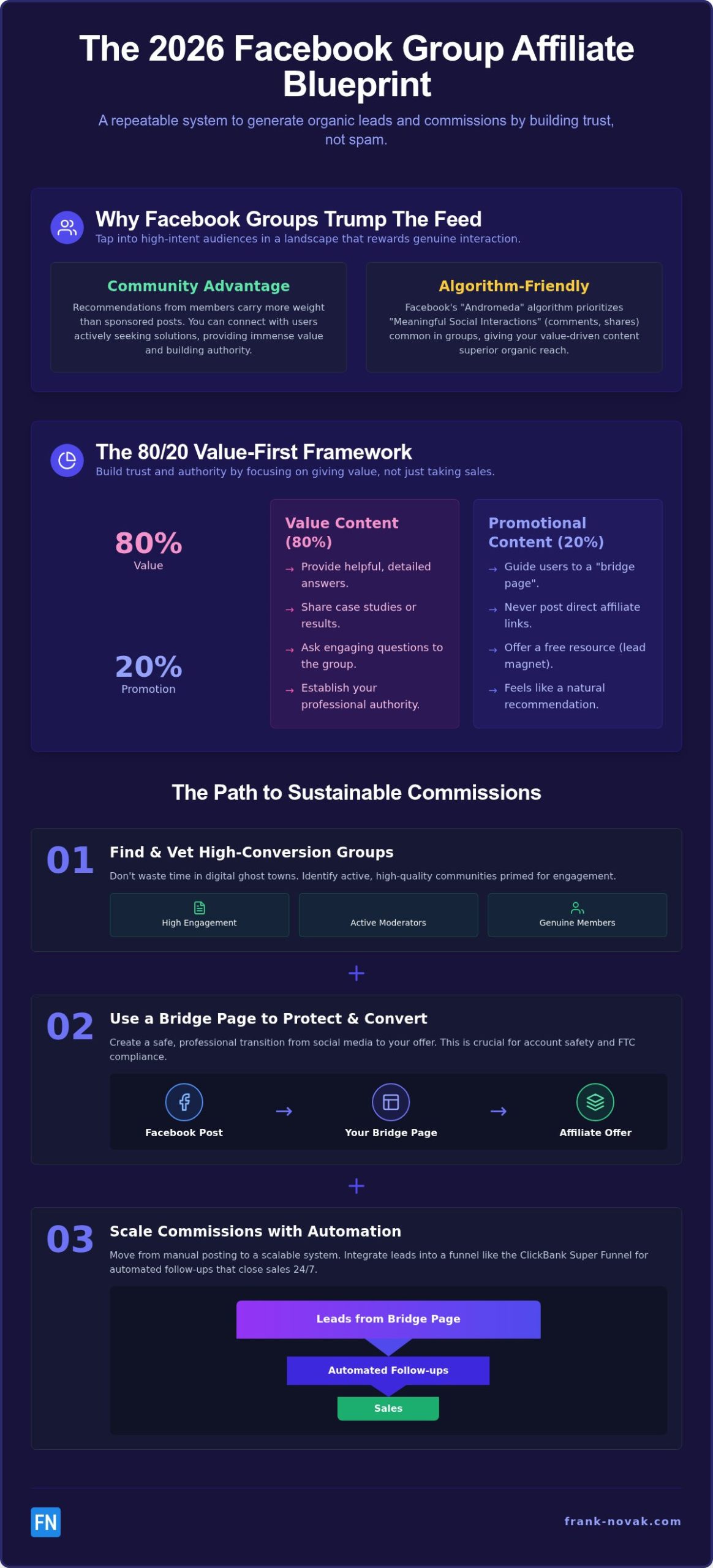
Facebook Group affiliate marketing is the strategic placement of value-driven content designed to guide community members into a structured sales funnel. While some critics claim social media groups are oversaturated, the reality in 2026 is that these communities offer a distinct “Community vs. Feed” advantage. Facebook’s “Andromeda” algorithm now prioritizes content that generates genuine engagement through comments and shares. If you contribute helpful insights within a group, the platform often ranks that content higher than a standard post on a personal timeline. This happens because the system is designed to reward “Meaningful Social Interactions” that keep users engaged within niche communities.
In the broader landscape of affiliate marketing, finding a pocket of users who already share a specific interest is a massive shortcut to success. These users aren’t just browsing; they are actively seeking solutions to specific problems. Promoting affiliate products on Facebook groups allows you to tap into this high-intent audience without the high costs associated with traditional advertising. It’s about being in the right place at the right time with the right answer.
The Psychology of a Group Member
Users typically join groups because they seek a “safe space” where they can interact with peers away from the noise of traditional ads. Within these digital walls, a recommendation from a fellow member carries significantly more weight than a sponsored post. By participating in daily discussions, you help users transition from being “problem-aware” to “solution-aware.” If a member asks for advice on a specific hurdle, providing a detailed, supportive answer establishes your professional authority. These interactions also provide the ultimate market research, revealing the exact pain points your audience faces daily.
Organic Reach in the Age of Paid Ads
As the average cost per lead for paid campaigns continues to fluctuate, organic group engagement offers a stable and cost-effective alternative. When you compare the financial investment of a paid ad to the zero-dollar entry point of a group post, the value becomes obvious. Building authority within these communities creates a “compound interest” effect for your brand. If you consistently show up as a top contributor, your profile becomes a beacon for curious leads. This steady presence ensures that promoting affiliate products on Facebook groups feels like a natural recommendation from a trusted mentor rather than a cold sales tactic.
- Zero upfront ad spend required to reach thousands of users.
- Higher trust levels compared to “Sponsored” labels.
- Direct feedback from potential leads in real-time.
Finding and Vetting High-Conversion Facebook Groups
Success begins with the search bar. When you’re looking for potential communities, use specific niche keywords to filter through the millions of existing groups. It’s vital to distinguish between “Active” and “Archived” spaces. An active group will show multiple posts from today or yesterday, while archived groups are essentially digital ghost towns where the last interaction happened months ago. Joining a dead group is a waste of your resources; you need a room where people are still talking.
Group Vetting is the process of auditing community health before investing your time. When you are promoting affiliate products on Facebook groups, you should look for three specific indicators: high engagement rates, active moderator presence, and genuine member quality. A group with 100,000 members might look impressive at first glance. However, if every post is just a lone affiliate link with zero comments, it’s a graveyard. You want to see members asking questions, sharing results, and debating ideas. This level of activity proves the audience is attentive and reachable.
Smaller, tightly moderated groups often convert much better than massive “Link Sharing” groups. In a moderated space, your value-driven content has the room to breathe. If a group is oversaturated with spam, your message will be buried in seconds. Look for groups that require you to answer entry questions. This extra step usually indicates that the moderators are protective of their community, which leads to a higher quality of discussion and better results for you.
The ‘Top Contributor’ Strategy
Identify the members who have the “Top Contributor” badge next to their names. These individuals have already figured out what the community likes. By analyzing their post structures, you can learn how to generate curiosity without breaking the rules. Always review the “About” or “Files” section for the specific group guidelines. Even if a group permits promotional content, you must follow FTC affiliate disclosure guidelines to maintain your credibility. Being transparent about your commissions isn’t just a legal requirement; it’s a way to build lasting trust with your peers.
Managing Your Group Portfolio
It’s tempting to join dozens of communities at once, but the “Rule of 5” is far more effective for long-term growth. Focus your energy on five high-quality groups where you can truly participate and provide value. It’s better to be a recognized authority in five places than a complete stranger in fifty. If you feel overwhelmed by the technical side of tracking these leads, Online Success Coaching can provide the structure you need to stay organized. Use tracking parameters on your links to see exactly which groups are driving your traffic, allowing you to double down on the most profitable communities.
The Value-First Content Framework: Selling Without Spamming
Many marketers treat Facebook Groups like digital billboards. They post a link and hope for the best. This approach usually leads to a quick ban. If you want a sustainable business, you must adopt a value-first mindset. This means prioritizing the needs of the community before your own commission when you’re promoting affiliate products on Facebook groups.
Follow the 80/20 rule. Devote 80% of your contributions to pure value. This includes answering questions, sharing tips, or providing free resources. The remaining 20% can be soft-call-to-actions. This strategy builds a bank of goodwill that makes your promotional posts feel earned rather than intrusive. Use story-based posts to generate curiosity. Instead of listing product features, share a specific case study. People relate to journeys. If you show how a tool solved a real problem, you stop being a salesperson and become a peer.
Use pattern interrupts in your headlines. A bold question or a surprising result can stop someone from scrolling. It’s about grabbing attention ethically. Additionally, use the comments section as a stealth traffic source. If someone asks a question your product solves, give a thorough answer first. Mention you have a resource that explains it in more detail. This invites them to ask you for more information.
Creating Curiosity Posts
The “I Found This” method is powerful. Share a breakthrough you had without dropping a direct link immediately. Use polls to identify warm leads. Ask questions like, “Who else is struggling with high ad costs?” Those who reply are signaling interest. When you eventually share a solution, ensure you follow the FTC’s Endorsement Guides. Proper disclosure builds more trust than hiding your affiliate status. It shows you’re a professional who respects the community’s intelligence.
Leveraging Video and Live Content
Facebook’s algorithm heavily favors native video. Short “How-To” clips are excellent for demonstrating product benefits. They provide visual proof that your recommendation works. Hosting a Live Q&A is another effective strategy. It allows you to build rapid trust by answering questions in real time. This interactive approach ensures that your efforts in promoting affiliate products on Facebook groups feel personal and authentic. You aren’t just a profile picture; you’re a helpful mentor providing real-time solutions.
The Bridge Page Strategy: Protecting Your Account and Scaling Sales
Direct linking to platforms like ClickBank or Amazon is the fastest way to lose your account in 2026. Facebook’s security bots are trained to identify “low quality content” patterns, and sending users directly to a sales page is a major red flag. If you post a raw affiliate link, you risk being shadowbanned, which means your posts will stop appearing in the group feed even if you aren’t officially blocked. This happens because the platform prioritizes a seamless user experience. Moving users directly to a checkout page disrupts that flow.
A bridge page serves as a valuable “middle-man” between the Facebook group and the affiliate offer. It’s a simple landing page that introduces you, reinforces the value of the product, and prepares the visitor for what they will see next. This strategy ensures that when you’re promoting affiliate products on Facebook groups, you’re providing a professional transition. It also allows you to capture the most important asset in your business: the email address. While a commission is a one-time event, an email lead allows for a lifetime of follow-up opportunities.
The first goal of your group engagement should always be lead generation rather than an immediate sale. If you own the list, you can market to these individuals even if a specific group closes or the algorithm changes. You can see how this architecture scales by reviewing our guide on Facebook Ads for Affiliate Marketing, which uses the same bridge page principles for paid traffic. This approach protects your social standing while building a sustainable business foundation.
Building Your First Simple Bridge Page
Your bridge page doesn’t need to be complex to be effective. It should include a clear headline that addresses the pain point you discussed in the group, a brief value proposition, and an email opt-in form. Using a “lead magnet,” such as a short PDF or a checklist, provides a reason for members to leave the Facebook app. Since the majority of group members browse on their phones, ensure your page is mobile-optimized. A slow-loading or poorly formatted page will cause potential leads to bounce back to the group immediately.
Compliance and Disclosures
Staying compliant with platform crawlers requires transparency. You must properly disclose your affiliate relationship on the bridge page to satisfy 2026 FTC and Facebook regulations. Avoid using “link cloakers” that hide the final destination, as these often trigger security bots. Instead, use clean, branded URLs that reflect your domain. Including a privacy policy and terms of service at the bottom of your page signals to Facebook that you’re a legitimate business rather than a temporary spammer.
Get the ClickBank Super Funnel
Scaling Commissions with the ClickBank Super Funnel
Once you’ve established a presence in your core groups, the goal shifts from active participation to passive scaling. Promoting affiliate products on Facebook groups shouldn’t require you to be glued to your screen all day. Instead, you can plug your leads into the ClickBank Super Funnel, which acts as a pre-built conversion engine. This transition allows you to move away from manual labor and toward a systematic approach where your content serves as the fuel for an automated marketing funnel. By directing traffic to a high-converting system, you ensure that every interaction has the potential to generate long-term value.
To maintain your momentum without burning out, you need a structured daily routine. A simple 30-minute daily checklist can keep your business growing while you focus on other tasks. If you follow this plan, you’ll stay ahead of the “Andromeda” algorithm shifts that often catch unprepared marketers off guard:
- Review Notifications (5 minutes): Respond to comments on your recent posts to boost engagement signals.
- Value Contribution (10 minutes): Answer three questions in your niche groups with detailed, helpful advice.
- Curiosity Posting (10 minutes): Share one story-based post or poll to identify new warm leads.
- Analytics Check (5 minutes): Monitor your bridge page opt-in rates to ensure your traffic is converting.
Navigating these platform changes is much easier when you have a steady guide. Engaging with Online Success Coaching can help you refine your strategy and avoid the technical hurdles that lead to account flags. This level of mentorship ensures you’re building on a solid foundation rather than guessing at what works.
Automating the Follow-Up
Many beginners fall into the Never Succeed Online trap by trying to manage every lead through manual private messaging. This method doesn’t scale and often leads to your account being flagged for “unusual activity” by Facebook’s security bots. Instead, use automated email sequences to nurture the leads you’ve captured on your bridge page. If you’re looking to scale into higher price points, integrating Webinar Profit Engines can help you close high-ticket sales from the same group traffic you’re already generating. This allows your business to work for you while you sleep.
Advanced Mentorship and Growth
The most successful practitioners don’t work in isolation. Having a coach prevents the expensive trial and error that often results in permanent bans. By joining the Ambassador JV, you gain access to high-level support and premium offers that aren’t available to the general public. This community-driven approach to business development mirrors the very groups you’re marketing in. It’s about building a sustainable brand that outlasts any single social media platform or algorithm update, giving you the freedom to grow with confidence.
Building Your Sustainable Traffic Engine
Success in 2026 requires a fundamental shift from direct linking to building genuine community trust. By prioritizing helpful interactions and utilizing bridge pages, you create a professional environment that protects your social standing and your account. Promoting affiliate products on Facebook groups becomes a reliable and consistent lead source when you treat it as the fuel for a larger, automated system. This approach ensures that you aren’t just chasing a one-time commission, but rather building a list of engaged prospects who value your recommendations.
You don’t have to navigate these complex algorithm shifts through trial and error. With personalized mentorship from Frank Novak and access to ready-to-use automated lead generation assets, you can move away from the grind of manual posting. This system allows you to maintain a focus on long-term business sustainability while the technology handles the heavy lifting of follow-up and conversion. It’s about working smarter by letting proven engines drive your results.
Scale your Facebook traffic with the ClickBank Super Funnel now!
Your journey toward a scalable affiliate business starts with a single, helpful interaction. Stay consistent, keep providing value to your chosen groups, and watch as your community-driven engine begins to deliver results. You have the tools and the roadmap; now it’s time to take that first step toward growth with confidence.
Frequently Asked Questions
Is it still possible to promote affiliate links on Facebook groups in 2026?
Yes, it is entirely possible to continue promoting affiliate products on Facebook groups as long as you follow the specific rules of each community. While Facebook’s general policies allow affiliate links, individual group moderators often have stricter guidelines to prevent spam. You should focus on building a reputation as a helpful contributor before sharing any links. This approach ensures your presence is welcomed rather than flagged by automated security systems.
How do I find Facebook groups that allow affiliate marketing?
You can find these groups by using the Facebook search bar with niche-specific keywords and then filtering for “Groups.” Once you join, check the “About” section or the pinned “Rules” post to see if they allow promotional content. Look for groups that have a specific “Promo Day” or a dedicated thread for sharing offers. If the rules are unclear, it’s best to message a moderator privately to ask for permission.
What is the best way to share a link without getting marked as spam?
The most effective way to share a link is to use a bridge page instead of sending people directly to a sales offer. When you’re promoting affiliate products on Facebook groups, providing a landing page that offers a free resource creates a buffer that the algorithm views as high-quality content. This method also allows you to capture email addresses for future follow-up. Always include a clear disclosure to remain transparent and compliant with current platform standards.
Do I need a business page to promote in Facebook groups?
No, you don’t need a dedicated business page to participate in groups, as most people find that personal profiles build trust more effectively. Group members often prefer interacting with a real person rather than a corporate entity. If you choose to post as a page, ensure the group settings actually allow pages to join. Using a personal profile allows for a more mentorship-style approach that resonates well within tight-knit digital communities.
How many groups should I post in daily to see results?
You should aim to be active in about five high-quality groups daily rather than spreading yourself thin across dozens of communities. Quality of interaction is much more important than the quantity of posts. If you provide deep, helpful answers in a few targeted groups, you’ll build professional authority much faster. This focused approach prevents your account from being flagged for “unusual activity” while maximizing your engagement with warm leads.
What should I do if a group moderator deletes my post?
If a moderator deletes your post, you should review the group rules immediately to see which guideline you might have accidentally crossed. Don’t take it personally or try to repost the same content right away. Instead, send a polite message to the moderator to ask for clarification on how you can provide value without violating their standards. This respectful communication can often turn a setback into a positive relationship with the group’s leadership.
Can I use automated software to post in Facebook groups?
You should avoid using automated software for group posting because Facebook’s security bots are highly sensitive to non-human patterns. Automated tools often trigger account bans or shadowbanning, which can permanently damage your reach. While you can use tools to schedule content on your own page, group interactions should always be manual and authentic. Real-time engagement is the only way to build the trust necessary for successful affiliate marketing in 2026.
Why is my affiliate link not generating any sales from groups?
Your links might not be generating sales if you haven’t spent enough time establishing trust or if you are skipping the bridge page step. People rarely buy from strangers who drop links without context. If your posts aren’t getting engagement, try shifting your focus to asking questions and sharing personal case studies. When you provide a clear reason for people to click, your conversion rates will naturally improve as you build a supportive reputation.

Article by
Frank Novak
Frank Novak is an online marketing professional and coach who focuses on affiliate marketing and business automation. Through his website, frank-novak.com, he shares insights and strategies for leveraging social media platforms like Facebook to generate traffic and commissions.
Affiliate / Sponsored Content Disclaimer
This [website/post] contains affiliate links. If you click through and make a purchase, we may receive a commission at no additional cost to you. We only recommend products or services we believe will add value to our readers.