

What if your resignation letter wasn’t a leap of faith, but the final step in a carefully calculated business plan? If you’re currently feeling drained by the 9-5 grind and overwhelmed by the conflicting advice of online “gurus,” your hesitation is completely valid. It’s understandable to worry about income unpredictability or the fear of failing and having to explain a resume gap to a future employer. You want to quit your job for affiliate marketing, but you need a transition that prioritizes your financial safety over blind optimism. With the industry projected to reach a value of $31.7 billion by 2031, the opportunity is real, but it requires a methodical approach to succeed.
This article provides a calculated, step-by-step blueprint to replace your current income with automated affiliate systems that don’t require 80 hours of your week to maintain. If you follow this structured path, you can build a scalable business that delivers a predictable monthly commission check and the time freedom you’ve been searching for. We will walk through the mechanics of setting up these systems, managing your 2026 tax obligations, and scaling your efforts so you can move from a fixed desk to a life of true professional independence.
Key Takeaways
- Identify why mandatory automation is the key difference between a sustainable business and a short-term hobby in the current digital environment.
- Calculate your exact “Freedom Number” to ensure you have enough net profit to cover your living expenses and self-employment taxes before you resign.
- Master the 90-day transition strategy to quit your job for affiliate marketing by building a solid tracking foundation and testing your return on investment.
- Explore the specific components of a salary-replacing funnel designed to automate your sales process and prevent the exhaustion of manual outreach.
- Learn how to navigate the critical first six months after leaving your 9-5 to ensure your new business scales effectively into a six-figure income.
Is It Realistic to Quit Your Job for Affiliate Marketing in 2026?
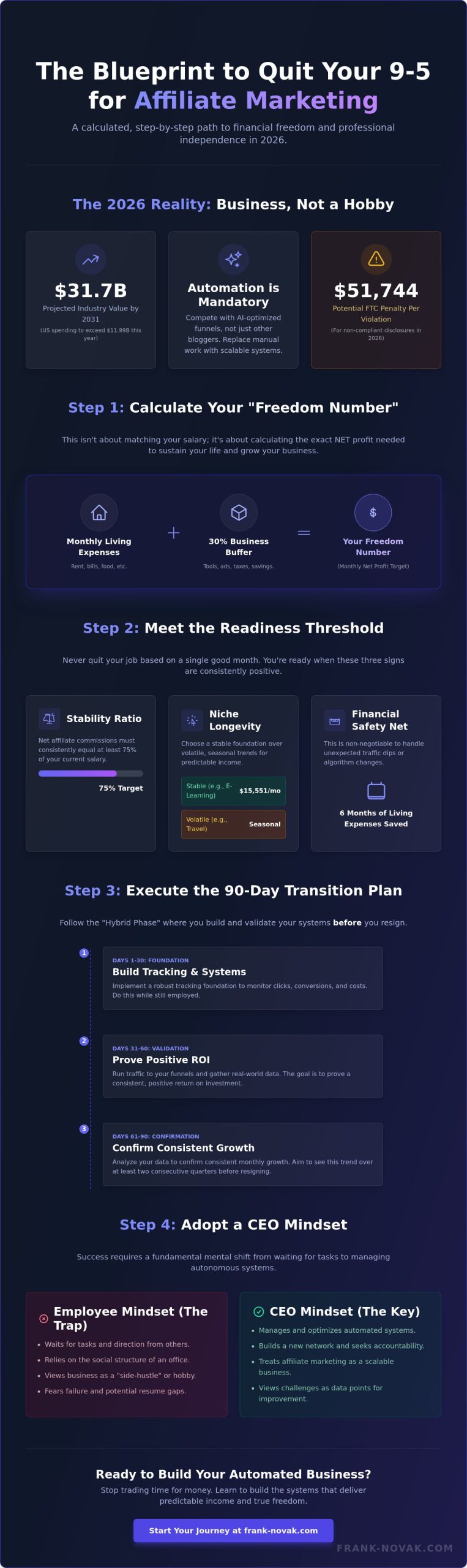
Many people are lured by the glossy image of the “laptop lifestyle,” but the 2026 reality is far more structured and data-driven. To understand what affiliate marketing is in a professional context, you have to view it as a sophisticated business system rather than a casual hobby. If you want to quit your job for affiliate marketing, you must realize that automation is no longer a luxury; it’s a baseline requirement. In a market where US affiliate spending is projected to exceed $11.99 billion this year, competition is intense. You aren’t just competing with other bloggers, you’re competing with AI-optimized funnels and high-budget campaigns. Success comes to those who replace manual labor with automated systems that remain compliant with strict 2026 FTC disclosure rules, which can carry penalties of up to $51,744 per violation.
To better understand how this transition works in practice, watch this helpful video:
Before you hand in your notice, you must enter the “Hybrid Phase.” This is the period where you maintain your 9-5 while your automated systems are live and generating real-world data. If you follow a logical path, you’ll know you’re ready to move from a side-hustle to full-time when you see three specific signs: consistent monthly growth over two quarters, a tracking system that proves a positive ROI, and an audience that regularly engages with your content. You should never quit before your systems are live; the pressure of needing immediate sales to pay rent often leads to poor business decisions and burnout.
The Readiness Threshold: When the Numbers Make Sense
A common mistake is leaving your job as soon as you see a single high-commission month. Instead, aim for a “Stability Ratio” where your net affiliate commissions consistently equal at least 75% of your current salary. Since intermediate affiliates typically earn between $1,000 and $10,000 per month, reaching this threshold is achievable with the right funnel. You must also assess your niche’s longevity. For instance, the education and e-learning niche currently averages $15,551 per month, providing a more stable foundation than seasonal travel trends. Finally, having six months of living expenses in a liquid savings account is non-negotiable to handle any unexpected dips in traffic or algorithm changes.
The Role of Mindset in Your Resignation Strategy
Transitioning to a digital business owner requires a total mental shift from an employee perspective. You’ll lose the social structure of a traditional office, which can lead to a sense of isolation if you aren’t prepared for the “loneliness of the entrepreneur.” Developing a strong affiliate marketing success mindset is just as important as mastering the technical side of your funnel, and it’s helpful to seek out online success coaching to maintain your momentum and stay accountable during those first few months of working for yourself. When you stop thinking like an employee who waits for tasks and start thinking like a CEO who manages automated systems, you’ve truly prepared to quit your job for affiliate marketing and build a lasting career.
The Financial Blueprint: Replacing Your Salary with Commissions
Success in this transition isn’t about how much you make in a single “lucky” week. It’s about your “Freedom Number,” which is the exact net profit you need to sustain your lifestyle after accounting for business overhead and personal obligations. When you plan to quit your job for affiliate marketing, you must calculate your current monthly expenses and add a 30% margin for business tools, hosting, and traffic acquisition. This isn’t just about matching your 9-5 take-home pay. It’s about building a surplus that allows your business to survive a month of low traffic or a sudden change in an affiliate program’s commission structure.
A critical part of this blueprint is understanding your tax obligations as a business owner. Unlike a traditional job where taxes are deducted automatically, you’re responsible for managing your own withholdings. For the 2026 tax year, the self-employment tax rate is 15.3% on net earnings over $400, which covers Social Security and Medicare. You also need to account for federal income tax, which ranges from 10% to 37% depending on your total earnings. If you expect to owe $1,000 or more in taxes for the year, you are required to make quarterly estimated tax payments. For more detailed guidance on these obligations, the Self-Employed Individuals Tax Center provides the necessary frameworks for staying compliant.
To avoid turning your new business back into a fragile “job,” you must diversify your income streams. Relying on a single program leaves you vulnerable to sudden account closures or policy shifts. Instead, aim for a mix of networks. You might combine the reliability of ShareASale with the high-percentage digital products found on ClickBank, which can offer up to 75% commissions. If you’re looking for a structured way to start, you might consider exploring the ClickBank Super Funnel to see how automated systems handle multiple products simultaneously.
High-Ticket vs. Low-Ticket: Which Replaces a Salary Faster?
The math of your transition depends heavily on your product mix. While $20 commissions from physical goods provide consistent data, it takes 250 sales to reach a $5,000 monthly goal. Conversely, high-ticket commissions of $500 only require 10 sales to hit that same target. Beginners often find the most stability by using low-ticket items to build an email list, while high-ticket offers provide the actual salary replacement. You can learn more about this balance in our guide on Financial Freedom Through Online Business.
Managing Cash Flow Gaps in Affiliate Payments
Affiliate networks don’t always pay instantly. Many operate on Net-30 or Net-60 terms, meaning you might wait two months to see the cash from today’s sales. This is why a “Buffer Account” is essential. You should have enough cash to cover two months of business expenses and personal bills before you officially quit your job for affiliate marketing. Recurring commission products, such as software subscriptions, are the “holy grail” for stability because they provide a predictable baseline of income that hits your account every month.
Building the Engine: Automation and Funnels
If you’re still manually posting links in social media groups or spending your evenings responding to individual comments, you haven’t built a business yet; you’ve simply created a second, more exhausting job. To truly quit your job for affiliate marketing, your income must be independent of your active hours. Manual promotion is the fastest route to burnout because it doesn’t scale. If you stop posting, the commissions stop flowing. A sustainable transition requires an automated “engine” that works around the clock, allowing you to focus on high-level strategy rather than repetitive tasks.
A salary-replacing funnel is the core of this engine. It typically consists of a lead magnet to capture contact information, a bridge page to establish your authority, and an automated email sequence that nurtures the lead. This structure ensures that every visitor has multiple opportunities to see your offer. For many, the technical barrier of building these pages is the biggest hurdle. You can leverage the ClickBank Super Funnel to skip the complex setup and move directly to the revenue-generating phase of your journey. This system acts as your 24/7 salesman, sending out automated broadcasts that deliver value and drive sales while you sleep or handle your current 9-5 responsibilities.
Choosing Your Primary Traffic Source
Your funnel needs a consistent stream of visitors to function. Facebook Ads offer incredible scale, allowing you to reach thousands of potential customers quickly. However, it’s vital to follow a proven strategy to drive traffic without risking account bans. Alternatively, organic social media allows you to build a personal brand that feeds your funnel for free, though it takes longer to gain momentum. If you’re leaning toward paid traffic, our guide on Facebook Ads for Affiliate Marketing provides the technical framework needed for sustainable growth.
Compliance and Business Longevity
Longevity in this industry depends on staying within the rules of both the ad platforms and the affiliate networks. Direct linking, or sending an ad straight to an affiliate offer, is a common mistake that often leads to permanent account bans. By building a “Compliant Bridge” page between your ad and the product, you satisfy platform requirements while pre-selling the visitor on the benefits. Utilizing automated marketing funnels protects your digital assets by ensuring every step of the customer journey is under your control. This layer of protection is what allows you to quit your job for affiliate marketing with the confidence that your income won’t vanish overnight due to a simple policy change.
The 90-Day Transition Strategy: From Office to Home
Moving from a steady paycheck to a commission-based income is a process that requires patience and a structured calendar. If you want to quit your job for affiliate marketing, you need a timeline that respects your financial safety while building your business assets. This 90-day window isn’t about working harder; it’s about working smarter to ensure your systems are robust enough to support you once the 9-5 safety net is gone.
- Month 1: The Foundation. Your first 30 days are dedicated to technical setup. You’ll establish your tracking software, build your lead magnets, and launch your first funnel. The goal here isn’t profit, but data. You’re learning how your chosen audience interacts with your pages.
- Month 2: The Optimization. During this phase, you focus on testing traffic sources and finding your return on investment (ROI). You’ll tweak your headlines, test different ad creatives, and identify which products are resonating.
- Month 3: The Scale. Once you’ve found a profitable pocket, you begin increasing your ad spend. You’re looking for income consistency. If your funnel can produce a profit for 30 consecutive days, you have the proof of concept needed to consider your exit strategy.
When you finally have the data to support your move, the “Resignation Talk” should be professional and forward-looking. Leave your job without burning bridges by providing standard notice and ensuring your current responsibilities are handed over smoothly. This structured approach allows you to quit your job for affiliate marketing with a proven track record of profit rather than a hopeful guess.
Phase 1: Validating Your Business Model
Validation begins with small-scale testing. You don’t need a massive budget to start; running your first $100 in ad spend is often enough to see if your funnel converts. This stage is about identifying “Winning” products that align with your specific traffic source. A Winning Product is one that yields a 20% ROI over a 14-day period. Once you hit this metric, you know you have a system that can be scaled with more capital.
Phase 2: Scaling Beyond the Side-Hustle
Scaling requires you to shift your schedule from “after-work hours” to “CEO blocks.” This means dedicating specific, uninterrupted time to high-level strategy rather than just reacting to emails. As your volume increases, you might find it helpful to use online success coaching to identify bottlenecks in your funnel that you might have missed. Eventually, you’ll reach a point where you should outsource low-level tasks, such as basic graphic design or copy tweaks, to keep your focus on growth. If you are ready to move past the technical hurdles and start seeing real results, joining the Clickbank Profit Club can provide the community and roadmap you need to succeed.
Scaling to 6-Figures and Beyond: Life After the 9-5
Leaving the office is a significant milestone, but the first six months are the true test of your business’s longevity. During this window, you must solidify your habits and ensure your automated systems are running efficiently without the pressure of a looming deadline from a manager. If you’ve managed to quit your job for affiliate marketing, you’ve already proven you have the drive; now you must prove you have the endurance. Complacency is the silent killer of new businesses, so maintaining a disciplined schedule is essential to avoid the trap of laziness that often follows the loss of a traditional structure.
One of the most effective ways to scale your income is by building a personal brand. While paid ads are excellent for rapid growth, they can be expensive if you rely on them exclusively. By establishing yourself as a trusted authority, you create a loyal audience that lowers your long-term customer acquisition costs. People buy from those they know and trust, and a personal brand turns one-time clicks into lifetime commissions. This trust acts as a multiplier for every ad dollar you spend, making your entire system more efficient and resilient to market changes. Cultivating the right affiliate marketing success mindset during this phase is what separates entrepreneurs who plateau from those who continue to scale.
Leveraging High-Ticket Engines
High-ticket offers are the fastest way to reach six figures and beyond. While low-ticket products are great for building your list, high-ticket webinars provide the massive injections of cash needed for significant expansion. You can integrate these into your existing funnels by using Webinar Profit Engines, which automate the heavy lifting of high-value presentations. Additionally, scaling through Ambassador JV opportunities allows you to partner with other established marketers to reach entirely new audiences without increasing your ad budget. This collaborative approach turns the lonely path of entrepreneurship into a shared journey of growth.
Long-Term Sustainability and Growth
To ensure your business thrives for years, you cannot rely on a single source of traffic or a single platform. If one social network changes its algorithm, you need other channels to pick up the slack. Diversifying into SEO, YouTube, or alternative social platforms creates a safety net for your income. For a deeper look at how this works in practice, you can review our Case Study in Automation and Growth to see real-world examples of scaling. Remember, your previous job was just the training ground for the skills you’re using now; affiliate marketing is the career that will provide the freedom you’ve earned. Stay focused on the mechanics, keep your systems automated, and your professional independence will remain secure.
Your Roadmap to Professional Independence
Transitioning from a 9-5 to a digital business isn’t a leap of faith; it’s a series of intentional, data-driven steps. By establishing your “Freedom Number” and building a system that prioritizes automation over manual labor, you’ve already laid the groundwork for a sustainable future. If you follow the 90-day roadmap we’ve discussed, you can quit your job for affiliate marketing without the fear of financial instability or the stress of an unexplained resume gap.
If you’re ready to stop guessing and start scaling, I’m here to help you navigate this transition. With over 8 years of digital marketing experience, I specialize in ClickBank and Facebook Ad automation to ensure your business runs efficiently. My proven “Super Funnel” architecture is designed to handle the technical heavy lifting so you can focus on high-level growth. Ready to build your exit strategy? Join the Online Success Coaching program today.
You now have the blueprint and the tools to change your professional landscape. The journey to time freedom starts with a single, calculated decision to invest in your own potential. Your future is waiting for you to take the first step.
Frequently Asked Questions
How much money do I need to start affiliate marketing full-time?
You should have enough capital to cover your business overhead and at least six months of personal living expenses. While you can start the technical setup with a few hundred dollars for hosting and basic tools, scaling to a full-time income requires a consistent budget for traffic acquisition. If you plan to quit your job for affiliate marketing, ensuring you have this financial cushion prevents you from making desperate, short-term decisions that could harm your long-term growth.
Is affiliate marketing still profitable in 2026 with AI and competition?
The industry remains highly profitable with US spending expected to exceed $11.99 billion in 2026. While AI has increased competition, it also allows individual marketers to handle tasks that previously required an entire team. By using AI for content creation and campaign optimization, you can maintain high-quality standards while keeping your overhead low. Success in 2026 depends on using these tools to build authentic connections rather than just generating low-value, automated spam.
How long does it typically take to replace a full-time salary?
Most intermediate marketers reach a salary-replacing level of $1,000 to $10,000 per month within one to three years of consistent effort. While our 90-day transition strategy provides the framework for a safe exit, the actual time to match your specific 9-5 income depends on your niche and traffic efficiency. If you focus on high-ticket offers and automated funnels, you can often reach your “Freedom Number” faster than those relying solely on low-commission physical products.
Do I need a website to quit my job for affiliate marketing?
You don’t necessarily need a traditional multi-page website, but you do need a professional landing page or funnel system. Direct linking to offers is often penalized by ad platforms and doesn’t allow you to build an email list. To quit your job for affiliate marketing successfully, you must own the customer relationship. A simple, automated funnel serves as your digital storefront, allowing you to capture leads and follow up with them through automated email sequences.
What are the biggest risks of quitting a job for an online business?
The primary risks include income volatility and the sudden loss of traffic sources or affiliate accounts. Unlike a traditional job, your earnings can fluctuate based on algorithm changes or seasonal trends. You also lose employer-sponsored benefits like healthcare and retirement matching. To mitigate these risks, you must account for the 15.3% self-employment tax and maintain a robust “Buffer Account” that can sustain your business during months where commissions might dip below your average.
Can I do affiliate marketing without showing my face or being an influencer?
You can absolutely build a successful business without ever showing your face or becoming a public influencer. Many high-earning affiliates operate “faceless” funnels that focus entirely on the product’s benefits rather than a personal brand. By using paid traffic sources like Facebook Ads or search engine marketing, you can drive targeted visitors to your offers based on their specific interests and intent. This approach allows you to maintain your privacy while building a highly scalable income.
What happens if my Facebook ad account gets banned after I quit?
If an ad account gets banned, your income could stop instantly if you haven’t diversified your traffic. This is why we emphasize building an email list and using “Compliant Bridge” pages to protect your assets. Professional affiliates always maintain backup traffic sources, such as organic social media or alternative ad networks. Having these contingencies in place ensures that a single platform’s policy change doesn’t jeopardize your ability to remain self-employed after you’ve left your job.
How do I explain my new “job” to family or mortgage lenders?
When speaking with family or lenders, it’s best to describe your business as a digital marketing or performance-based consultancy. Lenders typically look for two years of consistent tax returns, so keep detailed records of your 1099-NEC forms and business expenses. Explaining that you manage automated sales systems for established brands often feels more professional than using niche jargon. This framing demonstrates that you’re running a legitimate, scalable business with a clear revenue model and long-term stability.

Article by
Frank Novak
Frank Novak is an online marketing professional and coach who focuses on affiliate marketing and business automation. Through his website, frank-novak.com, he shares insights and strategies for leveraging social media platforms like Facebook to generate traffic and commissions.
Affiliate / Sponsored Content Disclaimer
This [website/post] contains affiliate links. If you click through and make a purchase, we may receive a commission at no additional cost to you. We only recommend products or services we believe will add value to our readers.