

What if the key to scaling your commissions wasn’t about spending more hours at your desk, but about stepping away from it entirely? If you’ve spent your evenings manually posting to social media only to see inconsistent results, you’re not alone. Many creators feel trapped in a cycle of direct linking and the constant fear of sudden platform bans. Learning how to automate affiliate marketing is the essential shift that moves you from a tired freelancer to a strategic business owner. By 2026, the global affiliate industry is projected to reach $19.4 billion, and those who thrive are the ones who embrace systems over manual labor.
If you’re ready to stop trading your time for every click, you’ll find that a reliable “set and forget” funnel is more accessible than you might think. This article provides a framework to help you transition from the daily grind to a fully automated ecosystem. We’ll explore how to build a steady lead flow and an email list that works for you 24/7. You’re about to see how a structured approach, similar to what we teach in our Online Success Coaching, can provide the professional freedom and consistent income you’ve been working toward.
Key Takeaways
- Understand the fundamental shift from the “Manual Grind” to a “Systematic Scale” model that prioritizes long-term business growth over daily chores.
- Learn exactly how to automate affiliate marketing by building a “Super Funnel” that bridges the gap between your traffic sources and high-converting offers.
- Discover a compliance-first approach to driving scalable traffic that protects your ad accounts while delivering a consistent flow of new leads.
- Implement an automated email follow-up system that acts as a 24/7 sales team, nurturing relationships and capturing commissions during the critical follow-up phase.
- Identify why professional mentorship and strategic coaching are the most effective ways to optimize your automated engine for sustainable online success.
What is Affiliate Marketing Automation and Why Does It Matter?
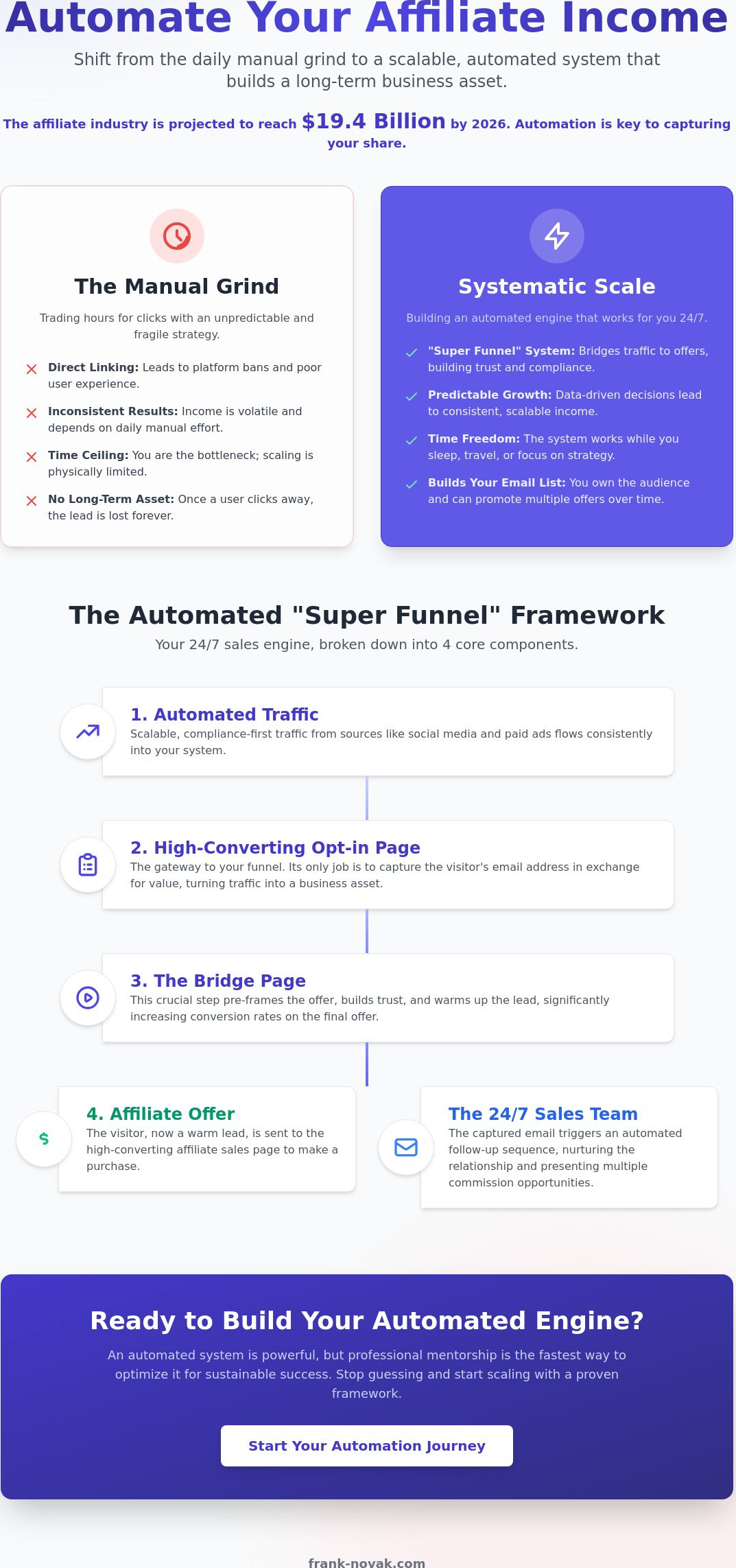
Automation in this field isn’t just about using software; it’s about building a predictable machine that works while you sleep. At its core, affiliate marketing automation is the strategic use of digital systems to manage lead capture, relationship nurturing, and traffic distribution without your constant manual input. While traditional Affiliate marketing often involves a “Manual Grind” where you’re constantly hunting for the next click, the “Systematic Scale” model allows you to focus on the architecture of your business. This transition relies on three core pillars: Automated Traffic, the Sales Engine (your funnel), and Relationship Nurturing through automated email sequences.
A common misconception is that automation means “no work.” In reality, it represents “leveraged work.” You invest your time upfront to build a system that produces results long after you’ve finished the initial setup. Understanding how to automate affiliate marketing effectively means you’re creating a business that isn’t dependent on your physical presence at a keyboard every hour of the day. It’s the difference between being an employee of your own brand and being the director of an automated marketing funnel enterprise.
To better understand this concept, watch this helpful video:
The Benefits of a Hands-Off Affiliate System
Scaling a manual business eventually hits a ceiling because you only have 24 hours in a day. Systems don’t have this limitation. When you move to a hands-off approach, you gain the ability to scale your efforts exponentially. Beyond just growth, automation provides much clearer data for ROI tracking. Instead of guessing which social post worked, you can see exactly how much every lead cost and what their lifetime value is. This clarity allows you to make calm, data-driven decisions while reclaiming your schedule for high-level strategy and personal time.
Manual vs. Automated: A 2026 Comparison
The old “Direct Link” method is becoming a relic of the past. In 2026, most major ad platforms and social networks actively reject or shadow-ban direct affiliate links because they often lead to a poor user experience. By using an automated funnel, you provide a bridge between the ad and the offer, which keeps platforms happy and builds your own business asset at the same time. The primary difference is the mailing list. A manual marketer loses the lead the moment they click; an automated marketer captures that lead, allowing for consistent follow-ups and multiple commission opportunities over the long term.
Building Your Sales Engine: The Automated Funnel Framework
To truly master how to automate affiliate marketing, you have to move beyond the idea of a simple referral link. Successful systems rely on what we call a “Super Funnel.” This architecture acts as a deliberate bridge between your traffic source and the final affiliate offer. Instead of sending a cold visitor directly to a sales page where they’re likely to bounce, a Super Funnel captures their interest and warms them up. This structured approach is a cornerstone of a modern AI marketing strategy, as it allows you to use smart systems to handle the initial introduction and sorting of leads. If you’d rather avoid the technical heavy lifting, the ClickBank Super Funnel provides this entire architecture in a pre-built, ready-to-use format.
The beauty of this framework is its consistency. Once the engine is built, it doesn’t get tired or take days off. It treats every visitor with the same level of professional care, ensuring that your marketing message remains clear and persuasive 24/7. This engine is composed of three technical components: the Opt-in page, the Bridge page, and the final Affiliate Offer. When these parts are aligned, the transition from curious browser to happy customer feels natural and effortless. For a deeper look at how these components work together at scale, the complete guide to scaling a digital business with funnels provides the architectural framework you need to grow without adding complexity.
Step 1: The High-Converting Opt-in Page
The first stage of your automated sales engine is the opt-in page. Its only job is to turn a visitor into a lead by offering something of immediate value. This is where the Lead Magnet comes into play. A Lead Magnet is a value-first trade where you provide helpful insights or a quick win in exchange for a person’s email address. To make this page convert, you need a strong hook that speaks to a specific problem, a few bullet points that promise a solution, and a clear call to action (CTA). By focusing on one simple goal, you ensure your automation starts with a high volume of new leads entering your system.
Step 2: The Bridge Page Strategy
The Bridge Page is often the missing piece for those struggling with low conversion rates. This page sits between your opt-in and the vendor’s sales page, and it’s the secret to high-ticket affiliate success. Here, you have the opportunity to “pre-sell” the offer. By using a short video or a personal story, you build trust and explain exactly why the product you’re recommending is the right choice. This personal touch makes a significant difference in how leads perceive the offer. Furthermore, having your own bridge page protects your ad accounts. Many platforms flag direct affiliate links as low-quality destinations, but a well-structured bridge page keeps your traffic compliant and your accounts safe. If you’re feeling overwhelmed by the technical side of building these pages, looking into pre-built funnel systems can help you get started much faster.
Automating Traffic: Driving Leads Without the Manual Hustle
Once your sales engine is ready, you need a reliable way to fuel it with high-quality visitors. Relying on manual social media posts or organic outreach often leads to burnout and inconsistent results. If you want to master how to automate affiliate marketing, you must embrace scalable traffic sources like Facebook Ads. Unlike manual posting, paid traffic allows you to reach thousands of potential customers instantly. By using the Facebook Pixel, you can let the platform’s algorithm identify individuals who are most likely to engage with your offer. This data-driven approach transforms your marketing from a guessing game into a predictable system.
Many people hesitate to use paid traffic because they fear the costs. However, successful automated systems often utilize a “Break-Even Funnel” strategy. In this model, the initial commissions you earn from your bridge page or immediate upsells cover your daily ad spend. When your funnel pays for itself, your lead generation becomes essentially free. This allows you to grow your email list and scale your business without draining your personal savings. It’s a shift from seeing ads as an expense to seeing them as a strategic investment in your growth. For a comprehensive breakdown of how to build a self-sustaining lead generation engine, the automated marketing funnel guide for 2026 walks you through every stage of creating a system that captures leads and generates commissions on autopilot.
Facebook Ad Compliance for Affiliates
The biggest hurdle for many marketers is the fear of account bans. To stay safe, you must adopt a “Compliance-First” approach. Facebook’s primary goal is to protect the user experience, so your ads should provide genuine value rather than using “get rich quick” hype or aggressive claims. Always ensure your automated landing pages include a clear privacy policy and terms of service. By following proven Facebook ads for affiliate marketing strategies, you can build a long-term presence that the platform trusts. Remember, your bridge page (which we discussed in the previous section) acts as a vital safety buffer between the ad network and the affiliate offer.
Scaling with Automated Bidding and Optimization
In 2026, the most effective way to manage your traffic is to let the technology do the heavy lifting. Using Campaign Budget Optimization (CBO) allows Facebook to distribute your budget to the best-performing ad sets automatically. You can also set up automated rules within the Ads Manager to manage your campaigns while you sleep. For example, you can create a rule that automatically pauses an ad if the cost per lead exceeds a certain amount, or increases the budget when an ad is performing exceptionally well. The industry has shifted toward “Broad” targeting, where you trust the algorithm’s ability to find your audience based on your ad creative rather than manual interest tweaking. This hands-off approach ensures your traffic stays consistent without requiring you to monitor the dashboard every hour.
Automating the Relationship: The 24/7 Email Follow-Up
If you’ve ever wondered why some marketers seem to make sales effortlessly while others struggle, the secret often lies in their follow-up strategy. While your funnel captures the lead and your ads drive the traffic, the real profit is usually found in the inbox. It’s a widely recognized industry reality that approximately 80% of commissions happen between the fifth and twelfth contact with a lead. Without a system to handle this, you’re likely leaving the vast majority of your potential income on the table. This is where an autoresponder becomes your most valuable asset, acting as a dedicated sales team that works every hour of the day.
Learning how to automate affiliate marketing effectively requires a shift from “blasting” links to building genuine trust. One of the most successful methods for doing this is the “Soap Opera Sequence.” This is a series of automated emails that tell a story, creating an emotional connection with your audience. By sharing relatable experiences and highlighting the “problem” your audience faces, you position yourself as a helpful guide. It’s essential to maintain a healthy balance; if you only send promotional offers, people will quickly tune you out. However, if you provide consistent educational value, your audience will be much more receptive when you eventually introduce the solution.
The First 7 Days: Your Automated Welcome Sequence
During the first week, your automated welcome sequence handles the critical task of making a great first impression. On Day 1, your system should immediately deliver the lead magnet you promised on your opt-in page to build credibility. From Days 2 to 4, your emails should focus on providing value and identifying the specific pain points your affiliate offer is designed to solve. By Days 5 to 7, you can introduce the affiliate product as the definitive solution. This transition feels natural because you’ve already spent several days demonstrating that you understand the reader’s needs.
Long-term Nurturing with Broadcasts and Segments
As your list grows, you can use “trigger-based” automation to make your communication even more personal. This allows your system to send specific emails based on which links a subscriber clicks, ensuring they only receive content that is relevant to their interests. Maintaining a healthy list is just as important as growing one. You can set up automated rules to perform “list hygiene,” which involves removing inactive subscribers who haven’t engaged with your content in several months. This practice ensures your emails actually reach the people who want to read them. Some industry reports indicate that using automated segmentation can increase your email open rates by 14% on average. If you’re looking for a way to implement these sequences without writing them from scratch, our ClickBank Super Funnel comes with pre-built email architecture ready for your offers.
Scaling Your System: From Automation to Online Success Coaching
Building an automated business is a significant achievement, but it’s important to remember that a machine is only as good as its operator. Once you’ve mastered the basics of how to automate affiliate marketing by setting up your funnel and traffic sources, the focus naturally shifts toward optimization. A system provides the structure, but strategy provides the direction. Without a clear plan for growth, even the most efficient automation can lead to a plateau. This is where professional mentorship becomes the essential shortcut to scaling your digital business and maximizing your return on investment.
Transitioning from a manual hustle to a systematic scale requires a change in mindset. You’ve already done the hard work of building the engine and automating the fuel delivery. Now, the goal is to fine-tune that engine for peak performance. Professional Online Success Coaching acts as the diagnostic tool you need to troubleshoot bottlenecks and identify new opportunities for growth. It’s the final piece of the puzzle that turns a functional system into a high-performance commission generator that operates reliably 24/7.
Why DIY Automation Often Fails
Many aspiring marketers fall into what we call the “Technical Trap.” This happens when you spend months obsessing over specific tools and software configurations instead of focusing on the actual marketing and relationship building. While the tech is necessary, it shouldn’t be the primary focus of your day. There is also the “Compliance Gap” to consider. Ad platforms like Facebook have unwritten rules and shifting algorithms that can catch a solo operator off guard. If you don’t know the nuances of 2026 compliance, you risk losing your accounts and your traffic overnight. Having an expert who monitors these trends provides a layer of security that you simply can’t get by going it alone. An expert can look at your funnel metrics and spot the small leaks that are draining your profits, offering solutions that you might have missed.
Your Next Steps to Affiliate Freedom
If you’re ready to claim your time back, start by auditing your current daily routine. Identify the manual tasks that are the most repetitive and make them the first priority for automation. You don’t have to build every component from scratch. Using a proven, pre-built template like the ClickBank Super Funnel allows you to bypass the technical hurdles and launch your system much faster. Finally, don’t underestimate the power of a supportive community. Joining a structured coaching program ensures you stay ahead of industry shifts and algorithm changes. This proactive approach turns the complexity of modern affiliate marketing into a clear, manageable roadmap for long-term success.
Your Roadmap to Sustainable Affiliate Growth
Embracing a systematic approach is the most effective way to reclaim your time while building a scalable business asset. You now have the blueprint for how to automate affiliate marketing by combining a compliant traffic engine with a robust follow-up sequence. This transition moves you away from the exhaustion of manual posting and toward a model that rewards strategic architecture over repetitive labor. By focusing on the three pillars of traffic, funnels, and relationships, you’re creating a foundation that can withstand industry shifts.
While the systems handle the heavy lifting, professional mentorship provides the necessary oversight to keep your engine running at peak performance. Frank Novak offers over 7 years of experience in online marketing, specializing in ClickBank success and the nuances of Facebook Ad compliance. By leveraging the proven “Super Funnel” architecture, you can skip the technical trial and error that often holds others back. It’s about working smarter so you can enjoy the freedom you set out to achieve.
Ready to stop the manual grind? Apply for Online Success Coaching with Frank Novak today.
You have the tools and the framework; now it’s time to take the first step toward your professional freedom and long-term success.
Frequently Asked Questions
Is affiliate marketing automation beginner-friendly?
Yes, automation is beginner-friendly when you follow a structured framework rather than trying to invent your own systems. Many newcomers find that learning how to automate affiliate marketing is actually simpler than manual outreach because it provides a clear, step-by-step process to follow. If you start with a pre-built architecture like the ClickBank Super Funnel, you can bypass the most difficult technical hurdles and focus on your strategy from day one.
What tools do I need to start automating my affiliate business?
You primarily need three types of tools: a funnel builder for your landing pages, an email autoresponder for follow-ups, and a tracking platform to monitor your results. While there are many individual software options available, the most important factor is how well they integrate with each other. A seamless connection between your traffic source and your email list is what allows the entire system to run without your constant supervision.
How much does it cost to set up an automated affiliate funnel?
The cost varies depending on the specific software you choose for your tracking and email needs. For example, industry tracking platforms like Tapfiliate start around $89 per month, while email autoresponders often have tiered pricing based on the size of your subscriber list. You should also budget for your initial ad spend. It’s helpful to view these costs as necessary overhead for a business that operates 24/7.
Can I automate affiliate marketing for free?
While you can find free versions of some tools, true automation usually requires a modest investment to be effective. Free platforms often have strict limitations on the number of leads you can collect or the complexity of your automated email sequences. If you’re serious about building a reliable system, investing in professional-grade tools ensures that your business remains stable and scales effectively as your traffic grows.
How do I prevent my Facebook ad account from being banned while using automation?
Preventing bans requires a strict compliance-first approach that prioritizes the user experience over aggressive sales tactics. You must avoid hype-filled claims and always use a bridge page to provide a buffer between your ad and the affiliate offer. Ensuring your landing pages have visible privacy policies and terms of service is also essential. This professional setup signals to ad platforms that you’re a legitimate business owner.
Do I need to be a tech expert to set up these systems?
You don’t need to be a tech expert to manage these systems in 2026. Most modern platforms use intuitive drag-and-drop interfaces that allow you to build pages and set up email triggers without writing a single line of code. If you can navigate a basic web browser, you have the skills necessary to operate an automated funnel, especially if you’re working with a mentor who can guide you through the configuration.
How long does it take to see results from an automated system?
The timeline for seeing results depends on your traffic volume and the quality of the offer you’re promoting. Some users see their first leads within hours of launching an ad campaign, while the process of optimizing for profit usually takes a few weeks of consistent data collection. It’s important to remember that automation is about building a long-term asset that provides steady growth rather than searching for an overnight win.
Is automated affiliate marketing still profitable in 2026?
Yes, it is. The global industry is projected to reach $19.4 billion in 2026, making this an ideal time to learn how to automate affiliate marketing. Businesses earn an average return of $6.50 for every $1 spent on these programs. As brands move away from traditional ads toward creator partnerships, having an automated system allows you to scale your commissions alongside this massive industry growth.

Article by
Frank Novak
Frank Novak is an online marketing professional and coach who focuses on affiliate marketing and business automation. Through his website, frank-novak.com, he shares insights and strategies for leveraging social media platforms like Facebook to generate traffic and commissions.
Affiliate / Sponsored Content Disclaimer
This [website/post] contains affiliate links. If you click through and make a purchase, we may receive a commission at no additional cost to you. We only recommend products or services we believe will add value to our readers.