

The most crowded niches on ClickBank aren’t your biggest threat; they’re actually your most reliable source of profit. If you’ve ever felt the frustration of watching your ad spend vanish while trying to compete with ‘Super Affiliates’, you’re certainly not alone. It’s natural to feel a bit overwhelmed when you’re unsure how to look under the hood of a successful competitor’s landing page or why their funnel seems to convert so well. Learning exactly how to analyze competition on ClickBank is the fundamental shift that transforms a struggling campaign into a scalable, predictable business.
You likely already understand that high competition proves there’s plenty of money to be made, but finding your specific place in that market requires a more methodical approach. I’ll help you master the art of reverse-engineering top affiliate campaigns so you can find a competitive edge that others often overlook. This guide provides a clear checklist for vetting your rivals, explains the 2026 metrics that truly drive results, and offers a plan to differentiate your own funnel. We’ll move through this process step-by-step to ensure you have a reliable roadmap for your growth.
Key Takeaways
- If you want to avoid wasting time on dead offers, the ‘Validation Rule’ helps you see why high competition is a sign of a healthy market.
- You will master the essential 2026 metrics, such as the Momentum Score, to gain a deeper understanding of how to analyze competition on ClickBank.
- By learning a reliable framework for reverse-engineering competitor funnels, you can use tools like the Facebook Ads Library to see exactly what works.
- We will explore how to map out where high-quality leads are hiding across various traffic sources so you can better target your own audience.
- You will discover how to apply your competitive insights to differentiate your offer and scale your results through strategic automation.
The Reality of ClickBank Competition: Why Saturated Markets Are Often Best
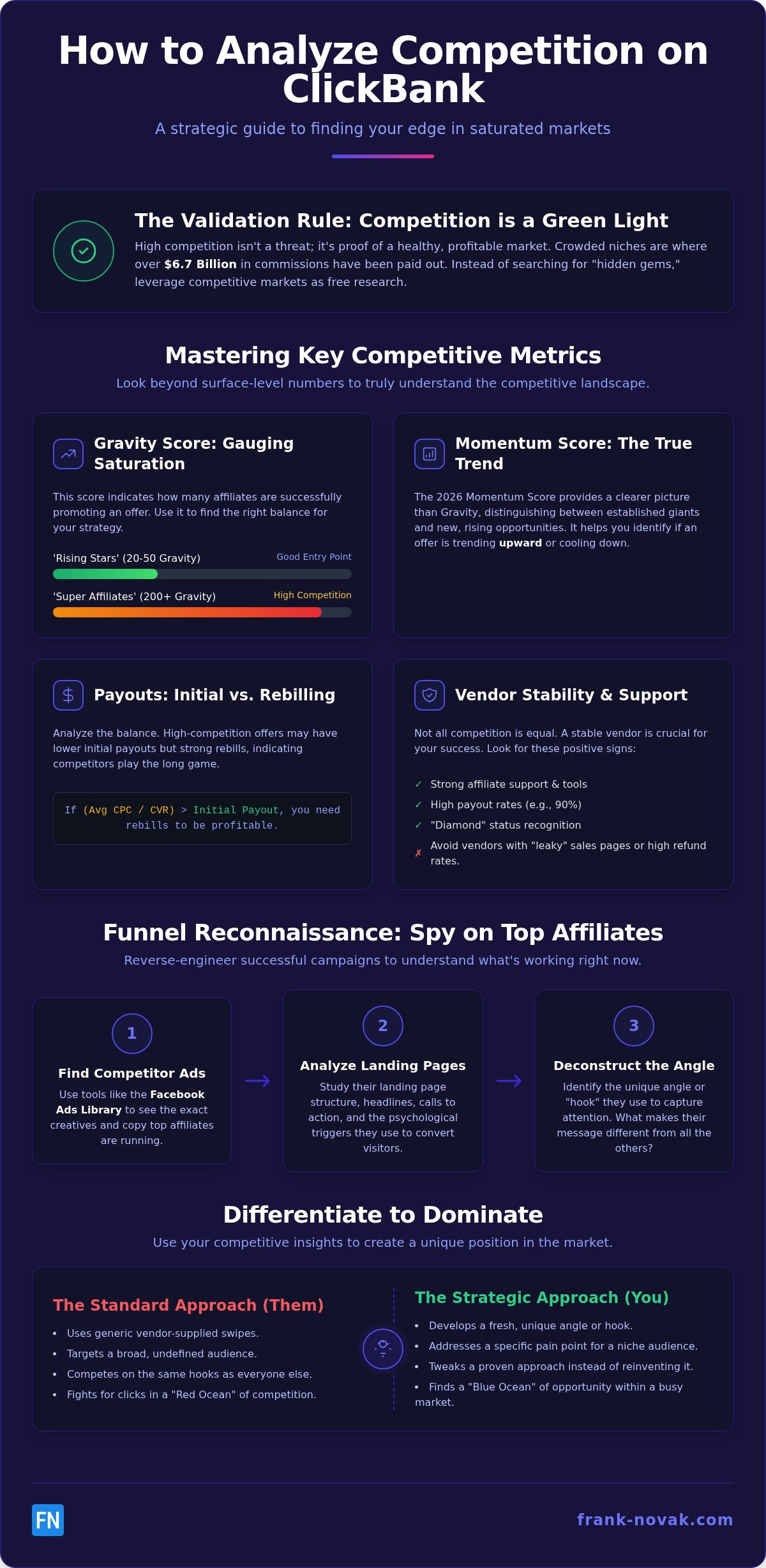
Understanding the competitive landscape in 2026 requires a fundamental shift in perspective. Many new affiliates fear “saturated” markets, yet these are often the only places where you’ll find consistent commissions. If you’re learning how to analyze competition on ClickBank, you first need to accept the Validation Rule. This rule suggests that if no other affiliates are successfully promoting a product, there’s likely a logical reason for it. High competition is simply a signal that a specific offer has already been tested and proven by the market. Since its founding, the ClickBank platform has paid out over $6.7 billion in commissions, and the bulk of that money flows through the most competitive niches.
Instead of avoiding competition, you should use it as a free source of market research. By observing what top-performing offers like ProDentim or The Genius Song are doing, you gain insight into what customers actually want. You aren’t looking for a market that is empty; you’re looking for a market that is sophisticated. Market sophistication refers to how many similar messages your audience has already heard. If you can offer a fresh angle in a busy niche like Dietary Supplements, you’ll find much more success than trying to create demand where none exists.
The Myth of the ‘Hidden Gem’ Product
It’s tempting to look for low-gravity products to avoid “Super Affiliates,” but this often leads to broken funnels and wasted ad spend. When you promote a product with zero competition, you’re essentially paying to be the vendor’s research and development department. You have to test the hooks, the creatives, and the landing pages entirely on your own dime. In contrast, high-competition categories allow you to find “Blue Oceans” by simply tweaking an existing, successful approach. This research phase is essential before you consider deploying a system like the ClickBank Super Funnel to automate your traffic.
Vetting the Vendor’s Stability
Not all competition is created equal. While a high Gravity Score is a good sign, you must also look at the vendor’s track record. Some vendors have “leaky” sales pages that prioritize their own email lists over your affiliate commissions. If a vendor doesn’t provide strong affiliate support or has a history of high refund rates, even a popular product can become a trap. Part of knowing how to analyze competition on ClickBank involves checking if the vendor offers 90% payouts or “Diamond” status. These are hallmarks of stability that ensure your efforts are actually rewarded.
Mastering ClickBank Metrics: A Deep Dive into Competitive Data
To truly understand how to analyze competition on ClickBank, you must look past surface-level numbers. While many affiliates fixate on the Gravity score, the 2026 Momentum score provides a much clearer picture of whether an offer is trending upward or cooling down. This metric helps you distinguish between established giants and new opportunities that haven’t been fully tapped yet. When you assess these dynamics, it’s helpful to consider broader online platform competition policies that influence how digital marketplaces evolve and how vendors maintain their dominance.
You should also pay close attention to the balance between Initial $/Sale and Rebilling revenue. High-competition products often have lower initial payouts because vendors spend heavily on their own customer acquisition. If a product offers a high subscription rebill, it suggests that competitors are willing to wait longer for profit, which raises your break-even threshold. You can calculate this by dividing your average cost per click by your expected conversion rate. If the resulting number is higher than the initial payout, you’ll need those rebills just to stay afloat. Checking the vendor’s ‘Affiliate Tools’ page is another vital step. If they provide high-quality swipe files and professional creatives, you’re likely facing sophisticated rivals who are already using these assets effectively.
The Truth About Gravity Scores
A Gravity score of 200 or higher tells you that your rivals are likely spending thousands on daily ad placements. This isn’t necessarily a reason to walk away, but it does mean you need a unique angle to stand out. If you’re just starting out, ‘Rising Star’ products with a Gravity score between 20 and 50 often provide a better balance. These offers have proven they can convert without being so crowded that ad costs become prohibitive. Be wary of ‘Gravity Spikes’ that appear during temporary product launches. If you see a sudden jump that doesn’t hold steady, it might be a sign of a short-term trend rather than a sustainable business model. For those who want more personalized guidance on interpreting these shifts, Online Success Coaching can help you identify which products are actually worth your time.
Earnings Per Click (EPC) and Conversion Rates
A high EPC is the ultimate indicator of a winning offer because it accounts for every step of the customer journey. If an offer like ProDentim shows an EPC of $1.30, you know exactly what you can afford to pay for traffic. Comparing your funnel’s potential against these industry averages allows you to see if your creative approach is competitive. Earnings Per Click (EPC) is the true north for affiliate scaling because it provides a direct correlation between your traffic costs and your eventual profit. Once you find an offer where the EPC consistently exceeds your costs, you have found a campaign that is ready to scale.
Funnel Reconnaissance: How to Spy on Top-Tier Affiliates
Most guides suggest looking at the Marketplace and stopping there, but that only gives you half the picture. If you want to understand how to analyze competition on ClickBank with precision, you have to step outside the platform and see what’s happening on the front lines. This involves finding the actual ads and funnels that Super Affiliates are currently using to drive their traffic. By reverse-engineering their path, you can save yourself months of trial and error and identify exactly where the market is responding. I use a simple 5-step framework to break down any competitor funnel:
- Locate the active ad creative using public libraries.
- Capture the primary headline and emotional hook.
- Identify the funnel type, such as a quiz, advertorial, or direct bridge page.
- Analyze the call-to-action and any scarcity tactics used.
- Verify the mobile responsiveness and page load speed.
When you look at these elements, you’ll start to see a pattern in the ‘Hook’ your rivals use to grab attention. Often, it’s a specific curiosity-driven angle like “the 30-second morning ritual” or a surprising health fact. Identifying these hooks tells you what’s currently working in the 2026 landscape. It’s also helpful to keep in mind how platforms favor products through their internal algorithms, as this often dictates which affiliates get the most visibility in search results and ad placements.
Social Media Reconnaissance
You don’t need a massive software budget to see what’s working on social media. The Facebook Ads Library is a completely free tool that allows you to search for specific product names or keywords. If you see an ad that’s been active for several months, it’s a clear sign that the campaign is profitable. You can also spot ‘Ad Fatigue’ in a niche if you see many affiliates using the exact same image or video. This is your entry point to offer something fresh. Mastering this research is a core part of running Facebook Ads for Affiliate Marketing effectively.
Anatomy of a Winning Landing Page
Once you click through an ad, you should carefully analyze the landing page. Look for how they use social proof and where they place their primary buttons. In 2026, mobile optimization is the most critical factor for success. If a competitor’s page is slow or looks cluttered on a phone, that’s a weakness you can exploit. You can use browser extensions like BuiltWith or Wappalyzer to see which tracking software and plugins they use. This technical insight helps you understand how to analyze competition on ClickBank by seeing the exact tools your rivals rely on to manage their scaling.
Traffic Source Analysis: Finding Where the Leads Are Hiding
Identifying where your competitors get their traffic is like finding a map to a hidden gold mine. If you notice that most top affiliates in the dental health niche are using YouTube, you know there’s high intent there. When you’re learning how to analyze competition on ClickBank, it’s vital to determine if your rivals rely on paid ads or organic search. Paid traffic offers immediate scale, which is great for testing, while organic search provides a steady foundation for the long term. High-ticket offers often perform better on YouTube because video allows for the deep trust-building needed for a larger purchase.
You should also look at the role of email marketing in your competitor’s strategy. Many successful affiliates use paid ads to build a list first, rather than sending traffic directly to a vendor’s page. This gives them a massive advantage because they can promote multiple related products to the same audience over several months. If you only look at the front-end ad, you’re missing the engine that actually sustains their competitive edge.
Keyword Gap Analysis for Affiliates
Discovering ‘Unicorn’ keywords is an excellent way to differentiate your campaign. These are specific search terms that competitors have missed but still carry strong buyer intent. You can find these fresh angles by exploring Google’s ‘People Also Ask’ section for your niche. If you see a common question that isn’t being answered by the top-ranking sites, you’ve found a gap. Mastering How to Drive Traffic to Affiliate Links requires this kind of proactive research to stay ahead of the curve.
The Power of List Building
The belief that the money is in the list is truer than ever in 2026. When you look at your rivals, pay attention to whether they use lead magnets or go straight for a cold sale. Affiliates who build an email list have a more sustainable strategy because they don’t have to pay for the same lead twice. If a competitor only uses direct-to-VSL pages, they’re much more vulnerable to sudden changes in ad costs. Learning how to analyze competition on ClickBank involves judging if a rival’s traffic source is a temporary spike or a long-term asset. This insight helps you build a more resilient business that can weather any market shift.
Deploy your own automated funnel system
Winning the War: Scaling with the ClickBank Super Funnel
Once you’ve mastered how to analyze competition on ClickBank, the next logical step is to turn those insights into an active, high-converting campaign. Research alone won’t generate commissions; you need a system that can take the hooks and traffic sources you’ve identified and turn them into a scalable business. By using the data you’ve gathered about your rivals’ weaknesses, you can construct a superior offer that addresses the gaps they’ve left behind. This is where the ClickBank Super Funnel becomes an essential tool. It automates the complex mechanics of lead generation and follow-up, allowing you to focus on the high-level strategy rather than the daily technical grind.
Differentiating your brand is often the final hurdle in a crowded niche. While competitors might be using the same generic swipe files, you can stand out by providing a more personalized experience for your audience. Engaging with Online Success Coaching offers the guidance you need to interpret complex competitive data and apply it to your unique situation. This mentorship helps you move from being a simple researcher to a true Super Affiliate who operates with clarity and confidence.
Automation as Your Competitive Advantage
Manual affiliates often struggle because they try to do everything themselves. They spend hours every day manually adjusting ads or writing emails. If you want a real competitive advantage, you need to implement automated lead-gen systems that work while you sleep. Setting up a Webinar Profit Engine allows you to out-convert basic bridge pages by providing more value and building deeper trust with your audience. This approach lets you scale your business without necessarily increasing your daily workload.
Final Strategy: The 90-Day Execution Plan
Success in 2026 requires a structured approach to your growth. During the first 30 days, you should focus on deep research and niche selection, ensuring you understand how to analyze competition on ClickBank before you spend a single dollar on advertising. The second phase involves funnel construction and the setup of your automation tools to handle the incoming traffic. Finally, the third phase is dedicated to traffic testing and scaling your winning campaigns based on the EPC data you’ve collected. The ClickBank Super Funnel is the bridge between research and revenue.
Your Path to Affiliate Mastery in 2026
You’ve seen that high competition isn’t a barrier; it’s a validation that the market is ready and waiting for a fresh, high-quality offer. By mastering how to analyze competition on ClickBank, you’ve moved past surface-level Gravity scores to understand the deeper mechanics of EPC, Momentum scores, and funnel reconnaissance. This research phase is the essential foundation you need before you step into the world of automated growth. If you choose to work with a mentor, Online Success Coaching provides the personalized insight needed to interpret these complex metrics and apply them to your specific goals.
Ready to skip the guesswork? Join the ClickBank Super Funnel and automate your path to commissions.
With access to proprietary marketing funnels and expert mentorship from Frank Novak, you can focus on sustainable, automated growth rather than the daily grind. Taking these steps now positions you ahead of the curve as the affiliate landscape continues to evolve throughout 2026. You have the tools and the roadmap; now it’s time to build the business you’ve been working toward. Your progress is a journey, and having the right systems in place makes all the difference.
Frequently Asked Questions
What is a ‘good’ Gravity Score for a beginner on ClickBank in 2026?
You should aim for a Gravity Score between 20 and 50 when you’re just starting out. This range indicates that a product has proven demand and is converting for other affiliates, yet it isn’t so crowded that advertising costs become impossible for a new marketer. Staying in this zone allows you to learn the mechanics of traffic without facing the full force of the industry’s most established Super Affiliates.
How can I see what ads my competitors are running on Facebook?
You can use the Facebook Ads Library to view any active campaign for free. Simply search for the name of the ClickBank product or a specific competitor’s page name to see their current creatives and hooks. If you find ads that have been running for several months, it’s a strong signal that the creative is profitable. This is a vital part of learning how to analyze competition on ClickBank effectively.
Is it worth promoting a product with a Gravity Score over 500?
It’s certainly worth it, but you’ll need a unique angle or a superior funnel to stand out. A score this high proves the market is massive and the offer is highly desirable. However, if you simply copy the vendor’s basic swipe files, your ad costs will likely exceed your commissions. Success here requires differentiating your approach, perhaps by targeting a specific sub-niche or using a more engaging lead-generation system.
Do I need expensive spy tools like AdBeat or SEMrush to analyze competition?
You don’t need expensive paid tools to get started, as free resources like the Facebook Ads Library and Google’s ‘People Also Ask’ provide significant insights. While high-end tools can offer deeper data on ad spend and keyword rankings, they aren’t necessary for the initial research phase. Focus on manual reconnaissance first to understand the emotional hooks and landing page structures that your rivals are currently using to win sales.
How do I know if a niche is too saturated for a new affiliate?
A niche is rarely too saturated if you can find a fresh way to solve the audience’s problem. Instead of looking at saturation, look at the sophistication of the marketing. If every competitor is using the exact same headline and image, the audience might have “banner blindness.” If you can introduce a new mechanism or a different story, you can still find plenty of success even in crowded health or wealth categories.
What is the biggest mistake affiliates make when analyzing competition?
The biggest mistake is assuming that high competition is a reason to avoid a product. Many beginners waste months trying to find a “hidden gem” with no competition, only to realize there’s no demand for the offer. Another common error is copying a competitor’s funnel exactly without understanding why it works. Learning how to analyze competition on ClickBank means identifying the principles behind their success so you can build something better.
Can I use AI to help analyze ClickBank product competition?
You can certainly use AI to summarize competitor landing pages or brainstorm fresh angles that your rivals might have missed. AI tools are excellent for analyzing patterns in customer reviews or identifying common objections in a specific niche. However, don’t rely on AI to make the final decision for you. It’s best used as a research assistant to speed up your workflow while you provide the strategic oversight and connection.
How often should I re-evaluate the competition for my chosen product?
You should do a quick check on your rivals at least once a month. The affiliate landscape moves fast, and a new competitor could enter the market with a hook that makes your current ads feel outdated. If you notice your conversion rates starting to dip, it’s time for a deeper dive into what others are doing differently. Staying proactive ensures that your automated systems continue to perform at their peak level.

Article by
Frank Novak
Frank Novak is an online marketing professional and coach who focuses on affiliate marketing and business automation. Through his website, frank-novak.com, he shares insights and strategies for leveraging social media platforms like Facebook to generate traffic and commissions.
Affiliate / Sponsored Content Disclaimer
This [website/post] contains affiliate links. If you click through and make a purchase, we may receive a commission at no additional cost to you. We only recommend products or services we believe will add value to our readers.