

While it might feel counterintuitive, the most effective way to generate more commissions in 2026 is actually to stop “selling” to your audience altogether. If you have ever felt a sense of dread while staring at a generic swipe file, you are not alone. Many marketers worry that learning how to write affiliate emails that don’t sound salesy is impossible without sacrificing their conversion rates or appearing like a “sell-out.” It is a valid concern, especially since inbox providers like Gmail now enforce a strict 0.3% spam complaint threshold that can silence your voice overnight. You want to grow your business, but you don’t want to lose the trust you have built.
The good news is that mastering this balance is a skill anyone can learn with a steady, methodical approach. By shifting your focus from promotion to mentorship, you can turn your inbox into a helpful resource that subscribers look forward to receiving. This guide provides a clear roadmap for balancing authenticity with results. We will explore how to use narrative “bridge” techniques, stay compliant with the latest EU AI Act disclosure rules, and use automated systems to deliver value at scale without losing your personal touch.
Key Takeaways
- Understand the psychological shift from pitching products to recommending solutions, which helps you build long-term trust with your subscribers.
- Discover exactly how to write affiliate emails that don’t sound salesy by using the “Bridge” Method to link personal stories with relevant solutions.
- Learn how to adapt generic swipe copy into your own unique voice to improve deliverability and prevent your audience from feeling overwhelmed.
- Master structural techniques, such as curiosity-based subject lines and the “First Paragraph Rule,” to keep your readers engaged from start to finish.
- Find out how to automate your outreach through systems like the ClickBank Super Funnel, allowing you to generate steady commissions while you focus on growth.
The Psychology of ‘Non-Salesy’ Affiliate Marketing
Many marketers hear the term “salesy” and immediately think of high-pressure tactics, artificial scarcity, or pushy scripts that feel out of place. In the context of affiliate marketing, being salesy is usually just a mismatch between what you are offering and what your audience actually needs at that specific moment. If you try to push a high-ticket enterprise software to a beginner who hasn’t even bought a domain yet, the friction feels uncomfortable. Learning how to write affiliate emails that don’t sound salesy starts with recognizing that your job isn’t to “pitch” a product. Instead, your goal is to recommend a specific solution to a problem your readers are already facing.
In 2026, trust is the only currency that truly scales. Being transparent about your commissions isn’t just a legal requirement for compliance; it’s a massive trust builder. When you tell your audience that you earn a small commission if they buy through your link, you aren’t being pushy. You’re being a professional. This level of honesty removes the “hidden agenda” feel that often plagues digital marketing, allowing you to focus on the mechanics of how to write affiliate emails that don’t sound salesy while keeping your integrity intact.
Redefining Your Role as a Trusted Guide
Your audience subscribed to your list because they value your perspective, not because they wanted a human billboard. There is a fundamental difference between an influencer who simply shows off a lifestyle and an affiliate mentor who provides a roadmap. If you align your personal values with the products you choose to promote, the recommendation feels like a natural part of the conversation. You aren’t just selling; you’re acting as a bridge from where the reader is to where they want to be. This approach ensures that every link you share is a logical next step in their journey.
The Cost of Being Too Quiet
If you have found a tool that genuinely saves you five hours a week, and you choose not to tell your list about it, you’re actually doing them a disservice. Many entrepreneurs struggle with “imposter syndrome” and feel they haven’t earned the right to promote anything yet. However, the cost of being too quiet is a list that stays stuck in the same place. You can overcome this by focusing on a simple success mindset: profit and help are not mutually exclusive. If your recommendation helps someone avoid a costly mistake, that link is a gift. When you view your role through the lens of Online Success Coaching, you realize that your income is a direct reflection of the problems you solve for others.
The Story-First Framework for High Conversions
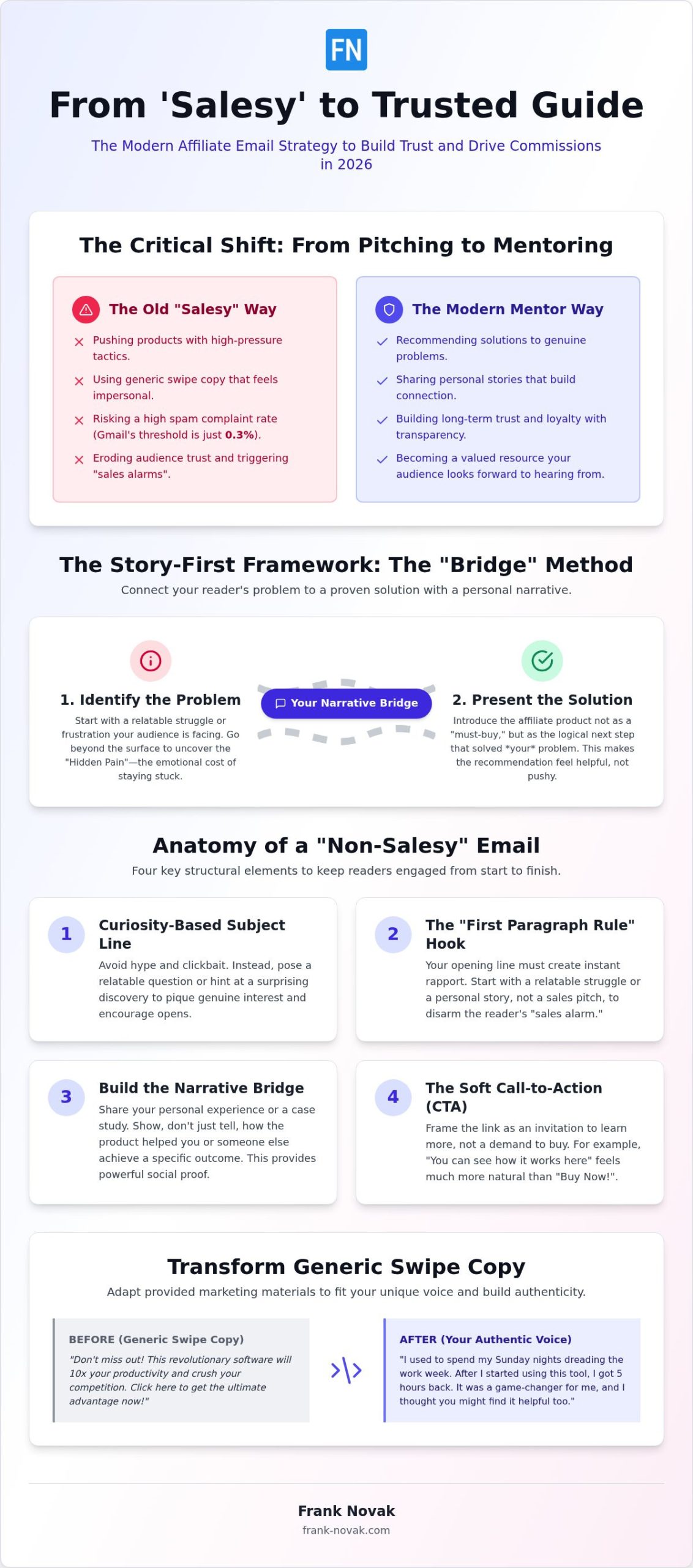
Traditional marketing copy often fails because it’s an interruption. When you shift to a story-first framework, you aren’t just sending an email; you’re sharing a journey. This approach is the foundation of how to write affiliate emails that don’t sound salesy because it prioritizes the human experience over the transaction. By using the “Bridge” Method, you create a path from the reader’s current frustration to a proven solution. To do this effectively, you must identify the “Hidden Pain” your product solves. This isn’t just the surface-level problem, but the emotional cost of staying stuck, such as lost time or the stress of a stagnant business.
For those who don’t consider themselves professional copywriters, the Problem-Agitation-Solution (PAS) framework is an excellent tool. First, you identify a specific problem. Next, you agitate that problem by describing the consequences of ignoring it. Finally, you present the affiliate product as the logical solution. This method works because it mirrors how we naturally give advice to friends. It feels helpful rather than pushy, which is exactly how you maintain a loyal list while generating steady commissions.
Crafting the Perfect Hook
Your first few words determine whether an email gets read or deleted. A strong hook is the entry point to your reader’s day, and it should immediately resonate with their current reality. Instead of using clickbait that leads to disappointment, try opening with a relatable struggle or a surprising industry fact. For example, you might start with a story about a failed campaign or a realization you had while working late. This creates instant rapport without triggering the “sales alarm” that most people have developed after years of being bombarded with ads.
Building the Narrative Bridge
After grabbing attention, build a narrative bridge that connects your story to the solution. Sharing your own experience with a product, or the success of a student, provides the social proof necessary to build trust. Focus on the “After” state. Describe what life looks like once the problem is solved. Adopting a sales mindset for non-sales people allows you to see this process as an act of service. If you’re looking for a structured way to apply these principles, exploring a professional Affiliate Marketing Success Mindset can help you refine your voice. When you truly believe in the solution you’re offering, the transition from story to link feels like a natural extension of the conversation. This narrative approach is the most sustainable way to learn how to write affiliate emails that don’t sound salesy while scaling your business. If you want to see how this works in a fully automated environment, the ClickBank Super Funnel provides a high-converting backend that supports this non-salesy approach.
How to Customize Swipe Copy Without Losing Your Voice
When you receive a bundle of pre-written templates from an affiliate vendor, it’s tempting to simply copy and paste them into your email service provider. However, this “Copy-Paste” culture is one of the quickest ways to trigger spam filters and alienate your audience. In 2026, email providers like Gmail and Yahoo are highly sensitive to identical bulk messages. If thousands of other affiliates are sending the exact same text, your deliverability will suffer. More importantly, your subscribers will recognize the shift in tone. To understand how to write affiliate emails that don’t sound salesy, you must treat swipe copy as a blueprint rather than a final script.
A helpful guideline is the 20% Rule. You should aim to keep only about 20% of the original copy, specifically the core psychological triggers like a unique benefit or a specific deadline. The remaining 80% should be your own words. By identifying the “core triggers” in the swipe, you can preserve the conversion power of the vendor’s copy while wrapping it in your unique brand voice. This ensures the message feels like a recommendation from a friend rather than a corporate broadcast, which is the secret to how to write affiliate emails that don’t sound salesy.
The ‘Frankenstein’ Method for Swipes
The “Frankenstein” method involves mixing and matching elements from multiple swipes to create something entirely new. You can take a curiosity-piquing headline from one template and pair it with a story-based body from another. Instead of listing generic benefits, swap them for outcomes that are highly specific to your niche. For example, if a swipe mentions “saving time,” you might change it to “reclaiming three hours every Monday morning.” Finally, always add a personalized P.S. at the end. This is a great place to add a bit of urgency or a personal insight without making the entire email feel high-pressure.
Maintaining Compliance and Trust
As you customize your copy, you must ensure that your modifications remain within legal and platform guidelines. In 2026, transparency is non-negotiable. If you are using AI to assist with your rewriting, the EU AI Act requires disclosure. Similarly, your affiliate link disclosure should be clear and placed naturally within the flow of your content. If you are driving traffic from other sources, such as Facebook Ads for Affiliate Marketing, maintaining a consistent voice from the ad to the email is crucial for building sustainable trust. This methodical approach ensures your marketing remains compliant while protecting your sender reputation.
Structuring the Email: From Subject Line to Soft CTA
The layout of your email is just as important as the words you choose. If a message looks like a wall of text, most subscribers will close it before reading a single line. Understanding how to write affiliate emails that don’t sound salesy involves creating a visual experience that feels light and conversational. By using ample white space and short paragraphs, you make your insights more digestible. This structure signals to the reader that you value their time. It prevents the feeling of being overwhelmed by a high-pressure pitch.
The “First Paragraph Rule” is a critical component of this structure. Your opening lines should act as a slide, carrying the reader effortlessly from the subject line into the heart of your story. If your first paragraph is too dense or focuses too much on the product, you risk losing the reader’s interest immediately. Instead, keep these initial sentences focused on the reader’s current situation or a relatable observation. This approach builds momentum and keeps the reader moving toward the solution you’re providing.
Subject Lines That Get Opened
In 2026, the “Curiosity Gap” remains one of the most effective ways to increase open rates without sounding desperate. This technique involves sharing just enough information to pique interest without giving away the entire solution. For example, instead of saying “Buy this tool for better SEO,” you might try “The one change that saved my morning routine.” Additionally, “How-to” subject lines continue to dominate because they promise immediate, practical value. To find what works best for your specific list, regular A/B testing is essential. You might find that your audience responds better to short, punchy questions than to longer, descriptive statements.
The Art of the Unobtrusive CTA
The transition from your story to your affiliate link should feel like a natural recommendation rather than a sudden pivot. This is the essence of a “Soft CTA.” Instead of using generic “Click Here” buttons, try integrating your links directly into the narrative using benefit-driven anchor text. This is a core part of how to write affiliate emails that don’t sound salesy because it keeps the focus on the reader’s progress. For instance, you could link a phrase like “the system I use to automate my follow-ups” instead of a raw URL. This approach guides the reader to the next logical step without breaking the flow of the conversation.
The “P.S.” at the end of your email is another powerful tool for secondary conversions. Many readers will scan your email and jump straight to the bottom. Use this space to provide a quick summary of the benefit or to answer a common question about the solution you’ve shared. It’s a low-pressure way to remind them of the value you’re offering without repeating the main body of the email.
Learn how the ClickBank Super Funnel automates your non-salesy sequences
Automating Your Non-Salesy Strategy for Sustainable Growth
While the previous sections focused on the craft of the individual message, long-term success depends on your ability to scale these efforts. Writing every email manually isn’t sustainable if you want to achieve high-ticket success. By automating your outreach, you ensure that every new subscriber receives the same high-value journey without you having to be at your desk every day. This shift allows you to move beyond simple metrics like open rates and start measuring “Trust Equity.” Trust Equity is the cumulative goodwill you build by consistently providing value, which makes your eventual recommendations feel like a natural next step for your audience.
Integrating your carefully crafted sequence into a proven system like the ClickBank Super Funnel allows you to focus on the mentorship aspects of your business. This funnel acts as the backend that supports the non-salesy approach we’ve discussed, handling the technical mechanics while you refine your unique voice. If you’ve been wondering how to write affiliate emails that don’t sound salesy while still hitting your revenue goals, automation provides the structure you need. It ensures your “Bridge” stories and “Soft CTAs” are delivered at the exact moment they are most helpful to the reader.
Building a Sustainable Sequence
A healthy automated sequence maintains a strict “Value-to-Offer” ratio. A common mistake is sending too many pitches too quickly, which leads to list fatigue. Instead, aim for a sequence where the majority of your content is purely educational or supportive. This prepares the reader for the moments when you recommend a specific solution. You can also use segmenting to ensure you only send offers to people who have shown interest in a particular topic. For a deeper look at this structure, check out our Automated Marketing Funnel Guide.
Scaling with Professional Guidance
Eventually, you may reach a point where your DIY efforts hit a plateau. Identifying bottlenecks in your automated commissions often requires an outside perspective to see where the narrative flow might be breaking down. Moving from a solo approach to Online Success Coaching can help you fine-tune your messaging and improve your overall conversions. A professional guide can spot where your hooks aren’t landing or where your transparency could be improved. If you’re ready to move past the “hustle” and build a business that works for you, start your journey with the ClickBank Super Funnel today.
Building Your Sustainable Affiliate Future
Mastering high-converting outreach doesn’t require you to compromise your integrity. By shifting your mindset from a salesperson to a trusted guide, you create a sustainable business model that respects your audience’s intelligence. You now have the practical tools to implement the Bridge Method and customize templates to fit your unique brand voice. Learning how to write affiliate emails that don’t sound salesy is ultimately about aligning your recommendations with the genuine needs of your subscribers.
When you pair these narrative techniques with proven business automation, you unlock the potential for consistent growth. You don’t have to navigate this journey alone. With personal mentorship from Frank Novak and a focus on high-ticket sustainability, you can move past the hustle mentality and build something that lasts.
Scale your commissions with the ClickBank Super Funnel
Take the first step toward a more professional and rewarding marketing career today. Your audience is waiting for a leader they can trust and follow.
Frequently Asked Questions
How often should I send affiliate emails to my list?
You should aim for a consistent rhythm that balances helpful advice with occasional promotions. A common strategy is the 80/20 rule, where 80% of your content is purely educational and 20% includes a recommendation. If you email three times a week, perhaps only one of those contains an affiliate link. This pace prevents list fatigue and ensures your subscribers feel supported rather than targeted by constant sales pitches.
Is it okay to promote multiple products in one email?
It’s generally more effective to focus on one primary solution per message to avoid confusing your readers. If you present too many choices, you might trigger decision paralysis, causing the subscriber to click nothing at all. However, a secondary link in the P.S. section can work well if it complements the main topic. Keeping the focus sharp is a key part of how to write affiliate emails that don’t sound salesy.
What if my audience gets angry when I promote an affiliate link?
If your readers react negatively, it often indicates a mismatch between the offer and their current needs. Don’t take it personally; instead, use it as feedback to refine your targeting. If you have built a foundation of trust through mentorship, a few unsubscribes are natural and even helpful for list hygiene. Focus on providing so much value that your recommendations feel like a logical next step in their professional journey.
Can I use affiliate links directly in emails on all platforms?
Most major email service providers allow affiliate links, but you must check the specific terms for both your provider and the affiliate program. In 2026, it’s vital to ensure your links are properly authenticated with SPF and DKIM to avoid being flagged as spam. Major providers like Gmail now enforce a 0.3% spam complaint threshold, so using a bridge page can sometimes help maintain a professional reputation across different platforms.
How do I find products that my audience actually wants?
The best way to find relevant products is to look at the tools you already use and trust in your own business. You can also survey your list to ask about their biggest challenges. If you find a recurring problem, search for a reputable solution on platforms like ClickBank. By promoting items you have personally tested, your emails will naturally sound more authentic and far less like a generic, high-pressure sales pitch.
What is the best length for an affiliate marketing email?
There is no single perfect length, but you should aim to be as long as necessary to tell a compelling story and no longer. Short emails of 150 to 300 words work well for quick tips. Longer, narrative-driven emails can go up to 600 words if the story remains engaging. If you keep your paragraphs short and use plenty of white space, even a longer email will feel quick and easy to read.
Do I really need an automated funnel to succeed?
While you can succeed with manual emails, an automated funnel is essential for scaling your business without burning out. A system like the ClickBank Super Funnel handles the heavy lifting of following up with new leads consistently. This ensures that your non-salesy sequences are delivered at the right time. Automation allows you to focus on high-level strategy and Online Success Coaching while the system generates steady commissions in the background.
How do I disclose my affiliate relationship without sounding corporate?
You can disclose your relationship in a way that feels personal rather than legalistic. Instead of a stiff disclaimer, try saying that you may earn a small commission if they use your link, which helps you keep your content free. This approach is transparent and aligns with 2026 regulations like the CAN-SPAM Act. It shows your audience that you value honesty, which is a fundamental part of how to write affiliate emails that don’t sound salesy.

Article by
Frank Novak
Frank Novak is an online marketing professional and coach who focuses on affiliate marketing and business automation. Through his website, frank-novak.com, he shares insights and strategies for leveraging social media platforms like Facebook to generate traffic and commissions.
Affiliate / Sponsored Content Disclaimer
This [website/post] contains affiliate links. If you click through and make a purchase, we may receive a commission at no additional cost to you. We only recommend products or services we believe will add value to our readers.