

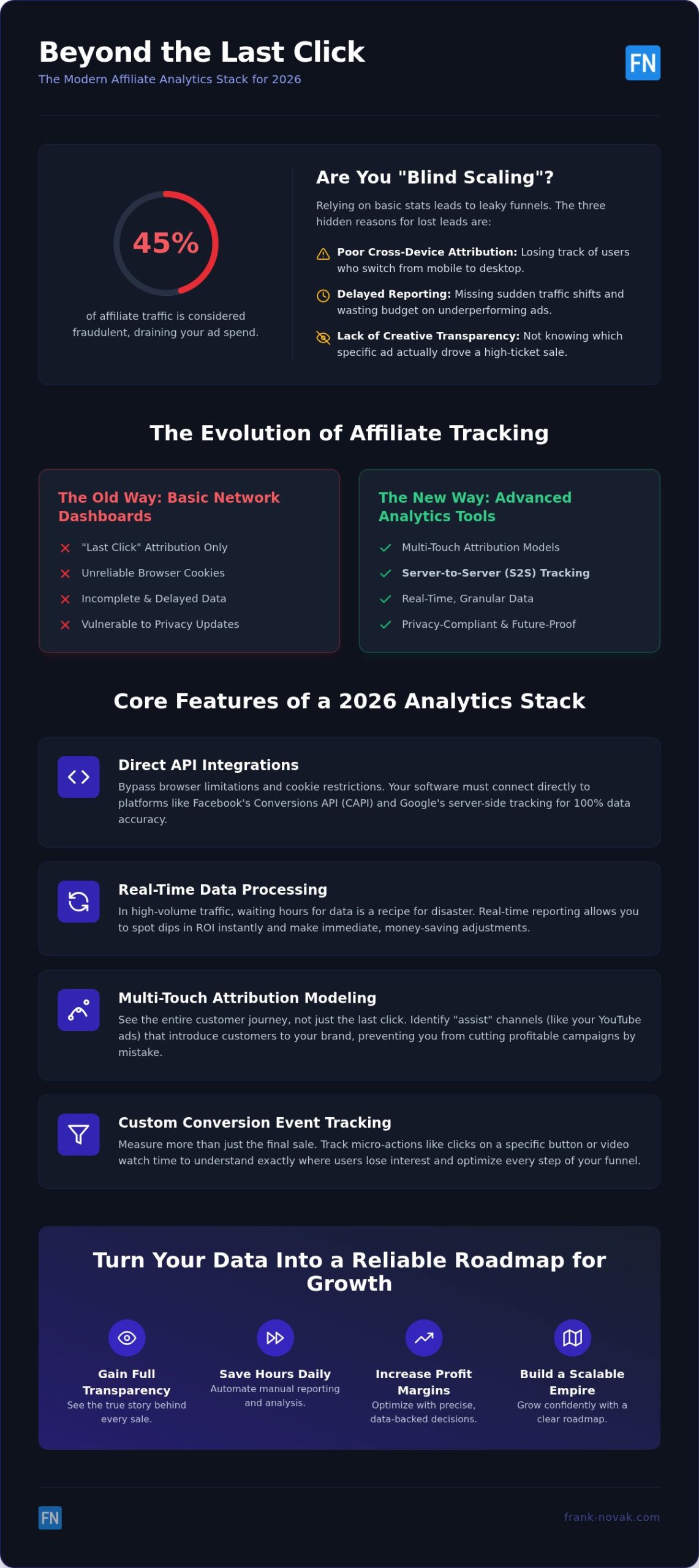
With 45% of affiliate traffic now considered fraudulent, how much of your current ad spend is actually reaching a real human buyer? It’s incredibly frustrating to watch your budget disappear into the black hole of Facebook clicks without knowing which specific keyword or creative actually triggered that high-ticket sale. If you’ve spent countless hours manually entering data across different networks, you already know that basic tracking is no longer enough to stay competitive in a $17 billion industry.
You likely feel that if you could just see the full customer journey, you’d finally have the confidence to scale your campaigns. We’re here to help you bridge that gap. By integrating advanced affiliate marketing analytics tools into your workflow, you can move beyond simple clicks and build a truly automated, data-driven empire. This guide explores the sophisticated analytics stack you need to gain full transparency, save hours on manual reporting, and increase your profit margins through precise, data-backed optimization. We’ll show you how to turn your data into a reliable roadmap for steady growth.
Key Takeaways
- Moving beyond basic network dashboards allows you to see the full story of a sale through multi-touch attribution.
- You’ll learn how to evaluate advanced affiliate marketing analytics tools based on their ability to provide real-time data and cross-device tracking.
- We’ll compare the leading market solutions for 2026 to help you find the software that integrates seamlessly with your automated traffic systems.
- Discover how clean data helps you optimize your automated marketing funnel by identifying exactly where potential customers are losing interest.
- Learn how professional guidance can help you translate complex analytics into a steady, reliable roadmap for your business.
The Evolution of Affiliate Tracking: Why Basic Stats Are Not Enough
The way we measure success in affiliate marketing has changed fundamentally over the last few years. In the past, you could get by with simple tracking, but the modern environment requires a much sharper lens. Using advanced affiliate marketing analytics tools is no longer just an option for the elite; it’s the necessary infrastructure for anyone who wants to scale without losing their shirt on ad spend. These tools provide multi-touch attribution and real-time ROI tracking, allowing you to see the true value of every interaction a customer has with your brand before they finally make a purchase.
If you rely solely on the basic stats provided by your traffic source, you’re likely “blind scaling.” This risky approach often leads to the three hidden reasons affiliate funnels leak leads: poor cross-device attribution, delayed reporting that misses sudden traffic shifts, and a lack of transparency into which specific creatives are actually driving high-ticket value. By moving toward a dedicated third-party tracking system, you gain the clarity needed for data-driven decision making. This shift ensures that every dollar you invest is working toward a specific, measurable outcome in the 2026 digital landscape.
The Limitations of Standard Affiliate Network Dashboards
While platforms like ClickBank or Amazon provide essential data, they don’t tell the whole story. They can’t track how a user interacted with your Facebook ad three days before they finally bought on their laptop. This “Last Click” attribution model is a major problem in our multi-device world. If you only see the final click, you might mistakenly cut a profitable ad set that was actually responsible for introducing the customer to your brand. For those using the ClickBank Super Funnel, having this granular level of detail is vital for optimizing every stage of the journey and ensuring no lead is left behind.
The Shift to Server-to-Server (S2S) Tracking
By 2026, the industry has moved almost entirely away from traditional browser cookies. They simply aren’t reliable anymore due to privacy updates and changing browser standards. This is why postback URLs have become so important for accurate conversion reporting. Server-to-server tracking is the gold standard for privacy-compliant data collection because it communicates directly between the network and your tracker without relying on the user’s browser. When your data is clean and compliant, you can make decisions with confidence. This technical shift allows you to focus on growth while the advanced affiliate marketing analytics tools handle the complex mechanics of data integrity in the background.
Core Features to Look for in Advanced Analytics Software
Choosing the right advanced affiliate marketing analytics tools requires looking beyond a pretty interface. In 2026, the most critical feature is the ability to bypass browser-side limitations through direct API integrations. Privacy is now the priority. Since most platforms now restrict third-party cookies, your software must communicate directly with Facebook’s Conversions API (CAPI) and Google’s server-side tracking to ensure no data is lost. This deep integration allows for a seamless flow of information between your traffic source and your internal dashboard, providing a clear view of your actual performance.
Real-time processing is another non-negotiable feature. If you’re running high-volume traffic to a system like the ClickBank Super Funnel, waiting even a few hours to see a dip in ROI can cost thousands. You also need custom conversion event tracking. This allows you to measure micro-actions, such as a lead clicking a specific bridge page button or watching half of a sales video, rather than just the final sale. If these technical layers feel a bit overwhelming, Online Success Coaching can help you navigate the setup and ensure you’re looking at the metrics that actually move the needle.
Multi-Touch Attribution Modeling
Most basic trackers only credit the very last click, but the customer journey is rarely that simple. Advanced tools offer various models like linear, time-decay, or position-based attribution. By using these, you can see every touchpoint, from that first curious Facebook click to the final purchase on ClickBank. This helps you identify “assist” channels that basic analytics often ignore. Perhaps your YouTube ads aren’t getting the final sale, but they’re consistently the first point of contact for your most profitable customers. Understanding this story prevents you from accidentally turning off your best lead generators.
Automated Optimization and Rules
Managing high-traffic campaigns can lead to significant mental fatigue. Modern advanced affiliate marketing analytics tools solve this by allowing you to set “auto-kill” or “auto-scale” rules based on real-time performance. If an ad set drops below a specific ROI threshold, the system shuts it down instantly. Conversely, if a creative is performing exceptionally well, the tool can automatically increase the budget. This level of automation ensures your business stays profitable even when you’re away from your desk. You can set up alerts for significant drops in ROI or tracking errors, giving you peace of mind that your infrastructure is stable and reliable.
The Top Advanced Affiliate Analytics Tools for 2026
Selecting from the available advanced affiliate marketing analytics tools can feel like a daunting task, especially when your budget and scaling potential are on the line. In 2026, the market has matured, offering solutions that range from accessible starter plans to high-end enterprise suites. If you’re building a business designed for longevity, your choice should prioritize seamless integration with your traffic sources and the ability to handle data without lag. The right tool acts as the central nervous system of your operation, connecting your ads to your conversions with absolute precision.
If you’re just starting to scale, you might find that a tool with a gentle learning curve is more valuable than one with every possible bell and whistle. However, for those already managing significant daily budgets, depth of features becomes the priority. Most of these platforms now offer tiered pricing, allowing you to start at a manageable level and upgrade as your revenue grows. This flexibility ensures that you aren’t paying for enterprise-level power until your traffic volume actually requires it.
Cloud-Based Tracking Powerhouses: Voluum and RedTrack
Voluum remains a top contender for those managing significant media spend, particularly because of its robust infrastructure and historical reliability. Its “Profit” plan starts at $119 per month, while the “Scale” plan, priced at $299 per month, provides the deeper insights needed for aggressive growth. It’s built for speed, which is essential when you’re buying traffic across multiple platforms simultaneously.
RedTrack has gained significant ground by offering a highly flexible pricing structure that caters to various scales of operation. While they offer a free “Relay” plan for those just starting, their “Builder” plan at $79 per month is a great entry point for serious affiliates. For larger teams requiring heavy automation and AI-driven insights, the “AI Team” plan starts at $499 per month. Choosing a cloud-based solution like these over a self-hosted one generally saves you from the technical headache of server maintenance, ensuring your tracking stays live even during massive traffic spikes.
API-First Solutions: AnyTrack and Hyros
AnyTrack excels if your strategy revolves around the Facebook Conversions API. It’s designed to bridge the gap between your affiliate links and your ad manager with minimal manual setup, making it an excellent choice for those who want a “set it and forget it” environment. Hyros, on the other hand, is specifically built for those who need to track long-term customer value (LTV). It’s a favorite for high-ticket coaching programs because it can track a lead for months before they finally convert.
For the ClickBank Super Funnel, both AnyTrack and RedTrack are particularly effective. They provide the necessary infrastructure to feed high-level data back into your automated systems. This ensures your funnel is always optimizing based on real revenue rather than just vanity metrics like clicks or impressions. By using these advanced affiliate marketing analytics tools, you’re giving your automation the “eyes” it needs to see exactly where your profit is coming from.
Integrating Analytics into Your Automated Marketing Funnel
Automation is a powerful way to grow your business, but it’s only as effective as the information feeding it. When you use advanced affiliate marketing analytics tools, you’re essentially installing a high-definition GPS for your automated marketing funnels. Without this level of detail, your funnel is just a series of guesses. By creating a symbiotic relationship between clean data and automated steps, you ensure that every part of your system is working toward a profitable outcome.
Mapping the data flow is vital for understanding the true customer journey. You need to see how a single Facebook click leads to an email subscription and eventually results in a commission weeks later. If you can’t trace this path, you won’t know which specific email follow-up or ad creative is your most valuable asset. While quantitative data tells you what happened, qualitative tools like heatmaps and session recordings show you why it happened. Seeing a user struggle to find a button on their mobile device is often more helpful than just seeing a high bounce rate in a spreadsheet.
Plugging Leaks in Your Affiliate Funnel
Friction is the enemy of conversion. By using drop-off reports, you can pinpoint the exact moment a lead loses interest and leaves your landing page. This allows you to stop guessing and start fixing the specific barriers to entry. It’s also important to A/B test your creatives based on actual ROI data rather than just Click-Through Rate (CTR). A high CTR is meaningless if the traffic doesn’t convert into sales. Small adjustments here make a massive difference; a 1% increase in funnel efficiency can lead to a 20% increase in monthly profit.
Leveraging Data for Facebook Ad Compliance
Staying on the right side of platform policies is a constant challenge for affiliate marketers. Your advanced affiliate marketing analytics tools can help monitor your landing page quality scores, which is a major factor in ad costs and account health. Accurate tracking ensures you don’t accidentally trigger “circumventing systems” flags by using outdated redirection methods that look suspicious to automated bots. If you want to dive deeper into staying safe while scaling, refer to the Facebook Ads for Affiliate Marketing guide for compliance best practices.
Build your high-performance funnel today
Turning Data into Growth with Online Success Coaching
Owning the most advanced affiliate marketing analytics tools is a significant first step, but it’s important to remember that these tools are simply instruments. If you have a dashboard full of numbers but no strategy to interpret them, you’re essentially looking at a map without knowing your destination. To truly scale to six figures and beyond, you must move from a tech-obsessed mindset to a results-obsessed one. This means shifting your focus away from the mechanics of the software and toward the story the data is telling you about your customers’ behavior.
A seasoned coach acts as the bridge between complex systems and your daily business operations. While the software provides the “what,” a mentor helps you understand the “why.” If you can identify why a specific segment of your audience is dropping off at the bridge page, then you can make the precise adjustments needed to recover those lost commissions. This level of insight is what separates those who struggle from those who build sustainable, automated empires in the 2026 landscape.
Personalized Mentorship for Data Interpretation
If you feel overwhelmed by the sheer volume of information your tracker provides, Online Success Coaching can help you cut through the noise. We focus on identifying your “North Star” metrics, which are the key indicators that drive actual revenue rather than just vanity stats. By narrowing your focus, you can avoid the analysis paralysis that often keeps entrepreneurs stuck in the testing phase. Developing the mental resilience to trust your data during a scaling phase is much easier when you have a steady, reliable guide confirming your decisions.
Your Roadmap to Automated Success
The most successful practitioners today don’t just use tools in isolation; they integrate them into a cohesive system. By combining the ClickBank Super Funnel with a professional analytics stack, you create a feedback loop that constantly improves your ROI. If you’re looking for a community of like-minded individuals, the ClickBank Profit Club offers a space to share data insights and stay ahead of industry trends. This collaborative environment ensures you’re never navigating the complexities of advanced affiliate marketing analytics tools alone.
Take Control of Your Affiliate Growth
Scaling a business in 2026 requires a fundamental shift from guesswork to granular precision. By implementing advanced affiliate marketing analytics tools, you’ve taken the first step toward seeing the full story of your customer’s journey. You now understand that sustainable success isn’t just about high traffic; it’s about knowing exactly which touchpoints lead to profit and which ones are simply draining your budget. If you combine these insights with the power of the ClickBank Super Funnel, you create a system that works for you around the clock.
Remember that data is only as valuable as your ability to act on it. While the technical setup is essential, the real growth happens when you interpret those numbers to make confident, strategic moves. You don’t have to navigate this complex landscape alone. Learning from a seasoned practitioner who has spent years in the trenches can save you months of trial and error. You have the tools and the roadmap; now it’s time to focus on the automated, sustainable growth you deserve.
Your journey toward a six-figure empire is a marathon, not a sprint. Stay patient, trust the data, and keep moving forward with the steady confidence that comes from having a clear view of your business’s performance.
Frequently Asked Questions
Do I really need a third-party tracking tool if I only use ClickBank?
Yes, you definitely need a dedicated tracker because ClickBank only shows you the “sale” end of the journey. It cannot tell you which specific Facebook ad or keyword led to that purchase. Without this data, you can’t optimize your ad spend or identify which campaigns are actually profitable. A third-party tool bridges this gap by connecting your traffic source directly to your conversion data.
How much should I expect to pay for advanced affiliate analytics in 2026?
You should expect to pay between $79 and $120 per month for a solid entry-level plan. For example, RedTrack starts their “Builder” plan at $79, while Voluum begins at $119 per month for their “Profit” plan. As your traffic scales and you require more advanced affiliate marketing analytics tools, these costs can increase to $300 or more for features like AI-powered optimization and higher event limits.
Can advanced analytics help prevent Facebook ad account bans?
While no tool can guarantee 100% safety, these systems help by monitoring your landing page quality scores and ensuring your tracking methods are compliant. By using Server-to-Server (S2S) tracking, you avoid suspicious redirect patterns that often trigger Facebook’s automated security flags. This transparency helps you maintain a healthy account standing by providing a clear, compliant path for your data.
Is Hyros better than Voluum for affiliate marketers?
The choice depends entirely on your business model and what you’re trying to achieve. Hyros is generally better for high-ticket coaching where you need to track long-term customer value over several months. Voluum is usually preferred by high-volume media buyers who need real-time data to make split-second decisions on fast-moving traffic. Both are excellent, but they serve different strategic priorities within the affiliate space.
How do I set up a postback URL for my affiliate offers?
You set up a postback URL by copying the unique tracking link from your software and pasting it into the “Postback” or “Pixel” section of your affiliate network’s dashboard. This creates a direct server-to-server connection that doesn’t rely on the user’s browser. When a sale happens, the network sends a notification back to your tracker, ensuring your ROI data is updated instantly and accurately.
What is the most important metric to track in an automated funnel?
While ROI is your ultimate goal, the most important metric for funnel health is often your Bridge Page Conversion Rate. This tells you how well your “pre-sell” content is working to move traffic from an ad to the affiliate offer. If this number is low, your entire funnel will struggle. Tracking this allows you to identify friction points and make the necessary tweaks to improve your overall earnings.
Do these tools work with organic traffic or only paid ads?
These tools work perfectly well for both organic and paid traffic sources. If you’re using SEO, YouTube, or social media to drive leads, you can use tracking parameters to see exactly which video or blog post is generating the most revenue. This allows you to focus your content creation efforts on the specific topics that actually lead to commissions rather than just chasing vanity views.
How long does it take to see an ROI from investing in professional tracking software?
You can often see a return on your investment within the first few weeks of active tracking. By identifying and cutting just one or two “bleeding” ad sets that aren’t converting, you’ll likely save more in ad spend than the monthly cost of the software itself. The clarity you gain allows for immediate, data-backed adjustments that directly impact your profit margins almost instantly.

Article by
Frank Novak
Frank Novak is an online marketing professional and coach who focuses on affiliate marketing and business automation. Through his website, frank-novak.com, he shares insights and strategies for leveraging social media platforms like Facebook to generate traffic and commissions.
Affiliate / Sponsored Content Disclaimer
This [website/post] contains affiliate links. If you click through and make a purchase, we may receive a commission at no additional cost to you. We only recommend products or services we believe will add value to our readers.