

Buying an email list is usually a poor shortcut for affiliate marketing. If you’re asking whether buying an email list for affiliate marketing is a good idea, the answer is generally no: recipients may not know you or expect your messages, making trust and effective communication harder to build.
The appeal is understandable. A purchased list seems to offer a ready-made audience, so you can promote offers without first creating content and attracting subscribers. But having email addresses is not the same as having an audience that wants to hear from you. That gap can lead to spam complaints, inaccurate contact data, and weaker email deliverability.
This guide explains how purchased lists can affect affiliate marketing and why permission-based audience building is more sustainable. You’ll learn what to consider about audience expectations, complaints, data quality, and deliverability, then find practical ways to grow a list of people who choose to receive your emails.
Key Takeaways
- Build your affiliate audience through clear opt-ins and relevant value, so subscribers know why they’re hearing from you.
- Unwanted emails can prompt spam complaints and harm your ability to reach subscribers’ inboxes.
- Check how contact data was collected and keep your list clean, since outdated or inaccurate addresses can lead to delivery problems.
- Use email to share useful, relevant content alongside affiliate recommendations, and disclose affiliate relationships clearly.
- When you need guidance shaping your affiliate marketing approach, Online Success Coaching can help you work through the next steps.
1. Building an email list for direct audience communication
An email list gives you a direct way to share messages with people interested in your topic. In affiliate marketing, you can send useful guidance, product explanations, and recommendations relevant to why someone subscribed. How contacts join matters: an opt-in form lets visitors choose to receive your emails instead of adding unfamiliar addresses to a campaign.
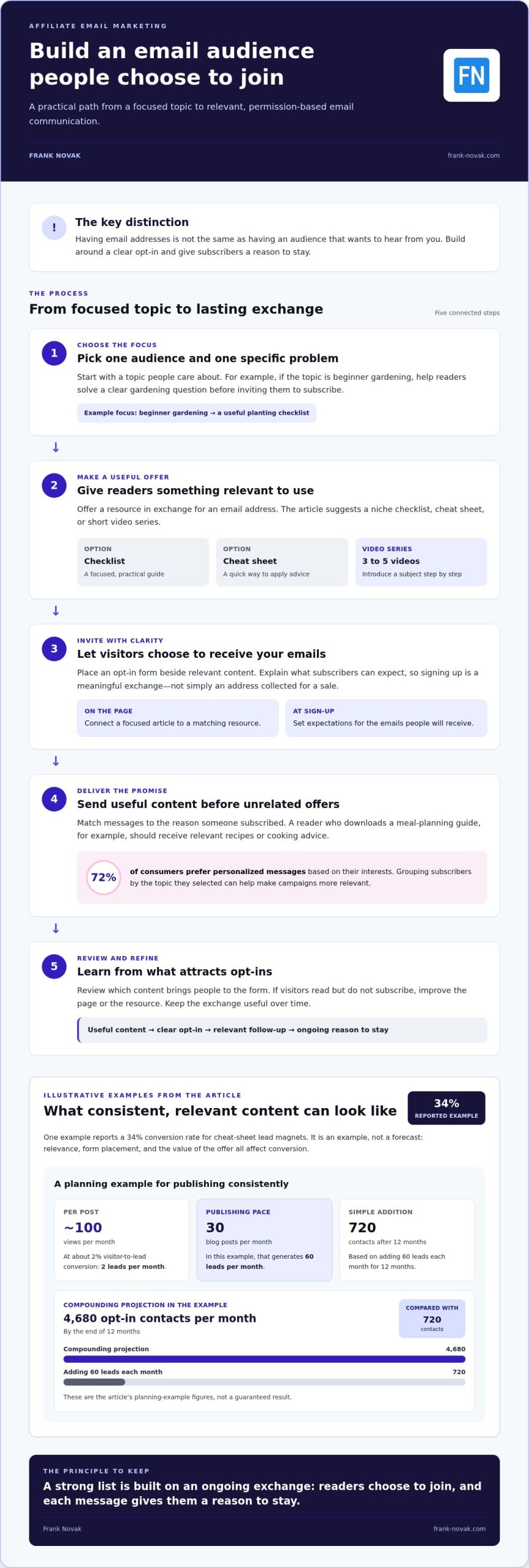
Better alternatives to buying an email list include inviting readers to subscribe through an opt-in form and offering a useful lead magnet. For example, create a niche checklist, cheat sheet, or short video series in exchange for an email address. A series of 3 to 5 videos can introduce a subject step by step and give subscribers a clear reason to hear from you.
To build a list from scratch, choose one audience and a specific problem before creating your form. If your topic is beginner gardening, offer a planting checklist beside a related article. Explain what subscribers can expect, then send content that delivers on that promise. This makes subscribing a meaningful exchange, rather than treating each address as a potential sale.
Content-based list building connects useful material to a clear next step. A blog post can answer a focused question, while a downloadable cheat sheet helps readers apply the advice. One example reports a 34% conversion rate for cheat-sheet lead magnets. Treat that as an example, not a forecast for every page: topic relevance, form placement, and the value of the offer all affect conversion rate.
Publishing consistently can also help an audience grow over time. In one planning example, a post with about 100 views per month and a visitor-to-lead conversion rate of about 2% produces two leads per month. At 30 blog posts per month, that example generates 60 leads per month. Its compounding projection reaches 4,680 opt-in contacts per month by the end of 12 months, compared with 720 contacts from simply adding 60 leads each month for 12 months.
Use the sign-up form and welcome message to set expectations. A reader who downloads a meal-planning guide, for instance, should receive relevant recipes or cooking advice before unrelated offers. Since 72% of consumers prefer personalized messages based on their interests, grouping subscribers by the topic they selected can help make marketing campaigns more relevant.
Start with one focused form and one useful resource, then review which content attracts opt-ins. If visitors read but don’t subscribe, improve the page or resource. A strong list is built on an ongoing exchange: readers choose to join, and each message gives them a reason to stay.
2. Spam complaints and deliverability
People on a purchased list may not recognize your name or remember signing up. They might ignore your message, mark it as spam, or report it to their email provider. These responses can weaken engagement and make future campaigns harder to deliver, even to subscribers who chose to hear from you.
Advertising-related email accounts for approximately 36% of all spam messages. Keep your own complaint rate below 0.1% as a practical list-health target. A campaign sent to unexpecting recipients works against that goal, while relevant messages to people who opted in are more likely to connect with their interests.
Permission matters under domestic regulations. In the United States, consider the CAN-SPAM Act when assessing email campaigns and ensuring proper compliance standards. The California Consumer Privacy Act is also relevant to how email addresses are used, stored, and protected nationwide. These laws address different concerns, so a seller’s claim that a list is compliant does not prove that your intended use is permitted.
Federal and state guidelines require careful attention to how consumer data is handled. Marketers must ensure that their outreach methods align with local legal expectations and consumer privacy protections across the country.
Do affiliate networks allow marketing to purchased email lists? Network rules vary, so read the specific program’s promotional terms before sending affiliate offers. Permission to promote a product does not automatically give you permission to email every address on a purchased list.
What email marketing platforms prohibit purchased lists? There is no universal list of platforms, and policies vary by provider. Review the platform’s acceptable-use rules before importing contacts. A provider may restrict purchased lists even when your campaign seems relevant.
How can marketers verify the consent and accuracy of a purchased email list? Ask for records showing how each address was collected, what the person agreed to receive, and when consent was recorded. Then assess whether that permission covers your messages and whether the contact data is current. A seller’s assurance alone cannot establish either point.
If you already have a list, pause before sending. Separate contacts by documented permission and remove addresses without adequate records. Use clear sender details and an easy unsubscribe option, then monitor complaints and engagement after each campaign. These steps help protect the subscribers who genuinely want your messages.
For a broader look at building an online business without relying on unsolicited outreach, explore Frank Novak.
3. Data accuracy and email deliverability
A list can look useful in a spreadsheet but fail when you send a campaign. Names, locations, interests, and email addresses may be outdated or mismatched. In affiliate marketing, that makes it harder to segment contacts and tailor messages to their actual interests. An address that accepts mail also does not prove the person wants your content.
How much do purchased email lists cost, and what affects list quality? Prices depend on factors such as list size, targeting detail, data age, and how contacts were collected. Quality depends on whether addresses are accurate, current, relevant to your audience, and backed by meaningful permission, not simply on the seller’s description.
Consider a list containing 50,000 names and email addresses for Minnesota residents who don’t have children. That information may sound specific, but it’s useful only if those details are current and fit the offer. A promoted parenting product would be poorly matched; even a relevant product could miss the mark if the records are old or inaccurate.
List decay can make the mismatch worse over time. At least 25.74% of an email list decays within one year. People change addresses, abandon inboxes, or stop using accounts. That means a list’s age matters, and a batch that once looked usable can produce more failed deliveries as its records grow stale.
Before a campaign, review the source, collection date, and available fields for each segment. Use email verification software to identify malformed or undeliverable addresses, then remove them before sending. Verification can assess whether an address is valid, but it cannot establish whether someone consented or whether their contact details are accurate.
Keep bounce rates below 2% to maintain list health. A bounce is a message that couldn’t be delivered, often because an address is invalid or unavailable. If a test send produces excessive bounces, stop and investigate the source or data before sending to more contacts. Repeatedly mailing invalid addresses can hurt deliverability beyond that single campaign.
Open rates can offer another signal, but interpret them carefully. One customer testimonial reports open rates rising from 2-6% to 40% to 60%. That report illustrates a possible result, not a standard outcome for purchased lists. Compare your own campaigns by source and segment, and look at clicks, replies, unsubscribes, and conversions alongside opens.
Use the results to make a practical decision: keep only records that are accurate, relevant, and permitted for your intended message. If a segment consistently bounces or shows little engagement, stop sending to it. Better data helps you reach the right audience, but it cannot turn an unrequested contact into an interested subscriber.
4. What email lists are and how businesses use them
An email list is a set of contacts an organization uses to send messages. Each record may include an address and details such as a subscriber’s chosen topic or previous interactions. In affiliate marketing, a list can help you share useful information, promote relevant products, and build an ongoing connection with readers.
Businesses use email lists for different kinds of communication. A welcome message introduces the sender, a newsletter shares useful material, and a product email explains an offer. For example, a cooking newsletter might share meal-planning advice before introducing a kitchen tool. This gives the recommendation context instead of turning every message into a sales pitch.
Purchased and opt-in lists differ in how contacts came into a business’s reach. An opt-in subscriber actively signs up for messages, often after reading an article or requesting a resource. A purchased contact may have shared an address for another purpose. That difference affects whether someone recognizes the sender, engages with the message, or considers the promotion relevant.
What are typical engagement and conversion rates for purchased email lists versus opt-in lists? No single rate applies reliably to every list. Audience fit, consent, message relevance, and data freshness all affect results. A purchased contact who does not recognize your business is less likely to engage than a subscriber who requested related updates, so compare campaign results by source and segment.
Use a list to organize communication, not just to store addresses. Group subscribers by the subject they chose, then send material connected to that interest. For instance, readers who sign up for beginner photography advice could receive camera guides and related product recommendations. Segmentation can make a campaign more targeted: segmented campaigns are reported to get 94.1% higher click-through rates.
A welcome sequence can set expectations and create a useful path from sign-up to recommendation. Welcome emails are reported to have 86% higher open rates than standard newsletters. Start by explaining what subscribers will receive, then share practical content before introducing an affiliate offer. Review clicks and replies to see whether each message serves its intended audience.
Revenue depends on more than sending an offer. The product must suit the subscriber’s needs, and the message should explain why it may help. Keep advice distinct from promotion, and disclose affiliate relationships clearly and conspicuously. Readers should understand when a recommendation may earn you a commission.
Decide each campaign’s purpose before writing: educate, introduce a product, or support a seasonal promotion. Then match the content and call to action to that purpose. This makes your list a tool for building trust and sharing relevant offers, rather than a collection of addresses to contact indiscriminately.
5. Affiliate email marketing basics
Affiliate email marketing uses messages to introduce readers to products or services and share tracked links. A business earns a commission when a reader completes an eligible action. If you’re asking, “Is buying an email list for affiliate marketing a good idea?” consider whether recipients expect your message before planning a campaign.
Start with a useful message, not a link. For example, a home-cooking newsletter can share a recipe, explain how a kitchen tool fits, and then link to that product. Readers get practical value even if they don’t buy. This approach also helps you assess whether the offer suits your audience.
Make disclosures clear and conspicuous. The Federal Trade Commission requires disclosure of affiliate relationships, so explain that you may earn a commission when readers use your links. Place the disclosure near the recommendation, where readers can see it before acting. A vague note hidden in a footer does not communicate the relationship as clearly.
Plan a steady schedule that gives subscribers room to engage. One recommendation is to send affiliate-list emails 2-4 times per week, while keeping the content useful and relevant. A practical content plan could include product education, answers to common questions, and occasional promotions. Track replies, clicks, unsubscribes, and sales to see what resonates.
A 60% value-content and 40% promotional-content balance offers one planning framework. For example, across five messages, three could provide tutorials or advice, while two feature relevant offers. Treat the split as a guide for planning, not a substitute for audience feedback. If promotional messages attract fewer clicks or more unsubscribes, adjust the mix and review the offer.
Email can complement social media and other marketing channels. Consumers are three times more likely to purchase from email than from social media marketing, according to the provided market data. Email marketing can be a useful way to reach customers, though results vary by campaign. These figures describe reported averages, not a promise about an individual campaign.
Automation can help deliver messages at useful moments. A welcome sequence, for example, can introduce your topic, share a helpful resource, and present a related offer. Automated emails are reported to generate 320% more revenue than non-automated emails. Set each message around a clear purpose, then review performance and refine the sequence.
Use your email platform’s reporting to compare campaigns by audience segment and offer. If a tutorial gets clicks but few sales, consider whether the product matches readers’ needs and whether the link leads to the expected page. If readers respond to a topic, create more useful content around it before promoting another product. So, is buying an email list for affiliate marketing a good idea? A permission-based audience gives your recommendations a stronger starting point.
Frank Novak: Online Success Coaching
Online Success Coaching is a natural next step if you want to build an affiliate marketing approach around an audience that chooses to hear from you. It can help you think through your goals and the steps involved, rather than relying on a purchased list as a shortcut. If you’re deciding how to connect content, audience growth, and affiliate offers, coaching can support that planning. Frank Novak also offers ClickBank Super Funnel, Never Succeed Online, and Clickbank Profit Club for readers exploring related paths. Choose the option that fits the question you’re working through, and keep your focus on relevant communication and permission-based growth. For more information, visit frank-novak.com.
Build a More Intentional Path Forward
If you’re still considering whether buying an email list for affiliate marketing is a good idea, focus on the audience relationship you want to build. Choose a clear topic, give people a useful reason to subscribe, and plan messages that serve their interests before promoting an offer. This gives you a practical direction to develop and improve over time.
If you’d like support shaping your affiliate marketing plans, Frank Novak’s Online Success Coaching can help. ClickBank Super Funnel and Never Succeed Online are also available for readers exploring different approaches to online business. Choose a next step that fits what you want to learn, then build at a pace that lets you stay thoughtful about your audience and recommendations.
Steady progress starts with a useful next step. Keep learning, stay focused on the people you hope to serve, and strengthen your approach as you go.
Frequently Asked Questions
Is Buying Email Lists Worth It?
Usually, no: buying addresses does not give you a responsive affiliate audience. A seller may describe contacts as interested in your niche, but that does not mean they recognize your business or want your recommendations. Before spending time on a list, ask whether you can explain why each person would expect your message. If not, focus on attracting readers through relevant content and voluntary sign-ups.
Is buying an email list legal in the United States under CAN-SPAM and state privacy laws?
Buying a list alone does not establish that emailing its contacts complies with U.S. rules. CAN-SPAM is relevant to commercial email, while state privacy laws such as the California Consumer Privacy Act address personal information and its use. Assess how each contact’s data was collected, what permission covers, and how you’ll handle requests to stop or delete information. A seller’s claim that a list is compliant does not settle those questions.
What are the risks of emailing purchased lists, including spam complaints and deliverability damage?
Recipients who don’t recognize your name may report a message, ignore it, or unsubscribe. For example, someone who expected updates from a local event organizer may find an unrelated affiliate promotion surprising, even if the topic seems relevant. Complaints and poor engagement can affect later campaigns, including messages to people who did sign up. Review results by contact source and stop sending to segments that generate complaints or consistently fail to engage.
What penalties can result from sending unsolicited marketing emails in the United States?
Unsolicited commercial email can bring legal and business consequences if messages violate applicable rules. CAN-SPAM is a relevant U.S. law, and state privacy requirements may also matter depending on how personal information is handled. Potential fallout includes enforcement, loss of access to an email platform, and harm to message delivery. Keep records of how contacts joined, honor unsubscribe requests, and make each campaign’s sender information and purpose clear.

Article by
Frank Novak
Frank Novak is an online marketing professional and coach who focuses on affiliate marketing and business automation. Through his website, frank-novak.com, he shares insights and strategies for leveraging social media platforms like Facebook to generate traffic and commissions.
Affiliate / Sponsored Content Disclaimer
This [website/post] contains affiliate links. If you click through and make a purchase, we may receive a commission at no additional cost to you. We only recommend products or services we believe will add value to our readers.