

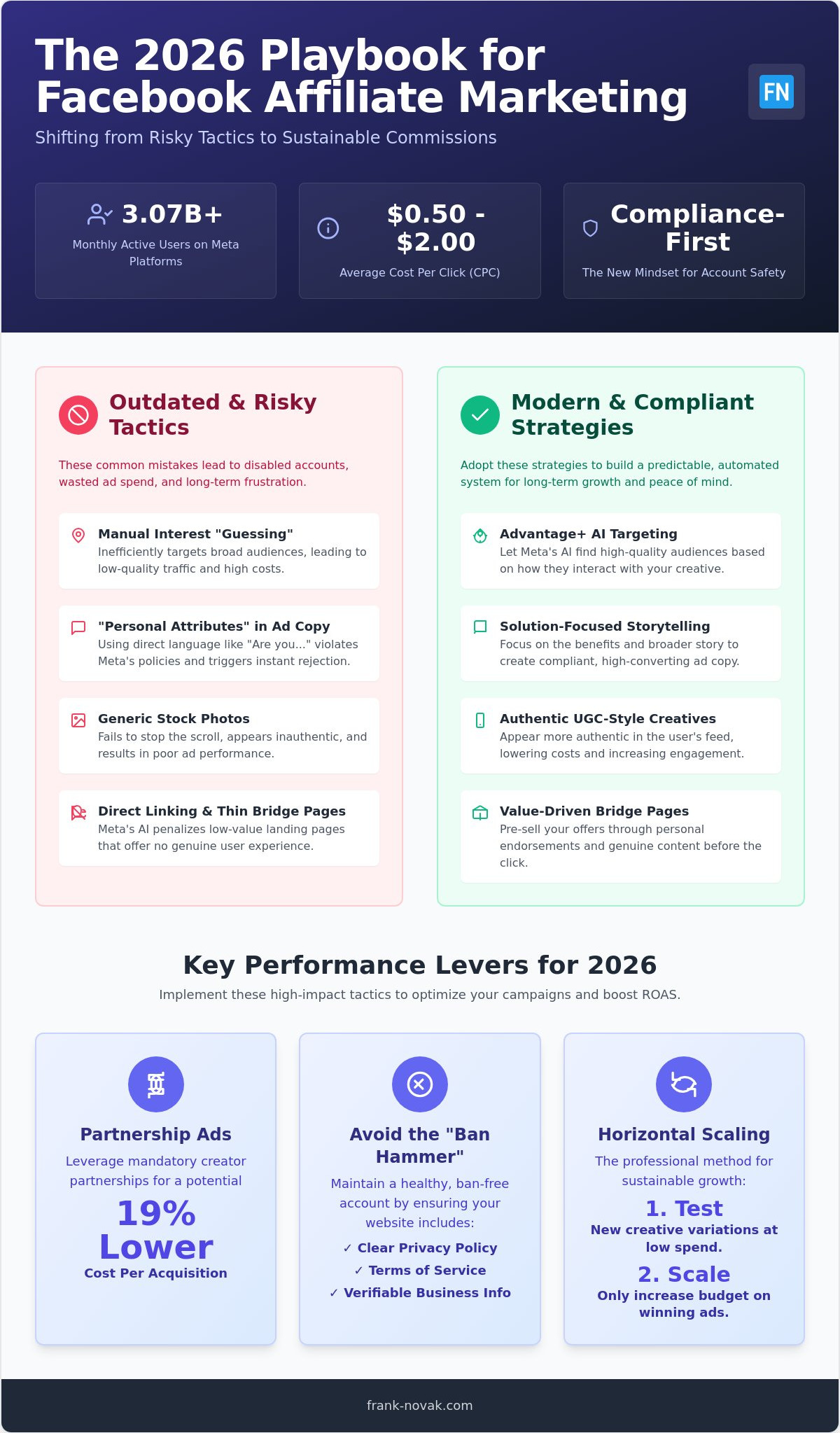
What if the secret to scaling your commissions wasn’t about finding a hidden loophole, but about becoming the most compliant advertiser in the Meta ecosystem? If you’ve ever woken up to a “Disabled Account” notification just as your campaign started to trend, then you know the frustration of building on shaky ground. Success in affiliate marketing with Facebook Ads in 2026 has shifted away from the “wild west” tactics of the past. With average CPCs now ranging between $0.50 and $2.00, there’s little room for error or inefficient tracking that eats into your profit margins.
We understand that managing the Meta Pixel and the newer Conversion API can feel overwhelming when you just want to focus on growth. This guide will help you build a compliant, high-converting engine that drives sustainable commissions while keeping your account safe from rejections. You’ll learn how to leverage mandatory Partnership Ads, which Meta reports can lead to a 19% lower cost per acquisition, and how to handle AI-generated content disclosures correctly. We’ll walk through a step-by-step roadmap to turn your advertising into a predictable, automated system that delivers a positive ROAS and long-term peace of mind.
Key Takeaways
- Learn how to transition from manual interest targeting to Meta’s AI-powered Advantage+ modeling to reach higher-quality audiences more efficiently.
- Discover why avoiding direct address and “personal attributes” in your ad copy is the key to maintaining a healthy, ban-free account.
- Understand how high-converting, UGC-style creatives can lower your costs by appearing more authentic in a user’s feed.
- Build a sustainable engine for affiliate marketing with Facebook Ads by implementing bridge pages that pre-sell your offers through personal endorsements.
- Master the horizontal scaling method to test new creative variations before you increase your daily spend to professional levels.
The Evolution of Affiliate Marketing with Facebook Ads in 2026
Facebook hasn’t just survived the shifting tides of digital advertising; it has redefined how we reach customers. With over 3.07 billion monthly active users, it remains the most powerful scaling tool available for anyone serious about growth. If you want to reach a global audience with precision, this platform is still the premier choice because of its unmatched data processing capabilities. However, affiliate marketing with Facebook Ads has moved away from the manual “interest guessing” of previous years. We’ve entered an era where Meta’s AI-driven Advantage+ audience modeling does the heavy lifting, finding your ideal customers based on how they interact with your creative rather than just a list of hobbies.
To understand the foundation of this industry, it’s helpful to revisit What is Affiliate Marketing and how it has traditionally functioned as a performance-based model. In 2026, the focus has shifted from raw click volume to the quality of engagement. If your ads don’t provide immediate value or clear transparency, the algorithm will deprioritize them. Success now depends on building a compliant relationship-building funnel rather than trying to “trick” the system with direct links that lead to low-quality offers.
To better understand the current methods for testing and scaling, watch this helpful video:
Why Traditional Affiliate Methods Fail on Facebook Today
The days of the “one-page” bridge site that offers no real information are over. Meta’s AI can now detect and penalize “get rich quick” patterns in milliseconds, often before an ad even finishes the review process. If your landing page doesn’t offer a genuine user experience, your account health will suffer. Because the cost of attention has risen, your creative must be “thumb-stopping” to survive. This means moving away from generic stock photos and toward authentic, high-value content that respects the user’s intelligence and time.
The Role of Paid Traffic in a Diversified Business Model
We often view paid traffic as a catalyst for broader growth, such as our Online Success Coaching. When you use affiliate marketing with Facebook Ads correctly, you’re doing more than just buying clicks; you’re investing in data. This data tells you exactly what your audience resonates with, which allows you to refine your organic community-building efforts. If you view your ad spend as a research budget for long-term stability, you’ll find it much easier to maintain a calm, methodical approach to scaling your business without the stress of daily fluctuations.
The Compliance-First Framework: Avoiding the Dreaded Ban
Building a sustainable business with affiliate marketing with Facebook Ads requires a mindset shift from short-term wins to long-term stability. One of the most common pitfalls involves the “Personal Attributes” policy. Meta’s automated systems are highly sensitive to language that targets a user’s specific traits or challenges. If you use the word “You” to point out a person’s financial status or health concerns, your ad will likely be rejected. Instead of saying “Are you tired of your debt?”, focus on the solution or a broader story. This approach keeps your account in good standing while still reaching the right audience.
A professional setup is equally vital for longevity. This includes maintaining a clean domain history and a verified Business Manager. If you fall into the Never Succeed Online mindset, you might be tempted to take compliance shortcuts. These shortcuts usually lead to permanent bans that are difficult to overturn. To avoid this, ensure your website has a clear Privacy Policy, Terms of Service, and a physical address. Adopting Smart strategies for Facebook affiliate marketing means treating your affiliate business like a legitimate brand rather than a temporary side project.
Crafting Compliant Yet High-Converting Ad Copy
To bypass the algorithm’s “salesy” triggers, you should lean into storytelling. Share a narrative about a transformation or a case study that highlights the “after” state without making unrealistic claims. This allows you to demonstrate value without triggering the AI’s skepticism. Compliance is the delicate balance between creating a positive user experience and applying effective marketing psychology. If your copy feels like a helpful suggestion rather than a high-pressure pitch, you’re on the right track for affiliate marketing with Facebook Ads.
Landing Page Architecture for Affiliate Safety
Your landing page acts as a bridge between the ad and the offer. Meta prioritizes pages that provide genuine utility, so your destination must offer more than just a button. Include contact information and clear disclaimers to build trust with both the user and the platform. High “click-through” rates on your bridge page tell Facebook that your content is relevant, which can improve your ad’s quality score. Avoid aggressive tactics like exit pops or countdown timers; these often trigger manual reviews. If you’re looking for a structured way to build these assets, our Online Success Coaching can help you design a compliant path to growth.
Creative Strategy and AI-Driven Targeting in 2026
If you’ve been struggling to lower your costs, the answer often lies in the creative rather than the technical settings. In 2026, affiliate marketing with Facebook Ads relies on “creative-led targeting.” This means the algorithm analyzes your video or image to determine who is most likely to engage, making traditional interest-based audiences less critical than they once were. When your ad contains the right “signals,” the AI does the heavy lifting of finding your buyers for you.
User-Generated Content (UGC) has become the gold standard for high-converting campaigns. When an ad looks like a video from a friend rather than a polished corporate production, it bypasses the “ad blindness” many users have developed. This low-production approach often results in a higher ROI because it feels authentic and trustworthy. To help the platform optimize your results, you should utilize Meta Advantage+ Creative. This tool automatically adjusts your images and text for different placements, ensuring your offer looks its best whether it’s in a feed or a story.
Great creative needs high-quality data to thrive. By integrating the Meta Pixel and the Conversions API (CAPI), you feed the algorithm the specific conversion signals it needs to find more buyers. This setup is essential for bypassing modern tracking limitations and ensuring your campaigns remain profitable. If you’re ready to move beyond basic testing, combining these creative strategies with a robust back-end is the next step. Our ClickBank Super Funnel is designed to work in tandem with these AI-driven targeting methods, ensuring that every click has the highest possible chance of converting into a commission.
Winning with Vertical Video and Reels Ads
Reels are currently the highest-engagement format for affiliate offers. You need a 15-second hook that stops the scroll by addressing a specific pain point or sparking curiosity. We recommend the “Edutainment” formula, where you provide a quick tip or insight while subtly introducing the affiliate product. Since many users watch without sound, adding captions and on-screen text is non-negotiable for mobile-first success.
Advanced Targeting: Lookalikes vs. Predictive AI
While broad targeting is powerful, you can still gain an edge by building “Deep Data” lookalike audiences from your existing email list. This gives the AI a head start on identifying your ideal customer profile. As you scale, the shift moves toward predictive AI, where the system anticipates user behavior based on past interactions. This methodical approach ensures your budget is spent on the people most likely to take action.
Building the Affiliate Bridge: From Ad Click to Commission
Once a user clicks your creative, the journey toward a commission has only just begun. Many beginners make the mistake of sending traffic directly to a vendor’s sales page, which often results in wasted budget and missed opportunities. Successful affiliate marketing with Facebook Ads requires a structured bridge that guides the visitor through a logical progression of value. This process starts with a high-quality lead magnet, where you offer a specific resource, like a checklist or a short video, in exchange for their contact information. By earning the right to sell through this initial gift, you establish trust before the visitor ever sees a product offer.
The next step is the bridge page, where you provide a personal endorsement of the affiliate product. This isn’t just a landing page; it’s a space where you explain how the product solved a problem or improved a situation. Following this, a well-timed email sequence handles the heavy lifting of nurturing the relationship. It’s a known industry standard that roughly 80% of actual profits are made in the follow-up rather than the first visit. Finally, you ensure a seamless affiliate redirect to the vendor’s checkout, while using heatmaps and split-testing to constantly optimize the flow for higher conversions.
Why You Must Own the Lead Before Sending the Click
By focusing on the lifetime value of a subscriber rather than a single transaction, you create a more resilient business. This mailing list acts as your insurance policy; if your ad account ever faces a temporary setback, you still have a direct line to your audience. When you own the data, you can promote multiple related offers over time, significantly increasing your ROI. For those looking to expand their reach beyond Meta, our guide on Strategic Traffic Generation provides a roadmap for multi-channel growth that complements your paid efforts.
The ClickBank Super Funnel Approach
If you’re looking to streamline this process, the ClickBank Super Funnel is designed to automate the transition from social media traffic to verified sales. It reduces the friction between the casual browsing environment of Facebook and the focused environment of a checkout page. This system ensures that your tracking remains accurate and your messaging stays consistent throughout the entire user experience. Modern marketing automation replaces the need for manual outreach by delivering personalized content to your leads at exactly the right moment in their journey. If you are ready to implement a professional system that handles these technical details for you, we invite you to explore how our ClickBank Super Funnel can accelerate your results.
Scaling Your Campaigns and Achieving Long-Term Success
If you’ve identified a creative that consistently brings in leads at a profitable rate, you’ve reached the most exciting phase of affiliate marketing with Facebook Ads. Scaling is not simply about doubling your daily budget overnight; it’s a methodical process of expanding your reach while maintaining your profit margins. We recommend the “Horizontal Scaling” method as your first step. Instead of risking your original ad set’s stability with a sudden budget hike, you should test new creative variations and slightly different audience signals to find more winning combinations. This approach allows you to build a broader foundation of successful ads before you commit to significant financial increases.
Knowing when to move from a $20/day test to a $200/day professional campaign depends on identifying the right “winning signal.” While many beginners focus solely on the Click-Through Rate (CTR), professional advertisers in 2026 look deeper at the Return on Ad Spend (ROAS) and the Cost Per Acquisition (CPA) within their entire funnel. If your bridge page and email sequence are converting well, a slightly higher CPC becomes manageable because the lifetime value of the customer is secured. Success in this landscape is about moving from a “side hustle” mindset to a professional business model where every dollar spent is an investment in a predictable, automated system.
The Online Success Coaching Advantage
Transitioning to high-ticket affiliate offers or larger daily spends can feel daunting when you’re managing everything alone. This is where Online Success Coaching provides a distinct advantage by replacing guesswork with expert-led campaign audits. If you’re facing technical hurdles with the Conversions API or mindset blocks regarding your budget, having a seasoned practitioner review your data can cut your learning curve by months. We focus on personalized strategies that help you navigate the complexities of Meta’s 2026 algorithm, ensuring that your scaling efforts are both safe and sustainable.
Your 90-Day Roadmap to Facebook Ad Mastery
To help you stay organized, we’ve outlined a logical progression for your first three months of growth. This structured journey ensures that every piece of your business is a building block for the next phase.
- Phase 1: Compliance and Infrastructure (Weeks 1-3) – Focus on setting up your verified Business Manager, clean domain history, and mandatory legal disclaimers.
- Phase 2: Creative Testing and Data Collection (Weeks 4-8) – Use Advantage+ to test UGC-style videos and Reels, gathering the conversion data needed to feed the algorithm.
- Phase 3: Aggressive Scaling and Automation (Weeks 9-12) – Implement horizontal scaling and refine your email follow-up sequences to maximize your long-term ROI.
If you’re ready to stop experimenting and start following a proven path to growth, we’re here to guide you. Join the Online Success Coaching program to accelerate your results today and build the compliant, high-converting affiliate business you deserve.
Future-Proofing Your Affiliate Business
Success in affiliate marketing with Facebook Ads in 2026 isn’t about chasing the latest short-term hack; it’s about building a robust, compliant foundation that respects both the platform and the user. By prioritizing a “compliance-first” framework and utilizing AI-driven Advantage+ creative, you can turn a volatile traffic source into a stable engine for growth. It’s vital to remember that owning your leads through a bridge funnel is your best insurance policy against the unpredictable nature of digital advertising. This methodical approach ensures that you’re building a real business rather than just a temporary campaign.
If you’re ready to move away from the stress of manual management, we can help you implement a more professional approach. With over 8 years of digital marketing expertise, we’ve developed proven ClickBank automation systems designed to streamline your path to commissions. Whether you need personalized Online Success Coaching or a structured roadmap, our goal is to provide the steady guidance you need to thrive in this new landscape. Take the next step toward a business that runs on autopilot and automate your commissions with the ClickBank Super Funnel. You have the tools and the strategy; now it’s time to build your future with confidence.
Frequently Asked Questions
Is affiliate marketing with Facebook Ads still profitable in 2026?
Yes, it remains highly profitable if you focus on a compliance-first strategy and high-quality creative. While competition has increased, Meta’s user base of over 3 billion people provides a massive scale that few other platforms can match. Success today depends on using AI-driven tools like Advantage+ to lower your acquisition costs while providing genuine value to your audience.
How much budget do I need to start affiliate marketing on Facebook?
You can start testing with as little as $10 to $20 per day, though a budget of $50 per day allows the algorithm to learn much faster. Since the average CPC in 2026 ranges between $0.50 and $2.00, you need enough daily spend to generate a meaningful amount of data. If you start small and scale horizontally, you can grow your budget safely as your campaigns become profitable.
Can I link directly to an affiliate offer in a Facebook Ad?
No, Meta’s 2026 advertising policies prohibit the use of raw affiliate links as the final destination for an ad. You must direct users to a landing page or a bridge page that you own. This setup is actually beneficial because it allows you to capture email leads and build a long-term asset while staying compliant with platform rules.
What should I do if my Facebook Ad account gets disabled?
If your account is disabled, you should immediately review the “Account Quality” section to identify the specific policy violation. You can then submit a formal appeal if you believe the decision was an error. While you wait for a response, it is a good idea to audit your landing pages for “Personal Attributes” violations and ensure all your AI-generated content is properly disclosed.
How do I track affiliate sales if I don’t own the product website?
You can track sales by using the Conversions API (CAPI) in combination with postback tracking provided by your affiliate network. Most networks now allow you to send conversion data back to your Meta Pixel, which helps the algorithm optimize for actual revenue. This ensures that your affiliate marketing with Facebook Ads remains data-driven even without direct access to the vendor’s checkout page.
What are the best affiliate niches for Facebook Ads right now?
Health and wellness, personal finance, and hobby-based niches are performing exceptionally well in 2026. These categories allow for the “Edutainment” style of content that works best on Reels and Stories. If you choose a niche with a high lifetime value, you can afford the rising costs of attention while maintaining a healthy profit margin.
Do I need a website to run Facebook Ads for affiliate marketing?
Yes, having your own domain is essential for hosting bridge pages and meeting Meta’s transparency requirements. A website allows you to display mandatory legal disclosures, contact information, and privacy policies that the platform requires for ad approval. It also gives you a professional home for your content, which builds trust with your visitors and the AI auditors.
How long does it take to see a positive ROAS with Facebook Ads?
Most advertisers achieve a positive ROAS within four to eight weeks of consistent testing and refinement. The initial phase is often about “buying data” to understand which hooks and creatives resonate with your target audience. Once you identify a winning creative signal, you can move into the scaling phase to see more significant returns on your investment.

Article by
Frank Novak
Frank Novak is an online marketing professional and coach who focuses on affiliate marketing and business automation. Through his website, frank-novak.com, he shares insights and strategies for leveraging social media platforms like Facebook to generate traffic and commissions.
Affiliate / Sponsored Content Disclaimer
This [website/post] contains affiliate links. If you click through and make a purchase, we may receive a commission at no additional cost to you. We only recommend products or services we believe will add value to our readers.