

More control doesn’t always mean a better campaign structure. For CBO vs ABO for affiliate marketing campaigns, use ABO when you need to control spend across ad sets and compare offers, audiences, or creatives; use CBO when you have proven ad sets and want the campaign to allocate budget among them. If an account or pixel is new, ABO can help you gather information before scaling.
It’s understandable to want a setup that makes testing simple while keeping a promising offer moving forward. The right choice depends on what you need to learn, how much control you want over each ad set’s budget, and whether you’re testing one offer or managing several.
This guide explains how to structure campaigns with one or multiple offers, when to test with ABO, and how to move proven ad sets into CBO for scaling. It also covers common setup mistakes so you can decide based on your campaign’s current stage.
Key Takeaways
- Use ABO when you need predictable spend across ad sets and want to compare offers, audiences, or creatives fairly.
- Consider CBO when you have proven ad sets and want campaign-level budget allocation to support scaling.
- Structure campaigns around what you’re testing: separate offers or audiences when you need to isolate performance, and consolidate when shared budget allocation is the priority.
- Set budgets with your offer payout and target profitability in mind, not just the ad platform’s reported results.
- Avoid switching campaign structures impulsively when results dip; first identify what changed and whether the data supports an adjustment.
CBO campaign structures for testing and scaling
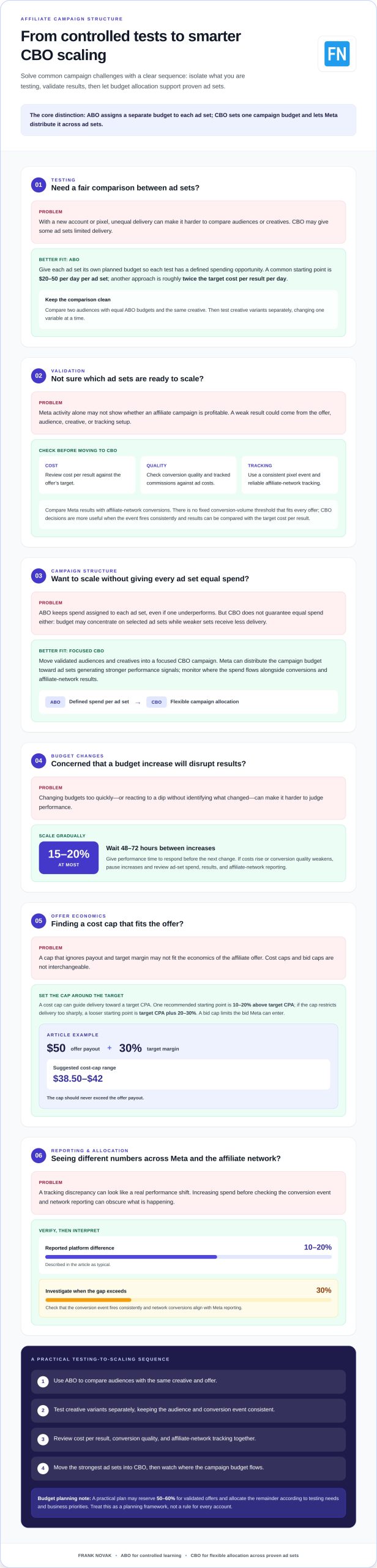
ABO suits controlled tests because each ad set gets its own budget. CBO suits scaling when the campaign budget can shift toward ad sets generating stronger conversions.
CBO Campaign Scaling
Campaign budget optimization (CBO) places the budget at campaign level, letting Meta distribute spend across the included ad sets. After testing, move validated audiences and creatives into a focused CBO campaign, then monitor conversions and affiliate-network results. Unlike ABO, CBO doesn’t guarantee equal spend for every ad set. It allocates delivery based on performance signals, which can concentrate spend while limiting exposure for weaker sets.
Campaign and Ad Set Budget Structure
With ABO, set a separate budget for each ad set, so an audience or creative test receives planned spend. With CBO, set one campaign budget and allow allocation across its ad sets. A common ABO starting point is $20-50 per day per ad set; another approach is roughly twice the target cost per result per day. There’s no universal CBO minimum: budget needs depend on offer economics and the number of ad sets competing for spend.
For example, give two audiences equal ABO budgets while keeping the creative constant. Then test creatives separately, changing one variable at a time.
Learning and Budget Allocation
ABO gives each test a defined spending opportunity, helping you gather comparable data when an account or pixel is new. CBO can direct more budget toward ad sets generating stronger signals, but some tests may receive less delivery. Neither structure generates conversion data on its own. Use a consistent pixel event and reliable affiliate tracking, then compare Meta results with network conversions before scaling.
There’s no fixed conversion-volume threshold that suits every affiliate offer. CBO decisions become more useful when the selected conversion event fires consistently and you have enough results to compare ad sets against the offer’s target cost per result.
| Option | Budget control | Best fit | Main trade-off |
|---|---|---|---|
| ABO testing | Ad set level | Comparing audiences or creatives | Spend remains allocated even if an ad set underperforms |
| CBO testing | Campaign level | Allowing Meta to distribute test spend | Some ad sets may receive limited delivery |
| CBO scaling | Campaign level | Scaling validated ad sets | Spend may concentrate on selected sets |
Choose ABO to control test exposure; choose CBO when flexible budget allocation across proven ad sets matters more.
A practical testing-to-scaling workflow keeps the comparison clear:
- Use ABO to compare audiences with the same creative and offer.
- Test creative variants separately, keeping audience and conversion event consistent.
- Review cost per result, conversion quality, and affiliate-network tracking together.
- Move the strongest ad sets into CBO, then watch where campaign budget flows.
This approach separates learning from scaling. It also helps you identify whether a weak result comes from the offer, audience, creative, or tracking setup.
CBO scaling of proven ad sets
Once an ad set produces conversions at an acceptable cost, CBO can help expand delivery without giving every ad set equal spend. Base scaling on affiliate revenue, not Meta activity alone: compare tracked commissions with advertising costs before increasing the budget.
Scale gradually and protect profitability
Keep proven ad sets together in a focused CBO campaign, then raise its budget in measured increments. A recommended pace is 15-20% at most every 48-72 hours; this gives performance time to respond before the next change. If costs rise or conversion quality weakens, pause increases and review each ad set’s spend, results, and affiliate-network reporting.
For example, if one ad set keeps generating profitable conversions while another spends without comparable results, CBO may direct more of the campaign budget to the stronger performer. That flexibility can support growth, but weaker sets may receive less delivery. Review budget allocation alongside results instead of assuming every ad set will scale evenly.
Set cost caps around the offer economics
A cost cap can guide delivery toward a target cost per acquisition (CPA), while a bid cap limits the bid Meta can enter. For affiliate offers, set the cap with payout and target margin in mind. One recommended cost-cap starting point is 10-20% above target CPA; if a cap restricts delivery too sharply, a looser starting point is target CPA plus 20-30%.
For an offer paying $50 with a 30% target margin, a suggested cost-cap range is $38.50-$42. The cap should never exceed the offer payout. A bid cap and cost cap work differently, so don’t treat them as interchangeable: one limits bids, while the other aims to control average acquisition cost.
Use validated offers to guide allocation
A practical affiliate budget plan can reserve 50-60% for validated offers, then allocate the remainder according to testing needs and business priorities. Treat this as a planning framework, not a rule for every account. An offer with dependable conversions and sustainable CPA can support more spend; uncertain tracking or unstable results call for caution.
Before increasing CBO spend, confirm that the conversion event is firing consistently and that affiliate-network conversions remain aligned with Meta reporting. A reported 10-20% difference between the platforms is described as typical; investigate when the gap exceeds 30%. This check helps distinguish a real performance shift from a tracking discrepancy.
For a steadier approach to affiliate decisions, build a clearer affiliate marketing plan around offer economics, reliable tracking, and gradual budget changes.
When setting a cost cap, use the offer payout as the ceiling: the cap must be at or below the amount the offer pays. A cap equal to the payout is the outer limit, not a level to exceed. Bring any proposed cap above that amount back within the payout boundary before using it for campaign allocation. This keeps the cap tied to the offer’s stated payout.
ABO control and flexibility
ABO assigns a separate budget to each ad set, giving you direct control over how much each test can spend. This is useful when an advertising account or pixel is new and results aren’t established. It also helps when audiences differ sharply in size or focus. A broad audience and a small niche group can receive planned budgets instead of competing for campaign-level allocation. The choice between CBO and ABO for affiliate marketing campaigns depends on whether controlled testing or flexible allocation matters more at this stage.
Use ABO when a test needs a fair comparison. For example, keep the offer and audience consistent while testing different creatives, then compare results under similar spending conditions. If you change the audience and creative at the same time, you can’t isolate which change influenced conversions. Controlled tests make results easier to interpret, though manual budget decisions need more oversight than automated campaign allocation.
A recommended ABO test budget is $200 to $500 per ad set. Treat that as a test-planning range, not a promise of a particular number of conversions. The amount each ad set needs depends on the offer’s target cost per result and the test design. If the budget is divided across too many audiences or creatives, each comparison may receive less delivery and take longer to inform a decision.
ABO can also help protect small, highly targeted audiences. Meta’s algorithm may favor larger audiences under campaign-level optimization, while an ABO budget lets you reserve spend for a niche group. For instance, separate ad sets make it easier to evaluate a broad interest audience against a dedicated fan base. This is useful when the smaller group matters strategically, even if it can’t absorb the same volume.
- Choose one variable to test, such as audience or creative.
- Keep the offer, conversion event, and remaining setup consistent.
- Assign each ad set its own planned budget.
- Compare cost per result and conversion quality before changing the next variable.
This sequence keeps the test easy to interpret and reduces the chance that automation shifts most spending to one ad set before other comparisons receive meaningful delivery. ABO doesn’t guarantee equal outcomes, but it gives you control over each ad set’s budget. CBO leaves allocation to campaign-level optimization, which can improve efficiency when flexible distribution matters more than fixed test exposure.
To evaluate CBO versus ABO for affiliate marketing campaigns, identify what decision your next test needs to support. Use ABO for controlled spending, distinct audience comparisons, or a clear creative test. Once results identify a stronger combination, apply what you’ve learned to the next campaign decision instead of treating every ad set as equally promising.
Campaign structure for single and multiple offers
For one proven offer, a simpler Meta Ads structure can keep delivery and reporting easier to interpret. A recommended setup for brands spending under $2,000 per day with one hero product is one campaign and one ad set, used to test and scale together. For affiliate marketers, the equivalent is one offer with a consistent audience, creative, and conversion event.
When managing multiple offers, don’t combine them automatically just because they share an account. Separate ad sets let you compare audience fit, conversion quality, and payout economics for each offer. If one offer attracts clicks while another generates tracked commissions, separate reporting makes the difference visible. Use ABO when each offer needs a defined ad set budget; use CBO when campaign-level allocation across validated offers is the priority.
For several products or offers, campaign structure can expand with daily ad spend. A recommended multi-ad-set CBO approach applies to accounts spending $2,000 to $5,000 per day with several SKUs. At $5,000 or more per day, a multi-ad-set CBO testing campaign paired with a single-ad-set CBO scaling campaign can keep learning and scaling distinct. These are structures to consider, not automatic requirements for every affiliate account.
Limited funding may also favor CBO if separate campaigns would spread the available budget too thinly. For example, if two offers share a relevant audience and reliable conversion tracking, one campaign can allocate spend across their ad sets. If the offers need different audiences, conversion events, or profitability targets, separate campaigns can make results easier to interpret and manage.
Before consolidating offers, map the key decision points: offer payout, intended audience, conversion event, and affiliate-network reporting. Group offers only when those conditions support a meaningful comparison. A high-payout offer and a low-payout offer may have different allowable acquisition costs, so a shared campaign budget could obscure whether each remains viable.
Meta Ads campaign structure doesn’t replace platform policies or an affiliate program’s offer terms. In the United States, choose CBO or ABO only after ensuring the ad, landing page, and promotion comply with the applicable platform and offer rules.
- One offer: Keep the audience, conversion event, and reporting aligned within a focused structure.
- Several offers: Separate ad sets when payout, audience, or tracking differs.
- Scaling: Use campaign-level optimization when validated ad sets can share allocation.
Choose the structure by identifying what needs to remain distinct. If each offer needs its own controlled spend, use ABO or separate campaigns. If proven offers can compete for shared ad spend, consider CBO. Match the setup to the offer economics and account’s daily budget, not just the number of offers.
Common ABO and CBO campaign mistakes
A campaign can lose efficiency when its structure doesn’t match the question you’re testing. With ABO, budgets spread across too many ad sets can leave each test with too little delivery. With CBO, combining offers with different audiences or profitability targets can make allocation harder to interpret. Before launch, decide what you’re testing and which result will guide your next change.
One frequent mistake is changing several variables together. If you replace the audience, creative, and offer in one edit, a change in conversions won’t show which adjustment mattered. Keep the target audience and offer stable while testing creative, then change one element at a time. For a new test, use 4-6 creative variants per ad set only when the budget can support meaningful delivery across them.
Another risk is reacting to a short-term dip by switching between ABO and CBO mid-campaign. That change can disrupt a clean comparison and make it harder to tell whether performance shifted because of the structure or the offer. First identify the issue by reviewing conversion quality, tracking, audience delivery, and recent edits. Then make one deliberate adjustment and assess its effect.
Campaign volatility also comes from scaling before the offer’s economics are clear. A useful planning step is to allocate 25-35% of campaign budgets to offers showing scaling potential, rather than treating every new offer as proven. Track affiliate commissions alongside ad spend. A 15% efficiency loss can eliminate an affiliate’s profit, so apparently small increases in acquisition cost deserve attention.
Policy violations carry a different risk. CBO and ABO control budget allocation, not whether an ad or landing page follows Meta’s policies or an affiliate program’s offer rules. A compliant campaign structure can’t make a non-compliant promotion acceptable. Keep the ad’s claims, landing page, and promoted offer aligned, and avoid edits that introduce unsupported promises or misrepresent the offer.
- Before launch: Choose one test variable and keep the remaining setup consistent.
- During delivery: Avoid changing campaign type just because results briefly dip.
- Before scaling: Compare commissions and ad spend, then confirm the offer’s margin can absorb costs.
- Before publishing edits: Review the ad, landing page, and offer together for consistent claims.
A measured review can prevent a temporary fluctuation from triggering several unhelpful changes. For example, if Meta reports a dip after a creative edit, check the timing and tracking before restructuring the campaign. If commissions reported by the affiliate network also fall, investigate offer performance. If they remain steady, review delivery and attribution first.
If results show a dip, compare the same offer’s conversion quality and delivery before treating the change as evidence that the campaign structure failed. Tie your observation to the change you made, and avoid adding another edit before you can assess its effect. A commenter advises against switching between CBO and ABO mid-campaign when results dip, claiming that switches reset the learning phase, fragment data, and raise costs per result. Treat this as a caution to preserve a clear comparison.
Frank Novak
Frank Novak offers Online Success Coaching for affiliate marketers who want to turn campaign results into a clearer next step. If you’re weighing CBO against ABO, coaching can help you connect campaign structure with offer economics, testing priorities, and tracking decisions. It can be useful when you’re unsure whether to control ad set budgets or let campaign-level allocation guide delivery.
Bring your current setup and the decision you’re trying to make, such as how to separate offers or when to scale a proven ad set. The focus is on building your understanding of affiliate marketing and choosing a practical direction, rather than treating one campaign structure as right for every situation.
Make your next campaign decision deliberate
Turn the campaign choice into a clear operating decision. Before changing a live setup, define what you want to learn, which result will guide your decision, and how you’ll distinguish an offer issue from a delivery or tracking issue. That gives your next test a purpose beyond simply changing settings.
The right approach to CBO versus ABO for affiliate marketing campaigns can shift as your offers, data, and priorities evolve. Treat each campaign decision as a working hypothesis, then use the results to refine your approach rather than copying a structure without considering the context.
If you’re building beyond ad setup, Frank Novak’s ClickBank Super Funnel and Never Succeed Online are also available as affiliate marketing resources. For support thinking through your campaigns and next steps, reach out to Frank Novak.
Steady, intentional testing can help you make more confident decisions.

Article by
Frank Novak
Frank Novak is an online marketing professional and coach who focuses on affiliate marketing and business automation. Through his website, frank-novak.com, he shares insights and strategies for leveraging social media platforms like Facebook to generate traffic and commissions.
Affiliate / Sponsored Content Disclaimer
This [website/post] contains affiliate links. If you click through and make a purchase, we may receive a commission at no additional cost to you. We only recommend products or services we believe will add value to our readers.